Se leen por separado y se usan juntas. Las otras 3 están a un clic.
La IdeaPor qué el juego es así: el argumento entero, sin reglas.
Juegoestás aquíEl manual completo: el motor, los personajes, el peligro, el Bazar y las veinte recetas.
AceleradoEl mismo juego en quince páginas: cuatro modos de tono y la vida que trae cada uno.
AppMonta la mesa con cuatro formularios, haz las fichas y pásalas con el Código.
Cómo leer este manual
El reglamento completo, de lo general a lo concreto: primero seis ideas, y después un capítulo para cada una. Lo demás —las fichas, el peligro, la consola de mezclas, el Bazar y las recetas— sale de aplicarlas.
Mapa rápido del sistema
Pieza
Qué controla
Dónde
La mesa manda
El pacto de la sesión 0: las líneas rojas, qué se va a sentir, cuándo se tira y cómo se pacta la muerte.
Elige. Lo que cambia no es el mundo: es lo que siente la mesa.
¿Qué es el rol? (Según las tiendas de rol)
Parece una pregunta evidente, pero decidimos añadirla al comienzo del manifiesto para eliminar cualquier barrera de entrada, y también como una oportunidad para definir cómo entendemos este hobby.
El rol es una actividad lúdico-narrativa en la que un grupo de amigos se congrega alrededor de una mesa para crear juntos una historia. Hay tantos manuales de rol que casi cualquier recopilación de sus aspectos definitorios va a encontrar alguna excepción.
Normalmente, la mesa está claramente dividida entre los jugadores y el máster (en este manual, el Director): la persona que escribe el esqueleto de la historia y los jugadores que la van a navegar. Algunos juegos diluyen esa diferencia.
También es muy frecuente que existan fichas de personaje, que describen todo aquello que los personajes pueden hacer, y unas reglas que definen cuándo una acción tiene éxito. Se añade cierto grado de azar para dar incertidumbre a los eventos, y que la narración no sea una imposición, sino una petición de permiso.
Las reglas, los dados, la jerarquía con el máster… todas las piezas tienen un sabor diferente según qué partes del proceso de creación narrativa le resulten más interesantes al diseñador del juego. Aquí no somos ninguna excepción. Elegimos qué partes de la narrativa nos importan más, y este manual tiene una personalidad muy fuerte que gira en torno a destacar esos elementos.
¿Qué es el rol? (Para NOGUM)
NOGUM se escribió para ser un manual universal, pero no es nada ingenuo en la prosecución de ese propósito. Hemos diseñado un manual que encaja con cualquier universo narrativo (desde una novela de detectives de mansión con diez sospechosos hasta una space opera de imperios galácticos). Pero no encaja con cualquier manera de jugar al rol. Muy al contrario, el manual tiene impresa una personalidad muy clara. A continuación describimos qué puntos son innegociables si quieres disfrutar de una partida con este manual. Si alguno choca frontalmente con tu filosofía de juego, quizá sea el momento de buscar otras opciones que resuenen más contigo.
La dicotomía más famosa es la que separa los juegos tácticos y simulacionistas (old school) de los juegos narrativos. Este juego es claramente narrativo. Pero esa definición es un poco vaga. Vamos a bajarla a tierra:
Los pilares innegociables
La historia, sobre los dados
Las reglas están para mejorar la narrativa. Si van a contrapelo, se ignoran (capítulo 0). Tomamos prestada la máxima: «tira solo si todos los resultados posibles son interesantes» (0.6). Tu vida es solo un número: ningún protagonista va a morir por una mala tirada. Su muerte es narrativa, y se pacta (0.7).
La historia, sobre la justicia
Lo anterior va sobre las reglas, pero no significa que siempre se puedan doblar a favor de los jugadores. A veces es todo lo contrario: un universo sucio golpea a los jugadores de maneras que la regla no contempla, y un universo épico hace concesiones que la regla tampoco contempla. Este juego es un pacto entre caballeros. Los jugadores aceptan los vaivenes de la historia, y el Director los administra siempre pensando en la diversión de todos, sin usar jamás su posición para hacer sentir incómodo a nadie. Hace falta deportividad para aceptar de antemano a qué se va, cuajo para mantener el compromiso cuando los resultados no acompañan y madurez para hablarlo y reconducir la experiencia entre todos. Podéis negociar lo que queráis para que la partida sea más divertida o la narrativa más potente, pero nunca para exigir reglas «más justas» o más respeto a los dados, porque este manual no va de eso. Lo que se argumenta es que la manera en que se han ignorado las reglas no es divertida o no ayuda a la historia.
La emoción como pulso de la narrativa
Cuando decimos que todo está subordinado a la narrativa, nos referimos a algo muy concreto: la emoción. Es divertido señalar que en una partida de la ópera de estrellas no debería haber un revólver del Oeste, sino una pistola láser. Pero lo realmente importante es si la partida se siente como una space opera épica y pulp, si se respira la diversión y el optimismo del género en cada paso. Para este manual, la emoción de un género debe notarse en la manera de narrar, en las reglas… y en las licencias del Director.
El ritmo debe fluir
El rol, tal y como lo entiende este sistema, es improvisación. Cualquier solución rápida a un problema será superior en la partida a una mucho más matizada, sesuda y equilibrada que obligue a romper el ritmo. El narrador debe saberlo, permitir y alentar la decisión rápida, y asumir que una decisión apresurada no siempre es la más acertada. Hemos venido a jugar, no a pasar un examen. Una idea «genial para haberla improvisado» debe premiarse en la partida como una idea genial en ese universo. Una idea traída pensada de casa, o fruto de 30 minutos de debate que interrumpen la sesión, debe tratarse con todo el rigor despiadado de que el Director sea capaz. El no-juego se desincentiva.
Mesa adulta, reglas líquidas
Jugadores mayores de edad (mentalmente, no en el carné) que colaboran con el Director en lugar de disputarle cada regla, porque la meta de todos es una narrativa coherente, no un duelo matemáticamente justo. Las reglas son líquidas: cambian según lo que pida la escena, y están ancladas por definición a una estadística que dé sentido a tirar dados. El combo no nos da miedo: lo que sabe hacer un personaje se escribe, en todas las fichas, con un bono de −2 a +4 (2.5), así que ningún malabar hecho en casa rompe la escala, y lo que es abusar de las reglas se pacta antes de empezar, en la conversación que llamamos sesión 0 (0.4).
¿Qué es este manual?
Este libro no es un producto cerrado: es una pregunta. O mejor dicho, es la respuesta a una incomodidad que me ha perseguido durante años como diseñador y narrador.
Durante la última década hemos vivido el auge de los sistemas «universales narrativos». Juegos como los sistemas narrativos de aspectos o la filosofía de los sistemas de movimientos nos prometieron la llave maestra: un único reglamento para jugar cualquier historia. Y nos mintieron. O, al menos, nos contaron una verdad a medias.
Estos sistemas son universales en la forma (puedes usarlos para disparar un láser o blandir una espada), pero son increíblemente rígidos en el fondo. Sin que te des cuenta, traen el tono de casa.
La trampa del tono predeterminado
Intenta jugar una partida purista de los pulpos antediluvianos con un sistema narrativo de aspectos. No podrás. El sistema está diseñado matemáticamente para que los personajes sean competentes, proactivos y capaces de sobreponerse al destino. Por mucho que describas monstruos horribles, la mecánica empuja hacia el pulp y la aventura.
El ejemplo contrario, y el que dio origen a este proyecto, son los sistemas de comedia negra. Su mecánica de «éxito con coste» es brillante para generar drama sucio y consecuencias constantes. Pero intenta usarla para una crónica de superhéroes de la Edad de Plata.
Imagina la escena: eres un Dios Solar, un paragón de virtud y poder infinito, deteniendo a un simple atracador de bancos. La ficción de la Edad de Plata exige perfección: es un trámite, una demostración de superioridad limpia. Pero el sistema te obliga a tirar, y la estadística dice «éxito parcial». De repente, el Dios Solar tropieza. O el atracador le rompe la nariz. O un edificio se derrumba por error.
Si estuviéramos jugando a la serie de los superhéroes podridos, la de los paladines de anuncio que son peores que los villanos, ese resultado sería perfecto. Pero en una fantasía heroica clásica, el sistema acababa de destruir la inmersión. La regla iba a la contra de la narración.
Deconstruyendo el tono
Este manual intenta destilar los elementos que dan emoción a un sistema. Se ha construido para exprimir cada uno de los que hemos encontrado y aislarlo, de forma que solo se aplique en un universo que comparta la emoción que esa regla exalta. El manual ofrece una propuesta completa de juego (si quieres las reglas rápidas y listas para jugar, algo simplificadas, al final está la versión acelerada con todas las recetas). Pero su razón de ser principal es darle al Director herramientas para diseñar sus propias reglas y empezar a entender sus partidas desde una óptica nueva: el tono.
Nuestro primer hallazgo fue que la probabilidad del dado imprime estados de ánimo muy diferentes. No es solo una cuestión de más o menos éxitos, sino también de lo previsibles que son las tiradas. Si tienes una gran probabilidad de éxito, parece evidente que tu resultado es previsible; pero el matiz entre el optimismo al tirar y la certidumbre no es nada evidente. Vamos a describir ambas cosas.
El eje del Optimismo: ¿el universo conspira para que brilles o para aplastarte?
El eje del Caos: ¿las acciones tienen consecuencias predecibles o reina la aleatoriedad absurda?
Imagina un universo divertido pero heroico, como el del aventurero del sombrero y el látigo. El aventurero nunca está en peligro real, pero sus acciones a veces provocan enredos inesperados que llevan la trama por lugares imprevistos y divertidos: problemas de los que sabes que saldrá, pero que suponen una vuelta interesante. Ese universo pide reglas con optimismo alto y caos alto.
Ahora imagina las novelas de los pulpos antediluvianos: un terror existencial que hiela la sangre. Aquí no hay giros locos, enredos ni imprevisibilidad. Solo la atmósfera asfixiante que te recuerda continuamente lo frágil que es un ser humano entre deidades que existen más allá del tiempo y el espacio. Cuando tienes un libro de magia arcana en la mano, quizá debas prepararte para lo inesperado; el resto del tiempo, tus pasos serán previsiblemente opresivos. Caos y optimismo bajos.
Este manual exprime esas dos sensaciones y crea reglas que aumentan el optimismo o el caos que se sienten en cada ambientación.
También exploramos cómo la letalidad cambia por completo la manera en que los personajes se enfrentan a los desafíos, y cómo adaptar la cantidad total de vida al tono del juego. Y la importancia de anclar numéricamente el mundo para que la tirada no pierda sentido: NOGUM admite niveles de poder muy diversos con un sistema numérico siempre coherente.
Por último, el manual pretende no perder la simplicidad y evitar a toda costa que las reglas le quiten protagonismo al juego. Da libertad absoluta al Director con un esquema modular ágil e intuitivo que exige el mínimo esfuerzo cognitivo para navegar las tablas. No para hacer el juego sencillo (este manual no lo es), sino para que el Director centre sus esfuerzos en lo que importa: discernir el tono y pensar qué conjunto de reglas pide el ambiente, no cómo aplicarlas.
El feliz accidente
Este manual se pensó inicialmente como una modularidad que permitiera a cada Director diseñar sus campañas con las herramientas correctas, fuera cual fuera el tono de su universo. Pero al diseñar los cambios de reglas de forma tan sencilla y fluida, hicimos un descubrimiento accidental revolucionario. No solo se puede adaptar el tono en cada campaña: se puede jugar una sesión entera con un tono distinto al del resto de la campaña (un alivio cómico, un interludio relajado entre arcos oscuros). Y la capacidad de cambio es tal que un Director avanzado puede ajustar el tono en cada escena… e incluso dar tonos distintos a cada personaje de la misma mesa.
Estas son las preguntas que se hace este manual. Yo encontré mis respuestas; quizá las tuyas sean mejores. Pero esperamos, como mínimo, haberte ayudado a hacerles a tus partidas preguntas que nunca les habías hecho.
Bienvenido a este experimento.
Las seis ideas
Todo el manual sale de seis ideas, una por capítulo, del 0 al 5. Las dos primeras rompen la realidad; las cuatro siguientes la anclan.
Con la mesa y el tono se puede convertir una historia seria en una comedia absurda o en una pesadilla letal cambiando solo la forma de leer los dados. Pero si el mundo es tan volátil, ¿qué impide que el personaje se disuelva? Hace falta un ancla, y hace falta separar, de una vez por todas, qué tan bueno eres de qué tan grandes son tus hazañas, a quién alcanzan y cuánto te cuestan.
Seis ideas que lo explican todo
La mesa manda. Las reglas son herramientas para que el tono y el progreso se controlen, y se dejan de lado cuando impiden lo que la trama pide. NOGUM es para adultos: no pone cortafuegos contra quien quiera abusar de las reglas. Eso se habla antes de empezar, en la sesión 0, y la mesa puede decir «esto no vale». (Capítulo 0)
El tono es la física. NOGUM no simula la física de los objetos, sino la del guion: de qué lado está el universo y a qué precio. Las dos cosas se leen en los dados, con dos d10 y siete tarjetas que dicen cómo leerlos, así que el mismo personaje cambia de mundo sin tocar un número. (Capítulo 1)
El Ancla: lo que sabes. El Ancla es tu porcentaje de éxito. Lo que sabe un personaje se escribe con un bono que va de −2 a +4, en todas las fichas, en cualquier género y en la sesión cien; por eso las probabilidades se quedan donde se diseñaron. (Capítulo 2)
La Rejilla: lo que eres. La Rejilla dice el tamaño de los desafíos a los que te enfrentas. Un boxeador genial de un mundo realista y un alienígena superpoderoso que grita y hace artes marciales pueden tener los dos un +4 en Pelea. La Rejilla dice que uno tira para romper una fila de ladrillos, y el otro para destruir un planeta con un rayo que le sale de los dedos. Y avisa de algo más: el boxeador no tiene nada que hacer contra el ser de otro mundo. Ni siquiera tiene derecho a tirada. (Capítulo 3)
La Llave: a quién afectas. Un ser humano no tiene derecho a afectar al alienígena… ¿verdad? Bueno, a menos que ese humano tenga un plan de contingencia para todo y una piedra verde que le quita los poderes al invasor durante unos instantes. Ese permiso narrativo para hacer cosas que están a otro nivel es lo que llamamos una Llave. (Capítulo 4)
Una sola cuenta: lo que cuesta. El personaje se hace con puntos, y con ellos se pagan las tres ideas anteriores, en dos monederos: los puntos de habilidad, que compran lo que sabes, y las Llaves, que compran lo que te deja tocar lo que está por encima. Cinco Llaves se pueden cambiar por un nivel entero de Rejilla; qué lo hace entero, lo veremos en su capítulo. Todo lo demás que lleves, del equipo a los poderes, se paga con la misma cuenta y en los mismos dos monederos. (Capítulo 5)
Casi todas las dudas del manual se resuelven con una de estas seis. Si alguna regla te parece rara, vuelve aquí: la regla sale de la idea, no al revés. Los casos difíciles, uno a uno, están en las aclaraciones al final de cada capítulo y en las preguntas frecuentes.
Y cuando una idea se te resista, búscala puesta en alguien. Al final del libro, los expedientes (9.5) son fichas hechas con las ideas más abiertas del manual, y cada parte que tiene la suya lleva una señal como esta:
Las reglas son herramientas para que el tono y el progreso se controlen: usadlas mientras os sirvan, e ignoradlas cuando os impidan hacer algo que la trama pide. Quien decide qué pide la trama es la mesa, y lo decide antes de jugar, hablando.
La sesión 0: antes de tirar un dado, la mesa decide qué historia va a contar.
Antes de escribir la campaña, antes de elegir el módulo, antes de hacer una sola ficha, la mesa se sienta a hablar. Esa conversación es la sesión 0, y en NOGUM no es un trámite: es donde se firma el pacto entre caballeros de la introducción. Todo lo que viene después —el tono, los números, el ritmo al que crecéis— sale de aquí.
Las reglas son vagas a propósito: dejan huecos para que la mesa los llene con criterio. Si alguien en la mesa busca otra cosa —un duelo táctico, una simulación exacta—, este es el momento de saberlo, y no la sesión cinco.
La sesión 0 tiene cuatro conversaciones: las líneas rojas (0.1), qué se va a sentir (0.2), quién propone (0.3) y qué no vale (0.4). Dos principios se pactan aquí: cuándo se tira (0.6) y cómo muere un protagonista (0.7). Y de todo eso salen los números (0.8) y las reglas que el manual no trae (0.9).
0.1 Las líneas rojas de cada uno
No se impone nada que haga sentir mal a nadie
Nada que pueda hacer sentir genuinamente mal a alguien de la mesa entra en la partida. No es una votación ni una lista de temas prohibidos: cada persona tiene sus líneas rojas, y basta con que exista una para que se respete. No hace falta justificarla, y no se discute.
Las líneas no son solo lo que se suele llamar contenido fuerte. Pueden ser:
sexo o violencia explícitos;
un tema concreto que a alguien le toca de cerca, o una fobia: las arañas, los sitios cerrados, el agua profunda;
una atmósfera opresiva, o una campaña en la que nunca vaya a salir nada bien;
o algo tan inocuo en apariencia como una larga exploración filosófica del sentido de tus actos, que a unos les fascina y a otros les resulta un tedio insoportable.
Todas valen lo mismo. Que a ti te encante algo no obliga a nadie a vivirlo.
Algunas líneas no se dicen delante de todos. Se pueden decir en privado al Director, y con eso basta: nadie tiene que explicar a la mesa de dónde viene cada cambio.
Algunas aparecen tarde. Hay cosas que no sabes que te tocan hasta que salen. Cuando pasa, se quitan, sin pedir permiso y sin dar explicaciones, y la partida sigue.
Lo que pesa se pide antes. Agobiar, frustrar, una trama que no le da respiro a nadie: todo eso puede ser una gran partida, pero se pregunta en la sesión 0. Y si para alguien cruza una línea, no se hace, aunque al resto le apetezca. Nadie arrastra a nadie a una experiencia que no quiere vivir.
0.2 Qué vamos a sentir
La segunda conversación es la que más se parece a elegir un género, pero no va de géneros: va de emociones. No basta con decir «terror»: hay que saber qué terror.
Qué se va a sentir en la mesa. Angustia, euforia, risa, melancolía, el vértigo de lo épico.
Qué queréis explorar, y qué os aburre. «Quiero que se explore el terror existencial.» «Quiero épica, y no me aburráis con dramas familiares.»
Qué zonas de la trama se respetan. El pasado que un jugador no quiere que se toque, una relación que no se rompe, un lugar que es sagrado para la historia.
Qué soluciones pide el género. ¿Aquí se resuelve investigando, peleando, hablando, huyendo? ¿Vale el truco de feria? En un pulp, el repelente de tiburones que sale del cinturón es una escena digna y unas risas. En una campaña que pedía averiguar cómo herir al enemigo final, quitárselo de encima con un truco barato es otra cosa.
Con esto el Director ya sabe qué tarjeta coger (capítulo 1) y hasta dónde puede llevarla. Lo que se acuerda es un rango, no cada escena: si la campaña puede llegar a la Pesadilla, la más oscura de las tarjetas (1.4), el Director se mueve dentro de lo acordado sin preguntar cada vez (1.5, 8.3). Lo que se salga de ahí vuelve a la mesa.
0.3 Quién propone
Depende de la mesa y de lo flexible que sea su Director. Lo normal es que el Director llegue con una idea —un mundo, un tono, un par de imágenes— y la mesa la ajuste. Puede ser al revés, y la conversación puede empezar en blanco.
Lo que se busca es consenso, teniendo siempre en cuenta quién hace el trabajo duro. El Director va a escribir, preparar y sostener la campaña durante meses, y no va a escribir bien una historia que no le apetece, por mucho que la pida la mesa. Sus ganas cuentan tanto como las líneas rojas de los demás. Los jugadores no le imponen una campaña al Director, y el Director no le impone a nadie lo que no quiere vivir.
0.4 «Esto no vale»
Este manual no dedica una línea a cortafuegos contra el juego sucio: está diseñado para adultos, y lo que frena el combo barato es la mesa. Cuando alguien dice «esto no vale», no está atacando a nadie ni discutiendo una regla: está recordando lo que acordasteis en la sesión 0.
Sumar bonos está permitido. Los bonos se acumulan, lo que se pueda y a criterio de la mesa, y lo que pase de +4 se tira con +4 (2.5), así que las fichas siguen viviendo entre −2 y +4 y sumar no rompe nada. El combo barato es abusar de las reglas: una Llave —ese permiso para tocar lo que está a otro nivel— que se deja en blanco al hacer la ficha y se rellena, ya empezada la partida, justo con lo que resuelve cada problema (4.4), y todo lo que se le parezca. No le tememos al jugador tramposo, porque aquí la meta no es matar mejor: lo que no es narrativo se pacta en la sesión 0.
Por eso esa conversación tiene que existir, aunque sea corta. Sin ella, «esto no vale» es la opinión de uno contra la de otro. Con ella, es la palabra de todos. Se dice sin drama, se rehace la escena si hace falta, y se sigue jugando.
0.5 Volver a la sesión 0
El pacto no es un contrato cerrado. Cualquiera puede pedir parar y repasarlo, y conviene hacerlo al cambiar de arco, cuando el tono cambia o cuando alguien se ha quedado fuera de la historia. La sesión 0 es el sitio donde esa conversación ya empezó.
0.6 Tira solo si fallar es interesante
Solo se tira si todos los resultados posibles son interesantes. No positivos, no deseables: interesantes, al menos como posibilidad que dé mérito y sentido al éxito.
La pregunta antes de cada tirada
Antes de coger los dados: ¿qué pasa si falla? Si la respuesta mueve la historia —un camino que se cierra, un precio, un enemigo que se entera—, se tira. Si fallar no lleva a ninguna parte, no se tira: sale, y se sigue jugando.
La pregunta es si fallar es interesante, no si es probable. Que el fallo sea numéricamente trivial no es motivo para saltarse la tirada: los bonos se quedan entre −2 y +4 para que no lo sea, y un +4 también falla de vez en cuando, en todas las tarjetas. Si lo que sumas pasa de +4, se tira con +4 (2.5).
Forzar una cerradura sin prisa y sin nadie mirando: si falla, se vuelve a intentar, y no se tira. Forzarla con la patrulla doblando la esquina: se tira, porque fallar cambia la escena. La cerradura es la misma; lo que ha cambiado es lo que cuesta fallar.
Cuando ya no se puede fallar, se tira para ver cómo. Hay escenas en las que nadie duda de que vas a ganar —los extras sin nombre, las masillas, el enemigo que ha quedado un nivel de Rejilla por debajo de ti y ya no tiene derecho a tirada—, pero el cómo sí importa. Para eso está el Estilo, un +2 que se tira cuando ya no puedes fallar (3.5).
0.7 La muerte se pacta
Ningún protagonista muere por una tirada. Una tirada puede dejarlo fuera de combate; la muerte se pacta, con argumentos de arco.
Los jugadores son dueños de su vida
Las reglas solo pueden sacar a un protagonista del combate. Fuera de combate es estar incapacitado y salir de la escena (6.4); si despiertas al día siguiente, lo deciden el tono de la campaña o la voluntad del jugador, no los dados.
La muerte de un protagonista es narrativa, no fruto de la suerte. Lo mismo vale para lo que en otros juegos se lleva a un personaje sin matarlo: la locura, la transformación o pasar a manos del Director como monstruo, villano o avatar. Solo llegan si se pactan (6.5).
Las armas tampoco la traen escrita. Por grande que sea, un golpe deja fuera de combate (4.5). Lo que sí hace el tamaño es ponérselo difícil a la mesa.
Se habla en la sesión 0: si en esta campaña un protagonista puede morir, y cómo se decide. Lo normal es que la muerte llegue cuando la historia la pide y el jugador la acepta: el sacrificio, el final del arco, la despedida que se veía venir. Si una mesa prefiere otra cosa —una noche de terror en la que los dados sí matan—, también es un pacto, y se hace antes de jugar, con todos de acuerdo. En algunos universos de terror es una pieza clave, sobre todo en las partidas de una sola sesión.
0.8 Y de ahí salen los números
Solo después de todo lo anterior se toca la mecánica, y casi todo sale solo. Cada cosa se explica en su sitio; esta es la lista, para no olvidar ninguna:
El tono: qué tarjeta se usa (capítulo 1), cuántos golpes aguanta un personaje antes de caer (6.4) y hasta dónde puede llegar la campaña (8.3).
Los techos de la Rejilla: con qué nivel puede empezar un personaje, qué es lo más grande que existe en vuestro mundo y hasta dónde podrán llegar los jugadores. Se mira por separado en lo físico, lo mental, lo social, lo técnico y lo arcano, con una pregunta: ¿es posible en vuestro mundo? (3.7).
Cómo se lee la Rejilla: si un nivel más es, de verdad, poder cien veces más, como en los mundos que se parecen al real, o si solo dice quién es el tema de la historia (3.2).
Con qué se empieza: cuántos puntos de habilidad tiene cada personaje, un extra aparte que se elige entre un nivel más de Rejilla o cinco Llaves (el bote), y el nivel de Rejilla de salida, que se puede subir o bajar según lo que queráis emular (5.2).
Ventajas y lacras: los rasgos que no son habilidades, como la visión nocturna o una fobia; si se empieza con alguno (5.8).
El ritmo de los dos monederos: cuántos puntos y cuántas Llaves se ganan a lo largo de la campaña, y quién crece (5.1, 5.8).
Qué se puede perder: además de la salud física, la mental, la espiritual o las que pida el género, y cuáles de esas pérdidas pueden sacar a un personaje de la historia (6.5).
Las reglas opcionales que queréis usar, del baúl de reglas del capítulo 9 (9.1).
0.9 Las reglas de vuestra mesa
Tarde o temprano la ficción pide algo que el manual no trae. Entonces se escribe una regla, como se escribe una ficha: qué hace, cuándo se aplica y cómo se tira. Si lleva azar, se lee con el dado de vuestra tarjeta, como cualquier tirada (1.3). Si da poder, se paga en la escala que toca, en puntos o en Llaves (5.3): que sea de la mesa no la hace gratis.
Y se apunta, para que la próxima sesión diga lo mismo: en la ficha, si es de un personaje, o en la lista de la mesa, si vale para todos. La App les guarda un sitio, «Reglas de la mesa», y se las enseña a su asistente. Un ejemplo: la Humanidad de «Viper» paga un d10 entre tres cada vez que se transforma, una regla que inventó su mesa (9.5).
Capítulo 1 · El tono (la física de la emoción)
El tono es la física de tu mundo: de qué lado está el universo y a qué precio. NOGUM lo pone en los dados, y por eso la misma ficha, leída con otra tarjeta, vive en otra historia.
Dos dados, todos los mundos. Se tiran siempre los dos; la tarjeta dice cómo se leen.
Aquí entramos en harina. Este capítulo da forma al concepto de la introducción: cómo la estadística de los dados influye en la emoción de la tirada, y cómo ese ánimo al lanzar los dados influye en la sensación de toda la mesa.
En el mundo real, la gravedad es una constante: 9,8 m/s². Si sueltas una manzana, cae. Siempre. En la ficción, la gravedad es una opinión. Si un héroe de acción salta de un edificio, cae sobre un toldo y sobrevive. Si un secundario de una película de terror hace lo mismo, se rompe el cuello.
La física no ha cambiado: ha cambiado la intención del universo. NOGUM no simula la física de los objetos; simula la física del guion. Para ello, antes de tocar un solo dado, te entrego el control de los dos motores invisibles que gobiernan esa realidad.
1.1 Los dos ejes de la realidad
Imagina que tienes delante una consola de mezclas con dos deslizadores principales. Al moverlos, alteras «cómo se siente» existir en tu mundo.
Eje Y · El Optimismo (la Voluntad)
Responde a la pregunta: ¿cuánto desea el universo que los protagonistas triunfen?
Optimismo alto (El Elegido). El universo es tu cómplice. Las casualidades son felices: el guardia mira hacia otro lado justo cuando pasas, los disparos enemigos solo rozan hombreras. Ejemplo: el del sombrero y el látigo saltando a un camión en marcha. Sabe que no va a fallar el salto; la tensión es solo ver lo genial que queda.
Optimismo neutro (La Indiferencia). El universo es sordo y mudo. No te odia, pero no te va a salvar. Las cosas son justas. Ejemplo: la vida real, o una novela histórica seria.
Optimismo bajo (La Hostilidad). El universo es un enemigo activo. Impera la ley de Murphy: si algo puede salir mal, saldrá peor. El suelo cruje justo cuando intentas ser sigiloso. Ejemplo: la última superviviente de la nave intentando huir; todo lo que toca se rompe, se bloquea o la traiciona.
Optimismo alto: el universo es tu cómplice.
Eje X · El Caos (la Predictibilidad)
Responde a la pregunta: ¿cuán estable es la relación entre causa y efecto?
Caos bajo (El Orden / Previsible). La realidad es un reloj suizo. Si eres bueno en algo, lo haces bien casi siempre. No hay sorpresas absurdas y las consecuencias son lógicas. Ejemplo: el consultor de Baker Street. Todo tiene una explicación deductiva; si disparas, la bala va recta.
Caos medio (Estándar). Hay espacio para el giro de guion y la sorpresa, pero dentro de una coherencia.
Caos alto (lo imprevisible). La realidad es líquida y lo improbable ocurre constantemente. Un disparo puede rebotar tres veces y darte en el pie, o puedes acertar a un blanco imposible con los ojos cerrados. Ejemplo:el mercenario bocazas o Alicia en el País de las Maravillas: la lógica física se subordina al chiste o a la locura del momento.
Pesimismo no es caos
Que las cosas salgan mal y que salgan raras se parecen, pero no son lo mismo. El test de «¿por qué falla el plan?»:
Optimismo bajo: el atraco falla porque el enemigo es listo, competente y cruel (un guardia de más, una alarma de última generación). Sensación: opresión. Las cosas salen consistentemente mal.
Caos alto: el atraco falla por algo absurdo (un gato salta sobre el panel, un estornudo, un explosivo caducado que hace «puf»). Sensación: descontrol. Las cosas salen inesperadamente raras.
Y la vida real es optimismo neutro con caos bajo: justa y previsible, no caótica.
1.2 El Cuadrante (el mapa de tu historia)
Al cruzar los dos ejes obtenemos el mapa de todos los géneros posibles: nueve sitios y siete tarjetas. La fila dice de qué lado está el universo (optimista, neutral, opresivo); la columna, a qué precio (previsible, la costumbre, caótico). Los dos sitios que quedan son huecos, a propósito.
Aquí todavía no hay números, solo sensaciones. Busca dónde quieres que vivan tus jugadores (o dónde quieres que vivan en esta escena concreta).
Previsible El mundo se comporta
La costumbre Ni ordena ni hace ruido
Caótico Todo tiene un precio
Optimista El universo está de tu parte
Épica El héroe es competente y el mundo es fiable. Sabes que vas a ganar; lo que no sabes es cómo de bien. el alien de mallas y calzoncillos, el espía con número, la mazmorra clásica
Hueco. Con un dado plano, en el que cada cara sale igual de a menudo, la única forma de inclinar el tono es mover el número que hay que sacar, y ese número no se mueve (1.3). Coge la vecina que más se te parezca.
Pulp desenfrenado Vas a ganar, pero será un caos de explosiones y planes locos que salen bien de milagro, y más de una victoria deja factura. los criminales que salvan la galaxia, el del sombrero y el látigo
Neutral El universo es justo
Realista La vida misma: justa y predecible. Consecuencias lógicas y planes que funcionan. drama policial, novela histórica
Primera marcha Riesgo real, consecuencias reales, sin red de seguridad. La partida de siempre. enanos, nieves y dragones
Comedia negra Todo puede pasar. Empieza con una tontería que nadie mira y acaba siendo un incendio con vida propia. el misterio de provincias, el crimen en la nieve
Opresivo El universo te pone a prueba
Angustia La realidad es fría, lógica y constante, y te desgasta en silencio. La derrota no es un susto: es la cuesta. la distopía del ojo que todo lo vigila, el desastre nuclear contado minuto a minuto
Hueco. Lo mismo por el otro lado del mapa: con un dado plano no hay manera de que el mundo te apriete sin mover ese número.
Pesadilla La amenaza es absurda y aleatoria. El miedo no viene del monstruo: viene de que nada se comporta. el asesino que entra en los sueños
Los dos huecos son de verdad (el porqué, en el apéndice de las matemáticas, la Sala de Máquinas: A.9). Si tu partida cae ahí, coge la vecina: la previsible si quieres que el mundo se comporte, la caótica si quieres que te cobre.
El Cuadrante no es un menú cerrado: los tonos son potencialmente infinitos y se invita a cada Director a crear los suyos. Si no te interesan las matemáticas y solo quieres saber cómo se juega, el 1.3 y las tarjetas del 1.4 bastan; el motor, con la tapa quitada, está en el Apéndice A.
1.3 La tirada
Toda la mecánica cabe en una línea: lees los dados como diga la tarjeta, le sumas lo que tu personaje aporta (su bono) y lo comparas con la TN, el número objetivo que hay que alcanzar. Lo demás lo pone la tarjeta.
La tirada
Lectura de los dados (según la tarjeta de tono) + bono total ≥ TN de la tarjeta → éxito
Cómo se lee cualquier tarjeta
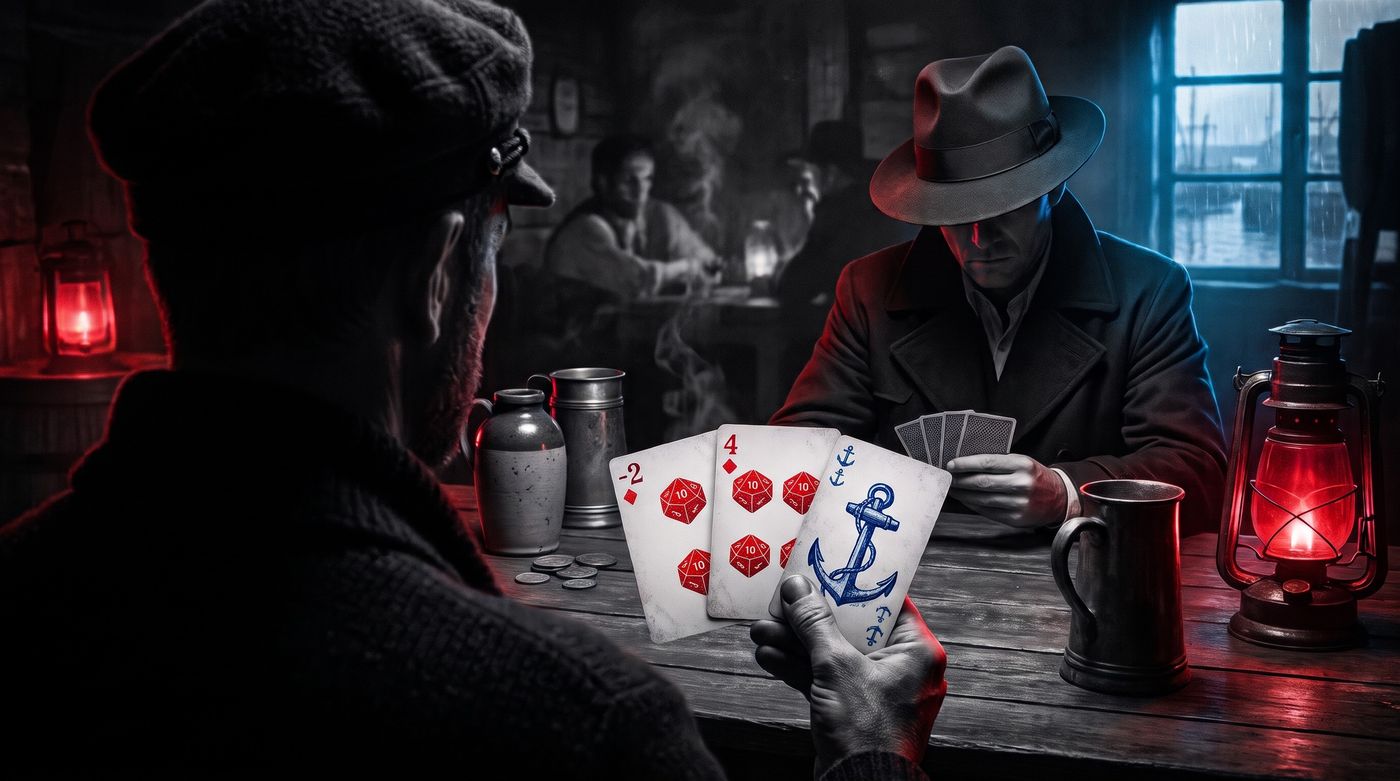
Tira los dos d10, uno rojo y uno azul, también cuando solo cuente el rojo. La tarjeta te dice qué número usas: solo el rojo, la suma, el más alto o el más bajo.
Mira ese número antes de sumar nada: si cae en la banda de pifia, es pifia; si cae en la de crítico, es crítico. Cada tarjeta marca qué resultados de los dados son su banda de pifia (fallas, y además algo se complica) y cuáles su banda de crítico (lo consigues, y más lejos de lo que buscabas): abajo. Las bandas tienen prioridad sobre todo lo demás.
Si no hay pifia ni crítico, súmale tu bono total —lo que sabes hacer (si te sirven varias cosas de tu ficha, cuenta la más alta), lo difícil que es la tarea, el equipo y lo que te ayude o te estorbe— y compáralo con la TN de la tarjeta. Todo eso, sumado, vive entre −2 y +4: es el Ancla (2.1, 2.5).
En dos tarjetas, el Pulp desenfrenado y la Comedia negra, acertar justo cuesta: si el total iguala la TN o la supera por uno, lo consigues y el Director elige el precio: es el éxito con coste.
Dos dados, cuatro lecturas
La tarjeta activa dice cómo se leen los dos dados:
Solo el rojo (1–10): un dado plano, en el que cada cara vale lo mismo. Es la costumbre del hobby, el caos neutro.
La suma (2–20): los resultados se amontonan en el centro, la suerte pierde peso y la competencia lo gana. Es el orden.
El mejor de los dos: el universo empuja hacia arriba. Es el optimismo.
El peor de los dos: cualquier 1 puede arruinar la tirada. Es el terror.
La columna caótica del cuadrante ensancha sobre esas lecturas la banda de pifia (en la Comedia negra, también la de crítico), y dos de sus tarjetas añaden el éxito con coste.
La TN no se mueve
La TN es 6, y 11 cuando se suman los dados. Lo que cambia de una tarea a otra es la dificultad, y la dificultad es un modificador sobre la tirada: +2 fácil, 0 estándar, −2 difícil, −4 heroico (2.5). Nadie tiene que recordar una vara distinta en cada escena. La única excepción está declarada: la Tragedia, que juega con la tarjeta Realista y pone la TN en 14 (1.4).
Pifias, críticos y éxito con coste
Cada tarjeta trae su banda de pifia y de crítico, estrecha, normal o ancha, con los números exactos escritos (1.4).
Una pifia es fallo y complicación; un éxito con coste es éxito y complicación. La complicación puede ser la misma y pesar lo mismo en los dos casos: lo que cambia es si además conseguiste lo que querías, y cuánto duele lo decide quien narra, según el tono y la mesa. Un crítico va donde ya ibas, y más lejos: nadie tiene que inventar nada (en combate, además, suma uno al daño: 6.2).
El precio del éxito con coste puede ser tiempo, un recurso, la posición o fuego amigo (6.6). Sales adelante las mismas veces que sin él: lo que cambia es cuántas de esas veces pagas.
Y antes de todo esto, la pregunta del 0.6: si fallar no es interesante, no se tira.
La Sala de Máquinas
Por qué cada lectura da el tono que da está en el Apéndice A · La Sala de Máquinas, con las cifras exactas, las cinco palancas con las que se construye un tono y cada tarjeta, bono a bono. Las tarjetas funcionan igual aunque no sepas por qué. Y como lo que se suma a los dados va de −2 a +4, las tablas se pueden calcular enteras: están en el Apéndice B.
1.4 Las tarjetas de tono (el Panel de Control)
Siete tarjetas, una por casilla del cuadrante. Cada una es la regla entera de la tirada mientras está sobre la mesa.
Olvídate de memorizar tablas. Como Director de NOGUM tu trabajo es llevar el ritmo, no las matemáticas. Imprime la hoja o tenla en la pantalla. Cuando la escena cambie, mira la tarjeta que toca: esa es la única regla que existe en ese momento. Todas se leen igual, con los cuatro pasos del 1.3.
Optimista · Previsible
Épica
Optimismo alto · Caos bajo
«Soy el mejor en lo que hago.»
Tirada
2d10, quédate el ALTO + bono
TN
6
Banda de pifia
1 · 1 %
Banda de crítico
10 · 19 %
Pifiar es casi imposible y uno de cada cinco golpes es memorable. Hasta quien no tiene nada que hacer aquí gana la mitad de las veces: los personajes brillan.
Optimista · Caótico
Pulp desenfrenado
Optimismo alto · Caos alto
«Sale, pero prepárate para pagarlo.»
Tirada
2d10, quédate el ALTO + bono
TN
6
Banda de pifia
1–2 · 4 %
Banda de crítico
10 · 19 %
Éxito con coste
Si aciertas justo (total 6 o 7), el Director elige el precio
Sale adelante igual de a menudo que en la Épica hasta +3 (con +4, la pifia ancha lo deja en 96 % frente a 99 %); lo que cambia es el precio. Con un personaje flojo, un tercio de las tiradas viene con factura; con un gran maestro, casi nada: el maestro no negocia. Anime, wuxia, capa y espada.
Neutral · Previsible
Realista
Optimismo neutro · Caos bajo
«La vida es justa y predecible.»
Tirada
2d10, SUMA los dados + bono
TN
11
Banda de pifia
2–3 · 3 %
Banda de crítico
19–20 · 3 %
Curva de campana: los resultados se agrupan en el centro y casi nada es memorable. Planificar funciona; improvisar, no. Es la única tarjeta donde una investigación larga aguanta sin que un dado la parta.
Neutral · Neutral
Primera marcha
Optimismo neutro · Caos neutro
«Todavía no sabemos qué tono queremos: empezamos aquí.»
Tirada
Solo el dado rojo + bono
TN
6
Banda de pifia
1 · 10 %
Banda de crítico
10 · 10 %
La costumbre del hobby: un dado, sin curvas. Cada escalón de bono vale exactamente diez puntos. Empieza aquí mientras no tengáis claro el tono, y vuelve aquí cuando la partida cambie de terreno y no sepáis todavía dónde estáis. Es la vara con la que se miden las otras seis.
Neutral · Caótico
Comedia negra
Optimismo neutro · Caos alto
«Empieza siendo una tontería.»
Tirada
Solo el dado rojo + bono
TN
6
Banda de pifia
1–2 · 20 %
Banda de crítico
9–10 · 20 %
Éxito con coste
Si aciertas justo (total 6 o 7), el Director elige el precio
Sale adelante como en la Primera marcha hasta +3 (con +4, 80 % frente a 90 %), pero nada es seguro y nada es gratis: pifia, coste y crítico rondan el 20 % con casi cualquier ficha. No es una bola que crece hacia alguna parte: es una hoja al viento que pelea por posarse en cualquier sitio y no lo consigue. Cada peaje suelto parece una tontería, y tres escenas después nadie sabe decir en qué momento se torció. Es la que más le pide al Director: cuatro de cada diez tiradas traen algo que inventar.
Y se llama comedia a propósito. Un mundo así frustra por dos sitios: porque nada sale limpio, y porque lo que hay debajo suele ser feo. La tarjeta carga uno, el que más pesa. La oscuridad no la trae el dado: la traen una vida que se acaba en pocos golpes (la Letal, 6.4) y el trasfondo que hayas puesto debajo. Por eso un ciberpunk sombrío y una comedia de enredo usan la misma tarjeta sin contradecirse.
Opresivo · Previsible
Angustia
Optimismo bajo · Caos bajo
«No quiero tirar.»
Tirada
2d10, quédate el BAJO + bono
TN
6
Banda de pifia
doble 1 · 1 %
Banda de crítico
doble 10 · 1 %
Falla mucho y falla callado. Con la Pesadilla, que es la misma lectura, son las dos tarjetas donde más pesa la ficha, del 9 % al 81 %: aquí no da miedo el monstruo, da miedo el dado. Que el fallo reste siempre algo —un camino, el tiempo, la ocasión—, o el desgaste se convierte en tedio.
Opresivo · Caótico
Pesadilla
Optimismo bajo · Caos alto
«No deberíamos haber venido.»
Tirada
2d10, quédate el BAJO + bono
TN
6
Banda de pifia
1 · 19 %
Banda de crítico
10 · 1 %
La misma tirada que la Angustia: sale adelante exactamente igual de a menudo. Lo que cambia es que en dieciocho de cada cien tiradas el fallo pasa a hablar. Y con +4 ocurre algo notable: el fallo limpio desaparece, así que el gran maestro ya no falla: pifia.
Aviso: el caos frustra
Las tres tarjetas de la columna caótica solo funcionan si la mesa ha acordado que lo que se persigue es la historia, no el éxito, porque muchas veces no vais a conseguirlo. La Pesadilla está pensada para una noche sucia o para una escena corta dentro de una campaña; una campaña larga con ella agota. Dilo antes de empezar y nadie se sentirá castigado.
De dónde viene la fila opresiva
No es una esquina teórica del mapa: es la emulación de una familia que existe y se juega. Fíjate en lo que hace la Angustia —9 % con −2, 25 % con 0, 49 % con +2 y 81 % con +4— y compáralo con los pulpos antediluvianos, donde una habilidad sin entrenar anda por el 5–20 %, un investigador corriente por el 25–35 % y un especialista en lo suyo por el 70–80 %. Es la misma distribución. Lo que allí se guarda en la ficha, aquí se guarda en la tarjeta, y por eso puedes entrar y salir de ese tono sin reescribir un personaje. La diferencia está en el reparto: allí el especialista tiene su rincón donde sí acierta, y aquí la tirada es igual de dura para todos. Por eso funciona mejor en formato corto —una noche, un acto, una escena—, igual que esos juegos de terror de una sola noche en los que se van apagando velas o se sacan piezas de una torre hasta que cae.
Una receta aparte: la Tragedia
La Tragedia es la excepción declarada a la TN que no se mueve (1.3), y es una receta, no una tarjeta: la suma de la Realista con la vara puesta en 14, declarada en voz alta. El mismo mundo de reloj, con la esperanza fuera del alcance. Como con los demás tonos más oscuros, se recomienda encarecidamente no usarla durante mucho tiempo. Su tabla está en el Apéndice B.
El cuadrante: dónde cae tu partida
Dos preguntas, «¿el universo tiene favoritos?» y «¿la física es fiable?» (8.1), colocan tu partida en el cuadrante del 1.2, ahora con sus números. No pienses en casillas cerradas: si tu partida cae cerca de un borde, es mestiza, y puedes quedarte con la lectura de una casilla y tomar prestada solo una parte de la vecina.
Nota de diseño. Al imprimir esto verás que la redundancia es tu amiga. No tienes que recordar que «en la suma el éxito es 11»: miras la Realista y ahí está. Si cambias a Angustia, tus ojos van a esa tarjeta y ves que el éxito es 6. Cero memoria. Cien por cien narrativa.
En la app que acompaña al manual: cada tarjeta puede traer su música. Le asignas uno de tus propios ficheros de audio a cada tarjeta, y suena en bucle desde un altavoz en su casilla del Cuadrante. No subimos nada ni te damos ninguna lista: tus ficheros se quedan en tu máquina.
1.5 El tono se mueve
El tono no se elige una vez y para siempre. Se puede cambiar por campaña, por arco, por sesión, por escena o por personaje, dentro del rango pactado en la sesión 0 (0.2).
Por campaña: se decide en la sesión 0 y no se toca. Es lo más sencillo, y lo recomendado para empezar.
Por arco o por sesión: cambia el escenario y cambia la tarjeta; un interludio cómico entre dos arcos oscuros.
Por escena: la tarjeta acompaña a la música y a la tensión, y cambia al cruzar la puerta del jefe.
Por personaje: en la misma mesa, el héroe elegido tira con la Épica y su compañero maldito con la Pesadilla.
Si no sabéis dónde estáis, la Primera marcha es la red de seguridad (8.2). Y nadie está obligado a mover nada: una campaña entera con la misma tarjeta es tan NOGUM como cualquier otra. Cómo se cambia sin romper la inmersión, y qué hacer cuando chocan dos tarjetas o la regla y la historia tiran cada una por su lado, está en el capítulo 8 (8.3, 8.4).
Capítulo 2 · Lo que sabes (el Ancla)
Todas las fichas van de −2 a +4. Por eso la estadística funciona tal como se diseñó: en cualquier género, con cualquier tarjeta de tono y en la sesión cien. Ese rango es el Ancla.
Del −2 al +4, en cualquier mesa. Cambia el mundo; lo que sabes se queda en la mano.
Lo que sabes hacer, tu oficio, se mide en ese rango y solo en ese. Qué tamaño tiene lo que haces es otra pregunta, y tiene sus propios capítulos: lo que eres (la Rejilla, capítulo 3) y a quién afectas (la Llave, capítulo 4).
2.1 El Ancla: de −2 a +4
Empecemos por una verdad estadística: ser un maestro significa fallar poco. En la mayoría de juegos de rol, subir de nivel significa inflar tus números hasta el absurdo. En NOGUM, la competencia es un valor cerrado. Definimos la maestría no por la cantidad de daño que haces, sino por la fiabilidad con la que ejecutas tu voluntad. Y la fiabilidad cabe en siete números.
Esos números salen de una pirámide de cuatro escalones, que se explica en 2.2: el Ámbito, un terreno entero, como lo físico o lo social; el Dominio, una de sus dos mitades; la Disciplina, un oficio dentro del Dominio, y la Firma, la cima de ese oficio.
Bono
Perfil
Significado
−2
La Nulidad
No tienes ni idea de nada en ese Ámbito. Se explica en 2.2.
−1
El Torpe
Tienes el Ámbito, pero con la mitad equivocada (2.2).
+0
La moneda al aire
La pirámide no lo da: salta del −1 del Torpe al +1 del Dominio. Es lo que queda cuando la dificultad se come tu bono, y entonces el éxito depende del capricho del universo (los dados).
+1
El ciudadano
Tiene el Dominio. Es funcional.
+2
El Profesional
Tiene la Disciplina. Ha inclinado la balanza. En un entorno estable, suele tener éxito.
+4
El Gran Maestro
Tiene la Firma. Es el techo de la fiabilidad, para cualquier ficha. Matemáticamente, casi ha eliminado el error no forzado.
No hay fila para el +3: no sale de la ficha. Si los bonos llegan a +3 al aplicarse (2.5), ese +3 no tiene nombre: puede ser un profesional con ayuda, o un torpe con muchísima ayuda.
Y aquí está la clave del sistema: el rango no cambia, sin importar el género que estés jugando. El pirata de goma es un Gran Maestro (+4) en Pelea. El sicario que venga perros es un Gran Maestro (+4) en Pelea. Un boxeador de barrio en una película realista es un Gran Maestro (+4) en Pelea. Todos tienen el mismo modificador, tiran los mismos dos dados y tienen la misma probabilidad de golpear a su rival con la misma tarjeta (en la Épica, casi segura). La estadística es idéntica porque su grado de maestría es idéntico: son los mejores en lo suyo.
Pero si todos tienen el mismo número… ¿por qué el puñetazo del pirata de goma rompe una isla y el del sicario que venga perros solo rompe una mandíbula? Porque eso no lo dice el bono. Lo dice la Rejilla (3.1), y a veces una Llave (4.1). El bono dice si lo haces bien; la Rejilla, si tu éxito perfecto «abre una puerta» o «abre un portal dimensional».
Lo que sale del rango
Así es como NOGUM consigue ser universal sin ser genérico. Del rango cerrado salen solas varias cosas:
El bono te dice que eres competente, que no cometes errores tontos y que tus manos son firmes. Mantiene la coherencia interna del personaje de una partida a otra.
La emoción de los dados queda anclada al tono de la partida, o de la escena. Lo que hace dura o amable una tirada es la tarjeta (1.3), no una ficha que se ha ido de madre. Por eso cambiar de tarjeta cambia de verdad el juego, y un +4 en Angustia sigue siendo un +4.
Las tablas se pueden calcular enteras: siete bonos por tarjeta, y ya está. Las tienes todas en el Apéndice B, y el porqué en la Sala de Máquinas (A.6).
La experiencia no hace a nadie más alto, solo más ancho. Cuando ya tienes tu +4, los puntos te hacen bueno en más cosas, no un dios en una (2.4, 5.8). En la sesión cien, el veterano tira lo mismo que el primer día cuando hace lo suyo; lo que ha cambiado es todo lo demás que sabe hacer.
Ninguna tirada se vuelve trivial por los números: con +4 todavía se puede fallar (0.6).
2.2 La pirámide (los cuatro niveles de zoom)
El rango se reparte con una pirámide. Salvo el Estilo, un +2 aparte que se tira cuando ya no puedes fallar (3.5), es la única forma de tener un bono de habilidad en la ficha, y acaba en +4: por eso ninguna ficha se sale del rango.
En NOGUM nos encanta encontrar salidas inesperadas. Los manuales que nos han servido de referencia eligen bando: o habilidades muy genéricas y narrativas, o habilidades muy precisas que convierten elegirlas en un calvario. Nosotros queremos, al menos es la intención, quedarnos con lo mejor de los dos mundos. Por eso la pirámide tiene cuatro niveles de «zoom», de más abiertos a más específicos. La tesis de NOGUM es que una habilidad general supone las bases: saber de qué va la cosa. Pongamos Historia. Alguien que sabe historia en general seguramente conozca la fecha de la independencia estadounidense, pero para dominar los detalles del periodo de los Tres Reinos de Corea (y, dentro de él, el auge y la caída de la confederación de Gaya) hablamos de alguien especializado: en ese lugar, en ese periodo, o en ambos. En las reglas, eso se traduce en que el bono de una habilidad general está limitado. Para brillar, debes especializarte: compras la habilidad general como base para poder especializarte en el siguiente escalón.
No hay atributos
En NOGUM no existen la Fuerza, los Reflejos ni la Inteligencia. Los campos amplios de la pirámide son lo bastante grandes como para sustituirlos. Todo en la ficha va directamente a los bonos, de −2 a +4.
Piensa en un mapa por satélite: el Ámbito es el continente, el Dominio la ciudad, la Disciplina la calle y la Firma el número del portal. Cuanto más cierras el zoom, más poder tienes y más estrecha es la visión.
Nivel
Qué es
Coste
Coste acumulado
Bono
Lista
Los Ámbitos (los 5)
El contenedor donde viven todas las habilidades. No se compra y no da bono. Cada habilidad de la ficha lleva un icono con su Ámbito. Ver Nulidad y Torpeza.
—
—
−2 si está vacío −1 en su otro Dominio
Cerrada
Dominio (10)
Muy amplio; lo que en otros manuales serían los atributos. Aquí no hay distinción entre habilidad y atributo.
1
1
+1
Cerrada
Disciplina (40)
Un conjunto abierto de habilidades. «Ciencias» presupone física, química, biología… Requiere su Dominio.
1
2
+2
Cerrada
Firma · Gran Maestro
Lo que otros juegos llaman «habilidad». Aquí sí te especializas. Requiere su Disciplina, y no tiene escalones: una Firma es la cima de esa Disciplina o no es una Firma. Es la única compra de dos puntos de la pirámide.
2
4
+4
Abierta
Todo cuesta lo mismo: un punto da exactamente +1. La mayor amplitud de los niveles bajos se equilibra de forma elegante con su límite de bono. Solo se llega a Gran Maestro en cosas muy específicas.
Llevar una rama al máximo cuesta 4 puntos (Dominio 1 + Disciplina 1 + Firma 2).
Dos Firmas al máximo que comparten Dominio y Disciplina: 1 + 1 + 2 + 2 = 6.
Dos Firmas al máximo en ramas distintas: 1 + 1 + 2 + 1 + 1 + 2 = 8.
Cuántos puntos tienes para repartir lo dice 5.2; cómo se ganan más, 5.8.
La Nulidad y la red de seguridad en cascada
Regla de la Nulidad y la Torpeza
Si no has gastado ni un solo punto en un Ámbito, eres una nulidad en él: no tiras con +0, tiras con −2.
En cuanto compras cualquier cosa dentro de ese Ámbito, la nulidad desaparece —pero no del todo—. Comprar algo es comprar al menos un Dominio, así que tu columna, el Dominio que has tocado, funciona con normalidad: tiras con lo que tengas en ella, +1 como poco. Lo que caiga en la otra columna del Ámbito lo tiras con −1: estás torpe.
Torpe no es nulo. Es mejor que la Nulidad: el Ámbito no te es ajeno, sabes de cosas cercanas y al menos distingues lo que sería una tontería. Pero es peor que tener la columna, y por una razón concreta: tienes el Ámbito, pero con la mitad equivocada. Eres puro Vigor, la fuerza y el aguante, y te toca una acrobacia. Eres pura Erudición, los datos de los libros, y te toca seguir un rastro por el monte (la lista entera de Dominios, en 2.3). No te falta el músculo ni la cabeza: te falta el pie.
Y por eso la ficha pesa. Cinco Ámbitos de dos Dominios son diez columnas (ocho si en vuestro mundo no hay nada sobrenatural, el Ámbito Arcano de 2.3), y cubrirlas todas se come casi toda la ficha. Con el presupuesto de salida (5.2) vas a estar torpe en algo, y esa es la decisión. Un personaje ancho casi nunca está torpe y casi nunca brilla; uno profundo brilla en lo suyo y se arrastra fuera de ello. Las dos fichas son legales y el juego no premia a ninguna: premia que en la mesa se sepa cuál ha hecho cada uno, y que se reparta el trabajo en consecuencia.
Para cada acción se usa el escalón más alto aplicable: los escalones de la pirámide no se suman entre sí. Una Firma no es +4 encima del +2 de su Disciplina: es el +4. Ejemplo: desactivar una bomba nuclear.
¿Tienes la Firma Explosivos? Tiras con +4.
Si no, ¿tienes la Disciplina Seguridad? Tiras con +2.
Si no, ¿tienes el Dominio Operaciones? Tiras con +1.
Si no, ¿tienes algo comprado en el Ámbito Técnico (el otro Dominio, Artificio)? Tiras con −1: estás torpe.
Si tu Ámbito Técnico está vacío, tiras con −2: probablemente cortes el cable rojo porque es más bonito.
Si una habilidad amplia de tu ficha «se parece» lo bastante a lo que intentas, lo negociáis con el Director en pie de igualdad.
2.3 La lista cerrada (el esqueleto de tu personaje)
Para que el rango signifique lo mismo en todas las mesas, los escalones tienen que ser los mismos en todas las mesas. Por eso los tres primeros son una lista cerrada.
Alerta es ver sin buscar; Investigación, buscar a propósito.
Antes de que te abrume: una lista de cuarenta Disciplinas asusta en una página, y con razón. La hemos mantenido porque la app la acota por ti: te enseña solo lo que tu mundo permite. Si te gusta leer catálogos largos a la vieja usanza, los tienes enteros en la caja de herramientas del capítulo 9 (9.2) y en su catálogo, el Bazar (9.3), por gusto, no por obligación.
NOGUM quiere ponértelo fácil y no compartir destino con algunos manuales perezosos que hay por ahí. Por eso damos una lista cerrada y universal para los tres primeros niveles: es el esqueleto de NOGUM. La Firma, mucho más amplia, te invitamos a crearla (2.4). Creemos que esta estructura ayuda a los jugadores a pintar a sus personajes primero con trazo grueso y, cuando toca el detalle, saber exactamente dónde poner el lápiz.
Potencia: levantar peso, romper puertas, placar · Entereza: resistir dolor, venenos, enfermedades; aguante físico · Pelea: combate sin armas o con armas improvisadas o naturales · Armas: armas de guerra cuerpo a cuerpo (filo o contundentes) y a distancia (arcos, armas de fuego)
Mental El cerebro
Erudición Datos acumulados
Ciencias: física, química, matemáticas, medicina teórica · Humanidades: historia, leyes, arte, teología · Ocultismo: mitos, leyendas, teoría mágica, monstruos · Actualidad: cultura pop, noticias, rumores, «saber de la calle»
Liderazgo: inspirar, dar órdenes, arengar masas · Intimidación: amenazar, interrogar, tortura psicológica · Contactos: moverse por redes sociales (bajos fondos o alta sociedad) · Recursos: gestión de dinero, equipo, sobornos
Proyección: lanzar energía (rayos, fuego, telequinesis agresiva) · Alteración: cambiar la realidad (ilusiones, transmutación) · Adivinación: sentidos sobrenaturales, ver el futuro · Protección: escudos, sanación mística, exorcismo
Ritual Poder externo
Alquimia: pociones, transmutación preparada, sustancias de poder · Invocación: llamar y atar entidades · Encantamiento: imbuir poder en objetos y lugares · Vínculos: pactos, lazos y conexiones sobrenaturales
Es la lista que usa la app; con las Firmas de cada Disciplina, en 9.2.
El Ámbito Arcano (también llamado Especial o «el Flujo») cambia de piel según el universo: magia, el ki, psiónica… En un mundo sin nada sobrenatural, simplemente no se usa. Tener Arcano es requisito para los hechizos, que se pagan aparte (4.7).
Saber no es hacer
Lo académico es Mental: la biología teórica vive en Erudición → Ciencias. Curar de verdad es Técnico: Artificio → Biotecnia.
2.4 Las Firmas
La Firma es la cima de la pirámide y el techo del rango: +4, por dos puntos. Es el único escalón abierto, porque la cima de cada oficio la escribes tú.
Son amplias, como las habilidades de otros juegos: Armas de fuego y no Francotirador; Maestro de la espada y no un modelo de espada concreto.
Cuelgan lógicamente de una Disciplina. Ejemplos: Armas → Esgrima antigua; Sistemas → Criptografía; Biotecnia → Neurocirugía; Ciencias → Química; Acrobacia → Parkour (que vale para cruzar la ciudad por los tejados, no para caminar por la cuerda floja del circo).
Regla de oro: para ser Gran Maestro (+4) en algo, debes poder explicar exactamente qué estás haciendo.
Catálogo de doscientas Firmas en el apartado 9.2, ordenado por Disciplina: cinco por cada una, que es como se buscan en mesa.
La Firma da bono, no tamaño. El tamaño lo dan la Rejilla y las Llaves, y una Llave cubre una Disciplina entera (4.1).
El acordeón: la maestría se pliega hacia arriba
Si eres Gran Maestro con la pistola, con el rifle y con la espada, ya no eres un especialista en tres cosas: eres Gran Maestro de las Armas. Y si lo eres de tres Disciplinas de Vigor, eres Gran Maestro del Vigor entero. La maestría no se amontona: se pliega.
Cuando tienes…
Se pliega en
Y entonces tiras
3 Firmas de Gran Maestro en la misma Disciplina
La Disciplina entera
+4 en cualquier cosa de esa Disciplina, tenga Firma o no
3 Disciplinas plegadas del mismo Dominio
El Dominio entero
+4 en todo el Dominio
Los 2 Dominios plegados
El Ámbito entero
+4 en todo lo que caiga en ese Ámbito
Es la otra forma de crecer, y la única que le queda a los puntos cuando ya tienes tu +4: el rango sigue sin moverse —ninguna ficha pasa de +4—, pero el +4 se va ensanchando hasta cubrirlo todo. Un personaje que ha plegado el Físico no es más fuerte que el que tiene una sola Firma: es que ya no hay nada físico que no sepa hacer.
Y es cara de verdad, que es lo que la hace un objetivo de campaña y no un truco de creación:
Plegar…
Puntos
Cuánto es eso
Una Disciplina
8
Más de media ficha nueva
Un Dominio
22
Una campaña corta entera
Un Ámbito
44
Cuarenta y cuatro sesiones a punto por sesión (5.8)
Con los puntos de salida recomendados (5.2), lo máximo que cabe es una Disciplina plegada y poco más, así que nadie llega a la mesa siendo el mejor del mundo en un terreno completo. Plegar un Ámbito es, literalmente, el final de una campaña larga: ahí es donde van los puntos cuando ya no queda nada que aprender.
Si en tu mesa tres se os hace mucho o poco, es el único número que tiene este acordeón: subidlo a cuatro para que la maestría total sea casi inalcanzable, o bajadlo a dos para campañas de héroes competentes desde el principio.
2.5 Los bonos se acumulan
En la tirada, a tu habilidad (el escalón más alto aplicable) se le suma todo lo que pese: la dificultad, el equipo, los efectos. Se acumula lo que se pueda, a criterio de mesa, y lo que pase de +4 se tira con +4 (abajo).
La fórmula de la tirada está en 1.3; el combate añade reglas propias (capítulo 6).
La dificultad (el filtro de la complejidad)
La dificultad no depende de la habilidad del personaje, sino de la complejidad intrínseca de la tarea. La TN la fija la tarjeta de tono y no se mueve (1.3). La dificultad de la tarea se expresa como un modificador sobre la tirada:
Modificador
Dificultad
Ejemplos
+2
Fácil
Tareas rutinarias bajo estrés.
0
Estándar
El desafío por defecto: disparar a alguien que se mueve, hackear un servidor comercial.
−2
Difícil
Requiere competencia profesional: un disparo a la cabeza, una operación a corazón abierto.
−4
Heroico
Matemáticamente improbable para un humano normal. Requiere bonos acumulados.
La regla del éxito y los límites numéricos
Suma todos los modificadores: habilidad, dificultad, equipo y efectos. Se acumula lo que se pueda, y qué se puede lo decide la mesa, caso a caso.
Si el total queda por encima de +4, tiras con +4. Lo que sobra es margen, y puedes aprovecharlo: ponte penalizadores, intenta algo más difícil y con más premio, y tira con tu +4.
Si el total queda por debajo de −2, el Director decide si hay derecho a tirada; si la hay, con −2.
Solo no se tira si fallar no es interesante, no porque el fallo sea improbable (0.6).
Lo que se acumula es lo que pide la ficción, no lo que se encuentra rebuscando en el manual: exprimir las reglas para sacar un número es el combo barato (0.4).
Pifias, críticos y éxitos con coste dependen de la tarjeta de tono activa (1.4), y se leen en el número que usas, sin bonos (1.3). Por eso pasarse de +4 no te libra de la pifia: el margen sirve para atreverte a más, no para dejar de arriesgar.
Lo que pesa cada bono
Qué significa en números lo que escribiste en tu ficha. Cifras con la tarjeta Primera marcha (dado rojo contra TN 6):
El Torpe (−1): el pie cambiado. Tienes el Ámbito pero esa columna está vacía. Tu probabilidad baja del 50 % al 40 %: un poco, y se nota. Con el peor de 2d10 (tarjeta Angustia) cae al 16 %, y ahí ya no es poco. Es lo que le pasa al forzudo cuando le piden una acrobacia.
La Nulidad (−2): el lastre. Con el Ámbito vacío sufres −2. Tu probabilidad de éxito baja del 50 % al 30 %. Con el peor de 2d10 (tarjeta Angustia) cae al 9 %: eres prácticamente un cadáver andante. La Nulidad convierte las tareas rutinarias en peligros mortales.
La competencia (+1): el ciudadano. Tener el Dominio te da un leve empujón: del 50 % al 60 %. Eres funcional. En la pirámide no hay +0 (2.1).
La disciplina (+2): el profesional. Eres fiable. Un +2 convierte una TN 6 en una TN 4 virtual y reduce drásticamente el peso de la mala suerte (70 %).
El Gran Maestro (+4): la fiabilidad. Con +4, en una tarea estándar solo fallas con el 1 natural, que es la pifia (90 % de éxito). Si el tono es optimista (tarjeta Épica), eres casi infalible en lo mundano (99 %). Con la suma de la Realista (TN 11), el 85 %: cinco puntos menos que con un dado, aunque la escala sea el doble de larga, porque la campana concentra los resultados en el centro y cuatro puntos de bono mueven mucha probabilidad. Ese 15 % es el grano de realidad de esa tarjeta.
Las siete cifras de cada tarjeta, con pifias, críticos y costes, están en el Apéndice B.
Modificadores temporales y permanentes
Lo que entra en la suma, además de la habilidad y la dificultad, son los modificadores. El equipo da los suyos, y su precio se cuenta en 5.6.
Temporales (duran una escena, unos turnos o hasta que se cumpla una condición)
Aturdido, Inspirado, Dopado, Derribado… Pueden ser de tres tipos: bonos (numéricos, modifican tu tirada), Llaves (narrativas: te dejan actuar por encima de tu nivel de Rejilla; las que duran solo un momento, en 4.4) o efectos (mecánicos o narrativos). Define la condición bajo la que desaparecen (fin de escena, curación, ritual, número de turnos…). Todo efecto que venga de una pieza de equipo es temporal, porque desaparece si no la llevas encima.
Permanentes (duran un arco o una campaña)
Son cambios en la hoja: cicatrices, traumas, corrupción, prótesis. No necesitan ninguna condición para estar ahí: simplemente están. Se eliminan o se modifican con experiencia (5.8) o, las secuelas, con otro arco significativo (6.6).
2.6 Aclaraciones
Tengo la Disciplina (+2) y la Firma (+4). ¿Tiro con +6? No: tiras con +4. Los escalones de la pirámide no se suman entre sí; lo que se acumula son los modificadores de la tirada (2.2).
Soy Gran Maestro y llevo un rifle de maestro armero (+1). ¿Para qué me sirve? Para atreverte. En una tarea normal tiras con +4 igual; pero si te pones una difícil (−2) —el disparo a la mano en vez de al cuerpo, o desde más lejos—, el rifle te deja en +3 en vez de +2 (2.5).
El personaje del Director con ficha rápida, la de diez segundos (7.4), tira con +0 fuera de lo suyo, no con −2. ¿Es un error? Es una simplificación de esas fichas, y está dentro del rango.
¿El Estilo (+2) se suma a mi habilidad? No. El Estilo va fuera de la pirámide y se tira solo, cuando ya no se puede fallar (3.5).
Capítulo 3 · Lo que eres (la Rejilla)
El Ancla dice lo bueno que eres; la Rejilla, lo que eres: a qué escala juegas en cada Ámbito. Cuando a la historia ya no le interesa que alguien te lo ponga difícil, os separa un nivel, y el de abajo pierde el permiso de siquiera intentarlo, a menos que la narrativa le otorgue una Llave.
Lo que separa el puñetazo que rompe una isla del que rompe una mandíbula no está en el bono (2.1): está aquí. Lo que te deja tocar lo que está por encima de ti es la Llave, y tiene su capítulo (4).
3.1 Qué significa un nivel
Hay un momento en toda campaña en que el combate contra cierto enemigo deja de interesar. Los matones del puerto ya no asustan a nadie: la mesa sabe que va a ganar, y tirar cada golpe es perder la tarde. Ese es el momento de resumir esa decisión poniendo un nivel de distancia, y lo más probable es que sea subiendo a los jugadores (3.6), no bajando al enemigo.
Un nivel de diferencia: el de abajo no tiene derecho a tirada.
Con ese nivel cambia el tipo de ventaja: ya no es un bono mejor, más vida o un arma mejor. El débil no tira peor ni con penalizador: no tira (4.1).
La regla del salto de poder
Vale para cualquier actor, protagonista o adversario. Compara el nivel de Rejilla de quien actúa con el de aquello contra lo que actúa, en el Ámbito de la acción. Basta un nivel de diferencia.
Mismo nivel: se tira con normalidad, con el bono de tu ficha (2.5) y, si es un ataque, con la secuencia completa de 6.2.
El de arriba no tira para tener éxito: tiene éxito (héroe de nivel 2 contra matón de nivel 1). Si importa cómo, tira Estilo (3.5).
El de abajo no tiene derecho a tirada contra el de arriba (humano de nivel 1 contra el soldado del suero, de nivel 2). Tus golpes no le hacen nada, y contra lo que él te hace —el monstruo que ataca a quien está por debajo— no hay tiradas, ni para acertar ni para el daño: se narra la derrota. Narración sugerida: «Es como golpear una montaña. Ni se inmuta».
Lo que sí puede hacer el de abajo sin Llave: huir, buscar la Llave o cambiar de plan.
Con una Llave, el de abajo sube en lo que la Llave cubre y tira con su bono completo; lo que no cubre sigue como estaba (4.2). La superioridad numérica puede ser esa Llave, una que dura solo ese momento (4.4).
El nivel no hace mejor a nadie en lo que sabe (3.4): dice quién tiene derecho a intentarlo contra quién.
¿Rejilla o Llave? Dos caras
La pregunta de siempre es si tu personaje es grande en todo el Ámbito o solo en una cosa. Y tiene dos caras, una por cada forma de leer la Rejilla (3.2):
La tangible, la de los mundos que se parecen al real. Si tu personaje es superior en todo el Ámbito, cien veces más que los de abajo, es hora de subirle un nivel de Rejilla.
La narrativa, la que mira qué le interesa a la historia. Puede que, simplemente, esos combates ya no interesen, aunque no haya una superioridad física tan patente.
En las dos, lo que es grande en todo el Ámbito es Rejilla. Si es solo una cosa —sus fans, su ordenador, los vampiros, el agua bendita—, es una Llave (4.1). La tentación es poner Rejilla alta a todo lo que en la ficción suena enorme; casi nunca lo es, porque la fama, el talento o el cacharro especial apuntan a algo concreto.
3.2 Las dos lecturas
Qué significa un nivel de diferencia depende del tono, y hay dos respuestas:
Narrativa. El de arriba es el tema de la historia y el de abajo no lo es. No dice nada de fuerza, ni de armadura, ni del mundo: dice dónde está la cámara.
Tangible. El de arriba puede, de verdad, cien veces más que el de abajo. Es la lectura de los mundos que quieren parecerse al real.
El tono decide cuál se lee, y se pacta en la sesión 0. Es la tesis del libro aplicada a la escala: la emoción dicta la física.
La lectura narrativa
Es la más intuitiva, porque es la que ya conoces de las historias. ¿Puede el enano del hacha levantar dos toneladas? Nadie lo sabe, y a nadie le importa. Lo que sí sabemos es que, cuando se lanza contra cien orcos llevando la cuenta en voz alta, nadie en la sala teme por él. No es por su esquiva ni por su cota de malla: es que es un héroe, y la historia no quiere que la horda tenga tirada contra él. Lo mismo el arquero al que los guardias no aciertan, o el bárbaro de la estepa entre cientos de soldados: humanos, o casi, que no son el tema de la escena.
En esta lectura, la Rejilla no tiene por qué atarse a una escala real. Puedes tener tu escala, pero seguramente el ×100 no encaje: el guerrero de pelo erizado del anime sube a saltos mucho más grandes, y el enano del hacha es superior sin que haya una superioridad numérica clara. Adecua la escala a tu mundo, o ignórala si no te suma.
La prueba, aquí, es esta: ¿le interesa a la historia que el de abajo tenga tirada? Quien deba poder herir a un héroe así —el cazador, el que se ha preparado justo para eso— trae su Llave, que es, en el fondo, pedir permiso a la mesa: el vampiro antiguo no cae a manos de un neonato porque los dados quieran, sino cuando la historia lo permite.
Para los universos que pretenden emular el mundo real hacía falta un número, y elegimos uno: cada nivel multiplica por cien el alcance en un Ámbito entero. Por tres razones: no deja lugar a dudas sobre la superioridad, es muy visual y crece al mismo ritmo que las escalas geográficas (una persona, una sala, un edificio, una ciudad, un país). Todo lo que sigue en este apartado habla de esa lectura, y solo de ella.
Si los números significan algo en tu mundo, el ×100 es la mejor elección. No recomendamos cambiarlo: un salto menor hace difusa la diferencia entre un nivel y el siguiente, y entre un personaje con −2 y otro con +4. El mejor boxeador del mundo no tiene nada que hacer contra una turba de cien adolescentes sedentarios. ¿Contra diez? Quizás. Y el quizás estorba.
Para adjudicar un nivel, no mires estadísticas. Mira el escenario y pregúntate: si esto se descontrola al máximo, ¿qué sale en las noticias?
Nivel
Escenario
Alcance
Ejemplos (casi todos, Llaves en manos humanas)
La lógica
1
Individual (la habitación): un duelo, un pasillo, una habitación de hotel
Una persona a la vez
Un puñetazo, una espada, convencer a un guardia
La escala humana por defecto. Si fallas, te haces daño tú o tu rival; el edificio ni se entera.
2
Táctico (la oficina / el grupo): una planta de oficinas, un vagón de metro, una comisaría
Una sala entera; cientos de personas
Una granada, una ráfaga de ametralladora, una bola de fuego clásica, un discurso ante la junta directiva
La tecnología o la magia supera a la biología: un solo individuo controla a la multitud.
3
Operativo (el edificio / el barrio): un rascacielos, un estadio, un crucero, una manzana
Cambias la estructura del mapa local
Un tanque demoliendo el vestíbulo, un misil táctico, un virus que apaga la empresa, un escándalo en la prensa local
Rompes hormigón y acero. Los individuos de nivel 1 son daños colaterales.
4
Estratégico (la ciudad): metrópolis, región
La población general; se ve desde el avión
El monstruo nuclear por el centro, una bomba nuclear táctica, un colapso bancario, una revolución social
Desastres naturales o sobrenaturales. Interviene el ejército.
5
Geopolítico (la nación): el mapa de fronteras
Cambias la historia
Una plaga bíblica, la guerra total, la caída de la moneda nacional, el control mental de todo un país
Casi siempre, para finales de campaña.
6
Cósmico: planetas, dimensiones
Un planeta entero
Dioses primigenios, entidades que devoran mundos
La mayoría de universos no lo tiene, y casi siempre es injugable. Se toca con Llaves (3.7).
La tabla mide hechos, no seres: a qué nivel llega lo que pasa. Casi todo lo que sale en ella, en manos de un humano, es una Llave (4.8): quien lanza la granada sigue siendo un 1. Una pistola corriente también es una Llave: un humano no puede esquivar la bala como esquiva un puñetazo, y quitarle a alguien una defensa que tendría a su nivel es cosa de Llaves (4.2).
La escala tangible es la misma en todas partes. Un nivel 3 es un tanque en Brooklyn o en Marte. Lo que cambia entre universos es qué niveles existen (3.7).
Si en tu universo no existe un ser vivo con el alcance de un nivel, ese nivel puede ocuparlo una corporación, una máquina o una institución.
Un nivel son dos ceros
Cada peldaño de la Rejilla multiplica por cien tu alcance: a cuánta gente llegas, qué tamaño de problema tocas, cuánto mundo mueves de una vez.
Con el número delante, la regla dura de este capítulo deja de parecer arbitraria: cuando alguien te saca un nivel no es que sea «mejor que tú», es que está jugando con dos ceros más. Por eso no hay tirada. Y la Llave se vuelve más dramática: con ella peleas cien veces por encima de tu peso en toda una Disciplina (4.1).
Es alcance, no literalidad. Un Físico 2 no levanta cien veces más peso ni corre cien veces más rápido: se enfrenta a cien veces más mundo a la vez. Si alguien pregunta «¿entonces cuánto pesa eso?», la respuesta es «lo que pida la escena».
Encoger la escala no arregla nada. Un salto de diez veces es justo lo que ya separa un −2 de un +4: eso lo compra la pirámide, no la Rejilla. Si en tu campaña el ×100 se sale de madre, la respuesta es dejar a todo el mundo en Rejilla 1 y jugar con los puntos de habilidad, y para lo de en medio, Llaves.
3.3 La Rejilla en ejemplos
Un ser de Rejilla hace cualquier cosa de su Ámbito a esa escala: el canto de Orfeo despierta cualquier emoción, no solo una. Lo que es enorme en una sola cosa es Llave, y tiene su tabla en 4.8. Esta es la de los seres, y cada casilla lleva su porqué, para que no haga falta captar la referencia.
Cada fila mide una cosa: en Físico, a cuánta gente te enfrentas a la vez; en Mental, cuántos datos cruzas a la vez; en Social, hasta dónde llega tu onda expansiva; en Técnico, lo que creas o reparas tú solo; en Arcano, el área sobrenatural que tocas.
Tabla 1 · Seres de ese nivel en todo el Ámbito (Rejilla)
Ámbito
N1 · Humano
N2 · Sala
N3 · Edificio
N4 · Ciudad
N5 · País
Físico
El poli del yipi ka yei, el boxeador. Contra tres matones a la vez, suda sangre.
El soldado del suero, el cromado, el licántropo. Un soldado raso no tiene sentido contra ellos.
El trepamuros: las balas no le alcanzan, su sentido arácnido las ve venir. El robot del futuro: las balas le rebotan.
El monstruo nuclear, el verde y furioso. Sus ondas de choque barren calles.
El alien de mallas y calzoncillos. Cambia la geografía.
Mental
El profesor de química enfermo. Un +4 en Química, no un nivel: brillante en lo suyo y humano en todo lo demás.
El consultor de Baker Street, el científico elástico que lidera a su familia de aventureros. Parecen humanos, pero sus deducciones quedan claramente fuera del alcance de su especie.
El genio alienígena de cabeza enorme. Ningún plan del edificio se le escapa: ya lo ha pensado antes.
La IA de una ciudad. Sabe en tiempo real todo lo que pasa en ella (cada cámara, cada registro, cada conversación), y sobre eso investiga, resuelve y deduce.
La IA de un país. Lo mismo, a escala de una nación: sabe lo que va a hacer antes que su gobierno.
Social
El negociador, el buen relaciones públicas. Convencen a quien tienen delante.
La presencia del vampiro. Entra en la sala y la sala entera queda prendada.
La reina de la colmena. Satura de feromonas un puerto entero, y cada tripulación siente lo que a ella le conviene: devoción, pánico, calma o furia. No se evita, porque hay que respirar.
Orfeo. Su canto despierta cualquier emoción, y una ciudad entera da la vuelta a su revolución.
El señor de los sueños. Lo que sueña o teme un país es cosa suya.
Técnico
El manitas universal, el hacker. +4 en Artificio, pero sus maravillas caben en una habitación.
El inventor imposible (el millonario que se construye una armadura en una cueva). Va un salto por delante de su mundo: solo, hace lo que un equipo entero.
Los técnicos de un futuro lejano. Manejan a placer las leyes de la física.
La nanofactoría sintiente. Monta al instante cualquier aparato desde la materia prima más básica, y decide ella qué montar.
El científico de un futuro imposible (el cínico de la pistola de portales). Domina esta física y otra nueva.
Arcano
El brujo cazador, el aprendiz de la Orden. Una señal, una maldición, un velo: magia sobre una persona cada vez. Tener Arcano ya es un salto, pero no te hace N2.
El maestro de la Orden. Lo mismo que el aprendiz, sobre una sala entera: levanta, protege, ve o derriba a todos los que hay en ella.
El archimago de la torre. Toda la torre es su hechizo, y puede llevar eso a cualquier barrio: tormenta, sanación, adivinación o destierro, a la escala de un edificio.
El hechicero supremo que guarda la ciudad. Nada sobrenatural entra sin que él lo sepa, y puede curar, desterrar o sellar a esa escala.
El señor oscuro. Su sombra cubre reinos: corrompe, vigila, levanta a los muertos y enferma las cosechas de medio mapa a la vez.
Con un poco de imaginación, todo puede ser un personaje: una IA, una nanofactoría con mente propia. Si es alguien y es grande en todo el Ámbito, es Rejilla.
Fíjate en la primera columna: ahí están los humanos, y todos son 1, por buenos que sean en lo suyo. Lo que sube es lo sobrenatural, o una tecnología que lo parece, o alguien que solo parece humano. El bárbaro de la estepa o el enano del hacha no están porque son de la lectura narrativa (3.2).
3.4 Por Ámbitos
La Rejilla no es un número: son cinco. Funciona como una lente de zoom que le dice al Director dónde está la cámara en cada Ámbito. Cuando está cerrada (nivel 1), vemos los detalles sucios de la calle y un navajazo es un problema mortal. Cuando se abre (nivel 5), vemos imperios y dioses; un navajazo es irrelevante, aquí se lanzan montañas.
Cada personaje tiene un nivel de poder para cada Ámbito:
Ámbito
1
2
3
4
5
Físico
●
Mental
●
Social
●
Técnico
●
Arcano
●
Este personaje es un rockero de ciberpunk: un humano normal, con todo a nivel 1. Su fama no le sube la Rejilla, porque ante ella un humano generalmente conserva su tirada para resistirse: le da Llaves en su Disciplina. Con cuatro, que es lo que cuesta ponerse dos peldaños por encima (4.3), saca a miles de fans a la calle, como haría un nivel 3. En principio la Llave vale entera, sin recortarla a unos pocos (lo que el capítulo 4 llama una Llave Limitada, 4.3): el ciberpunk es un mundo conectado, y una llamada mueve a sus fans. Si en vuestro mundo solo le conocen en los suburbios, es otra Llave; queda sujeto a la mesa. Lo que no hace es salirse de su Disciplina: no convence a una multitud que no sabe quién es. Un 4 en Social ya no es un rockero: es Orfeo (3.3).
La Rejilla humana realista es 1 en todo. El mundo real puede afectar a países enteros —un arma biológica, un discurso político—, pero en Ámbitos muy estrechos: eso son Llaves (4.8). En una ciudad de neón, generalmente el único que pasa del 1 es el súper cromado, con un 2 en Físico. Si un salto de Rejilla suena a cómic, es porque un salto de Rejilla es cómic.
Los unos abundan
Por grande que sea la partida, casi todos los Ámbitos de un personaje están en 1. Un súper tiene generalmente uno o dos Ámbitos por encima de 1, y excepcionalmente tres. El alien de mallas y calzoncillos es un 5 en Físico y un 1 en Social.
¿Tiene un 3 en Técnico el hacker que desactiva las defensas de un edificio entero? No. Un 3 en Técnico construye o repara cualquier cosa del tamaño de un edificio. El hacker es nivel 1, y su ordenador es una Llave de nivel 3, dos por encima (4.3).
Ser no es saber
No existe el nivel 0. El 1 es un humano normal. El bono (−2 a +4) es lo que sabes; la Rejilla es lo que eres. Puedes estar en nivel 1 y ser el mejor del mundo en ese Ámbito.
La ontología gana a la competencia. El mejor peleador del mundo no tiene derecho a tirada contra el peor humano mejorado (nivel 2): el soldado perfecto te escupe en el deporte de contacto que elijas, aunque no lo haya practicado nunca.
La Rejilla no mide cerebros ni músculos: mide herramientas de partida y escala. No se trata de hacer cosas sorprendentes (eso lo da el bono), sino cosas de otro nivel, que requerirían un equipo entero del tamaño de ese nivel.
Para pasar del 1 en un Ámbito hay que ser grande en todo el Ámbito. Quien solo destaca en química tiene un +4 en Química, como el profesor de la tabla (3.3), y si lo suyo llega más lejos, una Llave.
En lo físico, los personajes están «desnudos»: cuerpo humano contra algo mucho más grande. La tecnología permite a humanos corrientes saltar esa barrera: con una Llave (4.8) o, si te sube todo el Físico, jugando con la ficha de un traje o de un mecha mientras lo llevas, que es lo que llamamos Sincronización (3.8).
3.5 El Estilo
Cuando ya no se puede fallar, no se tira para ver si: se tira para ver cómo. Eso es el Estilo.
La ficha de cada protagonista, y la de los pocos personajes del Director que se hacen con el mismo detalle (7.1), tiene un apartado Estilo fuera de la pirámide, con un valor fijo de +2. Es un regalo del sistema y una seña de identidad de NOGUM: no cambia con la ficha ni con el género, y no se compra. No contradice el 0.6: aquí fallar ya no es posible, y lo que queda en juego es cómo ganas. Si tampoco eso importa, no se tira.
La regla del Estilo (gestión de masillas)
Se activa cuando te enfrentas a enemigos por debajo de tu nivel de Rejilla o que son decorado: masillas sin importancia narrativa, que declara el Director y que no tienen ficha ni tirada (7.5). Si un enemigo puede hacerte daño, no es decorado: tiene ficha rápida, la que el Director hace en diez segundos (7.4), y se tira con normalidad.
La premisa: no hay duda de que vas a ganar. Eres un maestro de la espada de nivel 3 y ellos son matones de taberna de nivel 1.
La acción: se da por sentado que aciertas. Cada tirada de Estilo tumba a uno; con crítico, a varios. No se restan puntos de vida a los masillas.
La tirada de Estilo: tiras una vez con la tarjeta de tono activa (1.4) + Estilo (+2), para ver cómo ganas. El Estilo no cuesta: en las tarjetas con éxito con coste, ese resultado se lee aquí como éxito a secas.
Resultado
Qué pasa
Pifia
Lo consigues, pero te ves ridículo. Ganas igual: eso nunca estuvo en duda. Lo que se te cae es la pose.
Fallo
Lo consigues de la forma más olvidable y anodina. Funciona, se acabó, y quizá nadie estaba mirando.
Éxito
Molas muchísimo. Eficaz y limpio, con piruetas y caras de asombro.
Crítico
Lúcete. Describe tú la escena, y que sea inolvidable: coreografía de cine, varios enemigos en una sola acción fluida, rumores que nacen esa noche. Si encaja con lo que está pasando, el Director puede darte además una ventaja temporal.
Un crítico de Estilo no cura. Recuperar salud con una floritura no tiene sentido; el estrés se puede negociar en la mesa, pero no de forma automática, y el efecto concreto lo decide el Director con el jugador.
Advertencia de tono
Esta regla no conviene en cualquier universo: pocas cosas desentonan más en una partida de horror cósmico. El autor la desaconseja en universos muy serios.
Donde brilla: anime, wuxia, space opera, cine de acción.
Donde rompe la inmersión: terror realista, drama bélico, survival. En la película bélica del desembarco, matar a un extra cuesta sudor y miedo, y hasta el último soldado enemigo tira dados: ahí no hay decorado.
Por eso el Estilo queda aparte en la ficha, como un sexto Ámbito que no depende de la pirámide.
3.6 Quién la sube
La Rejilla la abre la historia. No se compra con puntos de habilidad, y si sube uno, por defecto los demás reciben lo equivalente: su propio salto o su valor en Llaves (5.8).
El nivel de Rejilla sube con la campaña, por hitos narrativos, cambios de arco o saltos de tiempo, y lo decide el Director: muchas veces, porque el combate contra cierto nivel ya ha dejado de interesar (3.1). Pero cada salto vale un número exacto de Llaves (5.3), y eso lo hace intercambiable: quien no quiera subir cobra su valor, y quien quiera ajustar su subida tiene con qué. El permiso es de la historia; el precio, de la regla.
La Rejilla cambia el universo, no tu competencia. Subir de nivel cambia la escala en la que operas y lo que el mundo te deja tocar; no te hace más hábil. Eso lo hacen la pirámide (2.2), las ventajas y las lacras (5.8).
Hay varios techos, y conviene separarlos: el nivel máximo inicial, el nivel máximo del mundo y el nivel máximo de los jugadores. Los tres son de Rejilla; a las Llaves es mejor no ponerles techo.
Nivel máximo inicial
Lo más alto con lo que puede empezar una ficha. Por defecto, un 2: la salida recomendada es todo a 1 menos un Ámbito a 2, donde el universo lo permita (5.2).
Nivel máximo del mundo
Lo más alto que existe en ese universo, lo juegue alguien o no (lo cósmico, abajo).
Nivel máximo de los jugadores
Lo más alto que un jugador puede llegar a tener en todo un Ámbito, por mucho que dure la campaña. Es el que traen las recetas, las ambientaciones ya preparadas del capítulo 9, Ámbito por Ámbito (9.4).
No tienen por qué coincidir. En una partida ciberpunk, generalmente ningún jugador llega a Mental 2 por mucho que dure la campaña: no hay ingenio por cien. Lo que sí hay son cromados al borde de la psicosis, que llegan a Físico 2, y ahí se acaba el género. Un mundo de vampiros deja llegar muy alto, y aun así una ficha nueva suele empezar abajo.
El nivel máximo de los jugadores, más que el tono o que el equipo, es lo que hace que un universo se sienta como ese universo. Cada receta (9.4) trae el suyo por Ámbito, como propuesta, y se contesta en la sesión 0: ¿es posible en vuestro mundo?
A las Llaves, mejor sin techo
Los techos hablan de Ámbitos enteros; las Llaves, no. Siempre pueden sorprender con un plan que afecte a muchísima gente, y en universos con internet, aviones o armas de destrucción masiva hay muchas Llaves latentes. En ciberpunk no hay ingenio por cien, pero sí Llaves: el genio informático tiene el exploit que funciona contra esa IA, y un laboratorio forense de decenas de personas, al que mandas muestras, pistas cifradas y compuestos, es Investigación por cien (4.8).
Lo cósmico
Lo cósmico es el nivel 6: el de los planetas, en la lectura tangible. La mayoría de universos no lo tiene, y en la mayoría de mesas es injugable: los dioses primigenios y las entidades que devoran mundos suelen ser el nivel máximo del mundo (hay criaturas cósmicas, y generalmente no se juega con una), y se tocan con Llaves. Pero nada impide una partida cósmica en la que cada jugador lleve a un devorador de mundos, con las mismas reglas; y en los universos sin techo puede llegar ahí una subida de Rejilla: piensa en el guerrero de pelo erizado que no deja de subir.
3.8 Sincronización
Quien pilota un mecha, viste un exoesqueleto o un traje, o se fusiona con una entidad, juega con la ficha del mecha (o la del traje, o la de la entidad), con su nivel, mientras dure el vínculo. Si hay ficha, la cambia. Un vehículo normal no hereda nada.
Es la regla de los robots gigantes del anime y de los héroes que se transforman y se combinan. Mientras dura el vínculo, el protagonista es el mecha: se juega con su ficha, y el Director puede cambiar a mitad de sesión incluso cuántos golpes aguanta la vida, lo que el capítulo 6 llama el zoom (6.4): en la receta de los robots gigantes y la angustia adolescente (receta 18, 9.4), fuera del robot el piloto tiene nivel 1 y la vida más corta, la Letal, y los golpes del drama le caen en la vida mental (6.5); dentro, juega con la ficha del robot, de nivel 4, y la vida pasa a la más larga, la de Guerra.
Un vehículo normal no hereda nada. Pueden dispararle al vehículo, que tiene su propia vida, o a ti: si las balas entran por una ventana normal, te quitan vida estés donde estés; a un blindado quizá haya que dañarlo antes. Lo decide la escena, y el sentido común.
La Sincronización es Rejilla, y se paga como Rejilla (5.3); su precio, en 5.6.
3.9 Aclaraciones
¿Qué nivel se compara? El del Ámbito de la acción. La presencia del vampiro (Social 2) deja prendada a la sala, pero no le sirve para ganar un pulso si su Físico es 1 (3.1).
¿Puedo poner en Social el 2 con el que se empieza (5.2) sin un solo punto de Social? Si tu universo deja un 2 en Social, puedes, y ganarás sin tirar contra cualquier humano. Pero en cuanto te asomes al mundo de arriba —otro vampiro, la reina de la colmena— vas a −2, porque no sabes hacer nada en ese Ámbito (2.2). No hace falta prohibirlo: es una ficha que desperdicia su mejor capacidad. Ser no es saber (3.4).
Capítulo 4 · A quién afectas (la Llave)
Una Llave es toda una Disciplina que, contra cualquier objetivo, te pone uno o varios niveles de Rejilla por encima del tuyo. Lo que manda es lo que dice la Llave: anula lo que dice que anula.
La Rejilla dice lo que eres en un Ámbito entero (capítulo 3). La Llave dice a quién afectas con una de sus Disciplinas. Todo lo demás de este capítulo sale de esa frase, y lo que cuesta cada cosa vive en el capítulo 5.
4.1 Qué es una Llave
En la ficción, una Llave es cualquier explicación que te permita interactuar con un nivel superior de la Rejilla: un objeto, una información, una táctica, un aliado. Sin ella, contra quien está por encima de ti no tienes derecho a tirada (3.1). Con ella, tiras con tu ficha y con el tono de la partida, sin ninguna penalización: sigues siendo el mejor en lo tuyo.
Salvo que tenga un plan. La Llave es ese cuaderno.
La Llave, en tres líneas
Cubre toda una Disciplina. Atletismo, Acrobacia, Sigilo, Juego de manos: la Disciplina entera, con todas sus Firmas dentro (2.3).
Contra cualquier objetivo. Una Llave de Sigilo vale contra el guardia, contra la cámara y contra el perro. Contra una sola cosa, es otra Llave, más barata: la Limitada (4.3).
Te pone uno o varios niveles por encima del tuyo, pagando varias Llaves (4.3). En esa tirada actúas como si esa fuera tu Rejilla, a menos que la Llave esté limitada.
En mesa: eres nivel 1 y usas tu Llave de Armas contra alguien de nivel 1. La Llave te pone en 2, y él no tiene derecho a tirada para pararlo. Contra lo que sea; para eso la pagaste. Si importa cómo lo consigues, tiras Estilo (3.5). Contra alguien de nivel 2, la Llave te da la tirada que antes no tenías, con tu bono completo (4.2).
La Llave no cambia lo que eres. Fuera de esa Disciplina sigues en tu Rejilla, y tu bono sigue siendo tu bono, de −2 a +4 (2.1): la Llave te sube de nivel, no de oficio. La Rejilla te pone por encima en todo un Ámbito; la Llave, en una de sus Disciplinas. Por eso cubrir un Ámbito a mano son ocho Llaves, una por Disciplina, y por eso la Rejilla, que es el paquete entero, sale más barata: cinco (5.3).
El bárbaro de la estepa puede pelear con cientos de hombres «normales» a la vez, y un soldado raso no tiene derecho en ficha a hacerle un rasguño. Pero es mortal: tras la batalla bebe hidromiel y cae en un sueño tan profundo como las entrañas de la Tierra. Un soldado raso que lo sorprende en su cama tiene la Llave, y puede dañar a quien sin ella estaría fuera de su alcance.
El millonario vigilante contra el alien de mallas y calzoncillos. Un mortal contra un dios, pero el alien tiene el punto débil más famoso del cómic: la piedra de su propio mundo. Si el millonario logra usarla, se enfrentan en igualdad. Es la Llave para desbloquear la hazaña de combatir a un dios.
Un hacker es un mortal, pero su ordenador le permite dejar sin luz un edificio entero: hazañas de nivel 3 (4.8). Si convoca a todos los hackers de una gran asociación anónima y coordinan un ataque a los centros financieros del país, ese ataque es una Llave al nivel 5. Los efectos son mucho mayores, pero la tirada es la de siempre, con el bono completo.
Las tres son Llaves que da la ficción, de las que duran una escena (4.4). Las que se compran funcionan igual: lo que cambia es de quién son y cuánto duran.
4.2 Anula lo que dice que anula
Por defecto, una Llave hace lo que haría la Rejilla: quien está por debajo de su nivel no tiene derecho a tirada. Pero lo que manda es lo que dice la Llave. Si dice que anula una cosa, esa cosa ya no se tira; lo que no dice, no lo toca, y eso se sigue tirando. Una Llave es, en el fondo, un permiso que concede la mesa, y se concede en los términos en que está escrito.
La granada
Una granada es una Llave de nivel 2: el daño de una sala entera (4.8). Lo que dice es eso, y nada más.
No hay tirada para aguantarla. Contra quien está en el nivel 1, ni el cuerpo ni la armadura sirven de nada: eso queda anulado.
Esquivarla es difícil, pero se puede. La Llave no lo impide de forma tan tajante: sí hay tirada de esquivar.
Contra el nivel siguiente, da una tirada que antes no había. A un bicho de nivel 2 con mucha armadura natural, la granada sí puede hacerle daño. Tu puño americano, ni cosquillas.
Y como es de un solo uso, la granada que lanzas y se acaba no se paga, aunque sea una Llave de nivel 2 (5.4).
Esquiva, absorción y daño
En las armas, lo que se anula se dice explícitamente, y hay tres cosas que anular: la esquiva, apartarte para que no te dé; la absorción, o el bloqueo, aguantar el golpe con el cuerpo, la armadura o el escudo; y el daño, cuánto te hace lo que te alcanza. Cada arma las lleva escritas como tres etiquetas, Esq, Abs y Daño, que aplican esta misma regla; cómo se juegan, con el combate (6.3). Las dos últimas están muy relacionadas, pero no son lo mismo: algunas armas no se dejan absorber porque su daño es masivo, como la granada; otras atraviesan la armadura y hacen un daño menor, como las balas perforantes o la katana monofilo. Por eso una Llave de nivel superior no deja, por sí sola, al de abajo sin defensa: le quita la que dice, y la otra se tira.
Cada defensa que un arma anula es un rasgo, y cada rasgo, una Llave, sin cobrar dos veces el mismo concepto. La simple pistola no te pone difícil esquivarla: a nivel 1, una bala no se esquiva. Anula la esquiva, y paga una. Los casos resueltos están en el taller del Bazar, el catálogo de objetos y poderes del capítulo 9 (9.3).
Hacia arriba: con permiso, el bono completo
Lo contraintuitivo va en la otra dirección. Contra quien está por encima, con la Llave tiras con tu bono completo, sin penalizador ni dificultad añadida por ser él de arriba. No se protege dos veces: la Rejilla ya era su protección, y la Llave es justo lo que la levanta.
La espada es la Llave: contra el de arriba, tu bono completo. La maza es otra historia.
La Llave cubre lo que cubre. La Llave, o las Llaves, dicen qué tipo de oportunidad compras: un arma que lo hiere aunque se proteja, o una ocasión de la escena —una emboscada, una sorpresa—, que es una sola oportunidad. En lo que cubre, quedáis a la par y se tira con normalidad (6.2). En lo que no cubre, sigue estando por encima: si le toca a él, su golpe te entra como a cualquiera de abajo, sin tirada, salvo que tu Llave cubra también tu defensa.
Para defenderte de algo que está por encima, la Llave tiene que cubrir la Disciplina con la que te defiendes —Acrobacia para esquivar, Entereza para aguantar—, o ser una Llave de un momento que te dé la ficción (4.4). Con una Llave de Armas le das al vampiro; su zarpazo lo esquivas con otra. Y una espada no te cubre contra el aliento del dragón: aguantarlo es Entereza, y tú compraste Armas.
4.3 Subir más de un nivel
Una Llave te pone un nivel por encima. Para subir más, se apilan, y la escalera es cuadrada: subir n niveles cuesta n² Llaves. Es el precio completo: toda la Disciplina, contra todo.
Lo que subes
Llaves
Tu alcance en esa Disciplina (lectura tangible)
+1 nivel
1
×100
+2
4
×10.000
+3
9
×1.000.000
+4
16
×100.000.000
+5
25
×10.000.000.000
El alcance es el de la lectura tangible, dos ceros por nivel (3.2); en la narrativa, cada peldaño significa lo que signifique en vuestra escala. Con las cinco Llaves con las que se puede empezar (5.2), una Disciplina llega a dos niveles por encima —cuatro Llaves— y sobra una; el tercer peldaño, que son nueve, se gana jugando, o con lo que la mesa pacte repartir de más antes de la primera sesión (5.2). La Rejilla sube por la misma escalera, con el Ámbito entero: 5·n² Llaves, por las 8·n² que costaría cubrirlo Disciplina a Disciplina (5.3).
Si queréis un crecimiento más rápido y Rejillas menos inaccesibles, el Baúl de reglas opcionales trae una escalera más llana, 3n−2, como regla opcional (9.1).
La Llave Limitada
Contra una sola cosa —los vampiros, las máquinas, este monstruo—, o solo para una parte de lo que hace la Disciplina —solo el daño—, la Llave es Limitada, y más barata: la mitad (5.5). Subir dos niveles contra una sola cosa cuesta 2 en vez de 4.
A un nivel, limitarla no ahorra nada. Puedes escribirla «Armas contra los vampiros», y valdrá contra los vampiros y no contra el licántropo. Pero lo que se tiene para siempre cuesta al menos una Llave (5.4), así que te cuesta lo mismo que la Llave de Armas entera, que vale contra todo. Si te van a cobrar lo mismo, no se recomienda limitarla. Las Llaves contra una sola cosa suelen ser de las que presta la trama, como el agua bendita (4.4).
La Llave potenciada
A veces lo que hace tu poder no encaja con una Llave tal cual: hace lo que dice y algo más, y en mesa se siente demasiado poderoso, casi tramposo. Este manual sirve para cualquier poder, habilidad, conjuro o ventaja sobrenatural, y cada idea tiene que tener su precio. Para eso están los multiplicadores del Ajuste (5.5): la Llave Potenciada cuesta el doble, y la Desatada, el triple.
Un sigilo que te vuelve invisible, inaudible e indetectable al ki, a las cámaras térmicas y a los perros no puede costar lo mismo que una capa de invisibilidad. Tampoco es subir de nivel: no afecta a más gente, solo a quien mira, de uno en uno. Es Sigilo un nivel por encima, Desatada: 3 Llaves.
Potenciada (×2): hace lo que dice y, además, algo que la cuenta no paga.
Armas que, al acertar, también desarman.
Pelea cuyos golpes, además, lanzan al rival varios metros.
Persuasión que deja al otro convencido de que la idea fue suya.
Primeros auxilios que, además de cerrar la herida, quitan el veneno.
Volar llevando a un pasajero.
Desatada (×3): no tiene condiciones, y ni la ficción te la quita.
Un escudo que para balas, fuego, gas y magia, y no se cansa.
Teletransporte sin verlo, a cualquier sitio donde hayas estado.
Leer la mente a distancia, a voluntad, sin que el otro lo note.
Regeneración que cierra cualquier herida en la misma escena, sin gastar nada.
Una mentira que aguanta detectores de mentiras, telépatas y pruebas.
Precognición: ves venir cada golpe, y sorprenderte es casi imposible.
Cambiar a cualquier forma, con su voz y sus huellas.
Entrar en cualquier sistema a distancia, sin cable ni conexión.
En una ficha · «Nadie»: Sigilo un nivel por encima, Desatada (9.5)
4.4 Propia, prestada, de un momento
Una Llave puede ser un objeto (la piedra de su propio mundo), una información (el nombre verdadero) o una táctica (atraerlo a terreno favorable). No aparece de la nada: conseguirla suele exigir una escena de investigación o de riesgo.
De dónde sale una Llave, Ámbito a Ámbito
Ámbito
Ejemplos de Llave
Físico
Un arma pesada (C4, bazuca); un entorno letal (empujarlo a un alto horno); la superioridad numérica: veinte mercenarios disparando a la vez cuentan como uno (como una fila de jinetes apuntando al unísono), con una Llave de un momento, de las que da la ficción para una escena (abajo).
Mental
Para que un detective de nivel 1 desmonte el plan de un genio criminal de nivel 3: el cuaderno donde lo dejó escrito, o el testigo que lo vio todo.
Social
Para que un don nadie de nivel 1 hunda la carrera del alcalde de nivel 3: la cinta de vídeo del soborno, o el respaldo de un medio de comunicación nacional.
Técnico
Para que un humano de nivel 1 hackee una IA de nivel 3: una contraseña de administrador robada, un mes de preparación ininterrumpida o un portátil conectado al mainframe. También un laboratorio profesional, o los recursos de una megacorporación.
Arcano
El nombre verdadero de la criatura; un artefacto; el ki que te cede la humanidad entera.
Lo que importa en mesa es de quién es y cuánto dura. Hay tres clases.
Llave propia
La que se compra: con las cinco Llaves con las que se puede empezar (5.2) o con el monedero de Llaves, que por defecto da una por sesión y por cabeza (5.1). Es permanente. Se escribe en la ficha con su Disciplina y su nivel al comprarla, o la primera vez que la usas (en blanco, abajo). No te la quita nadie. Si viene en un objeto, vive en el objeto, y al soltarlo recuperas lo que pagaste para gastarlo en otra cosa (5.7).
Llave prestada
La da el Director por la trama o para premiar el ingenio: «se te ocurre usar el agua bendita». No se paga, y llega hasta donde diga la ficción; no se mejora con Llaves. Se apunta en la ficha, pero a lápiz: vive en la escena y se va con ella.
Llave de un momento
La establece la ficción: veinte mercenarios a la vez, el club de hackers, tu hermana, tu contacto en la policía. Son tu excusa y tu capacidad, no botones: tú solo hackeas una sala, con tu club un edificio, pero el club tiene que estar ahí, y tu contacto puede estar de vacaciones. Dura una escena y sube lo que la ficción diga. No es crecer: al acabar la escena vuelves a tu nivel, y lo que quieras tener para siempre se gana con la experiencia (5.8). Y la sostiene la ficción: si mañana sois tres mercenarios, la Llave no está.
La Llave es tan grande como diga la escena. Puede ser Limitada o mucho más potente, y su precio va de la mitad al triple (5.5). La prestada y la de un momento duran una escena y son narrativas, así que no tienen coste ni hace falta definirlas más. Con esa distinción el Director puede seguir regalando ideas sin inflar al personaje, y quien pagó la suya sabe que es suya; las que se compran suben por la escalera (4.3).
En una ficha · «Nadie», la torre: una Llave de un momento que regala la escena (9.5)
En blanco
Una Llave propia se puede guardar sin escribir y decidirla la primera vez que se usa. Es el repelente de tiburones del 0.2: en un pulp, que salga del cinturón justo a tiempo es una escena digna; si con él te quitas de encima al enemigo de la campaña, que pedía averiguar cómo herirlo, puede ser el combo barato del que habla 0.4, y cualquiera puede decir «esto no vale».
Tan abiertas como la ficción
Que mande lo que dice la Llave quiere decir también que una Llave puede decir casi cualquier cosa que la mesa sepa leer, no solo «un nivel más». La Presencia majestuosa, un poder del Bazar (9.3), dice que nadie de nivel inferior puede atacarte sin pasar antes una tirada Mental. No contradice a la Rejilla: no quita la tirada, pone una puerta delante. Y para quien está debajo, pasar esa tirada puede ser su Llave.
La Llave, de principio a fin
Nace propia, prestada o de un momento, y sube por la escalera, o lo que diga la ficción. No tiene techo: los techos son de la Rejilla, y a las Llaves es mejor no ponérselo (3.7). Renunciar a un salto de Rejilla te da Llaves, tuyas para gastar donde quieras (5.8). Y se va según su clase: la propia se queda, la del equipo se recupera al soltarlo (5.7), y la prestada y la de un momento, con su escena.
4.5 La Parca
La Parca es una Llave al daño. Si te alcanza y estás por debajo de su nivel, se te da fuera de combate, sin derecho a tirada.
El daño de un arma se escribe con un número pequeño, que llega a 2, y es a propósito: lo que separa un arma de guerra de un cuchillo son sus otras etiquetas, no un número más grande (6.3). Lo que está por encima no es un arma mejor: es un acontecimiento. Un cañón de asedio, un coche a ciento veinte, el aliento de un dragón, una bomba. A eso lo llamamos la Parca, y funciona como la Rejilla, no como el daño:
La Parca
Cada Parca lleva un nivel de Rejilla. Si te alcanza y estás por debajo de ese nivel, no hay daño que contar ni cuerpo ni armadura que valga: quedas fuera de combate, de la forma que corresponda a lo que te ha alcanzado (abajo). Sea cual sea vuestra vida, Letal o de veintisiete puntos: la Parca no cuenta casillas. Cuanta más vida tiene la mesa, más se nota (6.4). Si se puede esquivar, lo dice su etiqueta de esquiva, Esq: el francotirador que no ves (Esq: Nula) no se esquiva; una granada, por su área, se esquiva a duras penas (Esq: Difícil (−2)). Contra quien esté a su altura, hace el daño más alto de un arma, Daño 2, con defensa normal, y se juega como cualquier otro golpe. Contra quien esté por encima, nada sin Llave.
Es la misma frase de la Rejilla (3.1): por debajo del nivel, sin derecho a tirada, y la Llave es la excepción pactada. Aquí, lo que no tiene tirada es seguir en pie.
Por qué es una Llave. Sin Llave, haces daño a tu altura. La Parca alcanza al siguiente nivel de la Rejilla, y eso es exactamente lo que hacen las Llaves. Aunque sea daño, es además un permiso, y por eso la Parca por encima de tu nivel se paga, aunque el daño, por sí solo, no se pague (5.4). Es una Llave Limitada al daño (4.3), y sus niveles van por la escalera: una Parca 2 en manos de un nivel 1 le sube uno; una Parca 3, dos. Lo que cuesta en cada caso está en el taller del Bazar (9.3).
Cubre el daño, no el acierto: el bazuca. El bazuca es una Llave al daño, y ahí se queda. Si le das al tanque, lo nota aunque seas nivel 1; si te da a ti, te revienta, porque eso no se aguanta a pecho. Pero hay que acertar: el misil puede fallar, y el blanco puede ponerse a cubierto. Un misil teledirigido con tu cara en la memoria sería otra cosa: cubre el daño y el acierto, y no se para ni se esquiva. Para sobrevivirlo hace falta otra Llave, y puede ser narrativa: tu amiga hacker le corta el guiado un segundo, y en ese segundo puedes esquivar.
Lo que no se esquiva, se evita. Una Parca que no se puede esquivar (Esq: Nula) no es un problema de combate, es un problema de ficción. Se resuelve no estando ahí, cortándole la mecha, convenciendo a quien la dispara o subiendo de Rejilla antes de que llegue. Un Director que apunta con una Parca a un personaje que no la aguanta no está proponiendo un combate: está anunciando que ese personaje sale de él. Que se note en la mesa, y que se vea venir.
Y existe en las tres barras. La vida de un personaje se lleva en barras —la física, la mental, la espiritual— (6.4), y la Parca puede llegar por cualquiera de ellas (6.5). La física te tumba. La mental te saca de la escena por la cabeza, y también por la cara: hay pruebas, y mañana no eres nadie, porque lo social va a la barra Mental. La espiritual se lleva eso que llevas dentro, se llame como se llame en tu mundo. No vacía la barra: la tacha. Y lo que venga después lo pacta la mesa, no la Parca.
En un mundo de dibujos animados la Parca también existe y también tumba: durante dos viñetas. El yunque cae, el personaje queda plano, y en la escena siguiente está entero. Ahí lo que se tacha es la dignidad.
Cómo se escribe la Parca en la ficha técnica de un arma, con sus etiquetas, está en 6.3.
4.6 Los permisos
La ficha es una lista cerrada (2.3); el mundo no lo es. Lo que ninguna habilidad puede hacer —volar, ver a través de las paredes, respirar donde no se puede— es un permiso, y un permiso es cosa de Llaves: por defecto, una.
La prueba es una pregunta: ¿lo hace ya alguna Disciplina? Ver mejor es un bono, no un permiso, porque para ver ya hay una Disciplina (5.4). Ver a través de una pared no lo hace ninguna: eso es un permiso. Si algo da un permiso o te pone por encima de tu nivel, tiene Llaves, venga de una tienda, de un taller o de una impresora 3D; y si es para siempre, cuesta al menos una, aunque en la tienda sea barato (5.6).
La invisibilidad lo enseña entero. Volverse invisible no lo hace ninguna Disciplina: es un permiso, una Llave, y su precio sube o baja según sus correas, las condiciones que lo atan: una capa que te puedes quitar no vale lo mismo que volverte invisible e inaudible cuando quieras. Lo veremos con números al hablar del Ajuste (5.5). Y ser indetectable por cualquier medio ya no es un permiso: te pone por encima de todo lo que vigila, y eso es una Llave de Sigilo de un nivel, Desatada: 3 Llaves (4.3).
Lo demás es vago a propósito: según sus condiciones, un permiso puede costar entre la mitad y el triple, un poco a ojo de buen cubero (5.5), y si un poder hace varias cosas de forma limitada, el total se puede dividir, pero no baja de 1. La cuenta está en 5.4, y los ejemplos de poderes, en el Bazar (9.3).
4.7 Los hechizos
Un punto en Arcano es el requisito; el hechizo es el permiso, y se paga con Llaves.
La Disciplina se compra como cualquier otra: lanzar fuego se aprende igual que manejar una espada (Arcano → Don → Proyección), con puntos (2.2). Eso es lo bien que lo haces. Lo que el hechizo hace y ninguna habilidad puede —volverse invisible, abrir una puerta a otro sitio, hablar con los espíritus— es su permiso, y va en Llaves, como cualquier otro (4.6).
Cuánto, depende de lo que emules. Limitado, a mitad de precio, si el manual que emulas hace difícil la magia —maná, componentes, fe, horas de ritual—; entero si es a voluntad; en medio, decide la mesa (5.5).
Tener Arcano ya es un salto, pero no te hace nivel 2: un hechizo sobre una persona es de nivel 1 (3.3). Si el hechizo llega más arriba —toda una sala, un edificio—, es además una Llave de nivel, por la escalera (4.3). Y si es daño, es daño: la bola de fuego que arrasa una sala es una Parca 2 (4.5), y lo que se paga es la Llave, no el daño.
4.8 Llaves en ejemplos
La Tabla 1 (3.3) pone seres que hacen cualquier cosa de su Ámbito a esa escala, como Orfeo. Esta pone Llaves que llegan al mismo nivel sin ser Rejilla, porque son enormes en una sola cosa: las sirenas, el amo del hierro, la mujer del rayo.
Cada Llave es del Ámbito en lo que hace, no solo en lo que es. Técnico es crear, reparar, esas cosas: un satélite láser hace daño, así que es Físico, y dejar a alguien sin dinero es robar con Llave, no Técnico con Llave. La nanofactoría de esta tabla es la de la Tabla 1 sin mente: el plano se lo das tú.
Tabla 2 · Llaves que llegan a ese nivel sin ser Rejilla (si se compran, cuestan lo que una Llave de ese nivel, 4.3; si son de un solo uso o duran una escena, no se pagan)
Ámbito
N2 · Sala
N3 · Edificio
N4 · Ciudad
N5 · País
Físico
La granada. Daña a toda una sala, y quien la lanza sigue siendo humano.
El tanque. Derriba el vestíbulo; fuera de él, quien lo conduce es nivel 1.
La bomba nuclear táctica. Arrasa un centro urbano, y solo arrasa.
El arma biológica. Llega a todo un país, pero solo enferma; no levanta un coche.
Mental
El laboratorio forense que trabaja para ti. Investigación por cien, y nada más.
El algoritmo de bolsa. Predice un mercado; no sabe quién mató al portero.
La red de vigilancia de una ciudad. Lo ve todo, pero solo ve.
El servicio de inteligencia. Sabe los secretos de un país; no resuelve una ecuación.
Social
El discurso ante la junta. Una sala, un día.
La estrella del rock. Saca a miles de fans a la calle, pero no impresiona a quien no sabe quién es.
La cadena de televisión. Una ciudad oye su versión, y solo esa.
El discurso político que arrastra a un país. Con ese mensaje, no con cualquiera.
Técnico
El enjambre de drones. El trabajo de un equipo entero, pero solo aquel para el que se programó.
El hacker con su ordenador. Apaga las defensas de un edificio, pero no repara el ascensor.
La nanofactoría. Levanta los escudos de una ciudad en una noche, pero solo lo que dice el plano que tú le das.
El gusano que tumba la red de un país. Sabotea todo lo que está conectado, pero no arregla ni una tostadora.
Arcano
El pergamino de invisibilidad. Toda la comitiva desaparece a ojos de la sala; es de un solo uso, así que no se paga.
El amo del hierro. Levanta un estadio, si es de metal; contra una puerta de madera es un humano.
La mujer del rayo. Una tormenta sobre toda la ciudad, y nada más que tormenta.
El pacto del rey con el demonio. El reino no pierde ninguna guerra mientras dure; no le da al rey ni pan ni amor.
La tabla no hace la cuenta del precio: algunas de estas Llaves son Limitadas (4.3).
4.9 Aclaraciones
¿Es Rejilla o es Llave? Si eres grande en todo el Ámbito, Rejilla; si en una Disciplina, Llave. La prueba, con sus dos caras, está en 3.1.
¿Puedo poner la Llave en mi Firma? No hace falta: la Llave es de toda la Disciplina, y tu Firma va dentro. Con una Llave de Armas, tus Pistolas también suben. Si la partiéramos más fina, un Ámbito dejaría de valer ocho Llaves y la cuenta que cambia Llaves por Rejilla dejaría de cuadrar (5.3).
Soy nivel 2 y el enemigo es un humano de nivel 1 con ficha. Es un salto de poder: tu golpe entra sin tirada, y el Estilo dice cómo; él, contra ti, necesita una Llave. Que tenga ficha quiere decir que no es decorado (3.5), pero no le quita estar por debajo.
¿El hombre lobo paga su forma de lobo? La capacidad de transformarse, sí, porque es suya para siempre; la transformación de un momento que presta la trama, no (4.4). Cómo se cuenta, en 9.1.
Capítulo 5 · Lo que cuesta (la cuenta)
Todo lo que tiene un personaje se paga con dos monedas, y cada una compra una cosa. Los puntos compran lo que te hace mejor: un bono a una tirada. Las Llaves compran lo que te deja hacer lo que a tu nivel no se puede: un permiso, un nivel por encima. Lo demás sale de ahí: el daño no se paga, lo que dura una escena no se paga, y lo que es para siempre cuesta al menos uno.
Los capítulos anteriores dicen qué es cada pieza: el bono (capítulo 2), la Rejilla (capítulo 3), la Llave (capítulo 4). Aquí se cuenta cuánto vale, con una sola cuenta que sirve igual para una habilidad, un hechizo, una pistola o un robot gigante. El Bazar del Multiverso (9.3) es esa misma cuenta hecha ya, objeto a objeto, con su taller de casos resueltos.
5.1 Dos monederos
El presupuesto de creación, la experiencia y el precio del equipo salen de dos monederos independientes.
Puntos de habilidad: el oficio. Compran la pirámide (2.2) y cualquier otro bono a una tirada, venga de donde venga: la espada de maestro armero, la mira automática.
Llaves: el tamaño. Compran lo que a tu nivel no se puede: un permiso (4.6), un nivel por encima en toda una Disciplina (4.1), lo que tenga de Llave una pieza de equipo y, con permiso de la trama, saltos de Rejilla.
No se cambian entre sí: los puntos no compran Llaves y las Llaves no compran puntos. Cada uno tiene su ritmo, pactado en la sesión 0. Por defecto, una Llave por sesión y por cabeza; los puntos, al ritmo que elija la mesa (5.8).
Lo que se compra —el equipo, sobre todo— pide además un pago que no sale de ningún monedero: el Acceso, que esté a tu alcance. Los tres cerrojos, en 5.6.
5.2 Con qué se empieza
Un personaje nuevo empieza con 12 puntos de habilidad y un bote aparte: 5 Llaves o un nivel de Rejilla. Si algún jugador lleva Arcano, todos reparten 14. Con el bote en la Rejilla, la ficha arranca en 1·1·1·1·2 —un 2 en un Ámbito y 1 en los otros cuatro—, el punto de partida recomendado, no un límite.
Los puntos: 12, o 14 para todos
Si en la partida algún jugador se pone Arcano, reparten 14 todos, también el humano que no lo toca: nadie tiene más puntos por tener magia, y es de justicia en la mesa. Si en vuestro mundo hay magia pero no está al alcance de los jugadores, no da puntos: son 12. Los dos puntos de más pagan las diez habilidades (dos Dominios y ocho Disciplinas) que el Arcano añade a la ficha de todos, y la escasez queda igual; la cuenta, en A.10.
Doce puntos obligan a gestionar la escasez: si quieres destacar en algo, casi seguro que serás una nulidad en algún sitio. El precio de las Firmas es ser una nulidad: con doce, dos Grandes Maestros y la espalda cubierta salen por diez, y un tercero en otra Disciplina pide dejar un Ámbito a −2. Lo que ese hueco cuesta en mesa lo decide la tarjeta: un −2 saca adelante la mitad de lo que intenta en una Épica y menos de una de cada diez en Angustia (A.10). Dicho esto, da tantos puntos como te apetezca: el manual está para ajustarse a tu campaña.
En una ficha · Inés reparte 14, porque tiene Arcano; «Nadie», 12, porque su poder no lo es (9.5)
El bote aparte
La regla del bote
Además de los puntos, cada personaje recibe un bote que no se mezcla: +1 nivel de Rejilla en un Ámbito, o 5 Llaves propias. No se cambia por puntos en ninguna dirección.
El motivo es de mesa: si se pudieran cambiar, aparecería el héroe de Rejilla sin oficio, alguien enorme que no sabe hacer nada. Gastando los doce puntos en habilidades, todo el mundo llega con un oficio debajo del poder.
La elección no es neutra. El nivel cubre las ocho Disciplinas de un Ámbito por cinco Llaves; la libertad cuesta un 60 % más, pero la eliges tú (5.3). ¿Dudas? ¿Rejilla o Llave? (3.1).
El punto de partida: 1·1·1·1·2
Es una ficha humana en cuatro Ámbitos, con un salto en el quinto. Se puede empezar más alto o más bajo, según lo que queráis emular. Lo que sí: el 2 solo va donde el universo lo permita (3.7); cada receta, las ambientaciones listas para jugar del capítulo 9, propone dónde (9.4) y la mesa lo confirma. Si no quieres ese 2, te llevas las 5 Llaves. Hay mundos que no permiten ningún 2 —uno realista, unos zombis— y ahí todo el mundo empieza en 1·1·1·1·1 con sus 5 Llaves.
Experiencia de salida
Una mesa puede repartir antes de la primera sesión más puntos y más Llaves, o menos, por los mismos monederos y a los mismos precios (5.8). El presupuesto por defecto es un sitio cómodo para empezar, no el mínimo: está pensado para ciberpunk, donde el mundo suele ser más poderoso que en una partida de zombis o de horror cósmico. Es también la forma de empezar por encima de 2: un 3 son dos niveles, veinte Llaves (las cinco del bote y quince más, 5.3), pactados en la sesión 0, y por defecto los demás reciben lo equivalente (3.6). Que sea una decisión y no un descuido: más puntos dan personajes con menos motivos para salir a buscar Llaves, y buscarlas es buena parte del juego.
Si la campaña va de poderes o de cacharros, el equipo come de los puntos: sube el presupuesto, sabiendo que solo crece la anchura (nadie pasa de +4, 2.1) y que con veinte puntos nadie es el que sabe hacer algo.
Fichas de ejemplo, con sus cuentas: una protagonista construida desde cero, Inés, y dos fichas de salida en 7.2; fichas enteras de personajes de ejemplo en los expedientes (9.5).
5.3 La unidad de cambio
La Rejilla y las Llaves miden lo mismo —niveles por encima— con dos tamaños. Estar n niveles por encima en un Ámbito vale 5·n² Llaves; cubrirlo a mano, Disciplina a Disciplina, 8·n².
Por encima
Rejilla del Ámbito
8 Disciplinas con Llaves
Este salto
+1
5
8
5
+2
20
32
15
+3
45
72
25
+4
80
128
35
La proporción es cinco octavos en todos los peldaños, la misma del bote. De ahí sale lo que hace justa la cuenta: las Llaves no valen más que la Rejilla que sustituyen, así que renunciar a un salto no sale mejor que subir. La Rejilla la abre la trama (3.6); el precio la hace intercambiable (5.8).
Cuando tus Llaves en un Ámbito se acercan a lo que vale su Rejilla, quizá tienes un nivel que no has visto (3.1): si la historia lo abre, la Rejilla te da las ocho por ese precio; si no, las Llaves siguen siendo tuyas, porque los techos son de la Rejilla (3.7).
5.4 La cuenta
NOGUM no escribe una regla de drones ni otra de capas: todo se compra con las mismas dos monedas, y lo que las monedas no saben decir lo dice una etiqueta, la del Ajuste (5.5).
La cuenta, paso a paso
Descríbelo en una frase, como si se lo contaras a la mesa.
¿Cuánto dura? Lo de un solo uso o de una escena no se paga, y has terminado (abajo).
Ponle etiquetas: Daño, Esq y Abs (4.2) y, si llega a otro nivel, su Rejilla, como la Parca (4.5); cómo se escriben en la ficha de un arma, en 6.3. El daño es lo único que no se paga: viene con el objeto.
Bonos, en puntos. Cada +1 a una tirada tuya, 1 punto, como en la pirámide. Lo que le pone difícil la defensa al otro, 1 punto por cada −1: que esquivar no le libre del todo (Esq: Parcial), 1; un −2 a su esquiva (Esq: Difícil (−2)), 2; que su armadura solo le quite un poco del golpe (Abs: Máx 1), 1. La mira automática o el +2 al dar, igual.
Permisos, en Llaves. Lo que ninguna habilidad puede hacer cuesta 1 Llave (4.6), y entre la mitad y el triple según sus condiciones (el Ajuste, 5.5); si un poder hace varias cosas, cada una limitada, el total se puede dividir, sin bajar de 1. Un hechizo es un permiso (4.7).
Niveles, en Llaves. Subir n niveles en toda una Disciplina, contra todo, cuesta n²: 1, 4, 9 (4.3). Limitada —contra una sola cosa, o solo para el daño—, la mitad, al alza: a dos niveles, 2; a tres, 5. A un nivel cuesta lo mismo que la completa (4.3). Se puede subir hasta el nivel máximo del mundo (3.7); el precio depende de contra quién se pueda usar (6.3).
Lo que anula, en Llaves. Una defensa que a tu nivel no se dificulta sino que se anula es una Llave: la pistola no le pone difícil la esquiva a un humano, se la quita. Y afectar al nivel siguiente de la Rejilla, aunque sea daño, es una Llave por derecho: la Parca (4.5). Una Llave por rasgo, sin cobrar dos veces el mismo concepto (5.6).
Todo un Ámbito no es una Llave: es Rejilla, 5·n² (5.3).
Ajusta lo que la cuenta no haya sabido decir (5.5). Si es para siempre, cuesta al menos 1.
Dos pruebas que evitan casi todos los errores
Si una habilidad ya lo hace, no es un poder: es un bono. «Sentir cuándo te mienten» es Empatía; «aguantar el dolor», Entereza. Comprarlo como poder es pagarlo dos veces.
Si te pone por encima de tu nivel, no es un permiso: es una Llave de nivel, y se paga al cuadrado. Ver a través de una pared es un permiso; ser indetectable es Sigilo un nivel por encima, Desatado (4.3).
El dron
Lleva una cámara y te manda la imagen a las gafas: +2 a lo que mires con él. Dos puntos, y ni una Llave, porque para ver ya hay una Disciplina. Pero el dron se ve y se le puede disparar: el día que lo tiran, pierdes el +2 y has hecho ruido. Limitado: un punto. Ni una regla de drones: la desventaja la cobra la ficción, y el sistema solo decide que vale la mitad.
Cuánto dura: un uso, de vez en cuando, para siempre
De un solo uso, o de una escena: no se paga. La granada, el elixir, el pergamino que se quema, la Llave que la ficción te da para esta pelea. No es parte de tu ficha, y no se paga por eso, por durar poco, aunque su precio fuera alto. Para volver a tenerlo, hay que conseguirlo otra vez en la ficción.
Lo que no se acaba nunca es permanente. El carcaj que nadie cuenta, el saco de pociones que siempre está lleno: es equipo, y paga su precio entero.
Lo que hay que reponer de vez en cuando es Limitado: si te puedes quedar sin ello en el peor momento, la mitad (5.5).
El mínimo es uno. Lo que es para siempre cuesta al menos una Llave, o un punto, aunque la cuenta saliera por menos. Puedes hacer un poder tan limitado como quieras; si lo quieres para siempre, pagas 1, y es tuyo.
5.5 El Ajuste
Hay poderes que no se dejan desglosar. La cuenta dice 1 Llave y en mesa el poder resuelve la partida entera; o dice 9 y resulta que el chisme solo funciona si lo llevas puesto y no siempre lo tienes a mano. Para eso está el Ajuste: miras lo que el poder hace y la cuenta no ha pagado, y multiplicas.
Etiqueta
Qué significa
Puntos y Llaves
Limitado
Vale menos de lo que dice la cuenta porque tiene correas: solo mientras lo llevas puesto, una vez por escena, solo con luz, no siempre está a mano
÷2
Completo
La cuenta es toda la verdad
×1
Potenciado
Hace lo que dice y además algo que no está en la cuenta
×2
Desatado
La cuenta se queda muy corta: no tiene condiciones y ni la ficción te lo quita
×3
El Ajuste multiplica puntos y Llaves, no el Acceso. Se redondea al alza, y el total de lo que es para siempre no baja de 1 (5.4). Y es vago a propósito: los cuatro escalones son una guía para tasar a ojo de buen cubero, no una tabla que haya que defender en mesa.
El dron de 5.4 es el Ajuste hacia abajo: dos puntos, Limitado, uno. Y hacia el otro lado igual. Volar es un permiso de una Llave, y en una campaña de tejados no resuelve una escena: resuelve un tercio de la campaña —las persecuciones, las alturas, las fugas—. Eso la cuenta no lo ha pagado. Desatado: tres Llaves. La etiqueta no es un dial de potencia: es el corrector de lo que el desglose no ha cobrado.
El Ajuste solo paga lo que la cuenta no ha pagado ya
Este es el error más fácil de cometer, así que va en negrita. Si ya has desglosado el poder —le has puesto su nivel de Rejilla, sus permisos y sus bonos—, no lo cobres otra vez con la etiqueta. El Ajuste vive justo donde el sistema no llega, y se retira solo en cuanto el sistema llega.
Para que dos mesas distintas no tasen lo mismo de forma distinta, una sola pregunta de calibración: ¿cuántas escenas resuelve esto que no hayas pagado ya? Ninguna, y encima con correas: Limitado. Lo que dice la cuenta: Completo. Una escena entera suya: Potenciado. Cambia cómo se juega la campaña: Desatado.
Se pacta al comprarlo y se escribe al lado del poder. Si el juego demuestra que estaba mal tasado, se vuelve a etiquetar y se ajusta el precio: una subjetividad que multiplica por tres necesita puerta de salida. Y si algo te pide más de ×3, generalmente no es un poder: es un nivel que no has visto, o es decorado, parte del mundo y no de tu ficha.
La misma palabra, tres precios
La invisibilidad de 4.6 es el ejemplo perfecto, porque es una palabra que nombra tres cosas distintas según la mesa.
Qué es en la ficción
La cuenta
Ajuste
Precio
Una capa: solo mientras la llevas puesta, se cae, te la roban
permiso: 1 Llave
Limitado
1 Llave (el mínimo)
Invisibilidad a voluntad, y además inaudible
permiso: 1 Llave
Potenciado
2 Llaves
Indetectable por cualquier medio, humano o no
Sigilo un nivel por encima, contra todo: 1 Llave
Desatado
3 Llaves
Fíjate en la tercera fila: no te hace más grande, solo te esconde de quien mira, de uno en uno. Por eso es un nivel y no dos, y lo que el nivel no cubre —el ki, el calor, el olfato— lo paga la etiqueta (4.3).
¿Y qué de esto puedes pagar el día uno? Todo. El Ajuste no es un lujo de campaña avanzada, porque multiplica los mismos doce puntos y el mismo bote: un poder de +3 Desatado son nueve puntos de doce, y te quedan tres. Es una ficha legal y es una ficha dura —has comprado algo enorme y no te queda casi oficio debajo—, y así es como el sistema cobra en vez de prohibir. Es la misma frase de 5.2: el precio de las Firmas es ser una nulidad, y el precio de lo imposible es no tener oficio.
5.6 El equipo
El equipo se paga como todo lo demás: puntos por el bono, Llaves por lo que tenga de Llave. Añade un cerrojo delante, el Acceso, y una excepción: el daño, que viene con el arma.
Una pieza puede darte un bono de calidad (el rifle de maestro armero, +1: un punto), un permiso o un nivel por encima, lo que tenga de Llave (Llaves), y efectos, el cajón de sastre: el arma maldita que te corrompe paga lo que te dé, y lo que solo te complica la vida ya lo cobra la ficción.
Los tres cerrojos
Que algo acabe en tu ficha pide tres cosas, y la ficha de cada objeto del Bazar, su ficha técnica, dice cuáles (9.3):
El Acceso: lo que te dejan tener tus Recursos (Social → Jerarquía → Recursos, abajo). Lo cotidiano pide 0, el arma seria 1, el material militar 2, lo que no debería existir 3. Si no llegas, no es caro: no está a tu alcance, y conseguirlo es una trama.
Que la historia lo permita: que tenga sentido que esté en tus manos aquí y ahora.
El coste en los dos monederos, con el Ajuste que le venga bien (5.4). La mayoría de las cosas piden una moneda, o ninguna. Lo permanente que da un permiso cuesta al menos 1 Llave aunque su Acceso sea 0.
El tercero impide que una pistola de catálogo regale lo que otro personaje paga con sus Llaves. Lo que no cobra es la rareza: eso lo dice el mundo —está bajo llave, deja rastro—, y es el Acceso.
Los poderes no llevan Acceso: la Fuerza, el ki, los superpoderes describen lo que eres, y se pagan en puntos y Llaves. Lo que la ficción te da como ambientación —el coche de la familia— es decorado hasta el día que lo compras como equipo.
En una ficha · «Remache»: siete cachibaches por los tres cerrojos (9.5)
Las armas
Un arma es la cuenta aplicada a algo que hace daño. Una línea por regla; los casos resueltos (la katana, el cañón de riel, el lanzagranadas…) están en el taller del Bazar (9.3).
El daño, gratis. Un hacha y un cuchillo cuestan lo mismo en los monederos: nada. Los separa el Acceso.
Lo que dificulta la defensa del otro, o te hace dar mejor, en puntos (5.4).
Lo que anula una defensa a tu nivel, en Llaves. Una simple pistola es inesquivable a nivel 1: paga 1 Llave. Lo mismo lo que a tu nivel atraviesa la armadura. Los blásters de la ópera espacial se esquivan, por convenio del género, y no pagan esa Llave.
La Parca, una Llave Limitada al daño: cubre el daño, no el acierto. En manos de un nivel 1, una Parca 2 cuesta 1 Llave y una Parca 3, 2; en manos de un nivel 2, la Parca 3 cuesta 1 (4.5).
Una Llave por rasgo, sin cobrar dos veces el mismo concepto. Sin Parca, que no se pueda esquivar (Esq: Nula) y que la armadura no sirva (Abs: Nula) son dos rasgos: 2 Llaves. La Parca ya destroza el escudo, así que una Parca con Abs: Nula no paga esa Llave extra; si además no se esquiva, eso es otro rasgo: +1.
Lo que hereda la escala
El mecha o el exoesqueleto con cuya ficha juegas mientras lo llevas, con su nivel en todo un Ámbito, es Sincronización (3.8), y se paga como Rejilla, 5·n²: Limitado, la mitad al alza, solo si no siempre está disponible y la mesa decide que pesa; un traje que no te quitas paga entero, porque es tu cuerpo. Un vehículo normal no hereda nada: lo que haga por encima de tu nivel es una Llave, como el tanque de 4.8.
Lo que te acompaña
Un compañero animal, un familiar o un ayudante que va contigo se paga con tus monederos, como el equipo, pero sin Acceso: no se compra en una tienda, es un vínculo (el halcón amaestrado del mercado sí lo pide). Lleva ficha rápida (7.4) y se paga como la pareja:
Lo que hacéis igual se compra una vez, para los dos, a precio normal: sentir, rastrear, moverse. Tira quien esté, y si estáis los dos, el que mejor lo tenga. Si os separáis, lo conserva quien lo pagó.
Lo que solo aporta él va entero en su ficha: sus garras, su olfato, volar. Los permisos, en Llaves; y si opera por encima de tu nivel, lo que te saque, como el mutante mascota del Bazar (9.3).
Por defecto, ayuda: su presencia es un modificador a tu tirada (2.5), y no paga nada. Si actúa por su cuenta, con su propia tirada, hace más de lo que dice la cuenta, y lo que use para ello va Potenciado (5.5). Compartir los sentidos no rompe nada; actuar dos veces por ronda, sí.
Si lo pierdes, recuperas lo pagado, como el equipo que se suelta (5.7). Que llegue otro lo decide la historia.
En una ficha · Brezo y Ceniza: la druida y su lobo (9.5)
Lo que te puedes permitir: los cinco cajones de Recursos
Recursos
Quién eres
Lo que compras
Ejemplos
−2
No tienes nada y nadie te fía
Acceso 0, y lo que encuentres
Ropa, un cuchillo de cocina, lo que te presten
−1
Vives al día
Acceso 0
Herramientas, un cuchillo decente, el billete de vuelta
+1
Ahorros, contactos, una cuenta de gastos
Acceso 1; 2 con esfuerzo
Rifle de caza, chaleco, un coche decente
+2
Dinero de verdad, o un patrón que paga
Acceso 2; 3 con esfuerzo
Armadura militar, coche blindado, un laboratorio
+4
Mueves presupuestos que no son tuyos
Acceso 3
Helicóptero, quirófano, un equipo entero
«Con esfuerzo» es una vez por arco, y la mesa anota un precio que no es dinero: un favor, una deuda, un rastro. Es la misma clase de precio que deja una pifia (6.2), y convierte «quiero un helicóptero» en una trama. El Acceso dice lo que puedes tener, no lo que puedes usar esta noche (5.7).
5.7 Devolver, prestar, regalar
El equipo devuelve sus puntos y sus Llaves al dejarlo. Lo prestado o robado dura una escena y no cuesta. Los regalos del Director no se pagan mientras la historia los pida. Las tres salen de lo mismo: se paga lo que es parte de tu ficha, y solo mientras lo es.
Devolver
Cuando lo vendes, se rompe o lo dejas, sus puntos y sus Llaves vuelven a quedar libres: pierdes el objeto, no lo que pagaste. La Llave del equipo vive en el objeto; la que no va en ningún objeto va contigo.
Prestado y robado: una escena
Lo robado funciona una escena
Lo robado, prestado o conseguido en la ficción se usa una escena entera sin pagar nada, lo use quien lo use y aunque no lo use nadie; pasárselo no reinicia nada. Al acabar la escena, o lo pagas y es tuyo, o lo dejas. Así el saqueo es una decisión y no una escalada.
Robáis el C4 en el banco y os lo vais pasando: al salir del banco, el C4 ya no está, o lo pagáis.
Traspasar entre jugadores
Lo de un solo uso se declara y ya: le das la bala de plata a quien dispara mejor. Lo permanente se traspasa: el dueño lo libera, recupera lo que pagó, y el otro lo paga con su monedero. Y una línea que resuelve casi todo: lo que se lleva en la mano se presta; lo que se lleva en la cabeza, no. El agua bendita cambia de dueño; saber el nombre verdadero, no.
Los regalos del Director
El robot que la agencia os asigna para toda la campaña, la nave del grupo, la reliquia del mentor: no se pagan mientras la historia los pida, porque el regalo es parte del planteamiento. El día que es vuestro de verdad, se paga. Igual las Llaves que da la ficción, la prestada y la de un momento (4.4): no son tuyas, y no se pagan.
5.8 Progresión
Crecer es llenar los dos monederos: los puntos te ensanchan, las Llaves te agrandan, y la Rejilla la sube la historia. Cada cosa tiene su dueño y su ritmo.
Qué cambia
Su dueño
Cómo se mueve
El mundo · la Rejilla
El Director
La abre la trama, contra los techos del universo (3.6, 3.7). Cada salto tiene su precio en Llaves
El permiso es de la historia; el precio, de la regla
La Rejilla no se compra sin permiso de la trama, pero tiene precio (5.3). Eso es justicia en las dos direcciones:
La historia sube la Rejilla y tú no quieres subir: cobras el salto en Llaves, cinco por quedarte un nivel atrás y quince más si la mesa vuelve a subir. Son tuyas y las gastas donde quieras, con la complicidad de la mesa.
Quieres subir antes, o donde los demás no suben: ahorras y pagas el salto en cuanto la historia dé permiso.
Por defecto nadie se queda atrás (3.6); el Director puede escalonar o dar premios pequeños, y lo que importa es que no se sienta injusto. Lo normal sigue siendo acordarlo: la cuenta está para cuando hace falta que sea justo.
El monedero de Llaves es el mando de potencia de la campaña
Los puntos solo ensanchan: nadie pasa de +4 (2.1). Las Llaves abren equipo y suben niveles, y eso no se satura. Por eso el ritmo por defecto, una por sesión y por cabeza, es generoso aunque no lo parezca: la pistola, el permiso, el nivel por encima salen de ese bolsillo.
La recomendación: sube antes las Llaves que los puntos. Los puntos maxeados borran los papeles del grupo; las Llaves te hacen más capaz en lo tuyo. No se recomienda abrir los dos grifos a la vez sin pensarlo.
Pregunta 1 · ¿Cómo crecen los personajes?
Opción
Puntos
Se siente como
Quietos
0
One-shots, o campañas donde cambia el mundo y no la ficha
Despacio
+1 por arco
Novela: cada punto se recuerda
Deprisa
+1 por sesión
Serie: se les ve crecer capítulo a capítulo
Muy deprisa
+2 por sesión
Shōnen: al final saben hacer de todo
A saltos
+5 por arco y nada entre medias
El salto de tiempo. Casi obliga a mover la Rejilla a la vez
La misma pregunta, otra vez, para las Llaves, con el ritmo de arriba por defecto; en campañas de equipo, el monedero de Llaves es la tienda.
Pregunta 2 · ¿Quién crece?
Todos por igual, o quien se lo gane en la historia. Repartir solo por méritos hace que el fuerte se haga más fuerte; la forma sana es que el mérito sume encima de una base: todos reciben lo que marca el ritmo, y quien tuvo un momento gordo, +1 extra.
Qué se premia
Resolver el conflicto central del arco.
Jugar una lacra en contra propia cuando no convenía.
Encontrar una Llave, o dársela a otro.
Pagar un coste gordo por el grupo.
Cerrar un hilo de la historia personal del personaje.
Fallar de forma memorable y asumir las consecuencias.
Sobrevivir a una noche en una tarjeta más dura que la de la campaña.
La experiencia no rompe la matemática
La experiencia no hace a nadie más alto: solo más ancho (2.1). Los personajes se ensanchan, el Director sube el mundo, y el desafío vuelve solo. Si viven en +2 y +4 en lo suyo y las tarjetas pierden el fallo limpio, la respuesta no es recortar puntos: es mover la Rejilla, más probablemente subiendo a los jugadores que bajando al enemigo (3.1). Cuando ya no queda nada que subir, los puntos tienen su escalera hacia dentro, el acordeón (2.4); las Llaves suben hacia fuera.
Ventajas y lacras: se compran, y ocurren
Las ventajas y las lacras son rasgos permanentes que no son habilidades: la visión nocturna, el implante, la fobia. Llegan por dos caminos.
Se compran como todo lo demás
Una ventaja se paga con la cuenta de siempre (5.4), con su Ajuste. Una lacra hace el camino al revés: te da puntos para otra cosa, con el mismo criterio a ojo de buen cubero. La etiqueta [Lento] es el ejemplo: la habilidad marcada no sirve para la iniciativa, la tirada que decide quién actúa primero en un conflicto (6.1), y si es tan lenta que no cabe en un conflicto, ni siquiera puede usarse en él; se puede tomar como una lacra que da puntos. No hay catálogo: es un motor para que construyan los Directores.
Si se empieza con ventajas o lacras, se decide en la sesión 0; en principio, libertad total con tus puntos y tus 5 Llaves.
Y ocurren. Una lacra es la cicatriz de un daño serio. La vida de un personaje se lleva en barras —física, mental, espiritual—, partidas en bloques (6.4). Cuando se te llena un bloque de la barra Mental o Espiritual y luego te curas, el −2 que traía se va, pero queda algo con nombre: el insomnio, la deuda, el miedo al agua. La ventaja llega igual, cuando la ficción te la debe. Los umbrales, en 6.5.
La idea: crecimiento rápido, bonificación por el buen juego narrativo y experiencia fija en los hitos de campaña. Los hitos sirven como incentivo; la experiencia, para gestionar las expectativas.
5.9 Aclaraciones
Casi todo se resuelve con la frase del principio: bono, puntos; Llave, Llaves; el daño y lo de una escena, gratis; lo permanente, al menos uno. Los casos de armas, resueltos, en el taller del Bazar (9.3).
¿Y la Transformación del hombre lobo? Se paga la capacidad, como lo que te sube, y no la transformación de un momento (4.9). Es Limitada o no según sus condiciones, y no vale como truco para pagar menos si es a voluntad y siempre que quieras (9.1).
Capítulo 6 · El peligro
El peligro se juega con la misma tirada que todo lo demás. El que ataca tira para dar, el que se defiende tira para salvarse, y gana quien llega más arriba; el empate, para el defensor. Las armas dicen qué defensa anulan, igual que una Llave. Y lo que está en juego es la salud (la del cuerpo, la de la cabeza y la del espíritu), que vuelve cuando estáis a salvo, y las heridas que deja, que se quedan.
El peligro tiene tamaño: hay golpes que se esquivan y ejércitos que se ven pasar.
Los combates tienen un peso especial en todo manual de rol, y sus diferencias con las tiradas normales merecen un capítulo aparte. El combate es sencillo a propósito, y no trae modos opcionales para hacerlo más táctico: ese cambio no alteraría el tono ni el universo, solo movería el juego en el eje narrativo–táctico, y este manual está anclado en el lado narrativo. Se recomienda que todo personaje no jugador (PNJ, los que lleva el Director) que vaya a interactuar tenga su ficha (capítulo 7), o al menos las pinceladas para las pocas tiradas que hagan falta.
6.1 Iniciativa: ¿quién ataca primero?
¿Cuál es la forma más cinematográfica de repartir los turnos? NOGUM parte de una idea intuitiva: la velocidad viene de la maestría. El pistolero desenfunda rápido porque lo ha hecho diez mil veces; el hacker teclea rápido porque es un maestro. Por defecto, todas las habilidades sirven para tirar iniciativa.
Y como el rol es improvisación fluida, no se frena el juego eligiendo la acción de antemano. La intención, sí.
Las tres guardias
El Director pregunta: «La situación estalla. ¿Con qué guardia entráis?».
Cada jugador declara una de estas tres (no qué hará exactamente, sino cómo va a afrontar el problema) y tira su mejor habilidad acorde con ella:
Violencia
Vas de frente. Tiras tu habilidad de ataque con más puntuación. Cuando te toque, puedes usar otra habilidad distinta, siempre que siga siendo frontal y destructiva.
Treta
Tienes una ocurrencia: engañas, te ocultas, sacas ventaja del terreno, fabricas un cachivache o te lo sacas del bolsillo mágico. Tiras Sigilo, Engaño, Juego de manos… Se invita a ser flexible. En tu turno puedes cambiar a otra habilidad, siempre que siga siendo lateral y sibilina.
Especialidad
Vas a usar una habilidad concreta: pilotar, hackear, curar. «No sé qué haré exactamente, pero lo haré con el ordenador.» Aquí no hay margen: lo que hagas debe encajar como un guante con esa habilidad.
Se actúa de mayor a menor resultado. En tu turno concretas qué haces dentro de tu guardia. Empate: va primero quien tenga más bono; si sigue, los protagonistas antes que los PNJ. Crítico: actúas el primero. Pifia: el último.
El marcador de guardia. Cada ficha lleva un marcador con las tres guardias. No es una regla al uso, sino un recordatorio: si la mesa se olvida de elegir antes de actuar, vale la guardia que tenga el marcador desde la última vez.
¿Y si ya no quiero hacer lo que declaré? Puedes cambiar, pero has perdido toda la inercia: te preparaste para una cosa y ahora empiezas de cero. Cambiar de guardia te manda al final de la cola de la ronda en curso, sin más penalización.
Habilidades lentas. Por defecto, el hacker teclea tan rápido como dispara el pistolero. Si en tu universo eso rechina, esa habilidad lleva en la ficha la etiqueta [Lento], que se puede tomar como una lacra que da puntos para otra cosa (5.8). Una habilidad marcada así no sirve para tirar iniciativa: o entras con otra guardia, o vas el último. Y si es tan lenta que no cabe en el tiempo de un conflicto, ni siquiera puede usarse en él.
Los PNJ también tiran. Declaran guardia como todos: es una tirada enfrentada con la habilidad de la guardia elegida, y las fichas rápidas la resuelven con su Ámbito a +2 (7.4). El decorado no tira: actúa cuando la escena lo pide (7.5).
6.2 La secuencia de ataque: impacto contra mitigación
Antes de nada, el salto de poder (3.1). Si atacante y defensor no están en el mismo nivel de Rejilla en el Ámbito del ataque, el de abajo no tiene derecho a tirada, y el golpe del de arriba no se tira: se narra la derrota (si el de arriba es un protagonista y quiere ver cómo gana, tira su Estilo). Lo cambia una Llave: con ella se juega esta secuencia, con el bono completo, en lo que la Llave cubra (4.2). Lo que anula cada arma lo dicen sus etiquetas (6.3).
Para evitar la aritmética lenta (restar esquivas a ataques), NOGUM usa dos pasos. No se enfrentan totales: cada uno tira contra la TN, y se compara en qué escalón de la tarjeta ha caído cada tirada (pifia, fallo, éxito con coste, éxito o crítico). Ese escalón es su nivel de resultado.
Paso 1 · El impacto (atacante)
El atacante declara su intención y tira contra la TN de la tarjeta de tono activa. Ninguna habilidad del defensor da bonos aquí, pero sí sus circunstancias, como modificadores de dificultad (2.5): cobertura, niebla, que sea muy pequeño…
Pifia: el ataque no conecta. Puede volverse contra el propio atacante; si no tiene sentido narrativo, puede alcanzar a un compañero o generar otro efecto adverso. Fin de la secuencia.
Fallo: el ataque se pierde, choca contra una pared o el objetivo se mueve. Fin de la secuencia.
Éxito: el ataque conecta. El daño está «en el aire», viajando hacia el objetivo.
Crítico: conecta en una zona vital: +1 al daño. Es la única aritmética del combate.
Paso 2 · La mitigación (defensor)
El defensor solo tira si el ataque ha conectado: nadie se lanza hacia la bala que no le iba a dar. Si el atacante pifia o falla, no hay tirada de defensa. Y puede intentar evitar el daño solo si la ficha técnica del arma lo permite (6.3). Elige una vía permitida, esquivar o absorber, y tira su habilidad de defensa contra la TN de la tarjeta activa.
Su tirada no resta puntos por sí sola. Lo que cuenta es su nivel de resultado, que se compara con el del atacante como explica el recuadro de abajo.
La defensa gana los empates
Los dos habéis tirado contra la misma TN, así que lo único que hay que mirar es quién llegó más arriba. No se comparan totales ni márgenes: se comparan niveles de resultado.
El defensor saca…
Daño que recibe
Un nivel de resultado igual o mejor que el del atacante (los dos éxitos, los dos críticos, o el defensor por encima)
Ninguno. La parada es perfecta.
Éxito o éxito con coste, pero por debajo del atacante
Daño del arma −1
Fallo
Daño completo
Pifia
Daño completo, y sube un nivel: +1. Te lanzas justo hacia el golpe. Si además el atacante sacó crítico, se suman: +2.
Las etiquetas mandan sobre el empate. Cada arma dice en su ficha técnica qué defensas deja (6.3). Un arma con Esq: Parcial te deja comiendo al menos 1 punto aunque iguales, porque es un área, una ráfaga o fuego: no se esquiva del todo. Y con Esq: Nula ni siquiera hay esquiva que tirar: solo queda absorber, si el arma lo deja.
Defensa con coste (en las tarjetas que la llevan): reduce como un éxito, −1, y además el Director cobra un precio del menú de costes. Sales vivo, pero sueltas el arma, pierdes la posición o acabas donde no querías.
El menú de la pifia
La pifia es un fallo bien feo: no sale, y además pasa algo. Cuánto duele lo deciden la mesa y el tono; para no improvisar a pelo una de cada cinco tiradas en las tarjetas duras, aquí tienes seis puertas:
Se cierra un camino. La cerradura se traba, el contacto deja de fiarse, el puente cede.
Se gasta algo que no se repone. La última carga, el último vial, el favor que te debían.
Dejas un rastro. Alguien sabrá que estuviste ahí, y no en el buen sentido.
La amenaza se acerca un paso. El reloj avanza, la patrulla dobla la esquina, el ritual llega a su siguiente verso.
Se rompe lo que llevas. El arma, la herramienta, la radio. No siempre para siempre.
Alguien se fija en ti. Y ahora tienes un problema con nombre propio.
En la columna previsible, la pifia cierra una puerta: el camino que probaste ya no está. En la caótica, abre una rama: aparece algo nuevo que nadie había puesto ahí. Mismo menú, distinto tamaño.
Regla opcional · El monstruo no tiembla
La tarjeta dice cómo se siente la mesa con los dados en la mano, pero el adversario no los tiene en la mano. Si un horror pifia y falla como un protagonista asustado, el miedo se desinfla: en Pesadilla, un monstruo con +2 falla la mitad de sus ataques (51 %) y pifia casi uno de cada cinco (19 %).
Un Director con oficio puede hacer que un adversario con nombre —el némesis, la cosa del sótano— tire todas sus tiradas en Primera marcha: solo el dado rojo, TN 6. Con el mismo +2 acierta el 70 % y pifia el 10 %.
Hacia el centro. No al extremo contrario: un monstruo con la Épica acierta el 91 % y casi no pifia, y eso se siente injusto.
Solo con nombre. Las fichas rápidas tiran con la tarjeta de la mesa: que al sectario se le caiga la daga también es terror.
En voz alta. «Este tira en Primera marcha.» NOGUM existe para declarar lo que antes se hacía a escondidas.
Úsala con mucho cuidado. La opresión ya trae frustración, y un enemigo que encima no falla la multiplica; y si cada golpe se lleva un tercio de la vida (la vida Letal, 6.4), saca a la gente de combate bastante más rápido.
Resumen: primero vemos si te dan. Después, si tu armadura o tus reflejos te salvan la vida.
Habilidades habituales de defensa: Destreza → Acrobacia para esquivar; Vigor → Entereza (con la protección que lleves) para absorber. Se absorbe con la habilidad, se lleve armadura o no: el cuerpo es la primera protección. Lo que decide si sirve de algo son las etiquetas del arma —Abs: Máx N, la protección solo quita N, y Abs: Nula, no quita nada (6.3)— y los bonos que sume la protección que lleves.
Defensa mental, social y espiritual, por defecto (la mesa puede cambiarla según la ficción): contra lo social, se esquiva con Empatía y se absorbe con Jerarquía; contra lo mental, se esquiva con Alerta y se absorbe con Entereza; contra lo espiritual, Protección si tienes Arcano, y si no, Entereza.
Peligros sin atacante. Una caída, el fuego, el entorno: nadie tira el ataque. Cuentan como un ataque con éxito de su nivel, o como un crítico si son extremos, y tú te defiendes si la ficha técnica lo deja. Los enormes llevan Parca con su nivel, y a quien está por debajo lo dejan fuera de combate (4.5).
Toda pelea en NOGUM es una coreografía larga. Entre iguales, la defensa gana los empates y casi todo se esquiva o se para. Hasta que alguien saca un arma de verdad, de las que aunque esquives algo entra (Esq: Parcial o Esq: Nula, 6.3): ahí la coreografía se acaba. Si queréis que también se acabe sola, el Baúl trae el Cansancio (9.1).
Toda pelea es una coreografía larga, hasta que alguien saca un arma de verdad.
6.3 Arsenal: la ficha técnica
Un arma dice qué defensa anula, y anula eso y nada más: es la regla de la Llave aplicada al combate, con la granada como ejemplo (4.2). En lugar de listas de dados (1d4, 1d8, 2d6), cada arma se define por sus propiedades físicas, en tres etiquetas: la esquiva (Esq), la absorción (Abs) y el daño (Daño); a veces una cuarta, para la Rejilla, y su coste. Lo que la etiqueta no anula se defiende con normalidad (6.2). Combinándolas salen muchísimas armas distintas y con sabor, sin añadir complejidad.
Etiqueta
Valor
Qué significa
Ejemplos
Daño X ¿Cuánto daño hace si entra limpio?
1 · Leve
Escala de urgencias: nariz rota, bala en el hombro.
Puñetazos, cuchillos pequeños, balas de bajo calibre, caídas cortas
2 · Serio
Escala de UCI: transfusión, heridas internas.
Espadas de guerra, revólveres de gran calibre, garras de monstruo, caídas de 10 m
Artillería, explosivos de guerra, un coche a toda velocidad, la caída de verdad
Esq ¿Es posible apartarse?
Total
Puedes esquivar; tu reducción puede dejar el daño en 0.
Proyectiles lentos, ataques cuerpo a cuerpo (flechas, puños)
Parcial
Puedes esquivar, pero aunque mitigues recibes como mínimo 1 punto.
Ataques de área o ráfagas (escopetas, explosiones, fuego)
Difícil
Puedes esquivar, con −2 a la tirada.
Golpes de energía rápidos, técnicas marciales
Fácil
Puedes esquivar, con +2 a la tirada.
Armas lentas y pesadas, cañones de mano
Nula
Anula la esquiva: no te puedes apartar. Tu única esperanza es la absorción.
Ataques instantáneos o mentales (láser, mirada hipnótica, francotirador por sorpresa); las armas de fuego, contra quien es de nivel 1 (5.6)
Abs ¿Sirve de algo la armadura?
Total
La protección es eficaz: una buena tirada puede anular el daño.
Dagas contra placas
Máx N
El impacto es tan brutal que la protección solo ayuda un poco: reduces hasta N puntos; el resto entra por conmoción.
Martillos de guerra
Nula
Anula la absorción: la armadura es papel. Por el tamaño del daño, o porque la atraviesa.
Láser, balas perforantes, katana monofilo, veneno de contacto, magia psíquica
Rejilla ¿A qué nivel llega?
Estándar (se omite)
No afecta a niveles superiores al del portador.
Casi todas las armas
Nivel N / Llave N
El arma es una Llave de nivel N: contra quien está por debajo, anula lo que diga; contra quien está en el nivel N, da la tirada que sin ella no había (4.2).
Explosivos de sala entera, balas de plata contra licántropos
Ignora todo
Corta dioses: una Llave cuyo n puede ser el nivel máximo del mundo, se pueda jugar o no (3.7).
La espada vorpalina
Acceso · Puntos · Llaves ¿Está a tu alcance? ¿Qué te cuesta?
Acceso 0 · 1 · 2 · 3
Nivel de Recursos que hace falta para tenerlo (0 cotidiano, 1 arma seria, 2 material militar, 3 lo que no debería existir), y lo que cuesta llevarla en los dos monederos. Los tres cerrojos del equipo están en 5.6; la cuenta, en 5.4.
Bate (0), escopeta (2), rifle antimaterial (3)
Una armadura de combate que te sube de nivel en todo un Ámbito no lleva etiqueta de Rejilla: te sincroniza (3.8).
El daño máximo de un arma es 2. Es el techo, y es a propósito: 1 y 2 son el daño que tiene sentido tirar. Un arma de guerra se distingue de un cuchillo por sus otras etiquetas —no se esquiva, no se absorbe, llega lejos—, no por un número más grande, y lo único que sube el número es el crítico del atacante (6.2). Lo que está por encima no es un arma mejor: es un acontecimiento, como un cañón de asedio, un coche a ciento veinte o una bomba. Es la Parca, una Llave al daño con su nivel de Rejilla (4.5); aquí solo se ve cómo se escribe en la ficha técnica.
Ejemplo de terror
El Director te dice: «El francotirador dispara. Es La Parca · Rejilla 2Esq: NulaAbs: Nula».
Traducción: la Parca y la absorción nula te quitan la armadura; la esquiva nula, los reflejos. Si estás por debajo de nivel 2, no queda nada que tirar: estás fuera de combate. No tiras defensa. No tiras armadura. Reza.
Lo que no lleva etiqueta no es un ataque
Las etiquetas de combate solo tienen sentido en algo que hace daño. Una linterna, una cuerda o un mapa no las llevan porque no atacan a nadie; si alguien usa la palanca como arma, se lee Esq: TotalAbs: Total, que es el valor por defecto de cualquier cosa que no diga lo contrario.
Y como la defensa gana los empates (6.2), estas etiquetas son la principal superficie de equilibrio del juego: un arma de Esq: Total se para casi siempre, y una de Esq: Nula no se para. Ahí está la diferencia entre un duelo largo y un tiroteo corto, y por eso lo que una etiqueta le quita a la defensa del otro se paga (5.4).
Catálogo completo de armas, protecciones, poderes y vehículos, con sus precios, en 9.3 El Bazar del Multiverso; las que no están se fabrican en su taller.
6.4 La vida fractal (la muñeca rusa)
La vida en NOGUM funciona igual en todas las partidas: hay cuatro estados de salud (Sano, Herido, Crítico y Fuera de combate). Pero la letalidad es una de las formas más potentes de imprimir tono, y la solución vuelve a ser modular: no se cambian los cuatro estados, sino cuántos golpes hacen falta para llegar a cada uno. Es cuestión de con cuánto detalle se mira la vida, y a ese detalle lo llamamos zoom.
Esa escala de cuatro estados es una barra, y un personaje no tiene una sola: la Física es la salud, y la Mental y la Espiritual funcionan igual (6.5).
Bloque 1 · Sano
Bloque 2 · Herido
Bloque 3 · Crítico
3 bloques grandes · 9 casillas medias (3 por bloque) · 27 puntos (3 por casilla). Al llenar el tercer bloque: fuera de combate.
Zoom
Nombre
Cómo se usa
Resistencia
Tono
1
Letal
Se ignoran las casillas pequeñas. Cada punto de daño tacha un bloque entero: un arma tacha 1 o 2 bloques, y con un crítico o la pifia del defensor, uno más.
3 bloques y estás fuera
Letal, sucio, consecuencia inmediata
2
Táctico
Se usan las 9 casillas: cada punto de daño, una casilla.
Hay margen de error: combate largo y táctico
Aventura, pulp, épica: control sobre la situación
3
Guerra
Se usan los 27 puntos. Daño numérico y granular.
Larga duración, guerra de recursos
Desgaste, jefes finales, ejércitos, pérdida lenta de humanidad a lo largo de sesiones
El daño realista es el de la vida Letal. Con el daño de las armas hasta 2, tres bloques son lo que aguanta un cuerpo: dos balazos serios y estás fuera. Con nueve casillas o veintisiete puntos, la misma ficha aguanta balazos, hachazos en la cabeza y caídas que matarían a cualquiera. Es perfectamente legítimo, y lo habitual en el rol, pero que sea una decisión consciente de la mesa.
En la ficha están los tres trazados. Truco de mesa: marca de antemano media aspa en las casillas activas del zoom elegido y cierra la X al recibir daño. Si tachas el bloque grande, puedes ignorar todo lo de dentro. Las fichas de las 20 recetas (9.4) ya traen la vida elegida.
El zoom se puede cambiar en plena partida (3.8). Si ya hay daño marcado, se conserva la proporción —cuántos bloques llenos y cuánto del siguiente— y se redondea a favor del personaje.
Las barras vuelven enteras cuando termina la amenaza, no cuando termina un combate.Todas: la Física, la Mental, la Espiritual y las que el género le ponga. Lo que manda es estar a salvo, fuera de peligro de forma objetiva, y lo declara el Director, porque solo él sabe si todavía quedan ojos acechando en la oscuridad. Si el segundo combate llega pisando los talones del primero, es la misma escena y el daño sigue ahí.
La barra es tensión; la consecuencia es la grieta. La barra es esfuerzo, dolor, estrés: una goma que se estira y, si no se rompe, vuelve a su forma. Cuando un golpe llena un bloque entero, cruza un umbral y deja una consecuencia, que ya no está en la barra sino en tu ficha, y se queda (6.6) hasta que algo la cure de verdad: curas, tiempo, un hechizo, una poción. Si hoy resististe la tentación y la barra Espiritual no se agrietó, mañana no es más fácil que caigas; si se agrietó, sí.
El cuarto estado no se llama «muerto»
No es casualidad. Las reglas sacan del combate; la muerte de un protagonista no la decide una tirada, se pacta (0.7).
Fuera de combate significa incapacitado: pierdes el conocimiento, o sigues consciente sujetándote las tripas y pidiendo ayuda a gritos. Lo innegociable es que no puedes participar en el combate de ninguna forma: ni físicamente, ni con poderes, ni dando consejos útiles. Si despiertas al día siguiente, lo deciden el tono de la campaña o la voluntad del jugador, no los dados.
Fuera de combate, sales de la escena. Vuelves al acabarla, y tu barra sigue la regla de siempre.
6.5 Sistemas de daño: físico, mental y espiritual
NOGUM usa la misma barra fractal para las tres dimensiones del personaje: Física, Mental y Espiritual, y las que el género le añada. El estrés y la moral funcionan exactamente igual que el daño físico.
Barra
Fuentes
Lo que cura sus consecuencias
Al llenarse
Física (salud)
Armas, caídas, veneno
Medicina, descanso, tiempo
Fuera de combate (inconsciente o incapacitado)
Mental (estrés, cordura)
Terror, presión social, tortura psicológica, humillación pública. Un insulto devastador puede ser Daño 2Abs: Nula
Descanso, apoyo, terapia
Pánico, catatonia, crisis: fuera de la escena. No es muerte; es que ya no puedes participar
Espiritual (corrupción, esencia)
Magia oscura, violar códigos morales, ataques de espectros
Rituales, redención, arcos
El personaje pierde el control narrativo y queda en manos del Director como monstruo, villano o avatar (solo si se ha pactado, 0.7)
Los ataques sociales o a la reputación van a la barra Mental, por defecto. Y una campaña puede renombrar una barra o crear una propia: el Honor de los samuráis, la Reputación de los superhéroes, la Empatía en ciberpunk, la Sangre de los vampiros.
El nombre lo pone el género; la barra la pone la causa
Rebautizar una barra está bien; lo que no se elige a gusto es de qué barra cuelga, porque de eso dependen la curación, la penalización y lo que pasa al vaciarla. Cuerpo si lo que te gasta es físico. Mente si es cognitivo: tu cabeza rompiéndose, y nadie más vive ahí dentro. Espíritu si es sobrenatural: algo entra, algo se queda, algo te reclama, y suele tener voluntad propia.
El ejemplo que lo enseña todo es la Humanidad, que con el mismo nombre cae en barras distintas: en el gótico hay una Bestia dentro de ti que gana terreno cada vez que cedes, y eso es Espíritu; en ciberpunk no hay nadie dentro —la ciberpsicosis es tu propia cabeza dejando de reconocer a los demás—, y eso es Mente. Por eso sus grietas se curan distinto.
Y si en tu mundo no hay Arcano, no hay barra Espiritual: no está vacía, no existe. Lo que en otro sitio sería Espíritu cae en Mente, y la mesa pacta si esa barra puede retirar una ficha. Los nombres por género, con lo que se pierde, están en las tablas de problemas.
Las palabras son armas
No existe un «sistema de combate»; existe un sistema de conflicto. Las barras Mental y Espiritual tienen casillas como la Física, así que las palabras también tienen calibre y letalidad.
Interrogatorio: cinco horas de interrogatorio agresivo. El policía tira Intimidación y, si acierta, causa Daño Mental 1. Cuando el sospechoso llena un bloque, se quiebra y confiesa.
Horror: ver a una criatura abisal devorar a un amigo es un ataque pasivo Daño Mental 2Esq: Nula, directo a la cordura.
Juicio o corte noble: una abogada acorrala a un testigo tirando Persuasión o Engaño: Daño Mental 2. Si vacía su barra, el testigo pierde toda credibilidad y queda apartado del caso.
Y se paran como cualquier golpe, con las defensas por defecto de 6.2. Hay una lista de armas sociales en el Bazar.
Qué hace de verdad el daño mental y el espiritual
La barra es la misma y los umbrales son los mismos; lo que cambia es qué significa llenarlos. Esta es la lectura por bloque:
Bloque
Mental (estrés, cordura)
Espiritual (esencia, corrupción)
1 · Sano sin penalización
Se nota, pero aguantas: fumas más, hablas de menos, repasas la escena por la noche. Es color, no mecánica.
Algo se ha enfriado. Duermes mal, las oraciones suenan huecas, el animal de la casa te rehúye.
2 · Herido −1 primer bloque lleno
Evitas lo que te rompió. No puedes mentir con soltura, ni liderar, ni fingir calma: cualquier acción que exija serenidad va a −1.
La corrupción es visible para quien sabe mirar. Los símbolos sagrados molestan, los poderes salen torcidos, la gente se aparta sin saber por qué.
3 · Crítico −3 segundo bloque lleno
Paranoia o colapso. No aceptas ayuda, o no distingues amigo de amenaza. Las acciones complejas se caen solas.
Ya no eres del todo tuyo: el Director dicta una de tus acciones por escena, o tus poderes cobran el doble.
Las penalizaciones de las barras se suman: si vas Herido en Física y Crítico en Mental y la acción pide cuerpo y temple, tiras a −4. El total sigue en el Ancla: por debajo de −2, el Director decide si hay tirada, y si la hay, con −2 (2.5). Y además hay tres formas distintas de quedarte fuera, y los enemigos listos eligen la que tienes más llena.
La lacra es la cicatriz de un bloque lleno
Las ventajas y las lacras se compran y ocurren (5.8); cuando ocurren, ocurren aquí. Cuando se te llena un bloque de la barra Mental o Espiritual y luego te curas, el −2 se va, pero queda algo con nombre.
Ese algo es la lacra: el insomnio, la deuda, el tic, el miedo al agua, el nombre que no puedes pronunciar. No lleva número; lleva consecuencias. Y el día que la juegues en tu contra cuando no te convenía, es una de las siete cosas que esta mesa premia (5.8). La ventaja funciona igual por el otro lado, cuando la ficción te la debe: la cicatriz que te hace reconocible, el favor del moribundo, la calma rara de quien ya ha estado allí.
6.6 Catálogo de consecuencias
Cuando el daño acumulado llena un bloque grande (por un golpe letal o por acumulación de puntos), el personaje cruza un umbral y recibe una consecuencia narrativa y mecánica.
Umbral
Efecto
1 · Herida moderada 1.er bloque lleno
−1 a las acciones relacionadas
2 · Herida grave 2.º bloque lleno
−3 y pérdida de capacidades complejas
3 · Incapacitación 3.er bloque lleno
Fin de la escena para el personaje: fuera de combate.
Cada casilla que se llena dentro de un mismo bloque puede añadir un matiz narrativo nuevo, para que seguir recibiendo golpes no resulte indiferente.
Cinco ejemplos por umbral
Para no repetir siempre «ojo hinchado»: tira una, o elige la que encaje con cómo te han golpeado.
Barra
Umbral 1 · Herida moderada (−1)
Umbral 2 · Herida grave (−3)
Física
Ojo hinchado (falla la percepción) · Mano rota (nada a dos manos) · Costillas fisuradas (no puedes correr ni gritar) · Tobillo torcido (mitad de movimiento) · Sordera de un oído (pierdes la dirección del sonido)
Hemorragia arterial (cuenta atrás de 3 turnos) · Pierna inútil (movimiento 0) · Brazo colgando (una sola mano para todo) · Pulmón perforado (una frase por turno) · Conmoción (confundes el orden de lo que pasa)
Mental
Temblor (nada de Sigilo ni de pulso fino) · Duda (no puedes liderar) · Flashback (pierdes el primer turno de cada combate) · Tartamudeo (no puedes mentir con soltura) · Fijación (solo ves la amenaza que te rompió)
Paranoia (no aceptas ayuda de aliados) · Alucinaciones (el Director decide si lo que ves está ahí) · Mutismo (no hablas, escribes) · Furia (atacas a lo más cercano si te hieren) · Disociación (narras en tercera persona; no te importa tu propio cuerpo)
Espiritual
Aura gris (los animales te rehúyen) · Mala suerte (el Director repite una tirada contra ti por escena) · Sin reflejo (los espejos y las cámaras te odian) · Insomnio (no recuperas en descansos cortos) · Nombre marcado (los seres del otro lado saben cómo llamarte)
Posesión parcial (el Director dicta una de tus acciones por escena) · Vacío mágico (tus poderes cuestan el doble) · Hambre (necesitas algo que no deberías necesitar) · Sombra ajena (tu sombra no hace lo que tú) · Pacto abierto (algo tiene derecho a pedirte un favor)
En tono épico se eligen las vistosas, y seguramente todo se arregle con una cerveza en la posada o una poción; en una partida sucia se eligen las que estorban y tardan semanas. La misma tabla sirve para las dos mesas porque lo que cambia no es la lista: es cuánto dura.
Curación
Partida sucia o realista: consecuencias del umbral 1, de horas a días; del umbral 2, de días a semanas; del umbral 3, de semanas a meses. Un implante, una poción o un baño mágico pueden saltarse esos plazos.
Batalla sin peso narrativo para el personaje: consecuencias leves, de cura sencilla, pero ninguna desaparece sola. Qué es una cura sencilla lo decide el universo: en el mundo animado, un cambio de viñeta; en uno hiperrealista, una sesión entera en urgencias.
Batalla ligada a la historia personal: las heridas físicas o mentales dejan secuelas permanentes o difíciles de curar, que solo se curan con otro arco significativo, no con un proceso largo o caro.
El menú de los cuatro costes (éxito con coste)
En las tarjetas con éxito con coste (1.3: el Pulp desenfrenado y la Comedia negra), conviene que el Director no caiga en «lo consigues, pero pierdes un punto de vida». Elige un coste:
Tiempo: lo consigues, pero tardas demasiado. Abres la caja fuerte, pero los guardias ya están en el pasillo. Tirad iniciativa.
Recurso: lo consigues, pero rompes algo. Matas al zombi, pero el bate se astilla y te quedas sin arma.
Posición: lo consigues, pero quedas expuesto. Saltas el muro, resbalas y caes de espaldas; el enemigo te tiene a tiro.
Fuego amigo: lo consigues, pero perjudicas a un compañero o al grupo. La explosión mata al monstruo, pero se lleva también la única radio.
6.7 Una escena, de principio a fin
Así suena todo lo anterior en mesa. Inés, una vampira de la corte (su ficha se hace paso a paso en 7.2), tiene Rejilla 2 en Físico, Pelea +2 y Estilo +2. Tomás, un cazador humano, tiene Rejilla 1 en todo, Pelea +2 y una Llave: su entrenamiento de cazador. Sabe acercarse a un vampiro sin que sienta su hostilidad (4.1). Y lleva una estaca. Esta noche entran en la casa del Margrave, un vampiro de Rejilla 2 en Físico con Acrobacia +2. En la puerta, un portero humano, de Rejilla 1.
La casa del Margrave
La tarjeta. La corte se juega en Realista (1.4): se tiran los dos d10 y se suman, TN 11; pifia si la suma da 2–3, crítico si da 19–20, y sin éxito con coste.
La iniciativa. Inés y el Margrave tiran: los dos son Rejilla 2 en Físico. Tomás no tendría derecho a tirar: el Margrave oye latir un corazón al otro lado de la pared, siente la hostilidad antes de verla y vería venir a un humano a kilómetros (3.1). Pero años de entrenamiento de cazador son su Llave, y con ella tira como uno más (6.1). Inés saca 15; Tomás, 13; el Margrave, 12.
El salto. Inés contra el portero: los dos en Físico, y ella un nivel por encima. El portero no tiene derecho a tirada, ni para pararla ni para tocarla, e Inés no tira para acertar, porque acierta (3.1). Solo quiere saber cómo, así que tira Estilo (3.5): 6 y 5, once, más dos, 13. Pasa la TN: éxito, molas muchísimo. Inés lo dobla contra el marco de la puerta sin derramar la copa.
Una sola carta. El cuerpo del Margrave no tiene puntos débiles: las balas entran y salen. Para hacerle daño hace falta un permiso, y Tomás lleva uno: la estaca (Daño 1Esq: Difícil (−2), del Bazar). Es una Llave Limitada: solo sirve en el corazón (4.3). Tomás apunta, y apuntar de cerca, frente a frente, le cuesta un −1. El impacto: 8 y 4, doce, más dos, menos uno, 13. Éxito: la estaca conecta (6.2). El Margrave esquiva con Acrobacia +2, −2 por la estaca: 7 y 5, doce. Éxito también, y el empate es del defensor. La esquiva falla, pero no del todo: la estaca entra bajo la clavícula, no en el corazón. Sin corazón no hay Llave, y sin Llave no hay daño. El Margrave lleva la estaca clavada como tú o yo llevaríamos una pinza en el pelo.
Lo que las Llaves no cubren. Le toca al Margrave. Se arranca la estaca sin prisa y va a por Tomás. Tomás se lo jugó todo a una carta: su entrenamiento le dejó llegar sin ser sentido, y la estaca, buscar el corazón. Ninguna de las dos le deja defenderse ni seguir peleando. Así que no hay tirada, ni para acertar ni para el daño: se narra la derrota. El Margrave lo levanta del cuello y lo lanza contra la chimenea, y Tomás queda fuera de combate (6.4).
A la par. Queda Inés. Ella y el Margrave están los dos en Rejilla 2 en Físico: de aquí en adelante se tira con normalidad, golpe a golpe, como entre dos humanos.
6.8 Aclaraciones
Las zonas que más ha costado delimitar. Cada caso aplica una regla del capítulo; no añade ninguna. Lo que pasa cuando atacante y defensor no están en el mismo nivel vive en 3.1 y 4.2, y la escena de 6.7 lo enseña en mesa.
¿Puede un arma hacer Daño 3? Con un crítico o con la pifia del defensor, sí: Daño 2 más el +1. Y con las dos a la vez, Daño 4, porque se suman. Como etiqueta, no: lo que está por encima del 2 es la Parca (4.5).
Si igualo al atacante con una esquiva, ¿me libro siempre? Solo si el arma lo deja: con Esq: Parcial comes al menos 1 punto (6.2).
Hemos ganado un combate. ¿Se recuperan las barras? Solo si el Director declara que estáis a salvo. Las consecuencias no vuelven con la barra: se curan (6.4).
El héroe tira con una tarjeta y el monstruo con otra. ¿Cómo se comparan? Por niveles de resultado, cada uno leído en su tarjeta (8.3).
Capítulo 7 · Las fichas
Una ficha es lo mismo para todos: lo que sabe, lo que es, a quién afecta y lo que le ha costado. De una ficha a otra no cambia el poder, sino cuánto de eso se escribe.
Hacer una ficha es entrevistar a alguien. A Viper le está yendo bien.
En el cine no se ilumina igual al protagonista que al camarero que pasa por el fondo. En NOGUM no deberías tardar lo mismo en hacer la ficha del héroe que la del guardia que cae en el minuto cinco. Para mantener el ritmo, el sistema tiene cuatro resoluciones de ficha, y este capítulo va de la más principal a la más desechable.
7.1 Cuatro fichas
Lo que cambia entre estas fichas es el tiempo de gestión y el detalle dramático. Las cuatro leen las mismas reglas: la tirada del capítulo 1, el Ancla de −2 a +4 (2.1), la Rejilla (3.1) y las Llaves (4.1). Una ficha más corta no es una regla distinta: es la misma ficha con menos escrito, y lo que no está escrito se simplifica.
Ficha
Quiénes son
Profundidad
Qué lleva escrito
Protagonista Los personajes de los jugadores
Los héroes, o lo que la partida llame héroes.
Total: historia, traumas, inventario.
El sistema entero: Ámbitos, Dominios, Disciplinas y Firmas, Torpe y Nulo, Estilo, Rejilla, Llaves, vida fractal y equipo con su precio. Se hace paso a paso (7.2).
Ficha completa El némesis
El gran villano, el jefe final.
Total, como la de un protagonista.
La misma ficha que la del protagonista, hecha por el Director. Se recomienda una sola en la mesa (7.3).
Ficha rápida Secundarios y rivales: el obstáculo
El lugarteniente del villano, el contacto del bar, el monstruo de la semana.
Funcional: nombre y una motivación simple.
Nivel de Rejilla, un Ámbito entero a +2 y el resto a +0. Vida a medida (7.4).
Decorado Extras y masillas
Guardias anónimos, zombis de relleno, ciudadanos, soldados clon.
Cero. No tienen nombre, solo una función.
Nada: sin ficha ni tirada, ni siquiera Rejilla (7.5).
Para elegir cuál le toca a cada uno basta una pregunta: ¿cuánto tiempo va a estar en cámara? El protagonista vive en el encuadre, el némesis lo está al final, el rival entra y sale, y el decorado es el fondo.
7.2 La ficha del protagonista, paso a paso
La ficha del protagonista se hace en el orden del libro: primero lo que sabe (capítulo 2), luego lo que es (capítulo 3), después a quién afecta (capítulo 4) y, al final, lo que le ha costado (capítulo 5). Cada paso aplica un capítulo, y aquí no se vuelve a explicar ninguno: se enlaza.
La ficha no tiene atributos: los campos amplios de la pirámide hacen ese papel, todo va directamente a los bonos, y para brillar hay que especializarse (2.2).
Los seis pasos
Lo que pone la mesa. Antes de la ficha, la sesión 0 ya ha decidido casi todo lo que la rodea: la tarjeta de tono (1.4), la vida y sus barras (6.4, 6.5), los techos de Rejilla (el nivel máximo inicial, el del mundo y el de los jugadores, 3.7), si alguien en la mesa juega Arcano, el ritmo de los dos monederos y si hay experiencia de salida (5.2). Si jugáis una receta, casi todo viene escrito en ella (9.4).
El concepto. Una frase. Todo lo demás se decide mirándola.
Lo que sabes (capítulo 2). Reparte los puntos de habilidad, 12 o 14 (5.2), por la pirámide (2.2) y la lista cerrada (2.3). Si quieres un +4, es una Firma (2.4). Apunta también dónde te quedas Torpe y dónde Nulo (2.2): lo que dejas vacío también es ficha.
Lo que eres (capítulo 3). La Rejilla de salida es 1 en todo, la humana realista (3.4), salvo el 2 que pueda poner el bote (paso 5). El Estilo, +2, viene escrito en la ficha de todo protagonista, y en las completas (3.5).
A quién afectas (capítulo 4). El bote aparte: un nivel de Rejilla donde el mundo lo permita, o cinco Llaves (5.2). Cada Llave es una Disciplina entera, contra cualquiera (4.1), y sube los niveles que pagues (4.3); se puede dejar en blanco y decidirla la primera vez que se use (4.4). Si tienes Arcano, los hechizos se pagan de aquí (4.7).
Lo que cuesta (capítulo 5). Repasa la cuenta: los puntos, gastados en la pirámide; las Llaves o el nivel, en su bote; y ningún cambio de un monedero a otro (5.1). El equipo que importa se apunta con su precio (5.6, 5.4). Por último, los aspectos: ventajas, lacras y la etiqueta [Lento] (abajo).
Los aspectos: ventajas, lacras y [Lento]
Los aspectos positivos y negativos son las ventajas y las lacras, los rasgos que no son habilidades (5.8). Se compran y ocurren: aquí se apuntan los que se compran, si la sesión 0 lo ha permitido; los demás llegarán jugando.
Aquí también se apunta la etiqueta [Lento], para las habilidades que en tu universo no son ágiles en combate (5.8, 6.1).
Inés, desde cero
La ficha de ejemplo es la de Inés, la vampira de la receta 13 (horror gótico). Su expediente terminado, con retrato y todo, está en los expedientes; aquí se cuenta cómo se hizo, paso a paso.
Inés, las primeras noches
1 · Lo que pone la mesa. La receta 13 puede pedir dos partidas, y la sesión 0 elige la de las primeras noches: la culpa del primer beso, el miedo a la primera violencia, la sorpresa del primer balazo que no te mata. De ahí salen los números. Tarjeta Angustia. Vida de 9 casillas. Las barras Mental y Espiritual cambian de nombre: Sed, porque el ansia se juega como una abstinencia, y Humanidad, porque ahí dentro hay alguien que no es ella. La receta deja empezar con un 2 en lo Físico. Y como en la mesa alguien juega Arcano (ella misma), todos reparten 14 puntos, no 12. Ritmos por defecto, y sin experiencia de salida.
2 · El concepto. «Lleva tres noches muerta. Todavía le tiembla el pulso cuando tiene hambre.»
3 · Lo que sabe. Catorce puntos. Se empieza por lo que más la define, y eso da su Firma: en estas noches su mejor arma no es la fuerza, es la puerta abierta. «Que la inviten a entrar» cuelga de Seducción, así que la rama entera son cuatro puntos: Influencia +1, Seducción +2 y la Firma +4, que es la compra de dos. Con el Dominio ya pagado, Engaño +2 le cuesta uno. Después viene el resto del concepto: cazar sin que la vean y no soltar lo que ha cogido.
Ámbito
Compra
Lo que queda fuera
Puntos
Social
Influencia +1 · Seducción +2 · Firma «Que la inviten a entrar» +4 · Engaño +2
Jerarquía: torpe −1
5
Físico
Destreza +1 · Sigilo +2 Vigor +1 · Pelea +2
Nada: tiene las dos columnas
4
Mental
Ingenio +1 · Alerta +2
Erudición: torpe −1
2
Arcano
Don +1 · Adivinación +2 · Alteración +2
Ritual: torpe −1
3
Técnico
Nada
Nula −2
0
Total
14
Lo que deja vacío también es ficha. Técnico, nulo: nunca entendió los teléfonos, y ahora tiene la eternidad para seguir sin entenderlos. Jerarquía, torpe: todavía no conoce a nadie en la corte. Y en Angustia esos huecos se notan: con un −2, menos de una tirada de cada diez sale adelante (1.4). El punto en Don no es un hechizo: es el requisito para tenerlos (4.7).
4 · Lo que es. Rejilla 1 en todo, que es la humana realista (3.4). Casi humana, a propósito: esta partida va de que un mortal tire contra ella, y tiene que poder hacerlo. Estilo +2, como todo protagonista.
5 · A quién afecta. El bote. Un 2 en Físico la sacaría del alcance del mortal en todo lo físico, y esta partida lo quiere dentro, así que el bote son cinco Llaves. Cada una es una Disciplina entera y sube un nivel, a 1² = 1 Llave. No llevan objetivo, porque a un nivel limitarlas no las abarata (4.3).
Llave
Lo que se ve en la mesa
Llaves
Entereza +1 nivel
El balazo que no la tumba.
1
Potencia +1 nivel
Lo que la sujeta no la retiene.
1
Atletismo +1 nivel
Quien la persigue no la alcanza.
1
Pelea +1 nivel
La presa que ha cogido no se suelta.
1
Sigilo +1 nivel
La casa dormida no la oye entrar.
1
Total
5
Superior en lo quirúrgico. En esas cinco Disciplinas tira como un nivel 2, contra cualquiera (4.1). En Acrobacia, en Juego de manos, en Armas y en los otros cuatro Ámbitos sigue en el nivel 1, y un mortal le planta cara.
Hechizos, ninguno. Cada hechizo es un permiso que se paga con Llaves (4.7), y la receta los quiere caros, porque en vampiro crecer es sudar. Todavía no sabe hacer ninguno.
6 · Lo que cuesta. La cuenta cuadra: 14 de 14 puntos y 5 de 5 Llaves, cada monedero en lo suyo (5.1). No lleva equipo que pague (5.6). Ventajas y lacras compradas, ninguna: las que tenga le llegarán jugando (5.8).
La misma Inés, en la corte
Si la sesión 0 elige la otra partida, la de las intrigas de la corte, donde alimentarse ya es un trámite y lo difícil es sobrevivir a la próxima recepción del Príncipe, la ficha cambia en un solo paso: el quinto. Las Llaves sueltas decían, poder a poder, que es más que humana. Aquí eso se resume en una sola cifra: el bote va a la Rejilla, y sale Físico 2, que la receta permite. Los mismos catorce puntos, la misma Firma, el mismo Técnico nulo. No ha crecido: ha cambiado lo que le interesa a la historia.
Físico 2 no dice que sea más fuerte. Dice que a esta historia ya no le interesa el mortal corriente: ningún humano tira contra ella en lo físico. Es la Rejilla leída narrativa (3.2). Salvo el cazador: el que se ha entrenado para esto lleva una Llave, y con ella tira. Y por encima está el Príncipe, que es PNJ y está por encima de ella: sin una Llave, Inés no puede tocarlo (4.2).
Por el mismo bote, las cinco Llaves cubrían cinco Disciplinas de Físico, y el nivel cubre las ocho (5.3). Ninguna de las dos fichas es la buena: son las dos partidas que puede pedir la receta.
Dos fichas de salida: la profunda y la ancha
Los puntos de salida obligan a elegir entre ser un especialista con fallos o un generalista competente (5.2). Las dos fichas son de la misma mesa, y como el superviviente lleva Arcano, las dos reparten 14.
Caso A · El héroe de acción (especialista)
«El mejor disparando, y aguanta lo que le echen.»
Compra
Resultado
Puntos
Vigor → Entereza → Firma «Aguantar el dolor»
Vigor +1 · Entereza +2 · Aguantar el dolor +4
4
Vigor (ya pagado) → Armas → Firma «Pistolas»
Armas +2 · Pistolas +4
3
Operaciones → Pilotaje → Firma «Persecuciones»
Operaciones +1 · Pilotaje +2 · Persecuciones +4
4
Ingenio → Alerta · Táctica
Ingenio +1 · Alerta +2 · Táctica +2
3
Social y Arcano, nada
Nulidad −2 en los dos; Torpe −1 en Destreza, Erudición y Artificio (2.2)
0
Total
14
Bote: cinco Llaves. Armas y Alerta, un nivel cada una, completas (4.1): contra un humano, sus disparos y su olfato para las emboscadas juegan un nivel por encima. Las otras tres, en blanco (4.4). O, si el mundo lo deja, +1 de Rejilla en Físico y ninguna Llave.
Letal, duro y al volante como en las películas; un armario que no trepa, no recuerda fechas y no arregla nada. Si tiene que desescalar con palabras, tira con −2, y probablemente acabe a tiros.
Caso B · El superviviente (generalista)
«Preparado para todo.»
Un Dominio en cada Ámbito (5 puntos): Vigor, Ingenio, Influencia, Artificio y Don. No es nulo en ningún sitio, pero sigue torpe en los otros cinco Dominios.
Nueve Disciplinas a +2 (9 puntos): Entereza y Pelea; Alerta, Supervivencia e Investigación; Persuasión; Mecánica y Biotecnia; Proyección.
Total: 5 + 9 = 14. Bote: +1 de Rejilla en Social, en un mundo que lo deja (5.2): no es más listo ni más fuerte, es que ahora le escucha una sala entera.
Una navaja suiza que no brillará con un +4. Quitarse todo el −1 pide los diez Dominios, diez puntos de catorce, y deja cuatro para Disciplinas: la ficha ancha del todo, la que menos falla y la que menos luce.
7.3 Fichas completas
La ficha completa de un PNJ es la del protagonista, hecha por el Director con las mismas reglas y los mismos pasos (7.2). Recomendación: el Director solo debería tener una ficha completa en la mesa, la del antagonista principal. Tratar al villano con las mismas reglas que a los héroes (Firmas a +4, Estilo, la misma vida fractal) es lo que convierte el combate final en un acontecimiento memorable y no en una piñata de puntos de vida.
El antagonista gasta Llaves como todo el mundo: si quieres que sobreviva a la escena, dale Llaves y que se note en la ficción. Si además está por encima de los protagonistas en la Rejilla, no se le toca sin una Llave, como al Príncipe de Inés (4.2).
Para todo lo demás, simplifica. NOGUM está diseñado para que la cámara enfoque a los protagonistas; el resto del mundo puede estar un poco desenfocado.
7.4 Fichas rápidas
En la app: el quinto formulario, El reparto, hace estas dos fichas, la rápida y la de decorado, con tres toques, y te dice de paso si contra ese PNJ se tira el Estilo (3.5), si hay pelea de verdad o si no hay nada que tirar. El némesis no: ese se hace en la ficha, con las mismas reglas que un personaje jugador.
No se recomienda que el Director use una ficha completa para un PNJ que no sea crucial. Para improvisar, usa la ficha rápida, que cabe en una cartulina y se hace en diez segundos respondiendo a dos preguntas:
¿Qué nivel tiene? (Rejilla 1–5). Define si los protagonistas tiran el Estilo contra él o si tienen que pelear en serio. Ojo: el número no dice nada solo. Se lee al lado del vuestro. Un Rejilla 2 puede ser el psicópata de cromo que os revienta esta noche o, tres arcos más adelante, el mismo monstruo al que ya no hacéis caso. No le subas la Rejilla cuando subáis vosotros (3.6): déjalo donde está y deja que se quede atrás. Esa es la mitad de la gracia.
¿En qué Ámbito es bueno? Uno entero de los cinco, no una habilidad suelta: Físico, Mental, Social, Técnico o Arcano. Regla de oro: dentro de ese Ámbito tira con +2; fuera de él, con +0. Un Ámbito entero es mucho, y es a propósito: un PNJ rápido no se defiende con matices, se defiende con una sola idea clara: el matón de músculo, el que sabe de libros, el que te convence, el que arregla máquinas, el que hace magia. Si necesitas que sea bueno en dos, eso ya es una ficha completa. El +0 de fuera es una simplificación del Director para fichas rápidas: ahorra la cuenta. Un PNJ con ficha completa sigue las reglas de Torpe y Nulo como cualquiera (2.2).
Salud: usa la vida fractal (6.4), pero no elijas su vida según su fuerza «real». Pregúntate cuánto quieres que dure la pelea. Por defecto, tres casillas: sano, herido y fuera.
7.5 Fichas de decorado
El decorado es lo que ya no es interesante: contra él no se puede fallar (0.6), así que no tiene ficha ni tirada. Como no tira, actúa como n−1, con n la Rejilla de los jugadores: un nivel por debajo de ellos, sin que haga falta escribirlo. Ni siquiera necesita Rejilla. El decorado lo declara el Director y se resuelve con el Estilo, igual que todo lo que está por debajo de tu nivel: se tira para ver cómo, no para ver si (3.5).
Lo que está muy por encima no es decorado: está más arriba que vosotros. Sin Llave no se tira contra ello: se rodea, se huye o se busca una Llave; y si va a por ti, se narra la derrota (3.1). Ahí arriba suele quedarse lo cósmico (el nivel 6, 3.7), que en la mayoría de mundos es injugable.
7.6 Aclaraciones
¿El decorado puede hacerme daño? No: con él ya no se puede fallar, y se tira el Estilo para ver cómo. Lo que te hace daño sin que puedas tirar no es decorado: está por encima, y sin Llave se narra la derrota (7.5).
¿Cuándo pasa un PNJ de ficha rápida a completa? Cuando necesitas que sea bueno en dos Ámbitos, o cuando es el némesis. Que los protagonistas hayan subido no lo hace pasar: a ese se le deja atrás (7.4).
Capítulo 8 · La consola de mezclas
Las reglas son los botones de una consola, y el Director los mueve para que la mesa sienta lo que pactó en la sesión 0. Este capítulo no trae reglas nuevas: trae oficio. Cómo diagnosticar el tono, desde dónde empezar, a qué velocidad moverlo y qué hacer cuando lo que dicen los dados no es lo que siente la mesa.
Las reglas son los botones; el Director lleva la mesa de mezclas.
En NOGUM, el Director no es un simulador de física imparcial: es el técnico de una mesa de mezclas. Su trabajo no es aplicar las reglas a ciegas, sino elegir qué reglas se aplican para conseguir la emoción que busca. Si los capítulos anteriores eran la ciencia, este es el arte. Y el arte va de sensaciones, no de matemáticas: respira.
La caja negra
Este sistema es exigente para el Director, y solo para él. El jugador no necesita ni leer el manual.
El jugador declara (narrativa) → el Director consulta tarjeta, Rejilla y ficha técnica (mecánica oculta) → el Director narra la consecuencia
«Tú declara la acción y tira. Yo te cuento qué pasa.» Se insta al Director a interpretarlo todo y hablar en lenguaje narrativo. El jugador curioso puede asomarse hasta donde quiera.
8.1 Cómo identificar el tono (el diagnóstico)
Antes de empezar una campaña, o incluso una escena, hazte dos preguntas para calibrar los ejes. No preguntes «¿a qué jugamos?», sino «¿cómo se siente el mundo?».
Pregunta
Respuesta
Eje
Síntoma
1. ¿El universo tiene favoritos? Optimismo
«Sí, nosotros.»
Alto: quédate el mejor de 2d10
Los héroes saltan por la ventana y caen en un toldo, no en el asfalto. La suerte es un superpoder.
«No, a nadie.»
Neutro: un solo dado, o la suma si la física es un reloj
Las acciones tienen consecuencias lógicas. Si te disparan, sangras. La justicia es ciega.
«Sí, a los monstruos.»
Bajo: quédate el peor de 2d10
La esperanza es una trampa. Si algo puede salir mal, saldrá peor.
2. ¿La física es fiable? Caos
«Es un reloj.»
Bajo: bandas estrechas; con optimismo neutro, la suma
Un experto (+4) falla poco en lo suyo. La planificación táctica funciona.
«Es una película.»
Medio
Hay sorpresas, pero la trama avanza.
«Es una locura.»
Alto: bandas anchas, y en dos tarjetas, éxito con coste
Resultados extremos constantes: pifias divertidas y éxitos imposibles. La lógica se subordina al espectáculo (o al chiste).
Con las dos respuestas, busca tu casilla en el cuadrante del 1.4 y coge la tarjeta que le corresponde.
¿Malo o raro? Si dudas entre pesimismo y caos, usa el test del atraco (1.1): ¿el plan falla porque el enemigo es competente y cruel, o porque pasa algo absurdo?
8.2 Tono por defecto (la red de seguridad)
¿Qué pasa si no lo tienes claro? ¿Y si tus jugadores solo quieren «jugar a rol» sin filosofar sobre la narrativa? NOGUM recomienda una configuración estándar que funciona para la inmensa mayoría de aventuras.
El modo «Aventura clásica» (Primera marcha)
Optimismo neutro. Solo prestamos atención a un dado. La curva no se nota. Es lo más simple que hay.
Caos medio. Sin curvas ni reglas adicionales: la búsqueda del tono no se siente. Ideal para el «no quiero pararme a pensar en el tono».
Vida en zoom Táctico (9 casillas, 6.4). Queremos que sufran daño, pero no que caigan de un golpe.
Consejo: si te bloqueas, pon la consola en este modo. Es el piloto automático. No hay prisa: empieza a explorar cuando te apetezca.
8.3 Las tres velocidades del tono
El tono se mueve por campaña, arco, sesión, escena o personaje, dentro de lo pactado en la sesión 0 (1.5). Aquí va el cómo. La modularidad de NOGUM puede intimidar: no intentes mezclar en tiempo real desde el primer día. NOGUM crece contigo.
Velocidad
Cómo
Ejemplo
Para quién
1 · Tono de campaña (estático)
Decidís el tono en la sesión 0, antes de hacer las fichas, y no se toca.
«Vamos a jugar una campaña de terror espacial: tarjeta Angustia y vida en zoom Letal.» Toda la campaña, del bar al jefe final, usa esas reglas.
Recomendada para empezar. Consistente y fácil, aunque puede volverse monótona.
2 · Por arco o por sesión (episódico)
Cambias el tono cuando cambia el escenario, el capítulo o la sesión.
Tras cinco sesiones de terror en las trincheras, una fiesta de gala en la capital: «Hoy es un episodio de intriga y relax: tarjeta Realista y daño mental».
Cuando el grupo ya está cómodo. Refresca la experiencia; los jugadores sienten el cambio en los dados.
3 · Por escena (modularidad absoluta)
Cambias el tono escena a escena para acompañar la música y la tensión.
Al entrar en la sala del jefe: «Sentís un frío antinatural. La música cambia». Y el Director señala la tarjeta Angustia.
Nivel maestro, jazz improvisado. El cambio mecánico genera un miedo real que ninguna descripción puede igualar.
Y un paso más allá: tonos distintos para cada personaje de la misma mesa (el héroe elegido tira con la tarjeta Épica mientras su compañero maldito tira con la Pesadilla). Cada actor tira con su tarjeta. En un choque se comparan niveles de resultado, no totales, cada uno leído en su tarjeta.
Con los tonos más oscuros, como la Tragedia, conviene no quedarse mucho tiempo seguido (1.4).
La señal: cambiar sin romper la inmersión
La música es el gatillo. Violines tensos anuncian terror; rock o electrónica rápida anuncian acción. El cambio de canción es la señal para coger los dados de otra manera.
La llamada narrativa. Cuando el grupo ya entiende el juego, deja los nombres técnicos. En vez de «cambiamos a Comedia negra»: «La realidad empieza a parpadear y sentís que la lógica se derrite…» (y el Director sonríe).
Si la regla es…
Tú narras…
Cambio a optimismo bajo
«Sentís un peso en el estómago. De repente os dais cuenta de que aquí nadie va a venir a salvaros.»
Cambio a caos alto
«La realidad parpadea. La lógica de causa y efecto se ha ido de vacaciones. Ahora todo es posible.»
Cambio a Épica
«La música sube. Sentís la certeza absoluta de que no podéis fallar.»
Arma con Esq: NulaAbs: Nula
«No intentes esquivar. Si disparan, te darán. Solo puedes ponerte a cubierto o caer.»
Diferencia de Rejilla
«Es como golpear una montaña. Ni se inmuta.»
Umbral 2 de daño
«Olvida los rasguños. Ese golpe ha roto algo dentro. Estás luchando por no perder el conocimiento.»
El derecho a no cambiar
Si no te gusta la modularidad, este manual sigue siendo tu sitio. No cambies a mitad de partida si no hace falta. Es perfectamente válido jugar una campaña entera en Épica o siempre sumando los dados. NOGUM te sirve para encontrar tu tono: lo configuras una vez al principio y, si no tocas los botones, funciona como un reloj. Úsalo para emular el tono del género que amas, no el que otro manual universal te impone.
El mayor peligro en el rol es que lo que dice el sistema contradiga lo que siente la mesa. NOGUM te da herramientas para arreglarlo.
Síntoma A · Risas cómodas en el terror
Problema: narras una escena horrible y los jugadores hacen chistes y tiran los dados con alegría. Ojo a la diferencia: la risa nerviosa no es el problema, es el terror funcionando —se ríe quien lo está pasando mal—. El síntoma es la risa cómoda, la del que sabe que no le va a pasar nada. Diagnóstico: el sistema es demasiado benevolente y se sienten seguros. Solución: si la sesión 0 dejó bajar hasta ahí, baja el optimismo y anuncia que se pasa al peor de 2d10. Cuando un profesional (+2) vea que su éxito cae del 91 % al 49 % (Apéndice B), se acabarán las risas. El miedo mecánico induce miedo narrativo.
Síntoma B · Aburrimiento en el combate
Problema: llevan una hora pegándose con el jefe, solo le han quitado media vida y miran el móvil. Diagnóstico: has usado el zoom de Guerra (27 puntos) sin necesidad, o el caos es demasiado bajo y siempre pasa lo mismo. Solución: sube el caos y la letalidad. Cambia a un zoom menor para que el siguiente golpe, sea de quien sea, acabe el combate.
Síntoma C · La mesa está cansada (el factor humano)
Problema: tienes preparada una investigación política densa y seria (caos bajo), pero es viernes por la noche, la semana ha sido dura y solo quieren cerveza y explosiones. Diagnóstico: el tono del universo choca con el ánimo de la mesa. Regla de oro: la mesa manda. No fuerces el drama si piden comedia. Cambia los diales, dentro de lo pactado: convierte la investigación en una persecución de coches (sube el caos) y el debate en una pelea de bar. NOGUM te permite salvar la sesión adaptando la física del juego a la energía de tus amigos.
Preguntas frecuentes
Las dudas que más cuesta resolver en mesa, cada una con el sitio donde se contesta. Ninguna trae una regla nueva: todas salen de las seis ideas.
No hace falta leerlo de un tirón: está para volver cuando alguien dice «¿y entonces…?». Las preguntas salieron de lectores y de pruebas de mesa. Las palabras, con su definición, están en el glosario.
Las fichas rápidas dicen «Rejilla 1–5». ¿Y mi partida de seres de galaxia? Los mundos con Rejilla 6 son muy escasos, y quien los juega puede encontrar algún párrafo general que no está escrito para él. 3.7, 7.4
¿Por qué el PNJ de ficha rápida tira +0 fuera de lo suyo, y no −2? 7.4
¿El decorado puede hacerme daño? ¿Qué Rejilla le pongo? 7.5
¿Cuándo pasa un PNJ de ficha rápida a completa? 7.6
Capítulo 9 · La caja de herramientas
Este capítulo no trae reglas nuevas: trae las de siempre, ya montadas. Módulos, tablas, listas, equipo y recetas, hechos solo con las piezas de los capítulos 0 a 8. No se lee de corrido: se consulta.
Hasta aquí has leído la teoría: por qué los dados tienen emociones, por qué todas las fichas viven entre −2 y +4 y por qué la vida es una muñeca rusa. Esto es la caja de herramientas. Aquí es también donde los poderes, que el núcleo deja vagos a propósito, se bajan a tierra con ejemplos (4.6, 5.5).
El orden no es casual. Va de lo general a lo específico y, al final, a la aplicación:
9.1 Baúl de reglas: módulos opcionales tomados de otros manuales (lo general), con sus tablas de problemas al lado.
9.2 Listado de competencias: la pirámide completa y el catálogo de Firmas (lo específico).
9.3 El Bazar del Multiverso: las listas de equipo, con su ficha técnica (lo específico).
9.4 Simulación de manuales: veinte recetas que emulan universos famosos y los expedientes de ejemplo (la aplicación).
Las reglas y las listas van antes que las emulaciones por una razón: que no haya trampa ni cartón. Las veinte recetas de 9.4 se han construido solo con piezas que aparecen en este manual: tarjetas de tono, zoom de daño, Rejilla, Llaves, etiquetas y los módulos del baúl. Si una receta necesita algo, ese algo está en estas páginas.
Y una advertencia de principio: aquí se emulan lores, no carcasas. No encontrarás recetas para jugar «a la manera de» otro sistema universal. Emulamos mundos, historias y sensaciones; no emulamos a los emuladores.
El Bazar del Multiverso (9.3) tiene su propio apartado.
9.1 Baúl de reglas
El baúl es un cajón de sastre: todas las reglas de otros manuales que puedan aportar algo, desde los relojes narrativos hasta las tiradas de flashback. Ninguna es obligatoria. Son piezas que el Director saca del baúl cuando la historia las pide y que vuelve a guardar cuando dejan de servir.
Cada módulo dice qué hace, en qué recetas del 9.4 aparece, cuánta atención le pide a la mesa y cuándo estorba.
Módulo
Recetas del 9.4
Coste de atención
Cuándo estorba
Relojes de progreso (y de viaje / suministros)
3, 15
Poco. Un círculo en la mesa y una marca por éxito.
Cuando el objetivo cabe en una tirada: el reloj alarga lo que ya estaba resuelto.
Flashbacks
15
Algo. Se para el presente, se narra el pasado y se tira.
Si se usan para deshacer cada error: la mesa pierde el hilo del presente.
Pacto del diablo
Ninguna (terror, drama oscuro)
Poco. Una oferta antes de la tirada y un coste del menú.
En la Épica, que ya lee el mejor de dos: el pacto solo añade el precio.
Daño explosivo
Piedra Rosetta
Poco. Volver a tirar con cada crítico.
Con la vida Letal: una cadena de críticos acaba la pelea de un golpe.
Rejilla mística inversa
12
Algo. Anotar Daño Mental cada vez que se aprende o se usa saber prohibido.
Si el Arcano es la herramienta de todos los días: la barra Mental se vacía en dos escenas.
Destino (Wyrd)
6
Algo. El Director recuerda la condición de cada uno y la provoca cuando toca.
Si la condición no puede llegar en esta campaña: queda una Épica gratis para siempre.
Fundas (el cuerpo como equipo)
9
Mucho. Una ficha técnica por cuerpo, y la Identidad que vigilar en cada cambio.
Si nadie cambia de cuerpo: es una ficha de más para nada.
Clones
19
Poco. Un contador de seis en la ficha.
Fuera de la comedia: la muerte barata le quita peso a todo lo demás.
El Director tira en oculto
19
Algo. El Director tira por todos y cuenta solo lo que pasa.
Si la mesa no lo ha pactado, o si a los jugadores les gusta tirar sus dados.
Tablas (heridas graves, enfermedades y locura, fallos de equipo, mutaciones)
2, 10
Poco. Una tirada en la tabla cuando salta.
Si cada golpe acaba en una tabla: la escena se para a consultar.
Transformación
17
Algo. Pagar la capacidad y llevar la cuenta de su condición de fin.
Si la mesa apenas pelea: es una compra cara que se luce poco.
Escalera llana (3n−2)
Ninguna
Poco. Otra columna de precios.
Cuando la mesa quiere que la divinidad se gane en campaña: la llana la vende a plazos.
Sincronización
18
Algo. Una segunda ficha, la del mecha, mientras dure.
Si el mecha sale una sola escena: una ficha entera para muy poco.
Daño ambiental
10
Poco. Un contador de escenas de exposición.
Cuando el entorno es solo decorado: contar escenas frena sin asustar.
Si nadie juega lo que mide: una barra que no se mueve es una línea muerta en la ficha.
Vínculos
14
Algo. Dos o tres PNJ por cabeza que el Director tiene que traer a escena.
Lejos de casa: un vínculo que no sale a escena no puede hacer de Llave.
Menú de los 4 costes
Las que juegan en el Pulp desenfrenado o la Comedia negra
Poco. La tarjeta ya lo trae: el Director elige un precio.
Fuera del Pulp desenfrenado y la Comedia negra, que son las que lo llevan.
Cansancio
17
Poco. Contar rondas.
En peleas cortas o con armas de verdad: ya acaban solas.
Relojes de progreso
Reloj de progreso
Dibuja un círculo dividido en 4, 6 u 8 segmentos según lo largo que sea el objetivo (una infiltración, una persecución, el fin del mundo). Cada éxito en una tirada que empuje hacia el objetivo rellena 1 segmento; cada crítico, 2. Cada fallo en una tirada de riesgo rellena un segmento del reloj opuesto (el de los malos: la alarma, el ritual, la marea). Gana quien complete antes su reloj.
Reloj de viaje. Mide el camino, no el combate: cada etapa rellena segmentos y cada contratiempo (tormenta, emboscada, desánimo) los cuesta. Es el corazón de la receta 3.
Reloj de suministros. Sustituye a la contabilidad de flechas y raciones. Solo se saca cuando la escasez es el tema de la escena (perdidos en el desierto); el resto del tiempo, los héroes llevan bocadillos.
El núcleo ya usa un reloj sin llamarlo así: la hemorragia arterial del umbral 2 (6.6) es un reloj de 3 turnos.
Recetas: 3 («El paseo melancólico»), 15 («Ladrones en la niebla»).
Flashbacks
Planificación retroactiva
Un jugador puede interrumpir el presente para narrar una escena del pasado que resuelve el problema actual («No tengo la llave… pero ayer soborné al guardia»). El flashback no se paga: se tira.
Tira la habilidad que corresponda al plan contra la TN de la tarjeta activa.
Éxito: el flashback ocurrió, y tienes lo que fuiste a buscar.
Cada punto por encima de la TN te da un detalle más que puedes meter dentro: un objeto que dejaste preparado, una salida, alguien colocado en el sitio justo.
Fallo: el plan existía, pero salió torcido y lo descubres ahora.
Pifia: el pasado te delata; el menú de la pifia (6.2) decide cómo.
Así el flashback es una escena con riesgo, que es para lo que la mesa lo quiere.
Recetas: 15 («Ladrones en la niebla»), donde los flashbacks son obligatorios para planear el golpe.
Pacto del diablo
Riesgo por poder
Antes de una tirada importante, el Director ofrece un trato: la acción se resuelve con Mejor de 2d10 contra TN 6 (como en la tarjeta Épica), sea cual sea la tarjeta activa. A cambio, pase lo que pase, el Director aplica una consecuencia narrativa garantizada, elegida del menú de los 4 costes (6.6). El jugador puede rechazar el pacto.
En NOGUM no se añaden dados: el poder del pacto es cambiar la lectura hacia el optimismo durante una tirada.
Recetas: ninguna de las veinte lo usa. Está pensado para terror y drama oscuro.
Daño explosivo
Críticos en cadena
Cuando el atacante saca crítico, además de su +1 al daño (6.2), vuelve a tirar la misma lectura. Si saca otro crítico, suma otro +1, y así sucesivamente. El daño sigue sujeto a las etiquetas del arma y del defensor.
Es la versión «pulp desatado» de la única matemática del daño. No lo confundas con la Parca del núcleo (4.5), que es una propiedad del arma y no depende de los dados.
Recetas: ninguna de las veinte; aparece en la Piedra Rosetta (acción pulp frenética).
Rejilla mística inversa
Saber es perder la razón
En este módulo el conocimiento prohibido hace daño. Cada vez que un personaje aprende o usa saber prohibido (Ocultismo, cualquier competencia del Ámbito Arcano), recibe Daño Mental 1Esq: Nula, aunque la tirada sea un éxito. Un crítico es una revelación completa: Daño Mental 2. Cuanto más sabes, más cerca estás de quedar fuera de juego.
Al crear el personaje, el jugador escribe cómo y cuándo morirá (una condición narrativa, no una fecha: «cuando vuelva a ver el mar de mi infancia»). Hasta que llegue ese momento, el personaje tira sus acciones de supervivencia con la tarjeta Épica, aunque la mesa juegue con otra. Cuando el Wyrd se cumple, pasa a la receta Tragedia (1.4) hasta el final de la escena. Es tono por personaje (1.5 y capítulo 8) al servicio del destino.
La condición la aprueba el Director. Tiene que poder ocurrir en esta campaña: «cuando vuelva a ver el mar de mi infancia» no vale si la partida nunca va a salir del valle. Y el Director puede provocarla cuando la historia lo pida: el destino no espera a que el jugador tenga ganas.
Magia rúnica: la magia se paga con sangre. Cada runa tacha casillas de la barra Física del lanzador (1 por runa menor, 2 por runa mayor).
Aquí la muerte es legítima porque la ha escrito el propio jugador: es la muerte pactada de 0.7. Y la Tragedia llega en la dosis que recomendamos para los tonos más oscuros: poco tiempo, una escena. Es un consejo, no una regla: la mesa es adulta y decide (1.4).
Recetas: 6 («Vikingos, nieve y destino»).
Fundas (el cuerpo como equipo)
Tu mente es software
La barra Física y el nivel de Rejilla del Ámbito Físico pertenecen a la funda (el cuerpo), que se anota en la ficha como equipo, con su propia ficha técnica. Las competencias, la barra Mental y la barra Espiritual pertenecen al personaje.
Cambiar de funda causa Daño Mental 1Esq: NulaAbs: Nula. Aquí la barra Mental se llama Identidad (no hay Arcano, así que no hay barra Espiritual). Vaciarla no retira la ficha. Lo que hay al otro lado es terapia —danza mental, reconstrucción, el tiempo— y vuelves siendo un personaje muy distinto, que es mucho mejor material de mesa que un hueco. Los casos severos no se juegan como protagonistas salvo acuerdo expreso, y perder la ficha solo pasa en partidas cortas donde ese final estaba pactado desde el principio (0.7).
Si la funda queda fuera de combate, la mente se descarga en la nube y despierta en una funda nueva (si hay copia de seguridad y conexión). El salto cuesta el mismo daño a la Identidad.
Recetas: 9 («El backup de tu alma»).
Clones
Seis vidas
Cada personaje empieza con 6 clones, que se marcan en la ficha. Cuando queda fuera de combate, la mesa puede declarar que ese clon ha muerto: llega el siguiente, con la misma ficha y la vida completa, y suele traer una explicación poco convincente. Al gastar el sexto, el personaje sale de la partida.
La muerte es aquí un chiste recurrente pactado por la mesa. No contradice el pilar «ningún protagonista muere por una tirada» (0.7): en este género, morir es parte del humor.
Recetas: 19 («La distopía hilarante»).
El Director tira en oculto
Detrás de la pantalla
El Director tira todas las tiradas de riesgo detrás de la pantalla, también las de los jugadores, y anuncia solo el resultado narrativo. En la variante extrema, puede mentir sobre lo que ha salido.
Encaja con la caja negra del capítulo 8: el jugador declara y el Director cuenta. Úsalo solo si la mesa lo pacta en la sesión 0: el pacto entre caballeros también vale para el Director.
Recetas: 19 («La distopía hilarante»).
Tablas de dados
Cuatro tablas que se activan según el género. Las recetas las nombran, y están escritas, como ejemplos por género, en Tablas de problemas. Lo que sigue es para qué sirve cada una.
Heridas graves. Amplía las consecuencias del umbral 2 (6.6) con una tabla de 1d10 de lesiones concretas.
Enfermedades y locura. Una tabla de dolencias (físicas y mentales) para mundos sucios. Receta 2.
Fallos de equipo. Para mundos donde nada funciona: amplía el rango de pifia (herramienta A.3.1 de la Sala de Máquinas) solo para el equipo y, cuando salta, se tira en la tabla. Receta 10.
Mutaciones. Una tabla de mutaciones aleatorias para el horror corporal y el postapocalipsis. Ninguna de las veinte recetas la usa.
Transformación
Subir de nivel a gritos
Durante un combate, el personaje se transforma y sube (normalmente en el Físico). Como todo modificador temporal (2.5), la transformación tiene su condición de fin: se acaba al acabar la escena, porque lo que el género pide es que dure lo que dura la pelea.
Transformarse no sale gratis. Lo que se paga es la capacidad de transformarte, que es tuya para siempre; una transformación de un momento que te presta la trama no se paga (4.4). La capacidad se paga como lo que sube. Si sube un Ámbito entero, es Rejilla: 5·n² Llaves, con n los niveles que sube (5.3). Si sube Disciplinas sueltas, a voluntad es la Llave completa, contra todo: n² por Disciplina (4.3); si suben tantas que la cuenta pasa de 5·n², sale más a cuenta la Rejilla del Ámbito. Es Limitada o no según sus condiciones. Con limitaciones importantes —solo con luna llena, sin control, te cuesta vida…— va Limitada (5.5): la mitad, al alza, y como poco 1 Llave. Que acabe con la escena no la abarata: si te transformas a voluntad y siempre que quieres, es la completa, y la condición de fin no vale como truco para pagar menos. Una Disciplina sola que sube un nivel cuesta lo mismo Limitada que completa, así que ahí, como consejo, no merece la pena separarlas (4.3). Un nivel de Rejilla en todo el Físico, de 1 a 2, a voluntad, son 5 Llaves; el hombre lobo que solo se transforma con luna llena y no se controla va Limitado y paga 3.
Si el Director cambia además el zoom de daño a mitad de pelea, la transformación se combina con la Sincronización (3.8).
Recetas: 17 («El torneo de artes marciales (gritando)»).
En una ficha · «Viper»: su transformación, Limitada (9.5)
Sincronización
Es regla del núcleo y vive en 3.8: quien pilota un mecha, viste un exoesqueleto o se fusiona juega con la ficha del mecha, con su nivel, mientras dure. En el baúl solo figura para recordar que existe.
Recetas: 18 («Robots gigantes y angustia adolescente»).
Daño ambiental
El mundo te hace daño
Un entorno hostil (radiación, frío extremo, vacío, gas) inflige daño por cada escena de exposición y sin tirada de ataque, y el daño sube según te quedas: Daño 1 la primera escena, Daño 2 la segunda, La Parca · Rejilla 2 la tercera —a quien esté por debajo de ese nivel lo deja fuera de combate, sin derecho a tirada (4.5)—, y todo con Esq: NulaAbs: Nula. Rejilla 2 es lo corriente; el vacío o el corazón de un reactor llevan la suya, más alta. El contador vuelve a cero en cuanto sales. La protección adecuada (traje, refugio, antídoto) es lo que te salva: con ella, el daño se puede absorber o desaparece.
El caso extremo (el casco que se rompe en el vacío) es una Parca de nivel más alto (4.5).
Recetas: 10 («Chatarra, gasolina y óxido»).
Barras propias (Honor, Reputación y otras)
Una barra para lo que más importa
El núcleo tiene tres barras (Física, Mental, Espiritual) y admite que una campaña cree una barra propia o rebautice una existente (6.5). Todas funcionan igual: bloques, casillas, umbrales y consecuencias, y vuelven enteras cuando estáis a salvo (6.4).
Honor (barra propia): recibe Daño Social N. Llenarla del todo es la deshonra definitiva. Receta 4.
Reputación / Ciudad (barra propia): mide lo que el héroe se juega de verdad. Receta 16.
Sed (barra Mental rebautizada): el ansia del vampiro, que se juega como una abstinencia. Receta 13.
Sombra (barra Espiritual rebautizada): la corrupción que deja el mal en quien lo combate. Receta 3.
Corrupción (barra Espiritual rebautizada) en grimdark; Humanidad e Identidad (barra Mental rebautizada) en ciberpunk y mentes digitales, porque allí la pérdida es cognitiva y no sobrenatural. Recetas 2, 8, 9.
Los nombres salen de las recetas, y los usos concretos de cada barra están en las tablas de problemas.
Barra de campaña. Una barra propia puede ser de campaña: lleva su propio zoom (lo normal, Guerra: 27 puntos, la pérdida lenta de 6.4) y no se vacía al estar a salvo; se recupera con lo que diga la ficción: una terapia, una cura, quitarse el cromo. Sus umbrales dejan consecuencias como cualquier otra. Receta 8.
En una ficha · «Viper»: la Humanidad, de campaña (9.5)
Vínculos
El corazón como Llave
Cada personaje anota 2 o 3 vínculos: personas que le importan, que son personajes no jugadores —la hermana, el vecino, el viejo maestro—, no otro PJ. Un vínculo sirve para dos cosas:
Como Llave (4.4). Cuando el personaje actúa para proteger o apoyar a un vínculo presente en la escena, puede afectar a una amenaza de nivel superior. La amistad es el permiso narrativo.
Como escudo. Puede desviar daño hacia un vínculo, que se resiente en la ficción: una discusión, un abandono, una herida. Se sacrifica la vida personal para salvar lo otro.
Qué barra puede escudar lo decide el universo. Por defecto, la Mental. En el gótico, además la Espiritual: aferrarse a alguien que te quiere es justo lo que frena a la Bestia, y por eso allí los vínculos son media ficha.
Recetas: 14 («Niños en bicicleta vs el Gobierno»).
La escalera llana
Regla opcional · Crecer a plazos
Crecimiento más rápido, Rejillas menos inaccesibles. Por defecto, subir n niveles con Llaves cuesta n² (4.3). Pero este es un manual universal, y en algún momento alguien querrá llegar a dios. Si no quieres que el precio se dispare, usa 3n−2: 1, 4, 7, 10, 13. Con ella baja también la Rejilla, para que siga siendo la compra más barata del Ámbito entero (5/8 de cubrirlo con Llaves): 5·(3n−2), es decir 5, 20, 35, 50, 65, en vez de 5·n².
Subir
Cuadrada (n²)
Llana (3n−2)
Rejilla, cuadrada (5·n²)
Rejilla, llana (5·(3n−2))
Alcance en la lectura tangible
+1
1
1
5
5
×100
+2
4
4
20
20
×104
+3
9
7
45
35
×106
+4
16
10
80
50
×108
+5
25
13
125
65
×1010
Coincide con la cuadrada en los dos primeros peldaños —donde juega casi todo el mundo— y solo se separa cuando se va a por la divinidad. La cuadrada dice «la divinidad se conquista en campaña»; la llana dice «la divinidad se compra a plazos». Las dos son defendibles; por defecto va la cuadrada, porque n² se recuerda sin tabla. Por qué el precio de la cuadrada ya es un buen trato, en la Sala de Máquinas (A.10).
Recetas: ninguna de las veinte la usa; es para la mesa que quiere que la campaña escale deprisa.
Menú de los 4 costes
El éxito con coste y su menú (tiempo, recurso, posición, fuego amigo) ya están en el núcleo: la idea, en 1.3, y el menú, en 6.6. Solo lo llevan el Pulp desenfrenado y la Comedia negra, y las recetas que juegan en ellas lo dan por supuesto.
La Regla del Estilo y la gestión de masillas también se dan por supuestas: son núcleo, y viven en 3.5.
Cansancio
La defensa se cansa
A partir de la tercera ronda de una pelea, y cada tres rondas, −1 a las tiradas de defensa (esquivar y absorber), acumulable. Se recupera al estar a salvo, como las barras (6.4). Se suma a los penalizadores por herida y respeta el suelo del Ancla (2.5).
Entre iguales, la defensa gana los empates y la pelea es una coreografía larga (6.2). El cansancio no la acorta al principio: la hace converger. Hacia la décima ronda, dos luchadores que empezaron a +4 defienden a +1, y los golpes empiezan a entrar.
Recetas: 17 («El torneo de artes marciales (gritando)»).
Tablas de problemas
Varias recetas del 9.4 mandan a estas tablas, así que aquí están. No son un sistema, son ejemplos: tiradas para cuando el Director quiere que el golpe deje algo y no se le ocurre qué. Ninguna es obligatoria, todas se pueden leer en vez de tirar, y la mitad no deberían estar en tu mesa: cada una lleva escrito para qué género es.
La regla que vale para todas: el problema no es un número, es algo que hacer. Si lo que sale no da juego esta noche, tira otra vez o coge el de al lado. Y como en NOGUM solo hay d10, todas se tiran con el dado rojo: si sale un número por encima de la última fila de la tabla, vuelve a tirar.
Heridas graves (umbral 2 · todos los géneros, en dos sabores)
Cuando se llena el segundo bloque de la barra Física (6.6). La columna que uses dice más de tu campaña que media sesión 0: la misma herida es una cicatriz interesante o tres semanas en cama.
1d10
De aventura (épica, pulp, acción)
Sucia (realista, terror, grimdark)
1
Corte en la cara: sangra mucho y queda bien. Cicatriz permanente.
Hemorragia: cuenta atrás de tres turnos o alguien te cose.
2
Brazo en cabestrillo el resto de la escena.
Brazo roto: una sola mano para todo, semanas.
3
Cojeas aparatosamente; corres igual cuando hace falta.
Pierna inútil: alguien te arrastra o te quedas.
4
Te quedas sin aire: pierdes el próximo turno.
Pulmón perforado: una frase por turno y toses sangre.
5
Ves doble un rato: −2 a lo que exija puntería.
Conmoción: no recuerdas el orden de lo que acaba de pasar.
6
Se te rompe lo que llevabas encima, no tú.
Herida que se infecta si no la tratan hoy.
7
Quemadura vistosa: la ropa, el pelo, la ceja.
Quemadura de verdad: duele al moverte, −2 a todo lo físico.
8
Te desmayas al final de la escena, cuando ya ha terminado.
Pierdes algo: un dedo, un ojo, el oído de un lado.
Enfermedad y agotamiento (supervivencia, histórico, viaje, asedio)
Para campañas donde el enemigo es el camino. Se tira al final de una jornada dura, no en combate.
1d10
Qué pasa
Hasta que…
1
Fiebre: −2 a todo lo Mental.
Dos noches de descanso de verdad.
2
Disentería: no recuperas nada al descansar.
Agua limpia y tres días.
3
Pies destrozados: el grupo avanza la mitad.
Alguien te cure o te carguen.
4
Hambre: el primer bloque de la barra Física no se cura.
Una comida de verdad.
5
Frío o insolación: −2 a lo Físico y mal humor.
Refugio, fuego o sombra.
6
Contagias al que duerme a tu lado.
Os separéis, o os curéis los dos.
Locura y estrés (solo si tu campaña juega la barra Mental en serio)
Terror, los pulpos antediluvianos, guerra, cautiverio. Si tu mesa no quiere jugar esto, no lo juguéis: una tabla de locura es una herramienta de género, no una obligación, y hay mucha gente a la que estos temas le tocan de cerca. Se habla en la sesión 0 (0.1) y se quita sin pedir permiso.
1d10
Lo que se rompe
Cómo se juega
1
Fijación
Solo ves la amenaza que te rompió. Lo demás te da igual hasta que la resuelvas.
2
Mutismo
No hablas. Escribes, señalas, o te callas.
3
Paranoia
No aceptas ayuda de nadie del grupo durante la escena.
4
Ritual
Tienes que hacer algo —contar, tocar madera, rezar— antes de cada acción arriesgada.
5
Huida
Tu primera reacción a cualquier sorpresa es poner distancia.
6
Negación
Lo que has visto no ha pasado. Lo cuentas de otra manera, y te lo crees.
7
Disociación
Narras en tercera persona. Tu cuerpo te importa menos de lo que debería.
8
Un día bueno
Hoy no. Hoy aguantas, y la mesa lo nota más que si te hubieras roto.
Las barras con nombre propio (y en cuál cae cada una)
Casi todos los géneros rebautizan una barra: Corrupción, Humanidad, Sombra, Empatía, Honor, Sangre. Eso está bien y es lo que hace que una ficha huela a su mundo. Pero antes de ponerle nombre hay que saber de qué barra cuelga, porque de eso depende cómo se cura, qué penaliza y qué pasa al vaciarla: el cuerpo, si lo que te gasta es físico; la mente, si es cognitivo; el espíritu, si es sobrenatural. La regla, con el ejemplo de la Humanidad (Espíritu en el gótico, Mente en ciberpunk), está en 6.5; y si en tu mundo no hay Arcano, no hay barra Espiritual, y lo que sería Espíritu cae en Mente.
Nombre del género
Dónde se usa
Barra
Por qué
Cordura · Estrés
Terror, guerra, cautiverio
Mente
Es tu cabeza y nada más
Empatía · Ciberpsicosis
Ciberpunk
Mente
Dejas de reconocer a la gente; no hay nadie dentro
Identidad
Mentes digitales, cambios de cuerpo
Mente
Lo que se borra es la memoria de ser tú
Honor · Reputación
Samuráis, cortes, superhéroes
Mente
Vive fuera, pero te rompe por dentro
Humanidad · la Bestia
Gótico, licántropos
Espíritu
Hay otro ahí dentro esperando turno
Corrupción
Fantasía oscura, magia que cobra
Espíritu
Algo entra y se queda
Sombra
Fantasía melancólica de viaje
Espíritu
El mal del mundo pesa sobre ti aunque no te toque
Sed · Sangre
Gótico
Mente
Es ansia: el estrés de una adicción, no un depósito. No confundir con la Bestia, que es Espíritu
Fatiga · Suministros
Supervivencia, viaje
Cuerpo
El camino, que también mata
Lo que se pierde (tira o elige cuando se llene un bloque)
Dos tablas, una por barra, porque no se pierde lo mismo cuando te rompes la cabeza que cuando algo te ocupa.
Mente · cordura, empatía, identidad, honor
1d10
Cordura (terror)
Empatía (ciberpunk)
Identidad (mentes digitales)
Sed (gótico)
1
No soportas un ruido concreto
Las caras se te olvidan
Un recuerdo tuyo es de otro
Te fijas en el pulso de quien te habla
2
Repasas la escena todas las noches
Dejas de notar el frío y el dolor leve
Tu acento cambia sin que lo decidas
Calculas cuánto aguantas sin beber
3
Cuentas, tocas madera o rezas antes de actuar
Hablas de la gente como de inventario
No reconoces tu letra
Te molesta el olor de la comida
4
Evitas el sitio donde pasó, aunque haya que pasar
Prefieres la pantalla a la mesa
Contestas a un nombre que no es el tuyo
Pierdes el hilo a media frase
5
Una cosa te da un miedo que no puedes explicar
Un implante te responde antes de que lo pienses
Sabes hacer algo que nunca aprendiste
Alguien normal te parece lento y torpe
6
Tu gente te nota raro y te lo dice
Tu gente deja de llamarte
Alguien te quiere y no sabes por qué
Ya no te acuerdas de tener hambre de lo otro
Espíritu · corrupción, la Bestia, sombra. Solo en mundos con Arcano.
1d10
Corrupción (fantasía oscura)
La Bestia (gótico)
Sombra (viaje melancólico)
1
Los animales te rehúyen
Tu reflejo tarda en seguirte
Ya no te alegran las canciones
2
Algo tuyo cambia de color
No soportas un símbolo concreto
Caminas más rápido que el grupo y no esperas
3
Los símbolos sagrados te molestan
El hambre llega antes de lo que debería
Hablas de lo que harás cuando todo esto acabe, y no te crees
4
Sueñas con algo que no es tuyo
Pierdes una costumbre humana: comer, dormir, respirar al hablar
Guardas algo que deberías haber tirado
5
Tu poder sale torcido una vez por escena
Alguien que te quería te tiene miedo
Oyes que te llaman por tu nombre desde lejos
6
Alguien de fuera reconoce lo que te está pasando
Le pones nombre a lo que llevas dentro
Dejas de contar los días
Al vaciarse la barra entera, lo que marca 6.5: la Mente te saca de la escena —pánico, catatonia, crisis— y el Espíritu pone el personaje en manos del Director, y solo si se pactó.
Fallos de equipo (ciberpunk, postapocalíptico, steampunk)
Para mundos donde las cosas están viejas o son demasiado nuevas. Se tira cuando la pifia afecta a un cacharro, no cada vez que se pifia.
1d10
Qué le pasa al cacharro
1
Se encasquilla: una acción para arreglarlo.
2
Se queda sin munición, carga o vapor, justo ahora.
3
Funciona, pero hace un ruido que te delata.
4
Pierde una etiqueta hasta que lo repares: la que más te dolía.
5
Te quema, te corta o te da calambre: Daño 1.
6
Se rompe del todo. Vale como chatarra o como pieza.
7
Funciona de más: alcanza también a lo que no querías.
8
Hace algo que no sabías que hacía. El Director decide qué.
Mutaciones y cambios del cuerpo (postapocalíptico, horror corporal, magia que cobra)
No son premios ni castigos: son las dos cosas a la vez, que es de lo que va el género.
1d10
El cambio
Lo que te da y lo que te cuesta
1
Piel dura
Absorbes 1 fijo · ya no pasas por humano de cerca
2
Ojos de otro
Ves en la oscuridad · la luz fuerte te ciega
3
Algo de más
Un permiso nuevo (trepar por una pared lisa, respirar bajo el agua) · no te vale la ropa ni el equipo
4
Sangre rara
Los venenos no te hacen nada · tu sangre sí hace algo a los demás
5
Voz nueva
+1 a intimidar · −2 a cualquier otra cosa social
6
No duermes
No necesitas descansar · nunca recuperas la barra Mental del todo
7
Creces
+1 a la potencia bruta · no cabes donde cabe el grupo
8
Algo en la cabeza
Oyes lo que no se dice · no siempre es verdad
Las mutaciones se compran como cualquier otra cosa (5.4): lo que da un bono, en puntos, un punto por cada +1; lo que da un permiso (ver en la oscuridad, trepar por una pared lisa, respirar bajo el agua), en Llaves, como poco 1 (4.6). Si el Director te la regala por la trama, es una lacra con premio y no cuesta nada mientras la historia la pida: ya la estás pagando en la ficción (5.7, 5.8).
9.2 Listado de competencias
Referencia rápida de la pirámide (2.2): 5 Ámbitos, 10 Dominios, 40 Disciplinas y un catálogo abierto de Firmas. Las dos primeras capas de habilidades son listas cerradas; la Firma es tuya.
Nivel
Coste acumulado
Bono
Lista
Ámbito vacío (Nulidad)
0
−2
5 Ámbitos
Ámbito activo, la otra columna (Torpe)
—
−1
—
Dominio
1
+1
Cerrada: 10
Disciplina
2
+2
Cerrada: 40
Firma (Gran Maestro)
4
+4
Abierta
Las 40 Disciplinas
Ámbito
Dominio (+1)
Disciplina (+2)
Qué cubre
Físico
Destreza
Atletismo
Correr, saltar, nadar, trepar; el movimiento bruto.
Físico
Destreza
Acrobacia
Equilibrio, caer rodando, esquiva activa.
Físico
Destreza
Sigilo
Moverse en silencio, esconderse.
Físico
Destreza
Juego de manos
Robar carteras, trucos de magia, nudos rápidos.
Físico
Vigor
Potencia
Levantar peso, romper puertas, placar.
Físico
Vigor
Entereza
Resistir dolor, venenos y enfermedades; aguante físico.
Físico
Vigor
Pelea
Combate sin armas o con armas improvisadas o naturales.
Físico
Vigor
Armas
Combate con armas de guerra, cuerpo a cuerpo y a distancia.
Pociones, transmutación preparada, sustancias de poder.
Arcano
Ritual
Invocación
Llamar y atar entidades.
Arcano
Ritual
Encantamiento
Imbuir poder en objetos y lugares.
Arcano
Ritual
Vínculos
Pactos, lazos y conexiones sobrenaturales.
Alquimia, Invocación, Encantamiento y Vínculos son un punto de partida pensado para servir en cualquier mundo; cada campaña puede definir las suyas.
Red de seguridad en cascada
Los escalones de la pirámide no se suman entre sí: se usa el más alto que se aplique (lo que sí se acumula, en 2.5). Firma +4, Disciplina +2, Dominio +1; si solo tienes algo en el otro Dominio del Ámbito, −1 (Torpe), y si el Ámbito está vacío, −2 (Nulidad), porque la Nulidad es por Ámbito, no por habilidad. El ejemplo de la bomba, paso a paso, en 2.2.
El catálogo de Firmas
Principios.
Invéntatela. La Firma es una lista abierta. El catálogo es una ayuda, no un límite.
Amplias. Una Firma se parece a una habilidad de otros juegos: Armas de fuego, Armas melé. No es un modelo concreto ni una técnica minúscula: mejor «Armas de fuego» que «Francotirador», y mejor «Pistolas» que «Colt 45».
Dentro de su Disciplina. Toda Firma cuelga lógicamente de una Disciplina y exige haber comprado esa Disciplina y su Dominio.
Solo en cosas concretas. Solo se puede ser Gran Maestro en algo específico. El resto de la Disciplina se sigue tirando a +2.
Regla de oro. Para ser Gran Maestro (+4) en algo, tienes que poder explicar exactamente qué estás haciendo.
Consulta por rama. El catálogo se organiza para que solo mires tu rama: dentro de Mental → Erudición → Ciencias lees una lista corta, no la lista completa.
Algunos ejemplos, ordenados por Disciplina:
Disciplina
Firmas de ejemplo
Nota
Armas
Armas de fuego, Armas melé, Pistolas, Esgrima antigua, Lucha con cuchillo
«Francotirador» o «Katana monofilo» también valdrían, pero son más estrechas de lo recomendado.
Pelea
Gancho de izquierda
Ejemplo de por qué el boxeador y el ninja no comparten +4.
Como habilidad, Piroquinesis +4 pesa lo mismo que Espada +4. El hechizo en sí es un permiso y se paga con Llaves (4.7).
Sin asignar
Etiqueta cortesana
Encajaría en Persuasión.
El «poder metanarrativo» del detective —que el Director le dé pistas— es una Llave (4.6): una pista por escena, comprada y pagada como cualquier otra. Así es algo que el jugador eligió tener, y no un favor del Director.
Las 200 Firmas
Unas cinco Firmas por Disciplina, ordenadas por rama, para que nadie tenga que inventarse una desde cero en la sesión 0. No es una lista cerrada: la Firma es tuya y puedes escribir la que quieras, siempre que puedas explicar exactamente qué estás haciendo. Estas están aquí porque mirar cinco ejemplos de tu rama es más rápido que mirar un folio en blanco, y porque enseñan el tamaño correcto: Armas de fuego, no francotirador.
Físico
Disciplina
Firma
Qué cubre
Destreza · Atletismo
Maratón / resistencia
Mantenimiento del ritmo en carreras prolongadas sin acumular fatiga.
Salto imposible
Superación de brechas verticales u horizontales límite.
Escalada libre
Ascenso rápido por superficies verticales sin necesidad de arnés o equipo.
Natación extrema
Desplazamiento y maniobra en aguas bravas, corrientes o bajo presión.
Destreza · Acrobacia
Caída controlada
Absorción o disipación del impacto de caídas desde grandes alturas.
Contorsionismo
Paso del cuerpo por espacios extremadamente reducidos, o zafarse de ataduras.
Equilibrio extremo
Desplazamiento estable sobre repisas estrechas, cables o tendidos de alta tensión.
Piruetas y fintas
Maniobras aéreas para cambiar la orientación en combate o despistar al rival.
Parkour urbano
Fluidez para superar obstáculos arquitectónicos a máxima velocidad.
Esquiva refleja
Movimientos de evasión lateral y cobertura rápida ante proyectiles o impactos.
Destreza · Sigilo
Camuflaje en sombras
Desplazamiento usando los puntos ciegos de iluminación y entorno.
Movimiento silencioso
Insonorización de pasos sobre cualquier tipo de superficie (cristal, madera, metal).
Mimetismo / cobertura
Mantenerse inmóvil adaptando el contorno del cuerpo al entorno visual.
Rastro cero
Desplazamiento sin dejar huellas, olores ni alteraciones en el entorno.
Infiltración en sombras
Seguimiento y acecho a objetivos a corta distancia sin ser detectado.
Destreza · Juego de manos
Hurto sutil (pickpocket)
Robo o colocación de objetos en bolsillos o equipo ajeno sin que se entere.
Juego de naipes / trampas
Manipulación física de dados, cartas u objetos pequeños de azar.
Desarme rápido
Inhabilitación o arrebato mecánico de armas al descuido.
Ocultamiento en cuerpo
Camuflaje de pequeñas herramientas, llaves o armas entre la ropa o la piel.
Vigor · Potencia
Embestida / rompepuertas
Fuerza bruta aplicada para derribar estructuras, barricadas o puertas.
Levantamiento pesado
Elevación y sostén de peso estático masivo (vigas, vehículos, escombros).
Presión / agarre mortal
Fuerza de apriete para inmovilizar, estrangular o romper presas.
Lanzamiento de pesados
Arrojar objetos pesados como proyectiles improvisados a distancia.
Proeza estructural
Sostener techos o pesos a punto de colapsar para dar tiempo a otros.
Vigor · Entereza
Tolerancia al dolor
Ignorar penalizadores por heridas, dolor físico o tortura.
Resistencia a toxinas
Filtrado metabólico ante venenos, drogas, gases o intoxicaciones.
Inmunidad térmica / ambiental
Soportar temperaturas extremas (congelación/calor) o privación de aire.
Aguante cardio-pulmonar
Sostener el esfuerzo físico con niveles mínimos de oxígeno (apnea).
Estabilización rápida
Reducción de tiempos de sangrado y recuperación fisiológica tras trauma.
Bloqueo y absorción
Posicionamiento del cuerpo para reducir el daño de impactos desarmados.
Vigor · Pelea
Proyecciones y llaves
Uso de la fuerza del rival para derribos, proyecciones o llaves articulares.
Boxeo / golpes contundentes
Impactos directos (puños, codos) dirigidos a noquear o causar trauma.
Pelea callejera / sucia
Uso del entorno, mordiscos, cabezazos y golpes a zonas blandas.
Sumisión táctica
Agarres enfocados a dormir o neutralizar sin causar daño permanente.
Vigor · Armas
Hojas cortas / dagas
Manejo de cuchillos, dagas, katanas o armas blancas de ataque rápido.
Armas contundentes / pesadas
Uso de mazas, martillos, mandobles, hachas y armas de gran inercia.
Armas de asta
Control de distancia con lanzas, alabardas, bastones y varas.
Armas de fuego ligeras
Precisión y disparo con pistolas, revólveres y subfusiles en distancias cortas.
Armas de precisión / distancia
Manejo de rifles de francotirador, arcos, ballestas o proyectiles pesados.
Mental
Disciplina
Firma
Qué cubre
Erudición · Ciencias
Física teórica y aplicada
Cálculo de trayectorias, vectores de impacto, balística y gravedad.
Química y farmacología
Análisis y creación de compuestos, venenos, explosivos y antídotos.
Biología y anatomía
Conocimiento de la estructura fisiológica para hallar puntos débiles o curar.
Matemáticas y criptografía
Descifrado de códigos analógicos, algoritmos y patrones complejos.
Geología y ciencias de la Tierra
Lectura de estratos, estabilidad de terrenos y minerales.
Erudición · Humanidades
Historia y precedentes
Análisis de eventos pasados, tácticas históricas y genealogías.
Filosofía y lógica
Detección de falacias, debates teóricos y estructuración de argumentos.
Políglota y lingüística
Traducción, análisis de dialectos y descifrado de lenguas muertas.
Sociología y antropología
Comprensión de estructuras sociales, costumbres y ritos culturales.
Arqueología y peritaje
Autenticación de artefactos, datación y evaluación de reliquias.
Erudición · Ocultismo
Demonología y criptozoología
Identificación de criaturas, mitos, debilidades y comportamiento.
Grimorios y textos prohibidos
Lectura e interpretación de tomos antiguos, runas y fórmulas.
Simbología esotérica
Reconocimiento de sellos, marcas místicas y geometrías sagradas.
Profecías y presagios
Análisis de augurios, lecturas estelares o líneas temporales implícitas.
Lore del multiverso
Conocimiento de planos, dimensiones paralelas y leyes no terrenales.
Erudición · Actualidad
Cultura pop y tendencias
Manejo de referencias, jerga urbana y cultura de consumo.
Geopolítica y macroeconomía
Rastrear flujos de dinero, mercados corporativos y fronteras políticas.
Prensa y redes sociales
Rastreo de bulos, filtraciones de datos e información en tiempo real.
Submundo y crimen organizado
Conocimiento de bandas, rutas de contrabando y códigos callejeros.
Burocracia y leyes locales
Navegación por trámites, normativas corporativas y vacíos legales.
Ingenio · Investigación
Deducción en escena
Reconstrucción de hechos analizando rastros, manchas y desorden.
Interrogatorio técnico
Extracción de datos cruzando contradicciones y presión lógica.
Análisis forense
Inspección visual de heridas, causas de muerte y muestras en el sitio.
Conexión de pistas
Identificación de patrones o hilos conductores entre datos inconexos.
Búsqueda documental
Rastreo rápido de información específica en archivos físicos o digitales.
Ingenio · Alerta
Percepción de emboscadas
Lectura del entorno para detectar peligro inminente o emboscadas.
Detección de trampas
Localización de sensores, cables, mecanismos o minas antes de activarlos.
Aislamiento auditivo
Filtrado de ruidos de fondo para escuchar conversaciones o pasos lejanos.
Conciencia perimétrica
Mantenimiento del mapa mental de dónde está cada elemento a su alrededor.
Ingenio · Táctica
Emboscadas y enfiladas
Planificación y ejecución de ataques sorpresa con ventaja de posición.
Lectura del terreno
Identificación rápida de coberturas pesadas, cuellos de botella y rutas de escape.
Coordinación de escuadra
Optimización de ataques combinados y fuego de supresión con aliados.
Anticipación de errores
Prever los movimientos del enemigo basados en sus patrones de combate.
Retirada táctica
Organización de reagrupamientos o evacuaciones sin sufrir bajas en la huida.
Ingenio · Supervivencia
Rastreo
Seguimiento de huellas, vegetación rota o rastros en entornos naturales o urbanos.
Recolección de recursos
Búsqueda de agua potable, alimento seguro y refugio de fortuna.
Navegación / orientación
Ubicación espacial sin mapas ni brújulas (por estrellas, terreno o clima).
Trampas de caza
Construcción de mecanismos de captura, contención o alarma improvisados.
Social
Disciplina
Firma
Qué cubre
Influencia · Persuasión
Oratoria dialéctica
Convencer a grupos o audiencias mediante argumentos estructurados y datos.
Negociación táctica
Consecución de acuerdos, intercambios y pactos de beneficio mutuo.
Apelación moral
Manipulación del sentido de culpa, deber o ética del interlocutor.
Diplomacia de crisis
Desescalada verbal de situaciones de alta tensión o conflicto inminente.
Alineación de intereses
Convencer a un tercero de que tus objetivos coinciden con los suyos.
Influencia · Engaño
Suplantación de identidad
Hacerse pasar por otra persona mediante vestimenta, voz y actitud.
Construcción de coartadas
Invención y mantenimiento de mentiras complejas resistentes a verificación.
Ofuscación verbal / gaslighting
Confundir al rival haciéndole dudar de sus propios datos o percepción.
Falsificación documental
Creación o alteración de pases, credenciales y documentos oficiales.
Distracción táctica
Desviar la atención o generar falsas alarmas mediante representación dramática.
Influencia · Empatía
Lectura de intenciones
Detección del estado emocional subyacente y motivaciones reales del objetivo.
Calmar los ánimos
Reducción del estrés, histeria o hostilidad en una persona alterada.
Detección de vulnerabilidades
Identificar los miedos, complejos o deseos secretos de un objetivo.
Validación emocional
Crear un vínculo rápido de confianza demostrando comprensión absoluta.
Análisis de dinámicas de grupo
Identificar quién manda, quién sufre y quién es el eslabón débil en un grupo.
Lectura corporal
Identificación de microexpresiones, nerviosismo o mentiras en tiempo real.
Influencia · Seducción
Atracción magnética
Generación de fascinación o deseo mediante presencia, carisma y lenguaje corporal.
Encanto superficial
Ganarse el favor inmediato de desconocidos en entornos distendidos o festivos.
Llamado de auxilio
Proyectar vulnerabilidad para que otros actúen como protectores o aliados.
Flirteo táctico
Extracción de información o favores menores mediante insinuación o coquetería.
Adulación calculada
Manipular el ego del interlocutor mediante cumplidos específicos.
Jerarquía · Liderazgo
Arenga táctica
Otorgar bonificaciones o mantener la moral de los aliados en momentos de crisis.
Mando y disciplina
Emitir órdenes directas que se ejecutan sin vacilación en situaciones límite.
Asignación de roles
Coordinación de un equipo distribuyendo tareas según las fortalezas de cada uno.
Mantenimiento del orden
Evitar el pánico, la desbandada o la insubordinación en un grupo.
Inspiración por el ejemplo
Encabezar la acción para que otros superen sus propios límites o miedos.
Jerarquía · Intimidación
Coacción física / violencia explícita
Demostración de fuerza directa para amedrentar e imponer silencio.
Presión fría / amenaza implícita
Sugerir consecuencias nefastas sin levantar la voz ni perder las formas.
Dominación escénica
Uso de la talla, postura o mirada para empequeñecer la presencia del rival.
Tortura psicológica
Romper la voluntad de un cautivo mediante privación o desgaste sostenido.
Intimidación de masas
Aterrorizar a una multitud o grupo numeroso con un solo gesto o advertencia.
Jerarquía · Contactos
Red subterránea / círculos criminales
Localización de informadores, peristas y mercenarios en el hampa.
Cúpula corporativa / institucional
Enlaces con ejecutivos, diplomáticos y altos cargos gubernamentales.
Búsqueda de favores
Cobro de deudas pasadas para obtener cobijo, equipo o paso seguro.
Red de soplones urbana
Obtención de rumores y datos frescos en las calles a través de mendigos o taxistas.
Acceso VIP / salvoconductos
Entrar en zonas restringidas utilizando nombres de padrinos o referencias.
Jerarquía · Recursos
Inyección de capital
Financiación inmediata para adquisiciones caras, sobornos o fianzas.
Logística y suministros
Movilización de almacenes, transporte y aprovisionamiento pesado.
Especulación / blanqueo
Manejo y ocultamiento de activos financieros en paraísos fiscales o cripto.
Monopolio de mercado
Control o acaparamiento de un recurso específico en una región.
Línea de crédito ilimitada
Capacidad de gasto sin preguntas en entornos corporativos o bancarios.
Técnico
Disciplina
Firma
Qué cubre
Artificio · Mecánica
Reparación de emergencia
Parchear motores, estructuras o maquinaria averiada en mitad del combate.
Modificación de motores / subidón
Forzar el rendimiento de vehículos o sistemas mecánicos por encima del límite.
Ingeniería inversa
Desmontar y entender el funcionamiento de un mecanismo desconocido o alienígena.
Fabricación de herramientas
Crear utensilios, poleas o mecanismos simples con chatarra o recursos de fortuna.
Sabotaje estructural
Inhabilitar maquinaria, puentes o elevadores atacando sus puntos débiles mecánicos.
Artificio · Electrónica
Puenteado de circuitos
Saltarse paneles de control, encendidos o circuitos físicos sin clave.
Diseño de microchips / hardware
Creación o reparación de placas, transmisores y componentes lógicos.
Diagnóstico de placas
Localizar fallos de tensión, cortocircuitos o componentes quemados de un vistazo.
Inhibición de señal (jammers)
Bloquear frecuencias de radio, Wi-Fi, GPS o radares locales.
Cómputo analógico / sensores
Calibrar e instalar sensores de movimiento, visión nocturna o termografía.
Artificio · Biotecnia
Implantes y prótesis
Instalación, mantenimiento y calibración de cibernética, prótesis o bio-aumentos.
Síntesis biomédica
Fabricación de estimulantes, sueros de combate, coagulantes o fármacos.
Cultivo de tejidos
Mantenimiento de muestras biológicas, clonación básica o parches genéticos.
Ingeniería genética
Análisis de ADN, secuenciación y detección de mutaciones biológicas.
Ciber-diagnóstico
Detectar rechazos de cibernética, virus neuronales o incompatibilidades de hardware orgánico.
Primeros auxilios de campo
Torniquetes, cauterización y estabilización de emergencia sin quirófano.
Artificio · Artesanía
Armería y calibración
Ajuste, mantenimiento y modificación técnica de armas de fuego o cuerpo a cuerpo.
Forja y metalurgia
Tratamiento de metales, aleaciones, blindajes y soldadura estructural.
Sastrería técnica / balística
Creación de ropa reforzada, disfraces o trajes con protección térmica/química.
Soplado y química de vidrio
Fabricación de lentes, ampollas ópticas y recipientes reactivos.
Carpintería táctica
Edificación de barricadas, fortificaciones de madera o estructuras de contención.
Operaciones · Pilotaje
Conducción evasiva
Maniobras de escape, derrapes y persecuciones con vehículos terrestres.
Embestida de vehículos
Usar un coche/camión como arma contra otros vehículos o estructuras.
Pilotaje de maquinaria pesada
Manejo de grúas, excavadoras, bulldozers o elevadores industriales.
Navegación marítima
Pilotaje de lanchas, barcos o subacuáticos en condiciones extremas.
Conducción off-road / todo terreno
Cruzar desiertos, barro o terrenos rotos a alta velocidad.
Operaciones · Vuelo
Combate aéreo (dogfight)
Maniobras de caza, interceptación y evasión en jets, cazas o naves de combate.
Aterrizaje de emergencia
Posar aeronaves, helicópteros o módulos sin motores o en ruinas.
Vuelo rasante / bajo radar
Navegación aérea esquivando cañones antiaéreos o detección por radar.
Infiltración aérea
Salto en paracaídas (HALO), descensos en cuerda rápida o entrega de tropas.
Manejo de VTOL / drones
Pilotaje de naves de despegue vertical o enjambres de drones voladores.
Operaciones · Sistemas
Intrusión en redes (hacking)
Romper cortafuegos y acceder a servidores o bases de datos privadas.
Ciberseguridad / defensas
Bloquear intrusiones en tiempo real y rastrear la IP/origen del atacante.
Infiltración en IAs
Engañar, reprogramar o aislar rutinas de Inteligencias Artificiales.
Inyección de malware
Desplegar troyanos, ransomware o virus para paralizar sistemas enteros.
Exfiltración de datos
Copia y extracción silenciosa de volúmenes masivos de datos cifrados sin dejar registro.
Operaciones · Seguridad
Análisis de vulnerabilidades
Identificar puntos ciegos en patrullas, cámaras y protocolos de un edificio.
Bypass de biometría
Burlar escáneres de retina, huella dactilar o patrones de voz.
Control de cámaras / CCTVs
Vídeo en bucle, apagado remoto o manipulación de sensores de alarma.
Desactivación de explosivos (EOD)
Neutralizar minas, trampas, bombas de tiempo o detonadores.
Gestión de cierres (lockdown)
Activar la contención, sellado de puertas blindadas y aislamiento de zonas.
Ganzúa / cerrajería física
Apertura y manipulación de cerraduras mecánicas tradicionales.
Arcano
Disciplina
Firma
Qué cubre
Don · Proyección
Ráfaga de energía / plasma
Descarga directa de energía (fuego, telequinesis, plasma) a distancia.
Onda de choque kinética
Liberar una onda expansiva que repele y derriba objetivos a su alrededor.
Emanación focalizada
Canalizar energía a través de la mirada o las manos para debilitar o paralizar.
Alterar el entorno inmediato (congelar agua, encender fuego, mover tierra).
Telequinesis fina
Mover y manipular objetos pequeños o mecanismos a distancia con la mente.
Giro de fase / intangibilidad
Volver el cuerpo parcialmente incorpóreo para atravesar sólidos o ataques.
Aceleración metabólica
Incrementar la velocidad de reacción y desplazamiento durante unos instantes.
Duplicación ficticia / ilusión
Crear copias intangibles o proyecciones mentales/holográficas de sí mismo.
Don · Adivinación
Visión del pasado (retrocognición)
Leer la impronta emocional o histórica que dejó un objeto o lugar.
Presciencia inmediata (precognición)
Sentir el peligro o prever el movimiento del enemigo un segundo antes.
Lectura de auras / sentidos místicos
Percibir energía vital, nivel de poder o intenciones ocultas.
Clariaudiencia / clarividencia
Ver o escuchar lugares lejanos sin estar físicamente allí.
Sintonía empática / telepatía
Sentir las emociones directas o transmitir pensamientos a otra mente.
Proyección astral / psíquica
Separar la conciencia del cuerpo para explorar o comunicarse mentalmente.
Don · Protección
Escudo de fuerza / barrera kinética
Generar un campo de energía que frena impactos físicos o térmicos.
Aislamiento místico / limpieza
Disipar efectos negativos, maldiciones, venenos o control mental.
Reflejo de daño
Devolver una parte del impacto o energía recibida directamente al atacante.
Anclaje ontológico
Inmunidad a desplazamientos forzados, alteración de la gravedad o deformación del espacio.
Camino velado / inconspicuo
Volverse imperceptible para sentidos místicos, radares o escáneres arcanos.
Ritual · Alquimia
Pociones de transmutación
Elaborar brebajes que otorgan capacidades físicas o curación acelerada.
Ungüentos y aceites tácticos
Sustancias corrosivas, inflamables o de parálisis aplicables a armas o entorno.
Gases y vapores reactivos
Creación de granadas/redomas de humo espeso, ácido o alucinógeno.
Catalizadores de poder
Preparación de reactivos que potencian las habilidades arcanas de otros.
Polvos de revelación
Compuestos que revelan lo invisible, rastros mágicos o estructuras ocultas.
Ritual · Invocación
Atadura de entidades / familiares
Convocar un sirviente místico o criatura para tareas específicas.
Apertura de portales / desplazamiento
Crear brechas breves entre dos puntos del espacio o dimensiones.
Invocación de elementales
Traer manifestaciones puras de un elemento para combate o destrucción.
Llamado de entidades menores
Conjurar enjambres o masillas para distracción o cobertura.
Banquete / suministro místico
Invocar recursos, sustento o refugio temporal fuera de la realidad.
Ritual · Encantamiento
Inscripción de runas / glifos
Grabar sellos en puertas o suelo que se activan como trampas o cierres.
Imbuir propiedades
Otorgar temporalmente daño elemental o precisión aumentada a un arma o equipo.
Talismanes de salvaguarda
Crear objetos portátiles que absorben un único impacto o maldición fatal.
Forja de objetos místicos
Vinculación permanente de un efecto mágico a un ítem mediante ritual.
Sellado de zonas
Inhabilitar el uso de magia, tecnología o poderes en un área delimitada.
Ritual · Vínculos
Pacto de sangre / lealtad
Crear un nexo indeleble con un aliado para compartir resistencia o comunicación.
Transferencia de vitalidad
Drenar energía o vida de un objetivo para sanar a uno mismo o a un aliado.
Maldición de daño compartido
Vincular a dos enemigos para que el daño sufrido por uno lo sufra el otro.
Ancla psíquica / rastreo
Marcar a un objetivo para saber su posición exacta sin importar la distancia.
Ruptura de vínculos / exorcismo
Romper lazos místicos, dominaciones mentales o contratos arcanos ajenos.
9.3 El Bazar del Multiverso
El Bazar es la cuenta del capítulo 5 hecha cientos de veces. Cada objeto lleva su ficha técnica y su precio en Acceso, puntos y Llaves, para que mires cuánto cuesta algo parecido a lo tuyo y extrapoles.
El Bazar: lo que se puede tener, con su ficha técnica.
Es material de consulta, no de estudio. Es el gear porn de NOGUM: un escaparate de armas, armaduras, poderes y cachivaches de diez ambientaciones, más un arsenal social. Nadie tiene que memorizarlo. Ábrelo cuando necesites un arma para un PNJ, cuando un jugador pregunte «¿y esto qué hace?» o cuando quieras ver cómo suena tu género en números.
Las fichas técnicas son muletas didácticas: enseñan el tono mejor que la teoría. Que un Sable de energía lleve Abs: Nula y un Rifle de plasma Abs: Máx 1 explica la ópera espacial más rápido que tres páginas de ensayo. Un arma no se define por su precio, sino por cómo dobla las reglas: ¿se puede esquivar?, ¿sirve de algo la armadura?, ¿alcanza a quien está por encima en la Rejilla? Y el precio sale justo de ahí.
Cómo leer la ficha técnica
Cada objeto dice con etiquetas explícitas qué hace con el daño, la esquiva, la absorción y la Rejilla, y en tres columnas lo que cuesta. Las etiquetas de combate se explican en 6.3; aquí va lo justo para leer la tabla.
Daño 0–2
Puntos que tacha el golpe si entra limpio: 1 = leve («urgencias»), 2 = serio («UCI»). Si el atacante saca un crítico, +1 al daño. El daño de un arma llega a 2; lo que va más allá no es más daño, es La Parca con su nivel. Especiales: Daño Mental N y Daño Social N (el daño social va a la barra Mental salvo que la campaña cree una barra propia).
La Parca · Rejilla N
Va en la columna del daño. Quien está por debajo de N y recibe el golpe queda fuera de combate, sin derecho a tirada (4.5). Es una Llave, y anula lo que dice que anula: lo que deje su etiqueta de esquiva se puede intentar (4.2). Contra quien ya está en el nivel N, es un golpe normal.
Esq
Lo que permite la reacción de esquivar. Total: la reducción puede dejar el daño en 0. Parcial (área, ráfagas, fuego): aunque mitigues, recibes al menos 1 punto. Nula: no se puede esquivar. Difícil (−2) y Fácil (+2) modifican la tirada de esquiva. Una pistola o un arma de fuego normal no se esquiva a nivel 1; los blásters de la ópera espacial sí, por convenio del género.
Abs
Lo que permite la armadura. Total: puede anular todo el daño. Máx N: reduce como máximo N puntos. Nula: la armadura no sirve. Especiales: Mente, Voluntad y Reputación, que se resisten con la barra o la competencia mental o social.
Rejilla
Relación con la Rejilla. Estándar: no alcanza a niveles superiores; es el valor por defecto cuando la ficha no dice nada. Nivel N: el objeto opera en ese nivel (vehículos, servoarmaduras). Si es un mecha, un exoesqueleto o una servoarmadura, quien lo lleva juega con su ficha y su nivel: Sincronización (3.8). Un vehículo normal no hereda nada. Llave: criatura: una Llave contra un tipo de ser. Cualquier nivel: hasta el techo de vuestro universo; solo el filo imposible.
Acceso · Puntos · Llaves
Lo que te cuesta tenerlo, en las dos monedas y el permiso del mundo (5.6). Acceso es el nivel de Recursos (Social → Jerarquía → Recursos) que hace falta para que ese objeto esté a tu alcance: 0 cotidiano, 1 arma seria, 2 material militar, 3 lo que no debería existir. Puntos, los de habilidad, por lo que el objeto te hace mejor. Llaves, las de tu monedero, por lo que te deja hacer que nadie puede. Los precios están calculados para un portador de nivel 1. Los Accesos del catálogo salen del daño y de la rareza: el Director puede mover cualquiera un escalón sin que se rompa nada.
De dónde salen los números de las columnas
Es la cuenta de 5.4 aplicada a las etiquetas. Cuando no es evidente, la nota de cada objeto la escribe.
El daño no se paga. Es lo único gratis de un arma.
Lo que dificulta la defensa, en puntos.Esq: Parcial, 1; Esq: Difícil (−2), 2; Abs: Máx 1, 1. Con Daño 2, Abs: Máx 2 solo quita algo en el crítico, y no se cobra; con Daño 1, Abs: Máx 1 tampoco.
Cada bono, en puntos. +1 a una tirada, 1 punto; absorber N puntos, N. Mejor de 2d10 vale como +2, y Peor de 2d10 para quien te ataca, como −2.
Lo que anula, en Llaves. Una Llave por rasgo. Esq: Nula o Abs: Nula, aunque sea en un solo caso, es una Llave de un nivel: 1. En un arma sin Parca, las dos a la vez son dos cosas que anula, y cada una paga la suya: 2. La Llave anula lo que dice que anula, y lo que no dice se sigue tirando (4.2).
La Parca y la Rejilla, en Llaves. La Parca de nivel N te sube n = N − 1 niveles por encima de tu Rejilla, y cubre el daño, no el acierto, así que va Limitada: la mitad al alza de n², y a un nivel cuesta lo mismo que la completa, porque el mínimo es 1 (Rejilla 2, 1; 3, 2; 4, 5; 5, 8; 6, 13) (5.6). Su Abs: Nula va dentro y no paga la Llave de más: el daño masivo destroza también el escudo, y no se cobra dos veces el mismo concepto. Lo mismo vale para una Llave de nivel Limitada al daño, que es una Parca con otro nombre (la Superfuerza, el Martillo digno). Que no se esquive es otro rasgo: si además no se esquiva, 1 Llave más; si su esquiva es difícil o parcial, o su absorción tiene tope, eso dificulta la defensa y va en puntos, como en cualquier arma. Un vehículo con nivel paga la Llave de su nivel completa, n², con su Parca dentro. Heredar el nivel de todo un Ámbito (Sincronización) es Rejilla: 5·n² (5.3).
Cada permiso, en Llaves. Volar, ver a través, hacer daño sin arma: 1 Llave si es para siempre, aunque el Acceso sea 0. Un hechizo es un permiso (4.7). Si un poder es un permiso y además anula, paga las dos cosas.
Lo de un solo uso no se paga. Granadas, pociones, pergaminos, drogas. Si nunca se acaba, es permanente; si hay que reponerlo y te puedes quedar sin él, Limitado (5.4).
Lo malo del objeto no descuenta.Esq: Fácil (+2) o el −2 a Sigilo de unas placas son lo que el objeto es. Puede volverlo Limitado, y lo permanente cuesta al menos 1.
El Ajuste (5.5) está hecho a ojo de buen cubero. Si vuestra mesa lo ve distinto, cambiadlo: el sistema es vago a propósito.
Las tablas de poderes no llevan Acceso: los poderes describen lo que ya eres, y se pagan en puntos y Llaves (5.6).
Recordatorio del procedimiento (6.2): el atacante tira contra la TN de la tarjeta activa. Si conecta, el defensor hace una reacción (esquivar o absorber, la vía que permita el arma) y se comparan los dos niveles de resultado: si el defensor iguala o supera al atacante, no hay daño; si acierta pero queda por debajo, −1; si falla, daño completo. Siempre dentro de los límites de la etiqueta. En la columna «Notas» van también las etiquetas de uso: Permiso (hace posible lo imposible), Fractal (cura o afecta a una barra), Efecto, Inmunidad y Llave: criatura (Llave narrativa contra un tipo de ser). Un «—» significa que el dato no aplica.
El taller: lo que no está en la lista
Ninguna lista de objetos es suficiente, y menos en un manual universal. El catálogo es una tabla de equivalencias: si lo tuyo no está, busca lo más parecido y cuesta lo mismo; si es media pieza, redondea hacia arriba; si no se parece a nada, haz la cuenta de 5.4, con su Ajuste (5.5), y su Acceso por los cajones de Recursos (5.6).
El taller: lo que no está en la lista también tiene precio.
Casos resueltos
Las armas que más dudas dan, con la cuenta hecha. Las reglas, en el recuadro de arriba (de dónde salen los números) y en 5.6; aquí solo los números. Precios para un portador de nivel 1.
Caso
La cuenta
Puntos
Llaves
El hacha y la pistola
El hacha se esquiva: su daño es gratis y no paga nada. La bala, a un humano, no se esquiva: la pistola no le dificulta la esquiva, se la quita. Un hacha de maestro que te hace dar mejor paga ese +1 en puntos.
0 · 0
0 · 1
El bláster
Se esquiva por convenio del género, así que no paga la Llave de la pistola; su Abs: Máx 1, un punto. En una ópera espacial donde el rayo no se esquiva, es una pistola y paga como tal.
1
0
La katana monofilo
Si a tu nivel la armadura no sirve de nada contra ella, no la dificulta: la anula (Abs: Nula), y eso es Llave, como la bala con la esquiva. Si solo la hace servir menos (Abs: Máx 1), es un punto. El daño, gratis en los dos casos.
0 o 1
1 o 0
No se esquiva y no se absorbe, sin Parca
Dos rasgos, una Llave por rasgo.
0
2
El bazuca
La Parca 2, Limitada al daño: si le das, el tanque lo nota aunque seas nivel 1, pero hay que acertar. Su Abs: Nula ya va dentro.
0
1
El francotirador que no ves
La Parca 2 (1), su Abs: Nula dentro, y Esq: Nula, que es otro rasgo (+1).
0
2
El cañón de riel
La Parca 3, Limitada al daño (2), y no se esquiva (+1). Que sea raro no lo dicen sus Llaves: lo dice su Acceso 3, porque está bajo llave y deja rastro.
0
3
La granada
Lleva Parca, pero es de un solo uso: la lanzas y se acabó, y no se paga. El saco de granadas que siempre está lleno ya es equipo permanente, y paga como el lanzagranadas.
0
0
El lanzagranadas
La Parca 2 (1) y una esquiva difícil para el otro, Esq: Difícil (−2) (2 puntos). Con munición que nadie cuenta es permanente; si hay que reponerla, Limitado (5.4). Lo mismo el carcaj que nunca se vacía.
2
1
El exoesqueleto
Te pone a nivel 3 en todo el Físico mientras lo llevas: Sincronización (3.8), y se paga como Rejilla: de 1 a 3, veinte Llaves; si ya estabas en 2, quince. Que se rompa no lo abarata; que no siempre esté disponible puede hacerlo Limitado, si la mesa decide que pesa.
0
20
El robot de la misión
Un regalo del Director: no se paga mientras la historia lo pida (5.7). El día que es tuyo, paga como el exoesqueleto.
0
0
Si un objeto del catálogo da un permiso y no pone Llaves, es una errata, no una regla: cuéntalas como en el recuadro de arriba.
Cómo encontrar lo que buscas en el catálogo
Todo lo que se puede fabricar cabe en cuatro cajones, y lo que no entra en ninguno —una cuerda, un mapa, un botiquín— es un útil: cuesta Acceso y nada más. Cuatro preguntas te dejan en la tabla correcta:
Pregunta
Sí
No
1. ¿Hace daño?
Ve a 2
Ve a 3
2. ¿Es un vehículo, o lo pilotas?
Vehículo
Arma: busca por su Daño
3. ¿Te protege de algo?
Defensa: busca por lo que absorbe
Ve a 4
4. ¿Te deja hacer algo que no podrías?
Artefacto: busca por el permiso
Útil: cuesta solo Acceso
Categoría
De qué se hace
Lo que suele costar
Arma
Daño, Esq y Abs. Si alcanza por encima de tu nivel, la Parca
Acceso. Puntos si te hace dar mejor o le pone difícil la defensa al otro. Llaves si anula una defensa a tu nivel o lleva la Parca
Defensa
Un bono a la reacción, una absorción fija, o cambiar la etiqueta del atacante
Acceso y puntos. Llaves si te deja defenderte de lo que a tu nivel no se para
Vehículo
Un nivel de Rejilla propio. Un vehículo normal no te lo hereda; con un mecha o un exoesqueleto, mientras lo pilotas, juegas con su ficha (3.8)
Acceso y Llaves
Artefacto
Permisos y bonos: da poderes
Los tres cerrojos, según lo que dé
Y si lo que buscas no existe, ya sabes fabricarlo. El índice por categorías está al final (Índice del Bazar).
1. La mazmorra y la estepa
«Donde el acero pesa y la magia rompe las reglas.»
Armas de filo
Objeto
Daño
Esq
Abs
Acceso
Puntos
Llaves
Notas
Daga de ladrón
Daño 1
Esq: Total
Abs: Total
0
1
0
Rejilla: Estándar +1 al ataque si atacas por la espalda (se acumula con lo demás, 2.5). La cuenta: +1 a dar por la espalda: 1 punto. Es Limitado, pero lo permanente cuesta al menos 1.
Espada corta
Daño 1
Esq: Total
Abs: Total
0
0
0
Rejilla: Estándar Fiable y rápida.
Espada larga (bastarda)
Daño 2
Esq: Total
Abs: Máx 1
1
1
0
Aunque pares con la armadura, te llevas al menos 1 punto de conmoción (la absorción solo quita 1). La cuenta: Abs: Máx 1, 1 punto.
Mandoble a dos manos
Daño 2
Esq: Total (Lento)
Abs: Máx 1
2
1
0
La armadura evita que te corte, no que te rompa los huesos. «Total (Lento)» no está en la leyenda: se lee como Esq: Total; «Lento» es color narrativo (si el Director quiere que pese en la mecánica, lo trata como Fácil +2). La cuenta: Abs: Máx 1, 1 punto. Lo lento no descuenta.
Estoque de duelista
Daño 1
Esq: Total
Abs: Nula en huecos
0
0
1
Valor fuera de la leyenda. Por defecto, Abs: Total; si el atacante declara que busca los huecos (las axilas) y acierta con dificultad Difícil (−2), el golpe pasa a Abs: Nula. La cuenta: Buscar los huecos anula la armadura en ese golpe: una Llave Limitada, que a un nivel cuesta lo mismo que la completa (4.3): 1 Llave.
Hacha de batalla enana
Daño 2
Esq: Total
Abs: Total
1
1
0
Efecto: rompe escudos El escudo del defensor deja de protegerle. La cuenta: Romper el escudo le quita al defensor su bono: dificulta la defensa, 1 punto.
Lanza de caballería
Daño 2
Esq: Difícil (−2)
Abs: Máx 2
2
1
0
Solo a la carga. Impacto brutal. La cuenta: Esq: Difícil, 2 puntos; solo a la carga, Limitado: 1. Con Daño 2, Abs: Máx 2 no cobra.
Cimitarra
Daño 1
Esq: Total
Abs: Total
0
1
0
+1 a la tirada de esquiva o parada del portador. La cuenta: +1 a parar: 1 punto.
Látigo de púas
Daño 1
Esq: Total
Abs: Total
0
0
0
Efecto: agarrar / derribar Puede agarrar o derribar en lugar de dañar.
El filo imposible (Corta-Dioses)
La Parca · cualquier nivel
Esq: Total
Abs: Nula
3
0
13
Rejilla: cualquier nivel Si impacta y no se esquiva, el objetivo queda fuera de combate de un solo golpe, sea un dios, un dragón o una montaña. La decapitación es la narración. No se puede tanquear. La cuenta: «Cualquier nivel» es el techo de vuestro universo: el nivel del ser más poderoso del mundo, se pueda jugar o no (3.7). Si ese techo es el 6, para un portador de nivel 1 son cinco niveles, 5² = 25, Limitada al daño, la mitad al alza: 13 Llaves (5.6). Si lo más alto de vuestro mundo está más abajo, cuesta menos (1, 2, 5, 8). El precio depende de contra quién se pueda usar: contra cualquiera, el de la tabla; si solo corta a unos pocos, lo dice el Ajuste (5.5). Su Abs: Nula va dentro, y se esquiva del todo, así que no paga más. En la mayoría de mesas no es equipo de personaje: es un argumento.
Armas a distancia
Objeto
Daño
Esq
Abs
Acceso
Puntos
Llaves
Notas
Arco corto
Daño 1
Esq: Total
Abs: Total
0
0
0
—
Arco largo élfico
Daño 2
Esq: Parcial
Abs: Máx 1
1
2
0
La flecha atraviesa mallas ligeras. La cuenta: Esq: Parcial y Abs: Máx 1, 2 puntos.
Ballesta pesada
Daño 2
Esq: Nula
Abs: Máx 1
2
1
1
El virote es demasiado rápido para esquivarlo: solo te salva la armadura. La cuenta: Esq: Nula, 1 Llave; Abs: Máx 1, 1 punto.
Honda
Daño 1
Esq: Total
Abs: Total
0
0
0
Munición infinita (piedras).
Hachas arrojadizas
Daño 1
Esq: Total
Abs: Total
0
0
0
Corto alcance.
Magia y sobrenatural
Objeto
Daño
Esq
Abs
Acceso
Puntos
Llaves
Notas
Proyectil mágico
Daño 1
Esq: Nula
Abs: Nula
1
0
3
Perseguidor y etéreo: solo lo paran los escudos mágicos. La cuenta: Un hechizo es un permiso, 1 Llave (4.7); y anula la esquiva y la absorción, dos cosas que dice que anula (4.2): 1 Llave cada una, 2 más.
Bola de fuego
Daño 2
Esq: Parcial (área)
Abs: Máx 1
2
2
1
La armadura se calienta y quema igualmente, y aunque esquives entra al menos 1 punto: eso es Parcial. La cuenta: Hechizo, 1 Llave (4.7); Esq: Parcial y Abs: Máx 1, 2 puntos. Si la mesa la quiere de sala entera, es la granada: La Parca · Rejilla 2 (4.8).
Rayo relámpago
Daño 2
Esq: Nula
Abs: Nula (Metal)
2
0
3
Valor fuera de la leyenda. Contra quien lleva armadura metálica, el rayo es inevitable (Esq: Nula, Abs: Nula). Sin metal («desnudo»), se puede esquivar: se lee como Esq: Total. La cuenta: Hechizo, 1 Llave; contra el metal anula la esquiva y la absorción: dos Llaves Limitadas de un nivel, que no bajan de 1 cada una, 2 más.
Toque vampírico
Daño 1
Esq: Total
Abs: Nula
0
0
2
Atraviesa la armadura. Te curas tantas casillas como daño hagas. La cuenta: Hechizo, 1 Llave; Abs: Nula, 1 más. Curarte con el daño va dentro del hechizo.
Aliento de dragón
La Parca · Rejilla 3
Esq: Difícil (−2)
Abs: Nula
2
2
2
Funde la armadura. Tirarse al suelo es la esquiva, a −2. La cuenta: La Parca de nivel 3, Limitada al daño: 2 Llaves (5.6). Tirarse al suelo es la esquiva que la Parca deja intentar (4.2), y ponerla a −2 dificulta la defensa: Esq: Difícil, 2 puntos.
Protección y utilidad
Objeto
Daño
Esq
Abs
Acceso
Puntos
Llaves
Notas
Escudo de torre
—
—
—
0
1
0
Permite intentar absorber ataques con Esq: Nula (como las flechas). La cuenta: Lo que no se esquiva se absorbe si el arma lo deja (6.2), y contra los proyectiles el escudo es esa armadura: se tasa como el escudo de las piezas sueltas, 1 punto.
Cota de malla
—
—
—
0
1
0
Absorbe hasta 1 punto de daño de armas de filo. El tope de la etiqueta Abs del arma atacante sigue mandando. La cuenta: Absorber 1 punto es un bono: 1 punto.
Placas completas
—
—
—
0
2
0
Absorben hasta 2 puntos de daño físico; −2 a esquivar. La cuenta: Absorber 2 puntos, 2 puntos; el −2 a esquivar es lo que la armadura es, y no descuenta.
Capa de desplazamiento
—
—
—
1
2
0
Quien te ataca tira con Peor de 2d10 (se queda el dado bajo). Defensa mágica. Encaja tal cual en el motor canónico (lectura Peor). La cuenta: Peor de 2d10 para quien te ataca vale como un −2 a su tirada: 2 puntos.
Anillo de invisibilidad
—
—
—
0
0
1
Eres invisible mientras lo llevas; tu primer ataque suele ser sorpresa (Esq: Nula). La cuenta: Permiso, 1 Llave aunque el Acceso sea 0; Limitado (hay que llevarlo puesto), y a una Llave eso no la abarata. El golpe por sorpresa sale de que no te ven: va dentro.
Botas de levitación
—
—
—
0
0
1
Ignoras el terreno difícil y las caídas. La cuenta: Permiso, 1 Llave aunque el Acceso sea 0.
Gema de luz
—
—
—
0
0
1
Ilumina como el día y ciega a las criaturas de la oscuridad. La cuenta: Iluminar es Acceso; cegar a las criaturas de la oscuridad es un permiso: 1 Llave.
Poción de piel de piedra
—
—
—
0
0
0
Tu absorción cuenta como Abs: Total contra los 3 primeros ataques físicos que recibas. La cuenta: De un solo uso: no se paga (5.4).
Pergamino de vuelo
—
—
—
0
0
0
Movimiento en tres dimensiones durante una escena. La cuenta: De un solo uso: no se paga (5.4).
Amuleto anti-detección
—
—
—
0
0
1
Los magos no te detectan. La cuenta: Permiso, 1 Llave.
2. La Ciudad de Neón
«Donde la velocidad mata y el blindaje es temporal.»
Armas de fuego
Objeto
Daño
Esq
Abs
Acceso
Puntos
Llaves
Notas
Pistola ligera (9 mm)
Daño 1
Esq: Nula
Abs: Total
0
0
1
Rejilla: EstándarLa cuenta: Arma de fuego: a nivel 1 no se esquiva, y eso es una Llave (5.6).
Pistola pesada (.44 Magnum)
Daño 2
Esq: Nula
Abs: Máx 1
1
1
1
Te rompe las costillas aunque lleves chaleco. La cuenta: Arma de fuego: a nivel 1 no se esquiva, y eso es una Llave (5.6). Abs: Máx 1, 1 punto.
Subfusil (SMG)
Daño 1
Esq: Nula (ráfaga)
Abs: Total
0
0
1
La ráfaga es color. La cuenta: Arma de fuego: a nivel 1 no se esquiva, y eso es una Llave (5.6).
Escopeta (cartucho)
Daño 2
Esq: Nula
Abs: Máx 1
2
1
1
A quemarropa. La dispersión (Esq: Parcial) solo cuenta contra quien sí puede esquivar una bala. La cuenta: Arma de fuego: a nivel 1 no se esquiva, y eso es una Llave (5.6). Abs: Máx 1, 1 punto.
Rifle de asalto
Daño 2
Esq: Nula
Abs: Máx 1
1
1
1
Alcance medio o largo. La cuenta: Arma de fuego: a nivel 1 no se esquiva, y eso es una Llave (5.6). Abs: Máx 1, 1 punto.
Rifle de francotirador (antimaterial)
Daño 2
Esq: Nula
Abs: Nula
3
0
2
Supersónico: si oyes el disparo, ya te ha dado. Atraviesa paredes y blindajes personales. Es el ejemplo canónico de arma inevitable (6.3). La cuenta: No se esquiva ni se absorbe: dos defensas anuladas a tu nivel (4.2), 1 Llave cada una, 2 Llaves.
Lanzagranadas
La Parca · Rejilla 2
Esq: Difícil (−2)
Abs: Nula
2
2
1
De área; la onda expansiva ignora las coberturas. La cuenta: La granada es daño de nivel 2 (4.8): La Parca · Rejilla 2, Limitada al daño, que a un nivel cuesta lo mismo que la completa: 1 Llave (5.6). Esquivarla se puede, pero es difícil: Esq: Difícil, 2 puntos. Las granadas sueltas son de un uso y no se pagan; el lanzador, sí.
Cañón de riel (railgun)
La Parca · Rejilla 3
Esq: Nula
Abs: Nula
3
0
3
Rejilla: Nivel 3 Daña tanques y estructuras, y el tanque es nivel 3 (4.8). La cuenta: La Parca de nivel 3, Limitada al daño: 2 Llaves (5.6); y no se esquiva, 1 más: 3 Llaves.
Pistola inteligente (smart)
Daño 1
Esq: Nula
Abs: Total
1
1
1
Balas teledirigidas: no se esquivan, solo se paran con blindaje. La cuenta: No se esquiva, como toda pistola: 1 Llave. La mira automática, +1 a dar, 1 punto (5.6).
Táser / arma de choque
Daño 1 (aturdimiento)
Esq: Total
Abs: Nula (Metal)
0
0
1
Valor fuera de la leyenda. Contra quien lleva armadura metálica o ciberimplantes, Abs: Nula y el daño se duplica; en los demás casos se lee como Abs: Total. La cuenta: Contra el metal anula la absorción: una Llave Limitada, que a un nivel cuesta 1 (4.3).
Cuerpo a cuerpo (alta tecnología)
Objeto
Daño
Esq
Abs
Acceso
Puntos
Llaves
Notas
Cuchillo de combate
Daño 1
Esq: Total
Abs: Total
0
0
0
—
Katana monofilo
Daño 2
Esq: Total
Abs: Nula
1
0
1
Corta a nivel molecular: ignora el kevlar y las placas cerámicas. La cuenta: Abs: Nula: anula la armadura, 1 Llave (4.2).
Martillo cohete
Daño 2
Esq: Fácil (+2)
Abs: Máx 1
2
1
0
Lento pero devastador. La cuenta: Abs: Máx 1, 1 punto. Lo fácil de esquivar no descuenta.
Garras mantis
Daño 2
Esq: Total
Abs: Total
1
0
1
Ocultas: el primer ataque es sorpresa (ese golpe se lee como Esq: Nula). La cuenta: Ocultas: el primer golpe no se esquiva, una Llave Limitada que a un nivel cuesta 1.
Absorbe 1 punto de daño balístico. Inútil contra el monofilo. La cuenta: Absorber 1 punto, 1 punto.
Blindaje dérmico (implante)
—
—
—
1
1
0
Tu piel cuenta como armadura: absorbe siempre 1 punto. La cuenta: Absorber 1 punto, 1 punto.
Implante de tiempo lento (dilatador)
—
—
—
0
0
1
Dos reacciones de esquiva por turno. Lo normal es una reacción por ataque (6.2): esto te deja reaccionar a dos ataques distintos en el mismo turno. La cuenta: Reaccionar dos veces no lo hace ninguna habilidad: permiso, 1 Llave.
Camuflaje termo-óptico
—
—
—
0
0
1
Esq: Total contra ataques a distancia mientras no te muevas. La cuenta: Invisibilidad mientras no te mueves: permiso, 1 Llave (Limitado, y a una Llave no la abarata).
Inhibidor de dolor
—
—
—
0
2
0
Ignoras los penalizadores por heridas hasta quedar fuera de combate. La cuenta: Quitarte el −2 de las heridas es un bono de 2: 2 puntos.
Ciberojos
—
—
—
0
1
0
Anulan los penalizadores por oscuridad o humo. La cuenta: Quitar el −2 de la oscuridad o el humo es un bono de 2; solo en esos casos, Limitado: 1 punto.
Brazo gorila
—
—
—
3
0
2
Rejilla: Nivel 2 Manejas armas pesadas sin penalizador y abres puertas. El brazo tiene nivel propio (opera en N2) en dos Disciplinas, Potencia y Armas: dos Llaves.
Granada EMP
Daño 0 (humanos) / 2 (máquinas)
Esq: Nula (máquinas)
Abs: Nula (máquinas)
1
0
0
Contra drones y cíborgs, Esq: Nula y Abs: Nula. A los humanos no les hace daño. La cuenta: De un solo uso: no se paga (5.4).
Hielo negro (virus)
Daño Mental 2
Esq: Nula
Abs: Nula
2
0
2
Ataca directamente al cerebro del hacker. La cuenta: No se esquiva ni se resiste: dos defensas anuladas, 2 Llaves.
Exoesqueleto militar
—
—
—
3
0
20
Rejilla: Nivel 3 Limitado, la mitad, si no siempre está disponible. Te conviertes en un tanque. «Sube a Nivel 3»: es Sincronización (3.8); juegas con la ficha y el nivel del traje. Está por encima del nivel máximo de los jugadores que propone su receta: si existe en vuestro mundo es pregunta de mesa (3.7).
Inyector de adrenalina
—
—
—
0
0
0
Cura al instante 2 casillas de daño superficial. La cuenta: De un solo uso: no se paga (5.4).
Dron de combate
—
—
—
0
0
0
Aliado que te da fuego de cobertura.
Interfaz de hacking
—
—
—
0
0
0
Imprescindible para atacar en el plano digital.
Piernas reforzadas
—
—
—
0
0
1
Caes hasta 20 m sin sufrir daño. La cuenta: Permiso, 1 Llave aunque el Acceso sea 0.
Siroco (droga de combate)
—
—
—
0
0
0
Mientras dura, tus tiradas de reflejos (esquiva, Atletismo) usan Mejor de 2d10 (Optimismo Alto). Al terminar, sufres Daño Mental 1. La cuenta: De un solo uso: no se paga (5.4).
3. Pulpos antediluvianos
«Donde las armas fallan y el miedo mata.»
Armas improvisadas
Objeto
Daño
Esq
Abs
Acceso
Puntos
Llaves
Notas
Bate de béisbol
Daño 1
Esq: Total
Abs: Total
0
0
0
Se rompe con una pifia.
Hacha de bombero
Daño 2
Esq: Total
Abs: Total
1
0
0
Pesada: requiere las dos manos.
Motosierra
Daño 2
Esq: Total
Abs: Nula
2
0
1
Ruidosa: atrae a más enemigos. Si fallas el ataque, tiras para no herirte a ti mismo: el Director elige la tirada (por ejemplo, Destreza). La cuenta: Abs: Nula, 1 Llave.
Escopeta de caza
Daño 2
Esq: Nula
Abs: Total
2
0
1
Muy corto alcance. Alcanza a 2 objetivos si están juntos. La cuenta: Arma de fuego: a nivel 1 no se esquiva, y eso es una Llave (5.6).
Revólver.38
Daño 1
Esq: Nula
Abs: Total
0
0
1
Fiable: no se encasquilla. La cuenta: Arma de fuego: a nivel 1 no se esquiva, y eso es una Llave (5.6).
Bengala de señales
Daño 1 (fuego)
Esq: Nula
Abs: Nula
1
0
2
Se clava y quema. Aterroriza a las bestias. La cuenta: No se esquiva ni se absorbe: dos defensas anuladas, 2 Llaves. Si es una sola bengala, es de un uso y no se paga.
Cuchillo de cocina
Daño 1
Esq: Total
Abs: Total
0
0
0
Muy frágil.
Coche (atropello)
La Parca · Rejilla 2
Esq: Difícil (−2)
Abs: Máx 1
3
3
1
Rejilla: Nivel 2 Nivel propio del vehículo (opera en N2). La cuenta: El nivel 2 del vehículo, 1 Llave, con su Parca dentro; la Esq: Difícil y el Abs: Máx 1, 3 puntos. El coche de la familia que la ficción te da es decorado.
Piedra / ladrillo
Daño 1
Esq: Total
Abs: Total
0
0
0
—
Artefactos y magia sucia
Objeto
Daño
Esq
Abs
Acceso
Puntos
Llaves
Notas
Libro maldito
—
—
—
0
0
1 por hechizo
Permite lanzar hechizos a cambio de Daño Mental al usuario. La cuenta: Cada hechizo que saques de él es un permiso: 1 Llave (4.7). El Daño Mental es su correa, y a una Llave no la abarata.
Símbolo arcano (tiza)
—
—
—
0
0
1
Barrera que los monstruos de Nivel 1 no pueden cruzar. La cuenta: Permiso, 1 Llave aunque el Acceso sea 0.
Daga ritual
Daño 1
Esq: Total
Abs: Nula
0
0
1
Rejilla: Llave espiritual Permite herir a los fantasmas. Valor fuera de la leyenda: es una Llave narrativa contra entidades espirituales. La cuenta: Una Llave contra un tipo de ser, con la Abs: Nula dentro: 1 Llave.
Cámara fotográfica
—
—
—
0
0
1
El flash aturde a las criaturas de sombra (pierden el turno). La cuenta: Aturdir a las sombras con el flash es un permiso: 1 Llave.
Agua bendita (o ácido)
Daño 2
Esq: Total
Abs: Nula
1
0
0
Solo afecta a demonios o alienígenas. La cuenta: De un solo uso: no se paga (5.4).
Amuleto de la abuela
—
—
—
0
1
0
Una vez por sesión, ignoras 1 punto de Daño Mental. La cuenta: Ignorar 1 punto de Daño Mental es absorber: 1 punto.
Grabadora
—
—
—
0
0
1
Detecta presencias invisibles (psicofonías). La cuenta: Permiso, 1 Llave.
Sal
—
—
—
0
0
0
Barrera contra espíritus. La cuenta: Un puñado es de un uso y no se paga; un saco que nunca se acaba es permanente: 1 Llave (5.4).
Ouija
—
—
—
0
0
1
Sirve para comunicarse con el más allá, con el riesgo de invocar enemigos. La cuenta: Permiso, 1 Llave.
Muñeco vudú
Daño 1
Esq: Nula
Abs: Nula
1
0
3
Requiere un enlace (pelo o sangre). La cuenta: Dañar a distancia con un enlace es un permiso, 1 Llave; no se esquiva ni se absorbe, dos defensas anuladas, 2 más.
Equipo de supervivencia
Objeto
Daño
Esq
Abs
Acceso
Puntos
Llaves
Notas
Linterna
—
—
—
0
0
0
Anula los penalizadores por oscuridad. Las pilas se agotan (recurso).
Botiquín
—
—
—
0
0
0
Estabiliza a un herido grave; no cura al instante.
Radio de onda corta
—
—
—
0
0
0
Comunicación precaria.
Palanca
Daño 1
Esq: Total
Abs: Total
0
0
0
Bonificador para forzar puertas. Como arma, Daño 1. El bonificador es la dificultad de la escena (2.5): no es un bono de ficha y no se paga.
Mochila de suministros
—
—
—
0
0
0
Permite descansar en zonas inseguras.
Cuerda
—
—
—
0
0
0
Bonificador para escalar. La cuenta: El bonificador es la dificultad de la escena (2.5): no es un bono de ficha y no se paga.
Mechero
—
—
—
0
0
0
Luz mínima y fuego.
Mapa local
—
—
—
0
0
0
Te ahorra las tiradas de orientación.
Alcohol
—
—
—
0
0
0
Cura estrés (barra Mental), pero da un penalizador físico. La cuenta: De un solo uso: no se paga (5.4).
Anfetaminas
—
—
—
0
0
0
Ignoras el cansancio durante 1 escena; después, colapso. La cuenta: De un solo uso: no se paga (5.4).
4. Ópera de Estrellas
«Donde la tecnología es limpia, los láseres hacen «piu-piu» y la fe mueve naves.»
Armas de energía
Objeto
Daño
Esq
Abs
Acceso
Puntos
Llaves
Notas
Pistola bláster
Daño 2
Esq: Total
Abs: Máx 1
1
1
0
Cauteriza la herida. Inútil contra escudos de energía. La cuenta: Los blásters se esquivan por convenio del género (5.6); Abs: Máx 1, 1 punto.
Rifle de plasma
Daño 2
Esq: Parcial
Abs: Máx 1
2
2
0
Bola lenta pero devastadora: si impacta, funde blindajes ligeros. La cuenta: Esq: Parcial y Abs: Máx 1, 2 puntos.
Sable de energía
Daño 2
Esq: Total
Abs: Nula
2
0
1
Corta acero, carne y hueso; solo otro campo de energía lo para. Con una pifia te cortas un miembro (consecuencia grave). La cuenta: Abs: Nula, 1 Llave.
Cañón de iones
Daño 0 (físico) / 2 (escudos)
Esq: Nula
Abs: Nula
1
0
2
Fríe droides y desactiva escudos personales. No daña la carne. La cuenta: Contra droides y escudos no se esquiva ni se absorbe: dos defensas anuladas, Limitadas, que no bajan de 1 cada una: 2 Llaves.
Ballesta del gigante peludo (energética)
Daño 2
Esq: Difícil (−2)
Abs: Máx 1
2
3
0
Impacto cinético más explosión de energía. Te tira al suelo. La cuenta: Esq: Difícil, 2 puntos; Abs: Máx 1, 1.
Rifle francotirador láser
Daño 2
Esq: Nula
Abs: Total
2
0
1
Va a la velocidad de la luz y no se esquiva, pero no penetra: lo para un espejo o el humo. La cuenta: Este no se esquiva, convenio o no: 1 Llave.
Granada térmica
La Parca · Rejilla 2
Esq: Difícil (−2)
Abs: Nula
2
0
0
Desintegra en un radio de 5 m. La cuenta: De un solo uso: no se paga (5.4). Un lanzador que no se acaba, sí.
Lanzarredes electrificado
Daño 1 (aturdir)
Esq: Total
Abs: Nula
0
0
1
Efecto: incapacita El objetivo pierde turnos. La cuenta: Abs: Nula, 1 Llave.
Guantelete de choque
Daño 1
Esq: Total
Abs: Máx 1
0
0
0
Cuerpo a cuerpo. Aturde. La cuenta: Con Daño 1, el Abs: Máx 1 solo quita algo en el crítico, y no se cobra.
Lanza vibratoria
Daño 2
Esq: Total
Abs: Máx 1
1
1
0
Arma noble. Puede parar un sable de luz. La cuenta: Abs: Máx 1, 1 punto.
Escudos y trajes
Objeto
Daño
Esq
Abs
Acceso
Puntos
Llaves
Notas
Escudo deflector personal
—
—
—
0
1
0
Abs: Total contra el primer ataque de energía de cada turno; Abs: Nula contra ataques físicos (cuchillos, puños). Un cuchillo lento lo atraviesa. La cuenta: Absorberlo todo contra un bláster, que es Máx 1, es un bono: 1 punto.
Armadura de soldado de asalto
—
—
—
0
1
0
Abs: Total contra armas primitivas (flechas, balas); Abs: Nula contra blásters. La cuenta: Absorberlo todo contra lo primitivo es un bono: 1 punto.
Traje de vacío
—
—
—
0
0
0
Sobrevives 1 hora en el espacio; te mueves en gravedad cero.
Jetpack (mochila cohete)
—
—
—
0
0
1
Movimiento vertical. Esq: Fácil (+2) mientras vuelas; si te dan, caes (Daño 2). La cuenta: Volar es un permiso: 1 Llave.
Generador de camuflaje
—
—
—
0
0
1
Invisibilidad total hasta que atacas. Batería de 3 turnos. La cuenta: Permiso, 1 Llave; la batería es su correa.
Botas magnéticas
—
—
—
2
0
0
Caminas por el casco de la nave.
Brazal escudo
—
—
—
0
1
0
+1 a la defensa en cuerpo a cuerpo: a la tirada de esquiva o parada. La cuenta: +1 a defender, 1 punto.
Casco con visor táctico
—
—
—
0
1
0
Marca objetivos; ignoras la cobertura ligera. La cuenta: Mira automática: 1 punto (5.6).
Implante de traducción
—
—
—
0
0
1
Entiendes cualquier idioma conocido. La cuenta: Permiso, 1 Llave, como la lengua común de las piezas sueltas.
Capa de la Orden / los Caídos
—
—
—
1
1
0
No da armadura; +1 a tiradas sociales o de intimidar. La cuenta: +1 a lo social, 1 punto.
Poderes (la Fuerza / biótica)
Son poderes, no equipo: piden un punto en Arcano («El Flujo») y se pagan con puntos y Llaves, como cualquier hechizo (4.7).
Objeto
Daño
Esq
Abs
Acceso
Puntos
Llaves
Notas
Empujón del Flujo
Daño 1
Esq: Difícil (−2)
Abs: Nula
—
2
2
Efecto: derriba y aleja Si el objetivo choca contra una pared, Daño 2. La cuenta: Empujar sin tocar es un permiso, 1 Llave (4.7); Abs: Nula, 1 más; Esq: Difícil, 2 puntos.
Rayo del Flujo
Daño 2
Esq: Nula
Abs: Nula
—
0
3
Tortura pura. Paraliza. La cuenta: Hacer daño sin arma es un permiso, 1 Llave; no se esquiva ni se absorbe, dos defensas anuladas, 2 más.
Truco mental
Daño Social 2
Esq: Nula
Abs: Mente
—
0
2
Solo contra masillas. Abs: Mente = se resiste con la barra o la competencia mentales; ignora la esquiva física. La cuenta: Mandar en una mente es un permiso, 1 Llave; solo contra masillas es Limitado, y a una Llave no la abarata. Y que no se esquive, otra, aunque se resista con la mente: 2 Llaves.
Salto del Flujo
—
—
—
—
0
1
Salto vertical absurdo (20 m). La cuenta: Permiso, 1 Llave.
Lanzamiento de sable
Daño 2
Esq: Total
Abs: Nula
—
0
1
El sable va y vuelve. Es un objeto físico, así que se puede esquivar del todo. La cuenta: Lanzarlo y que vuelva es el permiso: 1 Llave. La Abs: Nula es del sable, que ya la paga.
Singularidad (vórtice)
—
—
—
—
0
2
Atrae a todos los enemigos a un punto y los deja flotando, indefensos. La cuenta: Permiso Potenciado: resuelve una escena (5.5), 2 Llaves.
Carga psiónica
Daño 2
Esq: Parcial
Abs: Nula
—
1
2
Te teletransportas hasta el enemigo e impactas; recuperas escudo. La cuenta: Teletransportarte es un permiso, 1 Llave; Abs: Nula, 1 más; Esq: Parcial, 1 punto.
Estrangular
Daño 1 / turno
Esq: Nula
Abs: Nula
—
0
3
Inevitable: el enemigo levita y se asfixia (daño continuo). La cuenta: A distancia y sin arma, permiso, 1 Llave; no se esquiva ni se absorbe, dos defensas anuladas, 2 más.
Meditación de batalla
—
—
—
—
4
0
Durante la escena, todos los aliados hacen sus tiradas con Mejor de 2d10 (Optimismo Alto). La cuenta: Mejor de 2d10 vale como +2, 2 puntos; para todos los aliados, Potenciado: 4.
Fantasma del Flujo
—
—
—
—
0
1
Inmortalidad Si el personaje sale de la historia, sigue presente como guía narrativo. La cuenta: Permiso, 1 Llave.
5. Post-Apocalipsis
«Donde todo está oxidado, sucio y duele mucho.»
Chatarra mortal
Objeto
Daño
Esq
Abs
Acceso
Puntos
Llaves
Notas
Bate con clavos
Daño 2
Esq: Total
Abs: Máx 1
1
1
0
Causa tétanos (consecuencia: Infección). La cuenta: Abs: Máx 1, 1 punto.
Rifle de clavos
Daño 1
Esq: Total
Abs: Total
0
0
0
Silencioso. Si es el golpe de gracia, clava al enemigo a la pared.
Ballesta de resorte (de coche)
Daño 2
Esq: Difícil (−2)
Abs: Máx 1
2
3
0
Dispara varillas de acero. Recarga de 1 turno. La cuenta: Esq: Difícil, 2 puntos; Abs: Máx 1, 1.
Lanzallamas casero
Daño 2
Esq: Parcial
Abs: Nula
1
1
1
Área cónica. Con una pifia explotas tú (Daño 2). La cuenta: Esq: Parcial, 1 punto; Abs: Nula, 1 Llave.
Martillo neumático
Daño 2
Esq: Fácil (+2)
Abs: Nula
2
0
1
Ignora las armaduras. Muy pesado: −2 a tu defensa (léase −2 a tus tiradas de esquiva). La cuenta: Abs: Nula, 1 Llave. Lo lento y lo pesado no descuentan.
Sierra circular de mano
Daño 2
Esq: Total
Abs: Máx 1
2
2
0
Ruidosa. Intimidante (+1 a tiradas sociales). La cuenta: Abs: Máx 1, 1 punto; +1 a intimidar, 1.
Cóctel Molotov
Daño 2 (fuego)
Esq: Parcial
Abs: Nula
1
0
0
Barato y eficaz. De área: el fuego persiste 1 turno. La cuenta: De un solo uso: no se paga (5.4).
Tubo de plomo
Daño 1
Esq: Total
Abs: Total
0
0
0
—
El «Gordo» (lanzabombas)
La Parca · Rejilla 3
Esq: Parcial
Abs: Nula
3
1
2
Mini-bomba nuclear: deja fuera de combate a todo lo que haya en la zona y deja radiación residual. La cuenta: Daño masivo es La Parca con su nivel: una zona del tamaño de un edificio, nivel 3 (4.8), Limitada al daño: 2 Llaves (5.6). La Esq: Parcial, 1 punto. Si además las bombas escasean, cuánto más baja lo decide el Ajuste (5.5).
Vehículos y supervivencia
Objeto
Daño
Esq
Abs
Acceso
Puntos
Llaves
Notas
Interceptor V8
La Parca · Rejilla 2
Esq: Difícil (−2)
Abs: Máx 1
3
3
1
Rejilla: Nivel 2 Blindaje ligero. La cuenta: El nivel 2 del vehículo, 1 Llave, con su Parca dentro; la Esq: Difícil y el Abs: Máx 1, 3 puntos.
Buggy de arena
—
—
—
2
0
0
Rejilla: Nivel 1 Rápido y sin blindaje: ideal para huir.
Camión de guerra
—
—
—
3
0
4
Rejilla: Nivel 3 Fortaleza móvil, lenta.
Armadura de neumáticos
—
—
—
0
1
0
Abs: Total contra golpes contundentes; inútil (Abs: Nula) contra el fuego. La cuenta: Absorberlo todo contra los golpes, Limitado (el fuego la atraviesa): 1 punto.
Armadura de chapas de señal
—
—
—
0
1
0
Absorbe como máximo 1 punto de balas ligeras. Ruidosa: fallo automático en Sigilo. La cuenta: Absorber 1 punto, 1 punto; el fallo en Sigilo no descuenta.
Contador Geiger
—
—
—
0
0
0
Pita cerca de las zonas de muerte invisible.
Máscara de gas
—
—
—
0
0
0
Inmune a toxinas en el aire; −1 a Percepción. «Percepción» se lee como la disciplina Alerta.
Pastillas de yodo
—
—
—
0
0
0
Limpian 1 casilla de radiación. La cuenta: De un solo uso: no se paga (5.4).
Carne de perro en lata
—
—
—
0
0
0
Restaura 1 casilla de daño físico. «Sabe a rayos». La cuenta: De un solo uso: no se paga (5.4).
Agua purificada
—
—
—
0
0
0
«El oro azul». Restaura Mente y Cuerpo. Cantidad sin fijar. La cuenta: De un solo uso: no se paga (5.4).
Mutaciones y artefactos
Objeto
Daño
Esq
Abs
Acceso
Puntos
Llaves
Notas
Brazo extra
—
—
—
—
0
1
Sostienes un escudo y un arma a dos manos. La cuenta: Permiso, 1 Llave.
Piel de escamas
—
—
—
—
1
0
Armadura natural: absorbe hasta 1 punto. −2 a tiradas sociales por el aspecto. La cuenta: Absorber 1 punto, 1 punto; el −2 social no descuenta.
Ojos brillantes
—
—
—
—
1
0
Visión nocturna, pero te ven a kilómetros. La cuenta: Como los ciberojos: un bono solo a oscuras, 1 punto.
Glándulas de adrenalina
—
—
—
—
1
0
En combate tiras con Mejor de 2d10 (Optimismo Alto); después, Daño Mental. La cuenta: Mejor de 2d10 vale como +2; solo en combate y con el Daño Mental de después, Limitado: 1 punto.
Servoarmadura antigua
—
—
—
—
0
20
Rejilla: Nivel 3 Tanque humano. Requiere baterías de fusión: Limitado, la mitad, si no siempre las tienes.
Ordenador de pulsera (ordenador de muñeca)
—
—
—
—
0
0
Mapa automático y diagnóstico de salud.
Emisor de camuflaje
—
—
—
—
0
1
Invisibilidad durante 1 minuto. Efecto secundario: paranoia. La cuenta: Permiso, 1 Llave.
El inhalador de combate
—
—
—
—
0
0
Acciones extra durante 1 turno. Adicción inmediata. La cuenta: De un solo uso: no se paga (5.4).
Mutante mascota
—
—
—
—
0
1
PNJ de Nivel 2 que obedece órdenes sencillas. La cuenta: Un aliado de nivel 2 opera por encima de ti, como un vehículo de nivel 2: 1 Llave. Lo demás, como cualquier compañero (5.6).
6. Artes marciales, brillos y gritos
«Donde gritar te hace más fuerte y la gravedad es opcional.»
Artes marciales (técnicas físicas)
Objeto
Daño
Esq
Abs
Acceso
Puntos
Llaves
Notas
El puño de los cien puños
La Parca · Rejilla 2
Esq: Nula
Abs: Nula
—
0
2
Puntos de presión: el enemigo queda fuera de combate al final del turno, sin derecho a tirada. Eso es La Parca (4.5). La cuenta: La Parca de nivel 2, Limitada al daño, que a un nivel cuesta lo mismo que la completa: 1 Llave (5.6); y no se esquiva, 1 más: 2 Llaves.
Patada huracán
Daño 1
Esq: Parcial
Abs: Total
—
1
0
Efecto: área Golpea a todos los enemigos adyacentes. La cuenta: Esq: Parcial, 1 punto.
Paso de la sombra (paso relámpago)
—
Esq: Total
—
—
0
1
Teletransporte corto: esquiva total automática una vez por combate. La cuenta: Teletransportarte es un permiso: 1 Llave.
Golpe de una pulgada
Daño 2
Esq: Difícil (−2)
Abs: Nula
—
2
1
Rompe costillas a través de la armadura; empuja 5 m. La cuenta: Esq: Difícil, 2 puntos; Abs: Nula, 1 Llave.
Piel de hierro
—
—
—
—
2
0
Tu piel cuenta como armadura de placas: absorbe hasta 2 puntos. La cuenta: Absorber 2 puntos, 2 puntos.
Caminar por el aire
—
—
—
—
0
1
Permiso: Vuelo Saltas sobre el aire como si fuera sólido. En el Mundo Animado, además, no caes hasta que miras abajo. La cuenta: Permiso, 1 Llave.
Corte de viento (katana)
Daño 2
Esq: Parcial
Abs: Total
—
1
1
Ataque a distancia con la espada (onda de vacío). La cuenta: Cortar a distancia es un permiso, 1 Llave; Esq: Parcial, 1 punto.
Clon de sombras
—
—
—
—
0
2
Creas una copia de ti; cada ataque tiene un 50 % de ir a parar a la copia. La cuenta: Permiso Potenciado: la mitad de los golpes no te llegan (5.5), 2 Llaves.
Puño borracho
—
—
—
—
2
0
Tus tiradas usan la tarjeta Comedia negra (dado rojo; pifia con 1–2, crítico con 9–10), y quien intenta defenderse de ti lo hace con Difícil (−2). La cuenta: El −2 a defenderse de ti, 2 puntos. La tarjeta de caos es el estilo: no se cobra.
Los ocho puntos (desbloqueo)
—
—
—
—
2
0
Sufres Daño 1 cada turno, pero todas tus tiradas usan Mejor de 2d10 (Optimismo Alto). La cuenta: Mejor de 2d10 en todo, Potenciado (4 puntos); el daño de cada turno lo vuelve Limitado: 2 puntos.
Técnicas de ki / energía
Objeto
Daño
Esq
Abs
Acceso
Puntos
Llaves
Notas
Onda de energía a dos manos (rayo)
La Parca · Rejilla 3
Esq: Difícil (−2)
Abs: Máx 1
—
3
2
1 turno de carga gritando. Destruye el terreno. La cuenta: La Parca de nivel 3, Limitada al daño: 2 Llaves (5.6). La Esq: Difícil y el Abs: Máx 1, 3 puntos.
Disco destructor
La Parca · Rejilla 3
Esq: Total
Abs: Nula
—
0
2
Corta montañas. Lento pero imparable. La cuenta: La Parca de nivel 3, Limitada al daño: 2 Llaves (5.6). Se esquiva del todo, así que no paga más.
Bengala solar (destello cegador)
—
—
—
—
0
1
Efecto: Ceguera Todos los enemigos pierden su siguiente turno. La cuenta: Permiso, 1 Llave.
Vuelo de ki
—
—
—
—
0
1
Vuelo libre a gran velocidad. La cuenta: Volar es un permiso: 1 Llave.
Escudo de energía
—
—
—
—
0
1
Abs: Total contra ataques de ki. Se rompe con daño físico. La cuenta: Te deja absorber lo que no se absorbe: es una Llave, 1 (Limitada, que a un nivel cuesta lo mismo).
Sentir el ki
—
—
—
—
0
1
Permiso: Radar Detecta enemigos invisibles o tras las paredes. La cuenta: Permiso, 1 Llave.
Teletransporte instantáneo
—
—
—
—
0
2
Permiso: Viaje A cualquier lugar donde haya una firma de energía conocida. La cuenta: Permiso Potenciado: a cualquier parte, no solo a la vista (5.5), 2 Llaves.
Bomba de energía (bomba de energía prestada)
La Parca · Rejilla 4
Esq: Nula
Abs: Nula
—
0
6
Rejilla: Nivel 4 3 turnos de carga, indefenso. Borra el mapa. El nivel 4 es en el que opera la técnica. La cuenta: Daño absoluto es La Parca con su nivel, aquí 4: tres niveles, 9, Limitada al daño, la mitad al alza: 5 Llaves (5.6); y no se esquiva, 1 más: 6 Llaves. Tres turnos de carga indefenso es una correa de las gordas: si la mesa quiere que pese también en el precio, el Ajuste (5.5).
Transformación (super)
—
—
—
—
0
3
Subes 1 nivel de Rejilla de forma temporal. Pelo rubio opcional. La cuenta: Un nivel de Rejilla en un Ámbito vale 5 Llaves (5.3); temporal, Limitado: 3. Cada Ámbito que suba paga lo suyo.
Regeneración (unión definitiva)
—
—
—
—
0
1
Recuperas 1 bloque de vida si pierdes una extremidad. La cuenta: Permiso, 1 Llave.
Artefactos místicos
Objeto
Daño
Esq
Abs
Acceso
Puntos
Llaves
Notas
Nube de los limpios de corazón
—
—
—
3
0
1
Rejilla: Nivel 2 Vehículo volador. Solo para puros de corazón.
Báculo sagrado
Daño 1
Esq: Total
Abs: Total
0
0
1
Cambia de tamaño: alcance infinito. La cuenta: Un alcance que nada tiene es un permiso: 1 Llave.
Semilla del viejo de la montaña
—
—
—
0
0
0
Fractal: Reset Total Cura al instante toda la vida y la energía. Consumible. La cuenta: De un solo uso: no se paga (5.4).
El filo que nadie puede levantar
—
—
—
0
0
0
Pesadísima: entrenar con ella da experiencia extra. El ritmo de la experiencia lo pacta la mesa (5.8).
Pendientes de fusión
—
—
—
0
0
3
Fusión de dos PJ: suman sus competencias y suben 1 nivel de Rejilla. Si la suma pasa de +4, se usa como en 2.5. La cuenta: Un nivel de Rejilla en un Ámbito vale 5 Llaves (5.3); hacen falta los dos, Limitado: 3. Cada Ámbito que suba paga lo suyo.
Pergamino de técnica prohibida
—
—
—
0
0
0
Enseña una técnica de Nivel 4 a cambio de daño permanente. «Daño permanente» se lee como una consecuencia que solo cura otro arco (6.6). La cuenta: El pergamino es de un uso y no se paga; la técnica que enseña se paga aparte, como cualquier otra (5.4).
Abanico de las tres tormentas
Daño 2 (área)
Esq: Parcial
Abs: Total
1
1
1
Crea tornados. La cuenta: Mandar en el viento es un permiso, 1 Llave; Esq: Parcial, 1 punto.
Radar de reliquias
—
—
—
0
0
1
Localiza objetos de trama (Llaves). La cuenta: Permiso, 1 Llave.
Armadura del guerrero de otro planeta
—
—
—
0
1
0
Elástica: absorbe hasta 1 punto (Abs: Máx 1). No se rompe al transformarte. La cuenta: Absorber 1 punto, 1 punto.
Agua sagrada
—
—
—
0
0
0
Convierte una habilidad de +2 en +4, pero beberla causa Daño 2. La cuenta: De un solo uso: no se paga (5.4).
7. Horror Gótico
«Donde la sangre es moneda y la política es eterna.»
Poderes de sangre (disciplinas)
Objeto
Daño
Esq
Abs
Acceso
Puntos
Llaves
Notas
Garras de la bestia
Daño 2
Esq: Total
Abs: Nula
—
0
1
Daño agravado: la armadura no para lo sobrenatural. Deja cicatriz permanente. «Agravado» es una consecuencia que no sigue los plazos normales de curación. La cuenta: Abs: Nula, 1 Llave.
La mirada (dominación)
Daño Mental 2
Esq: Nula
Abs: Mente
—
0
2
Si entra daño, das una orden sencilla que hay que obedecer. La cuenta: Mandar en una mente es un permiso, 1 Llave. Y que no se esquive, otra, aunque se resista con la mente: 2 Llaves.
Celeridad (velocidad)
—
—
—
—
0
3
Una acción extra por turno: atacas dos veces o huyes automáticamente. La cuenta: Una acción extra por escena ya es un permiso Potenciado (el instante robado de las piezas sueltas); por turno, Desatado: 3 Llaves.
Piel de mármol
—
—
—
—
2
0
Absorbe hasta 2 puntos (Abs: Máx 2). Las balas rebotan. La cuenta: Absorber 2 puntos, 2 puntos.
Forma de niebla
—
—
—
—
0
2
InmunidadAbs: Total contra todo daño físico; solo te afectan el fuego, el sol o la magia. La cuenta: Inmunidad a todo lo físico: permiso Potenciado, 2 Llaves.
Presencia majestuosa
—
—
—
—
0
1
Permiso: Miedo Nadie de nivel inferior puede atacarte sin superar antes una tirada Mental. Ilustra lo abiertas que son las Llaves: para quien está por debajo, superar esa tirada es la Llave (4.4). La cuenta: Permiso, 1 Llave.
Toque de descomposición
Daño 1
Esq: Total
Abs: Nula
—
0
2
Oxida y rompe al instante objetos y cerraduras. La cuenta: Pudrir lo que tocas es un permiso, 1 Llave; Abs: Nula, 1 más.
Sangre ácida
—
—
—
—
0
1
Si te hieren cuerpo a cuerpo, el atacante recibe Daño 1 automático. También sirve como mutación del yermo. La cuenta: Daño sin tirada a quien te golpea: 1 Llave.
Salto de depredador
—
—
—
—
0
1
Permiso: Movimiento Saltas 10 m y caes sin daño. La cuenta: Permiso, 1 Llave.
Invisibilidad mental (ofuscación)
—
—
—
—
0
1
La gente pasa por alto que estás ahí. Se rompe si interactúas. La cuenta: Permiso, 1 Llave.
Armas de cazadores y monstruos
Objeto
Daño
Esq
Abs
Acceso
Puntos
Llaves
Notas
Estaca de madera
Daño 1
Esq: Difícil (−2)
Abs: Total
0
2
1
Clavada en el corazón (un ataque apuntado, −1), el vampiro queda paralizado o muere, según el universo. La cuenta: Esq: Difícil, 2 puntos; el corazón es una Llave Limitada contra vampiros, 1.
Balas de plata
—
—
—
0
0
1
Llave: licántropos Contra hombres lobo, el daño pasa a Abs: Nula y cuenta como agravado. Valor fuera de la leyenda: es una Llave narrativa contra una criatura, no un nivel. La cuenta: Una Llave contra un tipo de ser: 1. Si hay que reponerlas, Limitado, y a una Llave no la abarata.
Lanzallamas pesado
Daño 2 (fuego)
Esq: Parcial
Abs: Nula
2
1
1
Obliga a los vampiros a una tirada contra el terror (Pánico rojo). La cuenta: Esq: Parcial, 1 punto; Abs: Nula, 1 Llave.
Espada ancestral
Daño 2
Esq: Total
Abs: Máx 1
3
1
2
Rejilla: Nivel 3 Puede decapitar: es la forma de narrar el fuera de combate. «Rejilla Nivel 3» se lee como el nivel propio del arma (opera en N3). La cuenta: Opera en nivel 3: una Llave de Armas dos niveles por encima, 4, Limitada al daño, la mitad: 2 Llaves (5.6). Abs: Máx 1, 1 punto.
Escopeta con aliento de dragón
Daño 2 (fuego)
Esq: Nula
Abs: Máx 1
1
1
1
Munición incendiaria. La cuenta: Arma de fuego: a nivel 1 no se esquiva, y eso es una Llave (5.6). Abs: Máx 1, 1 punto.
Ballesta de mano
Daño 1
Esq: Total
Abs: Total
0
0
0
Silenciosa.
Martillo de guerra (almádena)
Daño 2
Esq: Fácil (+2)
Abs: Máx 1
2
1
0
Rompe huesos que se regeneran. La cuenta: Abs: Máx 1, 1 punto. Lo fácil de esquivar no descuenta.
Látigo de cadenas
Daño 2
Esq: Total
Abs: Total
1
0
0
Efecto: agarrar Puede agarrar.
Granada de fósforo
La Parca · Rejilla 2
Esq: Difícil (−2)
Abs: Nula
2
0
0
Arde incluso bajo el agua o sin oxígeno. La cuenta: De un solo uso: no se paga (5.4).
Fractal: Reset Parcial Cura 3 casillas a un vampiro; a un humano no le hace nada. La cuenta: De un solo uso: no se paga (5.4).
Elixir de vitae (sangre de anciano)
—
—
—
3
0
0
Rejilla: Nivel 3 Tu nivel de Rejilla pasa a 3 durante una escena, pero quedas vinculado al donante (esclavitud). La cuenta: De un solo uso, y dura una escena: no se paga (5.4).
Amuleto solar
La Parca · Rejilla 3
Esq: Nula
Abs: Nula
3
0
3
Luz solar de verdad: daña a todos los vampiros del área. La cuenta: La Parca de nivel 3, Limitada al daño y solo contra vampiros: 2 Llaves (5.6); y no se esquiva, 1 más: 3 Llaves.
Ropa de diseño con Kevlar
—
—
—
0
1
0
Parece un traje de alta costura; absorbe hasta 1 punto (Abs: Máx 1). La cuenta: Absorber 1 punto, 1 punto.
Teléfono desechable
—
—
—
0
0
0
Indetectable.
Refugio seguro (escritura)
—
—
—
0
0
0
Nadie entra sin invitación.
Ghouls (criados)
—
—
—
0
0
0
PNJ de Nivel 1, leales hasta el final.
Motocicleta negra
—
—
—
3
0
1
Rejilla: Nivel 2 Rápida y sigilosa.
Cámara de seguridad hackeada
—
—
—
0
0
0
Efecto: información Lo que da lo saca también una tirada de Artificio: no es un permiso (5.4), es decorado útil.
Ataúd blindado
—
—
—
0
0
0
Te permite descansar de día en zonas de guerra.
8. Capas y mallas
«Donde la física es una sugerencia y los calzoncillos se llevan por fuera.»
Superpoderes (como equipo)
Objeto
Daño
Esq
Abs
Acceso
Puntos
Llaves
Notas
Visión láser / calorífica
Daño 2
Esq: Nula
Abs: Máx 1
—
1
2
Alcance visual: miras y explota. La cuenta: disparar sin arma es un permiso (1 Llave); que no se esquive a nivel 1, otra (1); que la armadura solo quite 1, un punto.
Superfuerza (golpe)
Daño 2
Esq: Total
Abs: Nula
—
0
5
Rejilla: Nivel 4 Lanzas coches, rompes tanques. La cuenta: una Llave de Pelea a nivel 4, Limitada al daño: tres niveles, 3² = 9, la mitad al alza, 5 (4.3). Es una Parca de nivel 4 con otro nombre, y su Abs: Nula va dentro: el golpe que rompe tanques rompe también la armadura, y no se cobra dos veces lo mismo (de dónde salen los números). Levantar los coches es Potencia: otra cuenta. Si eres así de fuerte en todo el Ámbito, ya no es una Llave: es Rejilla (3.3).
Vuelo supersónico
—
—
—
—
0
1
Permiso: Viaje Cruzas la ciudad en 1 turno. Permiso: 1 Llave.
Piel invulnerable
—
—
—
—
0
2
Abs: Total contra el daño físico convencional (Nivel 1–2); solo te dañan las armas pesadas o la magia. La cuenta: una Llave de Entereza a nivel 3 (4 Llaves), Limitada porque solo vale contra lo físico convencional: 2.
Grito sónico
Daño 1
Esq: Parcial
Abs: Nula
—
1
2
Efecto: cono, aturde Rompe cristales y tímpanos. La cuenta: el grito es un permiso (1 Llave) y que la armadura no sirva, otra (1); la Esq: Parcial, 1 punto.
Telequinesis
—
—
—
—
0
1
Permiso: Manipulación El daño depende de lo que lances. Permiso: 1 Llave.
Telepatía
Daño Mental 1
Esq: Nula
Abs: Mente
—
0
2
Lees los pensamientos superficiales sin tirar; sondear a fondo exige un ataque. Leer mentes es un permiso (1 Llave), y que el ataque no se esquive, otra (1).
Intangibilidad (fase)
—
—
—
—
0
2
Atraviesas paredes. Inmune al daño físico, pero vulnerable al energético o al místico. Atravesar es un permiso (1 Llave), y no recibir daño físico, otro (1).
Regeneración rápida
—
—
—
—
0
2
Curas automáticamente 1 casilla por turno. Permiso (1 Llave), Potenciado: cura cada turno sin pedir nada (5.5).
Control del clima (rayo)
La Parca · Rejilla 3
Esq: Difícil (−2)
Abs: Nula
—
2
2
Parca 3, Limitada al daño: 2 Llaves (5.6); la Esq: Difícil, 2 puntos.
Gadgets de justiciero
Objeto
Daño
Esq
Abs
Acceso
Puntos
Llaves
Notas
Cinturón de artilugios
—
—
—
0
0
1
Permiso: Solución Una vez por sesión sacas justo el objeto que necesitas (espray antitiburones, ganzúa, antídoto). Un permiso permanente cuesta al menos 1 Llave, aunque el Acceso sea 0 (5.4).
Bumerán afilado / shuriken explosivo
Daño 2
Esq: Total
Abs: Máx 1
1
1
0
El punto paga el Abs: Máx 1.
Capa planeadora
—
—
—
0
0
1
Caes desde cualquier altura y planeas. Planear es un permiso: 1 Llave.
Coche blindado (el coche blindado del justiciero)
La Parca · Rejilla 3
Esq: Difícil (−2)
Abs: Máx 1
3
3
4
Rejilla: Nivel 3 Las 4 Llaves pagan el nivel 3, que es también el de su Parca: un coche no te sincroniza (5.6). La Esq: Difícil y el Abs: Máx 1, 3 puntos.
Escudo de metal que se come los golpes / energía
—
—
—
0
0
1
Abs: Total e indestructible. Si gastas tu acción en defender, no te pasa nada. Que no te pase nada no es un bono: anula el golpe. 1 Llave.
Visor de detective
—
—
—
0
0
1
Escanea huellas, latidos y estructura ósea. Ver la estructura ósea es ver a través: permiso, 1 Llave.
Pistola de gancho
—
—
—
0
0
0
Movimiento vertical rápido; también sirve para desarmar. Un útil: solo Acceso.
Bombas de humo ninja
—
—
—
0
0
0
Huida automática o ataque por sorpresa. Cada bomba es de un solo uso: no se paga. Si la bolsa nunca se vacía, es permanente: 1 Llave (5.4).
Armadura de combate motorizada
Daño 2 (rayos)
Esq: Parcial
Abs: Máx 1
3
0
21
Rejilla: Nivel 3 Vuelo, superfuerza y rayos. La cuenta: te sincroniza el Físico a nivel 3 (20 Llaves, 3.8) y volar es un permiso aparte (1). Sus rayos van en su ficha. Limitada, la mitad, si no siempre está disponible: 11.
Cuerda de la confesión
—
—
Abs: Nula
0
0
1
Si te atrapa (presa), no puedes mentir. Obligar a decir la verdad es un permiso: 1 Llave.
Objetos cósmicos
Objeto
Daño
Esq
Abs
Acceso
Puntos
Llaves
Notas
Anillo de voluntad
—
—
—
—
0
2
Permiso: Creación Crea objetos de luz sólida que duran mientras te concentres. Permiso (1 Llave), Potenciado: lo que crea es lo que se te ocurra.
Cubo de poder estelar (fragmento)
—
—
—
—
0
1
Altera la realidad local: mientras actúa, las tiradas de la escena usan la tarjeta Comedia negra (caos alto). Peligroso. Cambiar la tarjeta de la escena es un permiso: 1 Llave.
Suero del soldado perfecto
—
—
—
—
0
5
Te hace sobrehumano en todo lo físico. En la Tabla 1 (3.3) el soldado del suero es nivel 2 en Físico: el suero no da un +4, da la Rejilla. La abre la historia (3.6); si se compra, vale 5 Llaves (5.3).
Cristal de la piedra de su propio mundo
—
—
—
—
0
8
Llave: debilidad Anula los poderes del héroe invulnerable y baja su nivel de Rejilla a 1. Es el ejemplo clásico de Llave (4.1). Si la ficción te lo presta, no se paga (4.4). Si es tuyo para siempre, es una Llave Limitada a un solo ser, del tamaño de lo que le quita: de 5 a 1, cuatro niveles, 16 ÷ 2 = 8 Llaves.
Casco místico
—
—
—
—
0
1
Inmune a la telepatía. Inmunidad: permiso, 1 Llave.
Martillo digno
Daño 2
Esq: Total
Abs: Nula
—
0
5
Rejilla: Nivel 4 Solo lo levanta quien el Director decida. Vuelve a la mano. La cuenta: una Llave de Armas a nivel 4, Limitada al daño: 9, la mitad al alza, 5. Como en la Parca, la Abs: Nula va dentro: no se cobra dos veces.
Gema primordial (una sola)
La Parca · Rejilla 6
Esq: Nula
Abs: Nula
—
0
14
Usarla te causa Daño 2. El daño de un arma llega a 2, y lo que pasa de ahí es la Parca con su nivel (4.5). Esta es cósmica, nivel 6 (3.7): casi siempre fuera del alcance de los jugadores, y antes un argumento que un objeto. Si se compra, cinco niveles por encima de un portador de nivel 1: 25, Limitada al daño, 13; y que no se esquive, 1 más.
Manto que levita
—
—
—
—
1
1
Tiene personalidad propia y te defiende sola. Levitar es un permiso (1 Llave); que te defienda sola, +1 a defender (1 punto).
Reactor de pecho
—
—
—
—
0
0
Fuente de energía inagotable. Por sí solo no hace nada en la ficha: alimenta lo que lleves, y eso se paga aparte.
Simbionte alienígena
—
—
—
—
0
1+
Da poderes físicos, a cambio de Daño Mental constante (corrupción). Lo que cuesten los poderes que te dé, cada uno según la cuenta (5.4): al menos 1 Llave. La corrupción puede justificar el Limitado si la mesa la juega en serio (5.5).
9. El Oeste Extraño
«Donde el vapor quema, los revólveres tienen 6 tiros y los fantasmas son reales.»
Armas de pólvora y vapor
Objeto
Daño
Esq
Abs
Acceso
Puntos
Llaves
Notas
Revólver «Pacificador» (.45)
Daño 2
Esq: Nula
Abs: Máx 1
1
1
1
6 balas. Como toda arma de fuego, a nivel 1 no se esquiva: no dificulta la esquiva, la anula, y eso es 1 Llave (5.6). El Abs: Máx 1, un punto.
Rifle Winchester
Daño 2
Esq: Nula
Abs: Total
1
0
1
De palanca. Alcance largo. Arma de fuego: 1 Llave.
Escopeta de dos cañones
Daño 2
Esq: Nula
Abs: Total
2
0
1
A quemarropa. En el yermo la llaman «la Recortada». Arma de fuego: 1 Llave.
Gatling de vapor (portátil)
La Parca · Rejilla 2
Esq: Difícil (−2, área)
Abs: Máx 1
2
3
1
Nube de plomo. Tarda 1 turno en girar el cañón. Parca 2, Limitada al daño: 1 Llave (5.6); la Esq: Difícil y el Abs: Máx 1, 3 puntos.
Rifle Tesla (voltaico)
Daño 2
Esq: Nula
Abs: Nula (Metal)
2
0
2
Arco eléctrico que salta entre objetivos metálicos. Valor fuera de la leyenda: contra objetivos con metal, Abs: Nula; sin metal, se lee como Abs: Total. Esq: Nula, 1 Llave; la armadura anulada contra metal, otra, que por ser Limitada no baja de 1.
Pistola de clavos a presión
Daño 1
Esq: Total
Abs: Total
0
0
0
Silenciosa.
Cañón de mano
Daño 2
Esq: Fácil (+2)
Abs: Máx 1
2
1
0
Un solo tiro. Puede romperte la muñeca. El punto paga el Abs: Máx 1.
Cuchillo Bowie
Daño 1
Esq: Total
Abs: Total
0
0
0
—
Dinamita
La Parca · Rejilla 2
Esq: Difícil (−2)
Abs: Nula
2
0
0
Mecha corta. Inestable. Cada cartucho es de un solo uso: no se paga. Una caja que nunca se acaba, 1 Llave; si hay que reponerla, Limitada, que a un nivel cuesta lo mismo (5.4).
Lanzallamas de queroseno
Daño 2
Esq: Parcial
Abs: Nula
1
1
1
Mochila pesada. La Esq: Parcial, 1 punto; el Abs: Nula no dificulta la armadura, la anula: 1 Llave (5.6).
Inventos de ciencia extraña
Objeto
Daño
Esq
Abs
Acceso
Puntos
Llaves
Notas
Brazo mecánico a vapor
Daño 2
Esq: Total
Abs: Total
1
0
3
Rejilla: Físico +1 Requiere carbón. Mientras funciona, sube un nivel tu Rejilla en el Ámbito Físico. La cuenta: subir el Físico entero un nivel es Rejilla, 5 Llaves (5.3), Limitada porque sin carbón no hace nada: 3.
Monóculo de análisis
—
—
—
0
0
1
Ves el flujo de la magia y a los fantasmas. Ver lo invisible: permiso, 1 Llave.
Jetpack de vapor
—
—
—
0
0
1
Salto enorme; si fallas el aterrizaje, te quemas las piernas (Daño 1). Ninguna habilidad te hace saltar así: permiso, 1 Llave.
Araña mecánica espía
—
—
—
0
0
0
Control remoto por cable. Un útil: solo Acceso.
Chaleco voltaico
—
—
—
0
1
0
Si te tocan cuerpo a cuerpo, descarga Daño 1. El daño no se paga; que salte solo, sin tirada, sí: 1 punto.
Botas de resorte
—
—
—
0
0
1
Saltas 3 m, con riesgo de caída. Permiso: 1 Llave.
Inyector de tónico
—
—
—
0
0
0
Cura instantánea o dopaje: tu siguiente tirada usa Mejor de 2d10 (Optimismo Alto). De un solo uso: no se paga (5.4).
Guantelete magnético
—
—
—
0
0
1
Atrae el arma del enemigo (desarme). Desarmar a distancia: permiso, 1 Llave.
Respirador de carbón
—
—
—
0
0
1
Inmune a los gases tóxicos. Inmunidad: permiso, 1 Llave.
Sierra mecánica de combate
Daño 2
Esq: Total
Abs: Máx 1
2
1
0
Atraviesa puertas. El punto paga el Abs: Máx 1.
Ocultismo y póker
Objeto
Daño
Esq
Abs
Acceso
Puntos
Llaves
Notas
Baraja de cartas maldita
Daño 1 (mágico)
Esq: Total
Abs: Nula
0
0
1
Lanzas una carta cortante. Abs: Nula: 1 Llave.
Mineral fantasma (combustible)
—
—
—
0
0
0
Los inventos que la queman hacen sus tiradas con Mejor de 2d10 (Optimismo Alto), pero atrae a los demonios. Lo que se quema no se paga. Si nunca se acaba, es un bono permanente y se paga en puntos (5.4).
Amuleto de chamán
—
—
—
1
0
1
Abs: Total contra ataques espirituales. Defenderte de lo espiritual, que sin él no se puede: 1 Llave.
Bala bendita
—
—
—
0
0
0
Llave: demonios Contra demonios, el daño pasa a Abs: Nula y cuenta como agravado. Valor fuera de la leyenda: es una Llave narrativa contra una criatura. Cada bala es de un solo uso: no se paga.
Elixir de aceite de serpiente
—
—
—
0
0
0
Cura o envenena (50 %). De un solo uso: no se paga (5.4).
Mano del hombre muerto
—
—
—
0
0
1
Si el personaje sale de la historia con ella en el bolsillo, vuelve como Resucitado (un zombi inteligente). Volver es un permiso: 1 Llave. Quién sale de la historia, y cómo, se pacta (0.7).
Lazo espiritual
—
—
—
0
0
1
Atrapa fantasmas. Tocar lo intangible: permiso, 1 Llave.
Tótem animal
—
—
—
0
1
0
Te da una habilidad animal a +2 de forma temporal. Un +2 que no siempre está: Limitado, 1 punto.
Reloj de bolsillo hipnótico
Daño Mental 1
Esq: Nula
Abs: Voluntad
1
0
1
Efecto: aturde Esq: Nula, 1 Llave.
Escopeta exorcista
—
—
—
0
0
1
Con inscripciones sagradas: repele a los demonios. Repeler demonios es un permiso: 1 Llave. Si además disparas con ella, usa la ficha de la escopeta de dos cañones y suma su Llave.
10. El Mundo Animado
«Donde el daño aplasta pero no mata.»
Armas de tienda de bromas
Objeto
Daño
Esq
Abs
Acceso
Puntos
Llaves
Notas
El yunque (caída)
La Parca · Rejilla 2
Esq: Fácil (+2)
Abs: Nula
2
0
1
Te deja como un acordeón (consecuencia: Plano). Parca 2, Limitada al daño: 1 Llave (5.6).
Mazo gigante de madera
Daño 2
Esq: Total
Abs: Total
1
0
0
Chichones instantáneos.
Dinamita con mecha larga
La Parca · Rejilla 2
Esq: Difícil (−2)
Abs: Nula
2
0
0
Siempre explota justo cuando vas a mirar por qué no ha explotado. De un solo uso: no se paga. Si siempre te queda otra en el bolsillo, 1 Llave.
Guante de boxeo con muelle
Daño 1
Esq: Sorpresa
Abs: Máx 1
0
0
1
Sale de cajas pequeñas y empuja 10 m. Valor fuera de la leyenda: si pilla al objetivo desprevenido, se lee como Esq: Nula; si ya lo conoce, como Esq: Total. Inesquivable cuando pilla desprevenido: 1 Llave, que por ser Limitada no baja de 1.
Tarta en la cara
Daño 0
Esq: Total
Abs: Nula
0
0
0
Efecto: Ceguera + Humillación Daña la dignidad. La humillación iría a la barra Mental. De un solo uso: no se paga (5.4).
Escopeta anudada
Daño de retorno
Esq: Nula
Abs: Nula
1
0
0
Si disparas, el tiro te da a ti. Valor fuera de la leyenda: el daño del arma se lo lleva quien dispara. No cuesta nada: quien sale perdiendo es quien la usa.
Bomba redonda negra
La Parca · Rejilla 2
Esq: Difícil (−2)
Abs: Máx 1
2
0
0
Te deja la cara negra y el pelo hacia atrás. De un solo uso: no se paga (5.4).
Sierra de suelo
Daño: Caída
Esq: Difícil (−2)
Abs: Nula
0
2
2
Recortas un círculo alrededor del enemigo, que cae al vacío. Valor fuera de la leyenda: el daño es el de la caída según la altura (1 o 2, o la Parca si es alta de verdad, 6.3). La cuenta: recortar el suelo es un permiso (1 Llave) y que la armadura no sirva, otra (1); la Esq: Difícil, 2 puntos.
Cohete a la espalda
—
—
—
0
0
0
Vas muy rápido y sin controlar la dirección: las tiradas para dirigirlo usan la tarjeta Comedia negra (caos alto). Se quema en un viaje: de un solo uso, no se paga.
Túnel pintado
—
—
—
0
0
0
Efecto: Muro Tú pasas; tu perseguidor se estampa contra la pared. Un túnel ya pintado es de un solo uso. Pintar los que quieras es La pintura de túnel, más abajo.
El yunque oportuno
La Parca · Rejilla 2
Esq: Nula
Abs: Nula
0
0
2
Cae desde arriba cuando hace gracia. No se esquiva porque no estaba ahí hasta que lo miraste. Parca 2, Limitada al daño: 1 Llave (5.6); que no se esquive, otra.
La sartén
Daño 1
Esq: Total
Abs: Nula
0
0
1
Suena como una campana y deja la cara marcada en el metal. La armadura no sirve: el ruido es el daño. Abs: Nula: 1 Llave.
El mazo de feria
Daño 2
Esq: Fácil (+2)
Abs: Máx 1
0
1
0
Enorme, lento y con un silbido que lo anuncia. Te aplana; a la escena siguiente ya estás bien. El punto paga el Abs: Máx 1.
La caja de cerillas infinita
Daño 1 (fuego)
Esq: Parcial
Abs: Nula
0
1
2
Nunca se acaba, y de ella sale todo lo que quepa en una caja de cerillas, que es sorprendentemente mucho. Como nunca se acaba, es permanente: sacar de ella lo que quepa es un permiso (1 Llave), el Abs: Nula otra (1), y la Esq: Parcial, 1 punto.
El imán gigante
Daño 2
Esq: Difícil (−2)
Abs: Nula (Metal)
1
2
2
Atrae todo el metal de la escena, incluidas las armas de tus amigos y las muelas de todo el mundo. Atraer todo el metal es un permiso (1 Llave) y la armadura anulada contra metal, otra (1); la Esq: Difícil, 2 puntos.
La pintura de túnel
—
—
—
2
0
1
Pintas un túnel en una pared y es un túnel. Solo funciona para quien lo pintó: los demás se dan contra el muro. Permiso: 1 Llave.
Poderes toon
Objeto
Daño
Esq
Abs
Acceso
Puntos
Llaves
Notas
Espacio en los bolsillos
—
—
—
—
0
2
Sacas cualquier objeto que tenga gracia en la escena. Permiso, Potenciado: cualquier objeto, cuando quieras.
Disfraz instantáneo
—
—
—
—
0
1
Te disfrazas de mujer o de abuela en 1 segundo, y quien sea de nivel 1 no tiene tirada para verte el truco. Es una Llave de Engaño a nivel 2: 1 Llave (4.1).
Cuerpo de goma
—
—
—
—
0
1
Inmunidad: contundente Las balas rebotan y los golpes te estiran. Una Llave de Entereza contra golpes y balas, Limitada: a un nivel, 1.
Regeneración de escena
—
—
—
—
0
1
En la escena siguiente estás curado y limpio. La barra ya vuelve sola cuando estáis a salvo (6.4); esto cura también las consecuencias: permiso, 1 Llave.
Salir del plano
—
—
—
—
0
3
Te sales de la película y borras al enemigo con una goma. Permiso Desatado (×3). Si borra a cualquiera, sea del nivel que sea, ya no es un permiso: es una Parca, y se paga con su nivel (4.5).
Inmortalidad cómica
—
—
—
—
0
1
Inmortalidad No sales de la historia: si quedas fuera de combate, te salen alas y tocas el arpa un rato, y luego vuelves. En el Mundo Animado suele venir con el tono: si es de toda la mesa, es lo pactado en la sesión 0 (0.7) y no se paga. Si es solo tuya, 1 Llave.
Ojos saltones
—
—
—
—
1
0
Bonificador a Percepción al ver a una chica guapa. «Percepción» se lee como la disciplina Alerta. Un +1 que solo sale a veces: Limitado, y el mínimo es 1 punto.
Bajar la cremallera
—
—
—
—
0
1
Te quitas el «disfraz» de personaje y eres otro. Permiso: 1 Llave.
Cartel de «Socorro»
—
—
—
—
0
1
Acción gratuita para comunicarte con el público. Permiso: 1 Llave.
El agujero portátil
—
—
—
—
0
1
Permiso: llevas un agujero doblado en el bolsillo y lo pones donde quieras. Una vez colocado, es un agujero de verdad.
La caída diferida
—
—
—
—
0
1
Permiso: no caes hasta que miras abajo. Si nadie te lo recuerda, puedes cruzar un cañón andando.
El disfraz fino
—
—
—
—
0
1
Permiso: un bigote postizo te hace irreconocible para cualquiera, incluida tu madre y quien te esté persiguiendo.
Los patines cohete
Daño 2 (al chocar)
Esq: Nula
Abs: Máx 1
—
1
1
Permiso: velocidad absurda. La dirección no viene incluida, y el daño te lo llevas tú tan a menudo como el otro. La cuenta: la velocidad es un permiso y el choque inesquivable, otro (2 Llaves), y el Abs: Máx 1, un punto; pero como el daño te lo llevas tú tan a menudo como el otro, Limitado: 1 Llave y 1 punto.
El segundo de más
—
—
—
—
0
2
Permiso: una acción extra por escena, hecha en el instante que hay entre que te caes y que tocas el suelo. Como el Instante robado de las piezas sueltas: permiso, Potenciado.
El Duelo Social (intriga cortesana)
«Donde la lengua corta más que la espada.»
Un salón, dos bandos y un bufón en medio: en la corte, el daño es social.
Arsenal social
Objeto
Daño
Esq
Abs
Acceso
Puntos
Llaves
Notas
El rumor sutil
Daño Social 1
Esq: Total
Abs: Total
—
0
0
Funciona como una daga: la buena reputación lo absorbe y la astucia lo desvía.
El insulto público
Daño Social 2
Esq: Parcial
Abs: Máx 1
—
2
0
Funciona como una espada larga: siempre entra algo de humillación, aunque tengas estatus. Esq: Parcial y Abs: Máx 1: 2 puntos.
El chantaje (la prueba)
La Parca · Rejilla 2
Esq: Nula
Abs: Nula
—
0
2
Un disparo de francotirador: tienen las fotos. Consecuencia grave: «Chantajeado». Parca 2, Limitada al daño: 1 Llave (5.6); que no se esquive, otra.
La verdad cósmica
La Parca · Rejilla 3
Esq: Nula
Abs: Nula
—
0
3
Ataque mental inevitable. Parca 3, Limitada al daño: 2 Llaves (5.6); que no se esquive, otra.
La orden de mando (voz de alfa)
Daño Social 1
Esq: Difícil (−2)
Abs: Voluntad
—
2
0
Ataca la autonomía. Abs: Voluntad = se resiste con la competencia mental. Esq: Difícil: 2 puntos.
Seducción agresiva
Daño Social 1
Esq: Total
Abs: Nula
—
0
1
Ataca al deseo e ignora la armadura lógica. Abs: Nula: 1 Llave.
Luz de gas (gaslighting)
Daño Mental 1 / turno
Esq: Nula
Abs: Voluntad
—
1
1
Fractal: Mente Daño continuo, turno a turno, que erosiona la cordura. Esq: Nula, 1 Llave; que siga dañando cada turno sin volver a tirar, 1 punto.
Excomunión / destierro
La Parca · Rejilla 4
Esq: Nula
Abs: Nula
—
0
6
Bomba nuclear social, espiritual: el personaje queda fuera de juego en ese Ámbito. Lo que pasa del Daño 2 es la Parca con su nivel (4.5), y el de una bomba nuclear es el 4 (4.8). Parca 4, Limitada al daño: 5 Llaves (5.6); que no se esquive, otra.
El silencio calculado
Daño Social 1
Esq: Nula
Abs: Reputación
—
0
1
No decir nada cuando toda la sala espera que digas algo. No se puede esquivar porque no ha pasado nada. Esq: Nula: 1 Llave.
La pregunta inocente
Daño Social 1
Esq: Total
Abs: Reputación
—
0
0
Preguntar en voz alta algo que no se puede contestar sin perder. Se esquiva contestando rápido y mal.
El elogio envenenado
Daño Social 2
Esq: Difícil (−2)
Abs: Reputación
—
2
0
Alabarte en público justo por lo que te avergüenza. Protestar lo empeora: por eso la esquiva es difícil. Esq: Difícil: 2 puntos.
La filtración
Daño Social 2
Esq: Nula
Abs: Nula
—
0
2
Permiso: lo privado se vuelve público Lo que dijiste en confianza, en boca de todos. No hay reacción posible: ya está dicho. Esq: Nula y Abs: Nula: dos defensas anuladas, 2 Llaves.
El ultimátum público
Daño Social 2
Esq: Parcial
Abs: Reputación
—
1
0
Elige ahora y delante de todos. Aunque esquives, algo pierdes: por eso es Parcial. Esq: Parcial: 1 punto.
La deuda recordada
Daño Social 1
Esq: Difícil (−2)
Abs: Total
—
2
1
Permiso: un favor Te recuerdan en público lo que te dieron. Además del daño, te obliga a aceptar una petición o a quedar como un ingrato. Esq: Difícil, 2 puntos; obligarte a elegir es un permiso, 1 Llave.
El desaire calculado
Daño Social 1
Esq: Total
Abs: Reputación
—
0
0
No saludarte. Barato, repetible y devastador si se hace delante de quien decide.
La confesión ajena
Daño Mental 2
Esq: Nula
Abs: Voluntad
—
0
1
Te cuentan algo que no querías saber, y a partir de ahora eres cómplice. Va a la Mental, no a la Social: no te quita reputación, te quita paz. Esq: Nula: 1 Llave.
El Duelo Social funciona como una ambientación más. Como es un arsenal social, su daño es Daño Social N (o Daño Mental N cuando el ataque es a la cordura).
Piezas sueltas: el catálogo genérico
Lo de arriba son diez mundos con sus marcas y su sabor. Esto es lo contrario: las piezas desnudas, sin ambientación y con el precio hecho en las tres monedas (Acceso, puntos y Llaves: la cuenta está en 5.4). Sirven en cualquier universo, valen de plantilla para fabricar lo tuyo y son la respuesta rápida cuando alguien saca algo que no está en ninguna lista.
Armas
Objeto
Daño
Esq
Abs
Acceso
Puntos
Llaves
Notas
Hoja corta
Daño 1
Esq: Total
Abs: Total
0
0
0
El cuchillo, la daga, el punzón. Existe en todos los mundos y no cuesta nada tenerlo.
Hoja larga
Daño 2
Esq: Total
Abs: Total
1
0
0
La espada, el machete, el hacha de mano.
Arma a dos manos
Daño 2
Esq: Fácil (+2)
Abs: Máx 1
1
1
0
Enorme y lenta: hace un destrozo, pero se ve venir. El punto paga el Abs: Máx 1; que se vea venir no descuenta.
Arma de maestro armero
Daño 2
Esq: Total
Abs: Total
2
1
0
El punto compra +1 a dar, y se suma a lo que ya tengas (2.5).
Proyectil ligero
Daño 1
Esq: Total
Abs: Total
1
0
0
Arco corto, honda, dardo. Una pistola, por pequeña que sea, es un arma de fuego (más abajo).
Proyectil pesado
Daño 2
Esq: Difícil (−2)
Abs: Máx 1
2
3
0
Ballesta, arco largo, jabalina: a distancia no hay dónde esconderse. Esq: Difícil, 2 puntos; Abs: Máx 1, uno.
Arma de fuego
Daño 2
Esq: Nula
Abs: Total
1
0
1
La pistola, el revólver, el rifle. A nivel 1 no se esquiva: no dificulta la esquiva, la anula, y eso es una Llave (5.6). En la ópera espacial, los blásters se esquivan por convenio del género.
Arma de área
Daño 2
Esq: Parcial
Abs: Máx 1
2
2
0
Fuego, metralla, aliento. Aunque esquives, te comes 1. Esq: Parcial y Abs: Máx 1: 2 puntos.
Arma inevitable
La Parca · Rejilla 2
Esq: Nula
Abs: Nula
3
0
2
El rifle supersónico, el rayo, la bala que ya te dio. No existe en todos los mundos, y donde existe lo cambia todo. Parca 2, Limitada al daño: 1 Llave (5.6); que no se esquive, otra.
Arma que abre la armadura
Daño 2
Esq: Total
Abs: Nula
2
0
1
Monofilo, perforante, ácido, maldita. Se esquiva bien; pararla, no. Abs: Nula: no dificulta la armadura, la anula, y eso es 1 Llave (5.6).
Arma aturdidora
Daño 1 (aturde)
Esq: Total
Abs: Nula
1
0
1
Porra, táser, hechizo de sueño. Hace poco daño y mucha diferencia. Abs: Nula: 1 Llave.
Arma de asedio
La Parca · Rejilla 2
Esq: Nula
Abs: Nula
3
0
2
Rejilla: Nivel 2 Cañón, ariete, bola de fuego de guerra: alcanza al nivel 2. Parca 2, Limitada al daño: 1 Llave (5.6); que no se esquive, otra.
La bomba de los mil soles
La Parca · Rejilla 4
Esq: Nula
Abs: Nula
3
0
0
Rejilla: Nivel 4 Borra una ciudad. No es equipo de personaje: es un argumento. Normalmente está en manos de alguien a quien hay que convencer. Y es de un solo uso, así que no se paga (5.4): lo que cuesta es tenerla, y eso es una trama. Una que se pudiera lanzar cada sesión costaría 6 Llaves: Parca 4, Limitada al daño: 5 Llaves (5.6), y 1 porque no se esquiva.
La luna que no era una luna
La Parca · Rejilla 5
Esq: Nula
Abs: Nula
—
0
9
Rejilla: Nivel 5 Apunta a un país entero y lo apaga. Nadie la aguanta. Se juega buscando el tubo de escape. Parca 5, Limitada al daño: 8 Llaves (5.6); que no se esquive, otra.
La lanza que cae del cielo
La Parca · Rejilla 4
Esq: Nula
Abs: Nula
3
0
6
Rejilla: Nivel 4 Un poste de metal soltado desde muy arriba. Sin explosivo, sin aviso y sin discusión. Parca 4, Limitada al daño: 5 Llaves (5.6); que no se esquive, otra.
La lista
La Parca · Rejilla 3
Esq: Nula
Abs: Nula
2
0
3
Rejilla: Nivel 3 Parca social: tu nombre aparece donde no debía, con fechas. Quedas fuera de combate en lo social: dejas de existir para quien decide. Parca 3, Limitada al daño: 2 Llaves (5.6); que no se esquive, otra.
Lo que viste de verdad
La Parca · Rejilla 3
Esq: Nula
Abs: Nula
—
0
3
Rejilla: Nivel 3 Parca mental o espiritual: lo entiendes del todo, de una vez y para siempre. Lo de antes no vuelve. Parca 3, Limitada al daño: 2 Llaves (5.6); que no se esquive, otra.
Arma silenciosa
Daño 1
Esq: Nula (por sorpresa)
Abs: Total
2
0
1
Solo es inevitable si nadie te ha visto llegar. Si te ven, se lee Esq: Total. Inesquivable cuando no te ven: 1 Llave, que por ser Limitada no baja de 1.
Defensas
Una defensa no ataca: por eso no lleva las tres etiquetas de combate. Lo que hace está en las notas, y lo que cuesta, en sus columnas.
Objeto
Daño
Esq
Abs
Acceso
Puntos
Llaves
Notas
Ropa reforzada
—
—
—
0
1
0
Absorbe 1 punto cuando el arma lo permite: 1 punto, como cualquier absorción fija.
Cota ligera
—
—
—
1
1
0
+1 a defender. El punto es el entrenamiento de llevarla puesta.
Placas completas
—
—
—
2
2
0
+2 a defender y −2 a Sigilo. Lo segundo es gratis: es lo que la armadura es.
Escudo
—
—
—
1
1
0
+1 a defender y, una vez por escena, puedes reaccionar contra un arma de Abs: Nula.
Blindaje de combate
—
—
—
3
3
0
+2 a defender y absorbe 1 punto fijo: 2 puntos más 1. Material militar: Acceso 3.
Cobertura portátil
—
—
—
1
1
0
Mientras la usas, quien te dispara tira con Esq: Difícil… para él. Es un +2 a tu defensa que solo vale parado detrás de ella: Limitado, 1 punto.
Campo de fuerza
—
—
—
3
0
1
Absorbe 2 puntos fijos y se agota al hacerlo. Para lo que nada para, y por eso es una Llave. Si se agota para siempre, es de un solo uso y no se paga.
Amuleto de protección
—
—
—
2
0
1
Te deja reaccionar contra lo sobrenatural, que es lo que nadie puede hacer sin él.
Yelmo
—
—
—
0
1
0
Ignoras el primer aturdimiento de la escena. Ignorar el aturdimiento es un extra: 1 punto.
Piel endurecida
—
—
—
—
1
0
Artefacto o poder: +1 a defender siempre, y no te lo pueden quitar. Si además nunca falla, es Potenciado: 2 puntos.
Vehículos
Objeto
Daño
Esq
Abs
Acceso
Puntos
Llaves
Notas
Montura
—
—
—
1
0
0
Te mueve campo a través y no pelea por ti.
Vehículo de calle
—
—
—
1
0
0
Mueve al grupo. Decorado, salvo que lo uses como arma. Si lo compras como el arma que es a toda velocidad, es una Parca 2: 1 Llave (4.5).
Vehículo blindado
—
—
—
2
0
1
Rejilla: Nivel 2 Atropella con Daño 2 y opera en nivel 2: por eso cuesta Llaves.
Vehículo de combate
—
—
—
3
2
1
Rejilla: Nivel 2 Armas integradas Daño 2Esq: Difícil. Militar: Acceso 3. La Llave paga el nivel 2; la Esq: Difícil de sus armas, 2 puntos.
Aeronave ligera
—
—
—
2
0
1
El permiso es volar. No opera por encima de tu nivel: solo te lleva donde no se puede ir.
Nave de carga
—
—
—
3
0
4
Rejilla: Nivel 3 Un hogar que cruza mundos y opera en nivel 3.
Exoesqueleto
—
—
—
3
0
20
Rejilla: Nivel 3 Limitado, la mitad, si no siempre está disponible. Te conviertes en un tanque mientras lo llevas: Sincronización (3.8).
Montura de guerra
—
—
—
1
0
0
Carga con Daño 2 y se asusta como cualquiera.
Embarcación
—
—
—
2
0
1
Rejilla: Nivel 2 Mueve a cientos de personas: eso ya es nivel 2.
Vehículo de rescate
—
—
—
1
0
1
Permiso: estabilizar a un herido grave en movimiento. Un permiso permanente: 1 Llave.
Artefactos y poderes
Un artefacto es un poder con asas: se puede perder. Un poder innato es lo mismo sin asas, y cuesta igual. Las dos últimas filas están ahí a propósito: son las dos trampas más comunes.
Objeto
Daño
Esq
Abs
Acceso
Puntos
Llaves
Notas
Ojo que atraviesa
—
—
—
—
0
1
Ves a través de una pared. La cuenta: permiso: 1 Llave. Ajuste: Completo.
Alas
—
—
—
—
0
1
Vuelas. La cuenta: permiso: 1 Llave. Ajuste: Completo.
Pulmón ajeno
—
—
—
—
0
1
Respiras donde no se puede. La cuenta: permiso: 1 Llave. Ajuste: Completo.
Lengua común
—
—
—
—
0
1
Entiendes cualquier idioma. La cuenta: permiso: 1 Llave. Ajuste: Completo.
Capa de invisibilidad
—
—
—
2
0
1
No te ven mientras la llevas puesta. La cuenta: permiso: 1 Llave. Ajuste: Limitado, y como el mínimo es 1, sigue costando 1 (5.5).
Invisibilidad a voluntad
—
—
—
—
0
1
Desapareces cuando quieres. La cuenta: permiso: 1 Llave. A voluntad es lo que dice la cuenta: Completo.
Velo absoluto
—
—
—
—
0
4
Nada ni nadie puede detectarte. La cuenta: nivel 3 en una Disciplina, Sigilo, contra todo: dos niveles, 2² = 4 (4.3). Ajuste: Completo.
Mano que cura
—
—
—
—
0
1
Cierras heridas sin material. La cuenta: permiso: 1 Llave. Ajuste: Completo.
Carne que vuelve
—
—
—
—
0
2
Recuperas un bloque por escena. La cuenta: permiso: 1 Llave. Ajuste: Potenciado.
Fuerza de sala
—
—
—
—
0
4
Te enfrentas a cientos a la vez. La cuenta: nivel 2 en las cuatro Disciplinas de Vigor, contra todo: 4 × 1² = 4. En todo el Físico, las ocho, ya sería Rejilla: 5 (5.3). Ajuste: Completo.
Fuerza de edificio
—
—
—
—
0
16
Tiras abajo un edificio. La cuenta: nivel 3 en las cuatro Disciplinas de Vigor, contra todo: 4 × 2² = 16; en todo el Físico sería Rejilla, 20. Ajuste: Completo.
Descarga
Daño 2
Esq: Parcial
Abs: Total
0
1
1
Haces daño sin arma. La cuenta: permiso: 1 Llave; Esq: Parcial, 1 punto. Ajuste: Completo.
Oído de pensamientos
—
—
—
—
0
1
Lees una mente. La cuenta: permiso: 1 Llave. Ajuste: Completo.
Oído de multitud
—
—
—
—
0
2
Lees a una sala entera a la vez. La cuenta: leer una mente es un permiso (1), y una Llave de nivel 2 lo lleva a la sala (1² = 1): 2. Ajuste: Completo.
Paso corto
—
—
—
—
0
1
Te teleportas a donde alcanza la vista. La cuenta: permiso: 1 Llave. Ajuste: Completo.
Instante robado
—
—
—
—
0
2
Una acción extra por escena. La cuenta: permiso: 1 Llave. Ajuste: Potenciado.
Voz de máquina
—
—
—
—
0
1
Le hablas a una máquina y obedece. La cuenta: permiso: 1 Llave. Ajuste: Completo.
Mando de multitud
—
—
—
—
0
1
Una muchedumbre hace lo que dices. La cuenta: nivel 2 en una Disciplina, Liderazgo, contra todo: 1² = 1. Ajuste: Completo.
Piel contra el elemento
—
—
—
—
0
1
El fuego, el frío o el vacío no te tocan. La cuenta: permiso: 1 Llave. Ajuste: Completo.
Ojo del mentiroso
—
—
—
—
1
0
Sabes cuándo te mienten. La cuenta:esto no es un poder: es Empatía. Ajuste: —.
Medio segundo
—
—
—
—
2
0
Ves el instante siguiente: +2 a iniciativa y a esquivar. La cuenta:tampoco es un permiso: son dos bonos. Ajuste: —.
Con esto, el taller y la cuenta (5.4) puedes ponerle precio a cualquier cosa. Si lo tuyo se parece a una de estas piezas, cuesta lo mismo; si es media pieza, redondea hacia arriba; y si no se parece a nada, desglósalo y ajústalo.
Resumen del catálogo
Ambientación
Nº de ítems
Notas
1. La mazmorra y la estepa
30
—
2. La Ciudad de Neón
30
—
3. Pulpos antediluvianos
29
El Cóctel Molotov está en 5. Post-Apocalipsis.
4. Ópera de Estrellas
30
—
5. Post-Apocalipsis
28
La Recortada está en 9. El Oeste Extraño (Escopeta de dos cañones); la Sangre ácida, en 7. Horror Gótico.
6. Artes marciales, brillos y gritos
30
—
7. Horror Gótico
30
—
8. Capas y mallas
30
—
9. El Oeste Extraño
30
—
10. El Mundo Animado
30
Caminar en el aire está en 6. Artes marciales (Caminar por el aire).
El Duelo Social (extra)
16
El arsenal social, aparte de los diez mundos.
Total
313
297 en las 10 ambientaciones + 16 del Duelo Social.
Piezas sueltas (genéricas)
59
Las cuatro categorías, con el precio hecho: Acceso, puntos y Llaves (5.4). No tienen ambientación: sirven en cualquier mundo y valen de plantilla.
Total con las piezas
372
313 de las ambientaciones y el Duelo Social + 59 genéricas. Son las 372 filas del índice de abajo.
Índice del Bazar por categorías
El catálogo está ordenado por mundos, porque así es como se lee el tono. Esta es la otra puerta: los mismos objetos ordenados por qué son y por cuánto cuestan, para cuando lo que buscas es un arma de Acceso 1 y te da igual de qué ambientación salga. La categoría es una ayuda de lectura y no una regla: un exoesqueleto es vehículo y defensa a la vez, y está donde más se usa. Dentro de cada categoría van de menos a más Acceso, y con el mismo Acceso, primero lo que más Llaves y puntos cuesta; lo que no lleva Acceso, los poderes, va al final. Los precios son los del catálogo, para un portador de nivel 1 (cómo leer la ficha técnica).
Un manual de rol es, sobre todo, una sensación. NOGUM no la copia regla a regla: la emula moviendo sus propias piezas (la tarjeta de tono, el zoom de daño, las barras, el nivel máximo de cada Ámbito) hasta que la mesa la reconoce. Las recetas dicen qué mover para cada mundo; los expedientes enseñan cómo queda una ficha hecha con ellas.
El menú degustación
Veinte sabores. Cada receta emula el lore de uno de los juegos de rol más conocidos y explica qué piezas de NOGUM hay que mover para que la mesa lo sienta. Principios:
Títulos de sarcasmo técnico. Cada receta lleva un nombre paródico que alude al tropo o a las reglas del original. Este manual es para Directores que se las conocen.
Ficha en modo imagen. En la maquetación final, cada receta es una ficha visual de un vistazo: el lore, el arreglo y las piezas.
Columna meta. Cada receta tiene sus comentarios de andar por casa en el margen.
Lista por fama, no por temas. Los veinte son los juegos más conocidos, no un reparto forzado de cuatro por bloque.
Cada receta tiene el lore (de qué va el mundo) y el arreglo (qué tocar). Debajo, cuando hace falta, una línea En NOGUM traduce el arreglo a piezas concretas del manual.
Cada receta trae su nivel máximo de los jugadores (3.7): hasta dónde puede crecer un personaje en la Rejilla, en cada Ámbito, en ese universo, por mucho que dure la campaña. Lo pone el género, y es lo que hace que un mundo se sienta como ese mundo. Es una propuesta: la mesa la confirma en la sesión 0 con una pregunta, ¿es posible en vuestro mundo? Por encima puede estar el nivel máximo del mundo: los PNJ legendarios, lo que duerme debajo de la ciudad. Y todo esto es de Rejilla: a las Llaves es mejor no ponerles techo.
Bloque A · Fantasía (espadas y brujería)
1. «GESTIÓN DE HOMICIDIOS EN MAZMORRA» · «CLASES, RAZAS Y COMBOS»
Ref: La mazmorra y la estepa
El lore: Grupo de inadaptados entra en casa ajena, mata a los inquilinos y se lleva los muebles.
El arreglo: Optimismo Alto. Regla del Estilo para limpiar salas rápido. Magia de Artillería (fiable).
En NOGUM: tono Épica (la tarjeta del 1.4: mejor de 2d10, TN 6, crítico con cualquier 10 y pifia con 1). Si quieres que limpiar la sala salga caro de vez en cuando, Pulp desenfrenado: los mismos dados, pero con éxito con coste y pifia ancha. Zoom de daño: Táctico (9 casillas). Goblins y esqueletos por debajo del nivel de los PJ: Regla del Estilo (3.5). La magia de artillería pide un punto en Arcano (Don → Proyección), y cada hechizo es un permiso que se paga con Llaves (4.7); aquí, que es fiable y a voluntad, entero. En la mesa se juega con ficha técnica de arma, por ejemplo Daño 2Esq: Parcial.
Nivel máximo de los jugadores(Fís · Men · Soc · Téc · Arc): 3 · 2 · 1 · 2 · 4. El arquimago llega a magia de asedio; el guerrero, a limpiar un barrio. El bardo que pone en pie a una corte y el paladín que arenga a un ejército lo hacen con Llaves —Persuasión, Seducción, Liderazgo—: en la mazmorra, quien los escucha generalmente tiene su tirada para resistirse (4.8), y los hechizos que encantan son Arcano (4.7).
2. «BARRO, RATAS Y HEREJÍA» · «ME CURARON EL BRAZO Y AHORA SOY PSICÓPATA»
Ref: La fantasía de barro y plaga
El lore: El mundo es horrible, tú eres pobre y probablemente mueras de diarrea antes que por un orco.
El arreglo: Optimismo Bajo. Tabla de Enfermedades y Locura activada. La magia corrompe (Daño Espiritual).
En NOGUM: Pesadilla (Peor de 2d10). Módulo del baúl: tabla de enfermedades y locura. La barra Espiritual se llama Corrupción; cada uso del Ámbito Arcano causa Daño Espiritual 1 al lanzador. Si la barra de Corrupción se llena del todo, el personaje pasa a manos del Director, si la mesa lo ha pactado (0.7).
Nivel máximo de los jugadores(Fís · Men · Soc · Téc · Arc): 2 · 2 · 1 · 2 · 3. Nadie es grande aquí. La magia es lo único que rompe el techo, y te corrompe al hacerlo. El predicador que echa a una turba contra la bruja lo hace con Llaves —Liderazgo, Intimidación—, y cada uno de la turba sigue pudiendo dudar (4.8).
3. «EL PASEO MELANCÓLICO»
Ref: La épica de la comarca
El lore: El viaje es más importante que el destino. Cantamos canciones tristes y fumamos en pipa mientras el mal avanza.
El arreglo: barra Espiritual de «Sombra». Relojes de Viaje. El combate es secundario; la resistencia espiritual es clave.
En NOGUM: la Sombra es la barra Espiritual rebautizada. Los ataques de la Sombra llevan Daño Espiritual NAbs: Voluntad. Módulo del baúl: reloj de viaje. Los orcos de a pie se resuelven con la Regla del Estilo; las escenas importantes son las de camino.
Nivel máximo de los jugadores(Fís · Men · Soc · Téc · Arc): 2 · 2 · 1 · 2 · 4. Los magos del mundo son antiguos y pocos; el resto sois gente andando. El rey que arenga a su caballería antes de la carga lo hace con Llaves —Liderazgo, Persuasión—, no con Rejilla: quien le escucha puede tirar para no seguirle (4.8).
4. «HONOR SUICIDA Y CEREMONIA DEL TÉ»
Ref: La corte y la katana
El lore: Samuráis donde equivocarse de protocolo social es peor que morir.
El arreglo: El Daño Social (Honor) mata igual que el Físico. Si tu Honor baja a 0, debes hacerte el Seppuku (Borrar ficha).
En NOGUM: barra propia Honor (6.5 y baúl). Los desaires y errores de etiqueta son armas con Daño Social NAbs: Reputación. El seppuku es la salida pactada del género: al aceptar la receta en la sesión 0, la mesa acepta que llenar la barra de Honor retira la ficha (la muerte se pacta, 0.7).
Nivel máximo de los jugadores(Fís · Men · Soc · Téc · Arc): 2 · 2 · 1 · 2 · 3. Aquí una frase bien dicha mueve una provincia, pero eso es fama, y la fama va con Llaves —Persuasión, Liderazgo, Intimidación—, no con Rejilla, con el mismo criterio que el ciberpunk (la receta de crítica): cualquier humano tiene derecho a tirar para resistirse a que lo convenzan, lo seduzcan o lo intimiden (4.8).
5. «DRAMA DE CAPA Y ESPADA»
Ref: piratas de panache
El lore: Piratas que se columpian en lámparas de araña. La física no existe, solo el panache.
El arreglo: Optimismo Máximo. No tiras para ver si aciertas, tiras para ver cuán guapo quedas.
En NOGUM: Épica. Los PJ empiezan con Físico 2 en la Rejilla (el 2 del bote, 5.2) y los guardias y matones son de nivel 1. Por el salto de nivel (3.1), casi toda la oposición se resuelve con la Regla del Estilo (3.5): se da por hecho que ganas, y el Estilo decide cómo. Solo los némesis (mismo nivel) obligan a tirar para acertar.
Nivel máximo de los jugadores(Fís · Men · Soc · Téc · Arc): 2 · 2 · 1 · 2 · —. Sin magia y sin techos altos: todo el espectáculo cabe en el nivel 2. El capitán cuyo nombre hace arriar banderas, o la espadachina que enamora a media corte, lo tienen en Llaves —Intimidación, Seducción, Contactos—: la fama abre puertas, pero quien está detrás puede tirar para no abrir (4.8).
6. «VIKINGOS, NIEVE Y DESTINO»
Ref: el rol de sagas nórdicas
El lore: Hace frío, la cota de malla pesa y los Dioses te miran mal. La magia son Runas que se pagan con sangre.
El arreglo: Mecánica de Destino (Wyrd). Defines tu muerte al crear el PJ; hasta ese momento, eres difícil de matar. La magia cuesta puntos de Salud Física.
En NOGUM: módulo del baúl Destino (Wyrd, 9.1): Épica para sobrevivir hasta que llega tu momento y Tragedia cuando llega, hasta el final de esa escena (Caos Bajo: el destino está escrito). Es la Tragedia en la dosis que recomendamos: los tonos más oscuros, mejor por poco tiempo, aunque la mesa es adulta y decide (1.4). La oposición mundana va con Letal (letalidad alta). Las runas tachan casillas de la barra Física. Nivel máximo de los jugadores recomendado: 2.
Nivel máximo de los jugadores(Fís · Men · Soc · Téc · Arc): 2 · 1 · 1 · 1 · 2. El techo general es 2, como pide la receta: aquí lo que crece es el destino, no el personaje. El escaldo cuyos versos recorren los fiordos crece con Llaves —Persuasión, Liderazgo— (4.8); los dioses que te miran mal son el nivel máximo del mundo, no el vuestro.
Bloque B · Futuro y ciencia ficción
7. «MAGOS ESPACIALES Y PADRES AUSENTES»
Ref: ópera de estrellas
El lore: Naves oxidadas, fascismo galáctico y una religión antigua que te da telequinesis.
Ópera de estrellas: naves oxidadas y un pasillo largo hasta el puente.
El arreglo: Ámbito Arcano (La Fuerza). Diferencia abismal entre «Héroes» y «Soldados de Asalto» (Regla de Masillas).
En NOGUM: el Ámbito Arcano se llama aquí La Fuerza (Don para los usos innatos). Épica para la trilogía clásica; Pulp desenfrenado si tu mesa prefiere la cantina, las persecuciones y las facturas. La «Regla de Masillas» es la Regla del Estilo (3.5): los héroes están un nivel de Rejilla por encima de los soldados de asalto, así que contra ellos no se tira para acertar.
Nivel máximo de los jugadores(Fís · Men · Soc · Téc · Arc): 3 · 2 · 1 · 3 · 4. El maestro de la Fuerza llega a 4; el contrabandista, a 2 con su nave. El truco mental es la Fuerza, no Social: es Arcano y se paga como un hechizo (4.7). La senadora que mueve un hemiciclo y el contrabandista que sale hablando de cualquier lío lo hacen con Llaves —Persuasión, Engaño, Liderazgo— (4.8).
8. «ALTA TECNOLOGÍA, BAJA ESPERANZA»
Ref: La Ciudad de Neón
El lore: Tienes un brazo robótico, gafas de espejo y debes tres meses de alquiler.
El arreglo: Caos Alto. Estilo sobre Sustancia. Daño Letal (Nivel 1).
En NOGUM: Comedia negra («sí, pero te va a costar»: dado rojo, éxito con coste y bandas anchas). Si quieres que la ciudad sea injusta además de caótica, Pesadilla. «Daño Letal (Nivel 1)» es el zoom Letal: cada punto de daño tacha un bloque. «Estilo sobre sustancia» se juega con la Regla del Estilo contra pandilleros de nivel inferior. La barra Mental se llama aquí Humanidad y se resiente con cada implante: la ciberpsicosis es una locura, no una posesión, y en este mundo no hay Arcano, así que no hay barra Espiritual. Es el mismo nombre que usa el gótico a propósito: la misma palabra, la misma pérdida, y sin embargo otra barra, porque allí hay una Bestia dentro y aquí no hay nadie.
Nivel máximo de los jugadores(Fís · Men · Soc · Téc · Arc): 2 · 1 · 1 · 1 · —. El techo que define el género: el cromado llega a Físico 2 y ahí se acaba, el ingenio no pasa de 1 por mucho implante, y el hacker toca el nivel 3 solo con Llaves (dos niveles por encima del suyo: cuatro Llaves, 4.3). La fama tampoco sube la Rejilla: el rockero que llena estadios lo hace con Llaves (3.4).
En una ficha · «Viper»: la ciberpirata que deja de parecer humana (9.5)
9. «EL BACKUP DE TU ALMA»
Ref: transhumanismo hardcore
El lore: La Tierra cayó. Tu mente es software, tu cuerpo es una funda alquilada. Puedes ser un pulpo espacial hoy y un tanque mañana.
El arreglo: Tu Ficha Física es Equipo. Cambiar de cuerpo cuesta Cordura (Daño a la Identidad). Si mueres, te descargas en la nube.
En NOGUM: módulo del baúl Fundas. El daño a la Identidad va a la barra Mental rebautizada como Identidad: lo que se borra es la memoria de ser tú, y aquí tampoco hay Arcano. Tono: optimismo neutro y caos alto, porque la tecnología falla: Comedia negra.
Nivel máximo de los jugadores(Fís · Men · Soc · Téc · Arc): 3 · 3 · 1 · 4 · —. El cuerpo es equipo: el techo físico lo pone la funda que puedas pagar. Lo social también: una funda con feromonas a medida es equipo que da una Llave (Seducción), y el ego con millones de seguidores tiene Llaves de Contactos y Persuasión. Quien lo tiene delante sigue pudiendo tirar para resistirse (4.8).
10. «CHATARRA, GASOLINA Y ÓXIDO»
Ref: post-apocalipsis
El lore: El mundo se acabó. Ahora peleamos por agua y latas de comida para perro.
Post-apocalipsis: el agua vale más que la bala.
El arreglo: Tabla de Fallos de Equipo (Pifias altas). Radiación como Daño Ambiental constante.
En NOGUM: «pifias altas» es la herramienta A.3.1 de la Sala de Máquinas (ampliar el rango de pifia, apéndice A): Comedia negra (pifia con 1–2 naturales) y, cuando la pifia afecta al equipo, se tira en la tabla de fallos de equipo del baúl. Radiación: módulo de daño ambiental.
Nivel máximo de los jugadores(Fís · Men · Soc · Téc · Arc): 2 · 1 · 1 · 2 · 2. Mundo pequeño y mezquino. Lo que sube no es la Rejilla: es la gasolina. El señor de la guerra que tiene temblando a toda la carretera lo hace con Llaves —Intimidación, Recursos—: el agua y la gasolina compran miedo, pero no quitan la tirada (4.8).
11. «CIBER-ELFOS Y MAGIA CORPORATIVA»
Ref: magia corporativa y orcos de discoteca
El lore: Ciberpunk, pero con Orcos porteros de discoteca y Dragones que dirigen multinacionales.
El arreglo: Unificamos Magia y Hacking en la misma mecánica (Ámbito Arcano/Técnico). Evitamos tirar 30 dados para abrir una puerta.
En NOGUM: los Ámbitos Arcano y Técnico funcionan exactamente igual. Un hechizo (Don → Proyección) y un programa de ataque (Operaciones → Sistemas) usan la misma tirada única, los mismos bonos y la misma ficha técnica. Los dragones corporativos son de nivel 4–5 en Social: sin Llave no se les toca.
Nivel máximo de los jugadores(Fís · Men · Soc · Téc · Arc): 2 · 2 · 1 · 3 · 3. Los dragones son PNJ: su 4–5 es el nivel máximo del mundo, y el vuestro es 1. Ante un dragón no se tira; ante la cara del equipo, sí, por mucha labia que tenga: lo suyo son Llaves —Engaño, Contactos, Seducción— (4.8).
Bloque C · Mundo actual y misterio
12. «LA BIBLIOTECA MORTAL»
Ref: pulpos antediluvianos
El lore: Eres un académico con asma que investiga a Dioses que no le importan.
El arreglo: Optimismo Muy Bajo. Saber = Daño Mental. El objetivo no es ganar, es sobrevivir cuerdo.
En NOGUM: «Optimismo Muy Bajo» es Angustia, y es, con el barro de la receta 2 (que juega en Pesadilla), una de las dos recetas de las veinte que viven en la fila opresiva; la única en Angustia. Sus números son los del género: 9 · 16 · 25 · 36 · 49 · 64 · 81 por ciento según tu bono, el mismo reparto que separa al profano del especialista en los manuales de los pulpos antediluvianos. Para una noche de locura pura, Pesadilla. Módulo del baúl: rejilla mística inversa. Ver un horror es Daño Mental 2Esq: Nula. Los dioses son de nivel 6, lo cósmico (3.7): casi siempre injugables. En la mayoría de mesas no se tira contra ellos, y si alguien los toca, es con una Llave. Un fallo no detiene la investigación; solo añade locura.
Nivel máximo de los jugadores(Fís · Men · Soc · Téc · Arc): 1 · 1 · 1 · 1 · 1. Todo se queda en nivel 1, porque el mundo emula el real y la Rejilla humana realista es 1 en todo. El catedrático que mueve una facultad entera lo hace con Llaves (4.1), no con un nivel. Contra los dioses eso no es nada.
13. «POLÍTICA DE COMUNIDAD DE VECINOS (CON COLMILLOS)» · «LOS ALBINOS Y LOS SACOS DE DADOS»
Ref: horror gótico
El lore: Eres inmortal y sexy, pero sigues siendo el recadero del Príncipe de la ciudad.
El arreglo: Rejilla Jerárquica estricta (Generación). Barra de Sangre como recurso de estrés.
En NOGUM, la Generación no es una escalera de Rejilla. Lo que separa a un vampiro de un humano no es la fuerza: es que tiene Arcano, y un humano no. Su Rejilla depende de dónde queráis jugar (abajo). Los hechizos —dominar, ocultarse, los sentidos de la sangre— piden un punto en el Arcano y se pagan con Llaves (4.7), y recomendamos que salgan caros: en vampiro, crecer es sudar. Si quieres distinguir a un neonato de un matusalén, no subas la Rejilla: dale Llaves —Entereza, Sigilo, Intimidación—, que es más fino y no rompe la escala. La Sed y la Humanidad son dos barras distintas, y conviene no mezclarlas. La Sed va en la barra Mental, porque es ansia: funciona como un síndrome de abstinencia, no como un depósito de combustible. Cuanto más llena, peor te concentras, peor mides el riesgo y más barato te sale ceder; al llenarse del todo llega el frenesí. La Humanidad es la Bestia y va en la Espiritual, porque ahí dentro hay alguien que no eres tú. Los manuales viejos trataban la sangre como una piscina de puntos; aquí se juega como lo que de verdad da juego en mesa: el mono. Tono sugerido: Realista (intriga predecible).
Para empezar: esta receta puede pedir dos partidas, y se elige en la sesión 0. En el horror de las primeras noches —la culpa del primer beso, el miedo a la primera violencia, la sorpresa del primer balazo que no te mata— el vampiro es casi humano: Rejilla 1, unas pocas Llaves en lo físico, y un mortal tira contra él. En las intrigas de la corte, donde alimentarse es un trámite, Físico 2: no porque sea más fuerte, sino porque a la historia ya no le interesa el mortal corriente (3.2). Las dos, hechas, en sus expedientes: las primeras noches y la corte.
Nivel máximo de los jugadores(Fís · Men · Soc · Téc · Arc): 2 · 2 · 4 · 1 · 3. El techo no lo pone la Generación, que aquí no existe. El 2 físico, si lo hay, es la lectura narrativa de la corte, y sale del bote (5.2). Lo demás se gana en campaña y no se hereda: el 3 en Arcano, si llega, y el 4 Social, que es el del príncipe: la presencia del vampiro, que deja prendada una sala sin que un mortal tire para resistirse (3.3), a la escala de toda una ciudad. El 5 existe en el mundo (es su nivel máximo, no el vuestro) y duerme debajo de la ciudad.
14. «NIÑOS EN BICICLETA VS EL GOBIERNO»
Ref: El verano de los ochenta y el monstruo
El lore: Años 80. Walkie-talkies. Un monstruo en el bosque y científicos malos en furgonetas.
El arreglo: Los PJs son Nivel 1 (Niños). El Enemigo es Nivel 3. No puedes ganar por fuerza física, solo por Ingenio y Corazón (Vínculos). Optimismo Alto (la amistad salva), pero Fragilidad Máxima.
En NOGUM: salto de nivel (3.1). Sin Llave, los niños no pueden tocar al monstruo, que está dos niveles por encima (4.3). Las Llaves son Disciplinas enteras del ingenio de los niños (Investigación, Táctica…), y sobre todo las que presta el módulo Vínculos del baúl: proteger a alguien que quieres es el permiso narrativo, y la de un momento no se paga (4.4). Épica. «Fragilidad Máxima» se traduce en el zoom Letal.
Nivel máximo de los jugadores(Fís · Men · Soc · Téc · Arc): 1 · 1 · 1 · 1 · —. Todos a 1, sin excepciones: ese es el chiste y ese es el terror. El monstruo está en 3.
15. «LADRONES EN LA NIEBLA»
Ref: planes y flashbacks
El lore: Crimen organizado en una ciudad victoriana industrial llena de fantasmas.
El arreglo: Relojes de Progreso y Flashbacks obligatorios para planear el golpe.
En NOGUM: módulos del baúl relojes de progreso y flashbacks. Los fantasmas viven en el Ámbito Arcano. La receta no fija tono; Comedia negra encaja con el «sí, pero» del golpe que se tuerce.
Nivel máximo de los jugadores(Fís · Men · Soc · Téc · Arc): 2 · 1 · 1 · 2 · 2. La banda gana nombre con cada golpe, y la ciudad entera a tus pies es fama: crece con Llaves —Contactos, Intimidación, Engaño—, no con Rejilla, porque cualquier humano tiene derecho a tirar para resistirse (4.8), con el mismo criterio que el ciberpunk (la receta de crítica).
En una ficha · «Remache»: los cachibaches y sus tres cerrojos (9.5)
Bloque D · Los raros y maravillosos
16. «DIOSES EN PIJAMA Y PROBLEMAS ÉTICOS»
Ref: capas y mallas
El lore: Puedes levantar un tanque, pero llegas tarde a tu cita.
El arreglo: Rejilla Nivel 4-5. El Daño Físico importa poco; el Daño a la Reputación/Ciudad importa todo.
En NOGUM: con Físico 4–5, casi todo lo mundano está por debajo (salto de nivel, 3.1): no se tira. Las amenazas reales traen Llave (la piedra de su propio mundo). Barra propia Reputación/Ciudad, que recibe Daño Social N y daño colateral de cada pelea. Y los unos abundan también aquí (3.4): el poder vive en uno o dos Ámbitos y el resto se queda en 1. El alien de mallas y calzoncillos es un 5 en Físico y un 1 en Social. Se empieza como siempre y se crece por saltos pactados; para empezar con héroes ya consagrados, experiencia de salida o un salto en la sesión 0 (5.2).
Nivel máximo de los jugadores(Fís · Men · Soc · Téc · Arc): 5 · 5 · 4 · 5 · 5. Techos altos en casi todo, porque el género da para cualquier poder; pero un súper suele tocar dos, y excepcionalmente tres. El 4 Social es de quien ordena y se le obedece sin tirada: el villano que manda con la voz, la diosa que baja de su panteón (3.3).
17. «EL TORNEO DE ARTES MARCIALES (GRITANDO)»
Ref: shōnen sucio (artes marciales, brillos y gritos)
El lore: La solución a todo es pegar más fuerte y gritar el nombre de tu ataque.
El arreglo: Neutro y grave. Vida Letal. Golpes de gracia con correa. Transformaciones que suben tu Nivel de Rejilla en mitad del combate.
En NOGUM: Realista, neutro y grave, porque aquí el protagonista pierde y muere. Zoom: Letal (3 bloques). Entre iguales, la Rejilla sube a la vez los golpes y la defensa, y todo queda como entre dos humanos: un puñetazo es Daño 1, y como la defensa gana los empates, la pelea es larga y se ve, y el golpe que entra se siente. Los golpes grandes van con correa: el que no se esquiva o hace más daño es un golpe de gracia que prepara la escena (una Llave de un momento) o la Parca, una vez por arco (4.5). Módulos del baúl: Transformación, que se paga (9.1), y Cansancio, para que la coreografía converja (9.1). Los unos abundan (3.4): los saltos pactados suben el Físico y el ki (Arcano), y lo demás se queda en 1. Para arrancar con maestros ya hechos, experiencia de salida o un salto en la sesión 0 (5.2).
Nivel máximo de los jugadores(Fís · Men · Soc · Téc · Arc): 5 · 2 · 1 · 2 · 5. Lo físico y el ki no tienen techo práctico; todo lo demás sigue siendo gente normal gritando. El campeón al que corea el estadio lo es con Llaves —Liderazgo, Intimidación— (4.8).
El lore: El fin del mundo se evita pilotando máquinas de 80 toneladas.
El arreglo: Regla de Sincronización. Tu ficha humana es frágil y depresiva; tu ficha Robot es Nivel 4.
En NOGUM: Sincronización (3.8). Fuera del robot, el piloto tiene nivel 1 y el zoom Letal, y su barra Mental recibe los golpes del drama. Dentro, juega con la ficha del robot —su nivel 4, su vida— mientras dure el vínculo, y el Director cambia el zoom a Guerra (27 puntos). Es un mecha: merece su propia ficha.
Nivel máximo de los jugadores(Fís · Men · Soc · Téc · Arc): 4 · 1 · 1 · 3 · —. Dos fichas: la del piloto, frágil y con su 1, y la del robot, con su 4, que es la que juega mientras pilota. Eso es la Sincronización. El as al que admira toda la base, o la comandante que manda sin dar explicaciones, lo tienen en Llaves —Liderazgo, Intimidación— (4.8).
19. «LA DISTOPÍA HILARANTE»
Ref: sin cordura en el búnker
El lore: Vives en un búnker. El Ordenador está loco. Tus compañeros son traidores comunistas mutantes. Tú también.
El arreglo: Caos Total. El Director tira en oculto y miente. Tienes 6 vidas (Clones). La muerte es un chiste recurrente. Si te quejas de las reglas, te ejecutan.
En NOGUM: «Caos Total» es Comedia negra (Ruleta rusa). Módulos del baúl: el Director tira en oculto (variante con mentira) y Clones. La ejecución por quejarse es lore, no regla: el pacto entre caballeros sigue en vigor fuera del búnker.
Nivel máximo de los jugadores(Fís · Men · Soc · Téc · Arc): 1 · 1 · 1 · 2 · 2. Nadie pasa de 1 en lo que importa, y el Ordenador está en 5. Ese desnivel es el chiste. Echarle la culpa a otro clon es Engaño, y con Llaves; el acusado generalmente tiene su tirada para defenderse (4.8).
20. «EL MUNDO SOSTENIDO POR QUELONIOS»
Ref: La sátira del disco (adaptación de un simulador de la vieja escuela) · Alias: sátira británica, magia narrativa
El diagnóstico (cómo se hizo en los 90): se usó un sistema de simulación para calcular con la gravedad real la caída de una bruja de su escoba. Si la física es realista, el chiste muere.
La solución NOGUM: un mundo cínico y burocrático con una magia nuclear e inestable. Daño Nivel 2 (Aventura): el daño letal suele quedarse en cosmético (hollín, ropa rota) si es gracioso.
Regla de oro, la Ley del Millón a Uno: lo lógico y seguro es Estándar; lo suicida, imposible y desesperado es Fácil. Las posibilidades de una entre un millón salen bien nueve de cada diez veces.
En NOGUM: optimismo neutro y caos alto es Comedia negra (1.4): el dado rojo, y no la suma de los dos, que es la herramienta del orden y la que mataba el chiste. La TN es la fija de la tarjeta, y la ley del millón a uno es un modificador: +0 (Estándar) para lo lógico y +2 (Fácil) para lo desesperado (2.5). Zoom: Táctico.
Nivel máximo de los jugadores(Fís · Men · Soc · Téc · Arc): 2 · 2 · 1 · 2 · 3. Magia nuclear e inestable con techo 3: lo justo para que el chiste tenga consecuencias. La bruja que manda en todo el valle a base de psicología y sombrero, y el tirano que gobierna la ciudad porque nadie quiere su puesto, lo hacen con Llaves —Empatía, Intimidación, Contactos— (4.8). El hechizo de los elfos, ante el que un humano no tira, es del nivel máximo del mundo, no del vuestro.
Receta de crítica y mejora: «Alta tecnología, baja esperanza, dados equivocados»
Algunas adaptaciones reales emularon un lore con la herramienta equivocada. Estas fichas dicen, sin rodeos, cómo debería haberse hecho.
«ALTA TECNOLOGÍA, BAJA ESPERANZA, DADOS EQUIVOCADOS»
Ref: los manuales clásicos de cromo y alquiler · Alias: la ciudad que te cobra por respirar
El diagnóstico: el género promete una cosa —que cada trabajo salga casi bien y la factura llegue después— y el motor entrega otra: una simulación letal y realista donde el plan sale o no sale, y si no sale, te mueres. Con esas reglas, la mesa aprende rápido que lo rentable es no arriesgar, y una partida de cromo en la que nadie arriesga es una partida de contabilidad. El fallo no es la letalidad: es que la letalidad sin «sí, pero» convierte el género en un simulador de evitar escenas.
La solución NOGUM: esto pide Comedia negra y no Realista. El dado rojo con éxito con coste y bandas anchas da exactamente lo que el género quiere: el trabajo sale, y sale con una deuda, un testigo, un implante que falla o un cadáver que no estaba en el plan. La letalidad no se quita, se mueve de sitio: va al zoom (Letal, un golpe decide) y a las etiquetas, no a la probabilidad de acertar.
Regla de oro, la factura: en esta receta el Director no puede decir «no pasa nada». Cada éxito con coste deja algo escrito en la ficha o en la ciudad, y a las tres sesiones los personajes ya no deciden por lo que quieren, sino por lo que deben. Eso es ciberpunk.
En NOGUM: Comedia negra, zoom Letal, la barra Mental llamada Humanidad, el menú de los cuatro costes (6.6) como lista de facturas, y el equipo con sus tres cerrojos (Acceso, que la historia lo permita y su precio en los dos monederos, 5.6), que es donde el género vive: querer el cañón de riel y no poder pagarlo es la trama.
Nivel máximo de los jugadores(Fís · Men · Soc · Téc · Arc): 2 · 1 · 1 · 2 · —. Casi los de la receta 8 (2 · 1 · 1 · 1): el cuerpo, la cabeza y el trato se quedan donde estaban, y solo el Técnico sube a 2, porque con el motor cambiado lo que escala son las deudas, los favores y las máquinas, no el cromo. Las deudas y los favores escalan con Llaves, no con Rejilla: no existe el ser que impida tirar a cualquier humano para resistirse a que lo seduzca, lo convenza o lo intimide (4.8).
La otra adaptación hecha con la herramienta equivocada, el mundo sostenido por quelonios, es la receta 20, con su diagnóstico, porque además de crítica es una de las veinte que más se juegan.
Títulos paródicos
Los títulos de la lista son de sarcasmo técnico. Hay además otros, que van junto al título en las recetas 1, 2 y 13:
Aludiendo a las reglas: «Clases, razas y combos» · «Los albinos y los sacos de dados» · «Me curaron el brazo y ahora soy psicópata».
Más burdos, para la mesa que los prefiera: «Lagartos que vuelan y antros sadomaso. Y las reglas» · «Hevochos con implantes. Y las reglas» · «La sanguijuela escondida. Y las reglas».
Piedra Rosetta: guía para refugiados
No emulamos universales, pero sí recibimos a quienes vienen de ellos. Si echas de menos la sensación de tu sistema de siempre, esta es la configuración que más se le parece.
Si vienes de…
Lo que echas de menos
Configuración NOGUM
Los simuladores narrativos
Héroes competentes y proactivos; historia rápida hacia la victoria
Épica (Mejor de 2d10, Caos Bajo). Flashbacks del baúl para el «ya lo tenía previsto».
Los sistemas de movimientos
El «sí, pero…» y los problemas que trae cada éxito
Comedia negra (dado rojo, con éxito con coste en 6–7) y el menú de los 4 costes (6.6).
Los simuladores de la vieja escuela
Realismo crudo, simulación detallada, campana de Gauss
Realista (Suma 2d10 contra TN 11). Zoom Guerra (27 puntos) y etiquetas de equipo estrictas.
El pulp de dados explosivos
Acción rápida, pulp y táctica
Pulp desenfrenado (Mejor de 2d10 con éxito con coste). Regla del Estilo para masillas y daño explosivo del baúl.
Los pulpos antediluvianos
Sentirse insignificante
Angustia (peor de 2d10 con bandas estrechas) y rejilla mística inversa (saber = locura).
9.5 Los expedientes · fichas de ejemplo
Una ficha por universo, hecha de verdad y con las dos monedas a la vista: los puntos compran oficio; las Llaves, tamaño. Debajo de cada una, el porqué de las decisiones que no son obvias. Si las Llaves te parecen abstractas en el capítulo 4, aquí se ven puestas. Y no están elegidas al azar: cada expediente pone cara a una de las ideas más abiertas del manual, de esas que en la regla parecen humo y en una ficha se ven claras. La primera va dos veces: la misma vampira, en las dos partidas que puede pedir su receta.
El archivo: una ficha por universo, hecha de verdad.
Retrato pendienteRetrato pendiente
Expediente 13 · Horror gótico · Las primeras noches
Inés, las primeras noches
Lleva tres noches muerta. Todavía le tiembla el pulso cuando tiene hambre.
Rejilla 1 en todo: un mortal tira contra ella, y tiene que poder hacerlo. Esta partida va de la culpa del primer beso, del miedo a la primera violencia, de la sorpresa del primer balazo que no te mata, y para eso el humano necesita su tirada. Es la Rejilla leída tangible (3.2).
Superior en cinco cosas.
Cinco Llaves físicas, cada una de una Disciplina entera: aguantar (Entereza), forzar (Potencia), correr (Atletismo), pelear (Pelea) y acechar (Sigilo). Cuando tira en ellas, actúa un nivel por encima, contra quien sea: las heridas leves no le hacen nada, lo que la sujeta no la retiene, quien la persigue no la alcanza (4.1). Un nivel cuesta una Llave, y a un nivel no tiene sentido limitarlas a un objetivo, porque costarían lo mismo (4.3). En todo lo demás, un mortal le planta cara.
Tiene Arcano, no poderes.
Lo raro de un vampiro no es ser más fuerte: es tener Arcano, que un humano no tiene. Por eso la mesa reparte 14 puntos y no 12: en cuanto alguien juega Arcano, los 14 son para todos (5.2). Pero el punto en Don es solo el requisito: cada hechizo es un permiso que se paga con Llaves, y aquí salen caros, porque en vampiro crecer es sudar. Todavía no sabe hacer ninguno.
Su Firma.
«Que la inviten a entrar.» En estas noches su mejor arma no es la fuerza: es la puerta abierta.
Lo que deja vacío.
Técnico, nulo: nunca entendió los teléfonos, y ahora tiene la eternidad para seguir sin entenderlos. Jerarquía, torpe: todavía no conoce a nadie en la corte.
Retrato pendienteRetrato pendiente
Expediente 13 · Horror gótico · La corte
Inés, en la corte
Alimentarse ya es un trámite. Lo difícil es sobrevivir a la próxima recepción del Príncipe.
Ninguno todavía: la corte los cobra en Llaves ganadas
0
La misma mujer.
Los mismos catorce puntos, la misma Firma, el mismo Técnico nulo. No ha crecido.
Físico 2 no dice que sea más fuerte.
Dice que a esta historia ya no le interesa el mortal corriente: alimentarse es un trámite y una caída en la oscuridad, no un desafío. Ningún humano tira contra ella. Es la Rejilla leída narrativa (3.2).
Salvo el cazador.
El que se ha entrenado para esto lleva una Llave, y con ella tira. Quién la tiene lo decide la mesa: es pedir permiso para amenazarla.
Y por encima, el Príncipe.
Es PNJ y está por encima de ella. Sin una Llave, Inés no puede tocarlo: no por los dados, sino porque la historia todavía no le ha dado permiso (4.2).
Dónde queréis jugar.
Ninguna de las dos fichas es la buena. Son las dos partidas que puede pedir la receta 13, y se elige en la sesión 0.
Retrato pendienteRetrato pendiente
Expediente 16 · Superhéroes
«Nadie»
Nombre real, desconocido. Las dos fotos de su ficha policial son de la misma detención.
Influencia +1 · Engaño +2 · Firma «Ser quien esperan» +4 · Empatía +2 Jerarquía: torpe −1
5
Técnico
Operaciones +1 · Seguridad +2 Artificio: torpe −1
2
Arcano
No lo tiene
0
Llaves · 5 de 5
Bote aparte
Sigilo +1 nivel, Desatada (×3)
3
Engaño +1 nivel
1
Acrobacia +1 nivel
1
Te ven, pero no a ella.
Su poder no la esconde: la cambia. Quien la mira ve a quien espera ver, y no da la alarma. Engaña a quien mira, de uno en uno, sin hacerla más grande: por eso es Sigilo un nivel por encima, y no dos (4.3).
Desatada.
Una capa de invisibilidad niega un sentido, y te la pueden quitar. Lo suyo engaña a todos: a la vista, al oído, a un perro, a una cámara térmica y a una prueba de ADN. Sin condiciones y sin correas: el triple, 3 Llaves (5.5).
La voz también es poder.
Cambia la cara y las cuerdas vocales: la apariencia y la voz son su excusa. Cuando habla, tira Engaño con su Firma, +4: poner la cara es lo fácil; lo difícil, hablar como esa persona. Y lleva otra Llave, Engaño un nivel por encima: quien está a su nivel no tiene tirada contra su actuación; como mucho, le dice «hoy estás raro». Para fijarse necesita una Llave, como mínimo saber que uno de los suyos no es quien dice ser, y aun así tira contra una Firma.
Sin Arcano.
Nace con su poder y no necesita ritual: es una Llave, no magia. Si nadie más en la mesa juega Arcano, reparte 12 puntos (5.2).
La escena: la torre.
La sede de una corporación armada hasta los dientes tiene seguridad de Rejilla 3, y ella es un 1 con Llaves de 2. Así que roba la cara del consejero delegado: su poder no la sube a 3, le da la ocasión. Ser el dueño del edificio es una Llave de un momento: la regala la situación y no se paga (4.4). Dentro, tira con su bono completo. Y lo que la escena te da, te lo puede quitar en cualquier momento, también sin coste: si aparece el consejero delegado de verdad, se acaba.
Lo que deja vacío.
No sabe arreglar nada (Artificio, torpe) ni conoce a nadie (Jerarquía, torpe): nadie conoce a Nadie.
Retrato pendienteRetrato pendiente
Expediente 17 · Artes marciales · Shōnen sucio
«Wukong»
El último de su raza. Le pusieron el nombre del mono de una leyenda, y no le hizo gracia.
Vigor +1 · Pelea +2 · Firma «Ráfaga de puños» +4 · Entereza +2 Destreza +1 · Acrobacia +2
7
Mental
Ingenio +1 · Alerta +2 Erudición: torpe −1
2
Social
Nulo −2
0
Técnico
Nulo −2
0
Arcano
Don +1 · Proyección +2 · Firma «Onda de ki» +4 Ritual: torpe −1
5
Llaves
Salida
La mesa empieza consagrada: Físico 5 y Arcano 5 (experiencia de salida)
—
Propias
Ninguna: entre iguales se pelea a pelo
0
A lápiz
El ki que le presta el planeta entero, una escena
0
Rejilla 5, vida 3.
Lo duro lo dice la Rejilla: ningún humano le hace un rasguño, y las balas le rebotan. Pero sus golpes escalan con él, igual que su defensa, y entre iguales todo queda como entre dos humanos: un puñetazo es Daño 1, y tres bloques son lo que aguanta un cuerpo (6.4).
La pelea es larga.
Entre dos luchadores a +4, la defensa gana los empates: en Realista, solo uno de cada siete ataques hace daño. El resto son esquivas y bloqueos, y ahí está la coreografía (6.2).
Pero un golpe se siente.
Cada golpe que entra llena un bloque entero, cruza un umbral y deja una consecuencia: el brazo, el ojo, la costilla (6.6). Dos, y está fuera de combate.
Los golpes grandes, con correa.
Lo normal es Daño 1, y es a propósito: así las peleas son largas y se ven. El golpe que no se puede esquivar, o que hace más daño, es un golpe de gracia, y llega cuando la escena lo prepara. La gran bola de energía con el ki que le presta el planeta entero es una Llave de un momento: la da la escena, no se paga y la escena se la quita (4.4).
No es Épica.
En este mundo el protagonista pierde, y muere. Neutro y grave: Realista, con su campana y sin éxitos con coste.
Lo que deja vacío.
Social y Técnico, nulos: no sabe conducir ni mentir.
Retrato pendienteRetrato pendiente
Expediente 1 · Fantasía de mazmorra · La pareja
Brezo y Ceniza
Una druida orca que habla poco y un lobo que no habla nada. Se entienden mejor que con nadie.
Tarjeta ÉpicaVida: 9 casillas · el lobo, 3
Rejilla Físico 1 · Mental 1 · Social 1 · Técnico 1 · Arcano 1 · el lobo, Físico 1
Puntos · 14 de 14
Brezo
Ingenio +1 · Supervivencia +2 · Vigor +1 Ritual +1 · Vínculos +2 · Don +1 · Protección +2 Erudición y Destreza: torpes −1 · Social y Técnico: nulos −2
7
La pareja
Alerta +2 · Firma «Percepción de emboscadas» +4 (sobre el Ingenio de ella)
3
Ceniza
Vigor +1 · Pelea +2, Potenciado (×2): muerde por su cuenta
4
Llaves · 5 de 5
Hechizos
Hablar con las bestias
1
Raíces que atrapan
1
Sanar heridas
1
Hablar con los árboles
1
Piel de lobo (cambiar de forma)
1
La pareja.
Lo que hacen igual se compra una vez, para los dos, a precio normal: la Alerta y su Firma, 3 puntos. Tira quien esté, y si están los dos, el que mejor lo tenga. Si se separan, lo conserva quien lo pagó: ella. Ni descuento ni doble pago (5.6).
El lobo, en su ficha.
Lo que solo aporta él va entero en la suya: la Pelea. Por defecto, Ceniza ayuda: su presencia es un modificador a la tirada de Brezo, y no paga nada. Ella quiere que muerda por su cuenta, con su propia tirada, y eso es hacer más de lo que dice la cuenta: Potenciado, 2 × 2 = 4 (5.5).
El segundo ataque es lo que se paga.
Compartir los sentidos no rompe nada. Actuar dos veces por ronda sí, y por eso es lo único que sube de precio.
Si lo pierde.
Ceniza es su punto débil, y el Director lo sabe. Si cae, Brezo recupera sus 4 puntos, como el equipo que se suelta (5.7); que llegue otro lobo lo decide la historia.
Los hechizos, en Llaves.
Cada hechizo es un permiso, 1 Llave (4.7). Piel de lobo le cambia la forma, no el nivel. Y el vínculo con el lobo no es un hechizo: es la pareja.
Lo que deja vacío.
Social y Técnico, nulos: en la ciudad se pierde, y el lobo, también.
Retrato pendienteRetrato pendiente
Expediente 15 · Ladrones en la niebla · Vapor victoriano
«Remache»
Inventora y ladrona. Lo que no puede abrir, lo desmonta.
Artificio +1 · Mecánica +2 · Firma «Todo tiene un tornillo flojo» +4 Operaciones +1 · Seguridad +2
6
Arcano
No lo tiene
0
Llaves · 5 de 5
Bote aparte
Las cinco, en cachibaches (en la hoja siguiente)
5
Recursos +1
Acceso
1; 2 con esfuerzo, una vez por arco
Tres cerrojos, no un precio.
Que algo acabe en su ficha pide tres cosas: que le llegue el dinero (el Acceso), que la historia lo permita y que pague lo que tenga de bono o de Llave. Cada cerrojo se abre por separado (5.6).
El daño, gratis.
Un arma no paga por hacer daño: paga lo que le quita al otro, su esquiva o su armadura, y lo que la hace mejor. Por eso un cuchillo y un hacha cuestan lo mismo: nada.
Los cacharros comen de la ficha.
Un punto y sus cinco Llaves se le van en cachibaches: por eso es buena en pocas cosas (5.2). Si los pierde, recupera lo que pagó (5.7).
Lo que deja vacío.
Vigor, Ingenio e Influencia, torpes: no aguanta un golpe, no ve venir la emboscada y no convence a nadie. Para eso tiene un guantelete.
Daño, gratis. No se esquiva: 1 Llave. Atraviesa el metal: 1 Llave
Botas de resorte
0
Sí
Saltar 3 m: un permiso, 1 Llave
Guantelete magnético
0
Sí
Desarmar a distancia: un permiso, 1 Llave
Monóculo de análisis
0
Sí
Ver fantasmas: un permiso, 1 Llave
Chaleco voltaico Daño 1
0
Sí
Daño, gratis. Que salte solo, sin tirada: 1 punto
Araña mecánica espía
0
Sí
Un útil: nada
Inyectores de tónico
0
Sí
De un solo uso: nada
Gatling de vapor
2: con esfuerzo
No: en la ciudad no se pasea
—
Total
1 punto · 5 Llaves
Con esfuerzo.
Su Recursos +1 llega a Acceso 1. El rifle pide 2: lo consiguió una vez en este arco, y le debe un favor al gremio de relojeros. Ese favor lo cobrará el Director cuando peor le venga (5.6).
Lo que no entra.
Podría permitirse una gatling de vapor, pero no hay forma de pasearla por la ciudad. Ese cerrojo no es el dinero: es la historia.
Permisos, a una Llave.
Saltar tres metros, desarmar desde lejos, ver fantasmas: ninguna habilidad lo hace, así que cada uno es un permiso, 1 Llave (4.6).
Lo que no se paga.
Lo que solo te ayuda (la araña) pide Acceso y nada más. Lo de un solo uso (los inyectores) tampoco se paga: se gasta (5.4).
Retrato pendienteRetrato pendiente
Expediente 8 · Alta tecnología, baja esperanza · Ciberpunk
«Viper»
Ciberpirata. Una sonrisa cualquiera, hasta que deja de parecer humana.
Tarjeta Comedia negraVida: Letal, 3 bloquesHumanidad (Mental): 27, de campaña
Pierde la apariencia humana y su Físico sube a 2, el techo de la receta: un nivel entero de Rejilla, que vale 5 Llaves (9.1). Transformada, un matón corriente no tiene derecho a tirada contra ella.
Limitada, porque tiene correa.
Cada vez que se aleja tanto de su especie, su identidad se diluye un poco, y la Humanidad paga: tira un d10, divídelo entre 3 y redondea hacia abajo, de 0 a 3 puntos, sin esquiva. Qué dado se mira lo dice el tono, como en cualquier tirada (1.3): en Comedia negra, el rojo. Esa correa deja la transformación a mitad de precio: 3 Llaves (5.5).
La Humanidad, de campaña.
Su barra Mental se llama Humanidad, como pide la receta, y va con 27 puntos: la pérdida lenta. No se vacía al estar a salvo; solo con terapia, o quitándose el cromo (9.1). Su cuerpo, en cambio, va en Letal: tres bloques. El cuerpo se rompe de golpe; la persona, poco a poco.
Lo que no vuelve, una lacra.
De cada transformación regresa un poco menos humana, y se nota: −1 a Influencia al tratar con personas. Una lacra devuelve puntos, y esta le da 1 (5.8). La correa abarata la transformación; lo que no vuelve le paga su punto.
Una regla de su mesa.
El d10 entre tres no viene en ningún capítulo: lo inventó la mesa de Viper, porque una pérdida lenta tenía que doler a veces más y a veces menos. Así se hace (0.9): si la ficción pide una regla que el manual no trae, escribidla, leedla con vuestro tono y apuntadla en la ficha.
Glosario · una idea, un nombre
Cada idea de este manual tiene un nombre, y solo uno. Aquí están todos, con su definición corta y el sitio donde se explica.
Acceso
El nivel de Recursos que hace falta para que un objeto esté a tu alcance, de 0 (lo cotidiano) a 3 (lo que no debería existir). Es el primero de los tres cerrojos del equipo (5.6).
Acordeón
La maestría se pliega hacia arriba: tres Firmas de una Disciplina la convierten entera en +4, y lo mismo pasa con los Dominios y el Ámbito. No sube el +4: lo ensancha (2.4).
Ajuste
El corrector de lo que la cuenta no sabe decir: Limitado ÷2, Completo ×1, Potenciado ×2, Desatado ×3. Vago a propósito (5.5).
Ámbito
Cada uno de los cinco terrenos de la ficha: Físico, Mental, Social, Técnico y Arcano. Es la base de la pirámide, no se compra ni da bono, y en cada uno tienes un nivel de Rejilla (2.2, 3.4).
Ancla
El rango de todas las fichas: de −2 (Nulidad) a +4 (Firma) (2.1).
Arcano
El quinto Ámbito, el del flujo: magia, psiónica, ki. Si algún jugador lo toca, todos reparten 14 puntos (2.3, 5.2).
Banda
El rango de números que da pifia o crítico, estrecho, normal o ancho según la tarjeta, leído en el número que usas (1.3). No es el reparto entre fallo, éxito con coste y éxito, que va sobre el total.
Barra
Cada línea de vida de la ficha: Física, Mental, Espiritual y las que pida el género, todas con la misma vida fractal. Vuelve entera cuando el Director declara que estáis a salvo (6.4, 6.5).
Baúl
Las reglas opcionales que se encienden para una campaña entera (9.1). No es el Bazar.
Bazar del Multiverso
El catálogo de armas, protecciones, poderes y vehículos, cada uno con su ficha técnica y su precio (9.3).
Bote aparte
Lo que recibe cada personaje además de sus puntos: +1 nivel de Rejilla en un Ámbito, o 5 Llaves. No se cambia por puntos (5.2).
Cerrojos del equipo
Lo que hace falta para que un objeto acabe en tu ficha: el Acceso, que la historia lo permita y su coste en los dos monederos (5.6).
Combo barato
Abusar de las reglas. Lo frena la mesa, que puede decir «esto no vale» (0.4).
Consecuencia
La grieta que deja un golpe cuando llena un bloque. No está en la barra sino en la ficha, y se queda hasta que algo la cura de verdad (6.6).
Cuadrante
El mapa de tonos: la fila dice de qué lado está el universo; la columna, a qué precio. Siete tarjetas y dos huecos, a propósito (1.2).
Dados
Dos d10, uno rojo y uno azul. La tarjeta dice cómo se leen: el rojo solo, la suma, el mejor o el peor (1.3).
Decorado
Lo que tiene función pero no ficha ni tirada. Lo declara el Director, y actúa como un nivel por debajo de los jugadores (7.5).
Dificultad
Un modificador sobre la tirada: +2 fácil, 0 estándar, −2 difícil, −4 heroico. La TN no se mueve (1.3, 2.5).
Disciplina
El tercer escalón de la pirámide: +2, por un punto, en una lista cerrada de cuarenta. Es lo que cubre una Llave (2.3, 4.1).
Dominio
El segundo escalón, dentro de un Ámbito: +1, por un punto. Cada Ámbito tiene dos (2.2).
Don
El Dominio del poder interno del Arcano (2.3). El aspecto bueno, gemelo de la lacra, es la ventaja.
Escalera cuadrada
Subir n niveles con Llaves cuesta n² Llaves (4.3).
Escena
La unidad de tiempo del juego: lo que dura una situación con tensión propia. Lo que dura una escena no se paga (5.4).
Estilo
El +2 fijo de toda ficha completa, fuera de la pirámide. Se tira cuando ya no se puede fallar, para ver cómo (3.5).
Etiquetas (Daño, Esq, Abs)
Las tres que describen toda arma. Anulan lo que dicen que anulan, y mandan sobre el empate (6.3).
Éxito con coste
Lo consigues y el Director elige el precio. Es un total igual a la TN o un punto por encima, solo en las tarjetas que lo llevan: el Pulp desenfrenado y la Comedia negra (1.3, 6.6).
Experiencia de salida
Los puntos y las Llaves de más, o de menos, que la mesa da antes de jugar (5.2).
Ficha completa
La ficha entera —pirámide, Rejilla, Llaves y Estilo— de los protagonistas y, si acaso, del antagonista principal (7.3).
Ficha rápida
La del PNJ que puede hacerte daño pero no merece más: su nivel de Rejilla y un Ámbito a +2, con +0 fuera de él (7.4).
Firma
El cuarto escalón: la habilidad concreta que te define, a +4, por dos puntos (2.4).
Fuera de combate
El cuarto estado de la vida: no puedes participar en el combate de ninguna forma. No es la muerte, que se pacta (6.4, 0.7).
Guardia
Con qué actitud entras a la acción —Violencia, Treta o Especialidad—, declarada antes de tirar iniciativa (6.1).
Lacra
La desventaja: un rasgo permanente que no es una habilidad. Da puntos para otra cosa, y también ocurre, como la cicatriz de un bloque lleno (5.8, 6.5).
Lectura narrativa
Una de las dos formas de leer la Rejilla: el de arriba es el tema de la historia, y eso no dice nada del mundo (3.2).
Lectura tangible
La otra: el de arriba puede, de verdad, cien veces más (3.2).
Líneas rojas
Lo que alguien de la mesa no quiere vivir en la partida. Basta una persona (0.1).
Llave
La explicación narrativa que, en toda una Disciplina y contra cualquier objetivo, te pone uno o varios niveles de Rejilla por encima del tuyo. Anula lo que dice que anula (4.1, 4.2).
Llave en blanco
Una Llave propia que se guarda sin escribir y se decide la primera vez que se usa (4.4).
Llave Limitada
La que tiene correas: contra una sola cosa, solo al daño o con condiciones. Cuesta la mitad, al alza y con mínimo 1 (4.3).
Llave prestada (o de un momento)
La que dan la ficción o el Director, por la trama o por una buena idea. Dura una escena y no se paga (4.4).
Cada una de las dos bolsas de experiencia: la de puntos (el oficio) y la de Llaves (el tamaño). Crecen a ritmos distintos y no se mezclan (5.1).
Nulidad
El −2 en un Ámbito donde no has gastado ni un punto (2.2).
Parca
Lo que está por encima del daño de cualquier arma: una Llave al daño con su nivel de Rejilla. Si te alcanza y estás por debajo, quedas fuera de combate, sin derecho a tirada (4.5).
Permiso
Lo que ninguna habilidad puede hacer, como volar o ver a través de las paredes. Se paga con Llaves (4.6, 5.4).
Pifia y crítico
Los extremos de la tirada, leídos en el número que usas antes de sumar ningún bono (1.3). En combate, el crítico del atacante suma +1 al daño, y la pifia del defensor, también; si coinciden, +2 (6.2).
Pirámide
Ámbito (no se compra) → Dominio +1 → Disciplina +2 → Firma +4. Se usa el escalón más alto aplicable (2.2).
Puntos de habilidad
Doce por personaje, o catorce para todos si algún jugador se pone Arcano. Cada punto da +1 en la pirámide (5.2).
Regalo del Director
Lo que la historia pone en vuestras manos como parte del planteamiento. No se paga mientras la historia lo pida (5.7).
Rejilla
La escala de poder: un nivel por Ámbito, de 1 (una persona) a 5 (un país), y el 6, lo cósmico. Con un nivel de distancia, el de abajo pierde el permiso de intentarlo, salvo que tenga una Llave (3.1, 3.4). En inglés, Grid.
[Rejilla] (etiqueta)
La etiqueta de equipo que dice a qué nivel opera un objeto: Estándar, Nivel N o Ignora todo. Si te pone por encima de tu nivel, es una Llave (6.3).
Sala de Máquinas
El apéndice de los números: por qué cada tarjeta se comporta como se comporta (Apéndice A).
Sesión 0
La conversación antes de la campaña: las líneas rojas, qué se va a sentir y hasta dónde llega el tono. De ahí salen los números (capítulo 0).
Sincronización
Quien pilota un mecha, viste un exoesqueleto o se fusiona juega con la ficha del mecha, con su nivel, mientras dure. Es Rejilla, y se paga como Rejilla (3.8).
Tarjeta (de tono)
Cada una de las siete configuraciones de reglas del Cuadrante. Dice cómo se leen los dados, la TN, las bandas y si hay éxito con coste (1.4).
Techos
Son tres: el nivel máximo inicial, el del mundo y el de los jugadores. Son de Rejilla; a las Llaves es mejor no ponérselos (3.7).
TN
El número objetivo: 6, u 11 con la suma. No se mueve (1.3); la Tragedia es la excepción declarada (1.4).
Torpe
El −1 en el otro Dominio de un Ámbito donde sí tienes algo (2.2).
Un solo uso
Lo que se gasta al usarlo no se paga. Si nunca se acaba, es permanente; si hay que reponerlo, Limitado (5.4).
Unidad de cambio
La Rejilla de un Ámbito vale 5·n² Llaves; cubrirlo Disciplina a Disciplina, 8·n² (5.3).
Ventaja
El aspecto bueno, gemelo de la lacra: un rasgo permanente que no es una habilidad. Se compra, y también llega cuando la ficción te la debe (5.8, 7.2).
Vida fractal
3 bloques, 9 casillas o 27 puntos, con la misma ficha: Letal, Táctico o Guerra. El zoom lo pone el tono (6.4).
Apéndice A · La Sala de Máquinas
Aquí está el motor con la tapa quitada: por qué cada tarjeta lee los dos dados como los lee, cuánto sale adelante con cada bono y cuánto cuesta ser alguien. Para jugar basta con 1.3; esto es el porqué.
Todas las cifras de este apéndice salen de una enumeración exacta de las combinaciones posibles: 10 con un dado y 100 con dos. No son redondeos ni simulaciones. Siguen las reglas del manual: la pifia y el crítico se leen en el número que usas (el rojo, la suma, el mejor o el peor de dos), sin bonos, y tienen prioridad sobre el total. El resto se resuelve con lectura + bono total contra la TN de la tarjeta activa.
A.1 El punto de equilibrio: un dado, caos neutro
¿Qué es lo «normal»? En la vida real, una distribución plana es una locura: un cirujano experto que cometiera un error garrafal una de cada diez veces sería caos puro. Aun así, el hobby lleva décadas tirando un único dado lineal (el d20 de la mazmorra y la estepa, el d100 de los pulpos antediluvianos), y la mesa lo siente como «lo normal». NOGUM toma esa costumbre como punto de partida. Un dado lineal es el Caos Neutro. Con 1d10, cada cara vale un 10 %, y un Gran Maestro (+4) contra TN 6 acierta un 90 %: solo falla con el 1 natural. Es emocionante, pero poco profesional.
A.2 Herramientas de orden: sumar dados
Al sumar dados, los resultados se amontonan en el centro (el teorema central del límite, la campana de Gauss). Con 2d10 sumados, cada extremo (2 o 20) sale solo un 1 % de las veces, y el valor central, 11, sale un 10 %. La suerte pierde peso y la competencia lo gana: eso es orden (Caos Bajo).
Un simulador de la vieja escuela tira 3d6 (3–18, media 10,5). Un 10 o un 11 sale un 25 % de las veces, y un 3 o un 18 apenas un 0,93 %. Es el ejemplo clásico de un mundo fiable.
El sistema de los dados de más y menos tira 4dF (−4 a +4). El 0 sale un 23,46 % de las veces y los extremos ±4 solo un 2,47 %: la ficha manda sobre el dado.
A.3 Sucumbiendo al caos
Para subir el Caos hay dos palancas que no tocan la media:
A.3.1 Ampliar los rangos naturales
Más caras del dado se convierten en pifia o crítico. Con 1d10, pasar de «1 y 10» a «1–2 y 9–10» dobla los extremos: del 20 % al 40 % de las tiradas. Solo tiene sentido porque la pifia y el crítico son naturales: el bono no los toca. Es lo que hace la Comedia negra sobre el dado rojo.
A.3.2 El éxito parcial
Una franja de resultados pasa a ser «sí, pero…». Es el corazón de los sistemas de movimientos, que tiran 2d6: con 6 o menos se falla (41,67 %), con 7–9 se tiene un éxito con coste (41,67 %) y con 10 o más, un éxito total (16,67 %). Así se elimina el punto muerto: siempre ocurre algo. En la mazmorra y la estepa el equivalente clásico es el crítico con 20 natural. Es el éxito con coste del Pulp desenfrenado y de la Comedia negra.
A.4 Las palancas del optimismo y del terror
Optimismo: quedarse el MEJOR de 2. Es la ventaja de la mazmorra y la estepa, 5.ª edición, y los dados de bonificación de los pulpos antediluvianos, 7.ª (que se quedan la mejor decena). Con 1d20, la ventaja sube la media de 10,5 a 13,825 y reduce la pifia del 5 % al 0,25 %. En NOGUM, con 2d10, la media sube de 5,5 a 7,15, la probabilidad de que algún dado sea 10 pasa del 10 % al 19 % y el doble 1 se queda en un 1 %.
Terror: quedarse el PEOR de 2. Es el espejo exacto. La media baja a 3,85, cualquier 1 arruina la tirada (19 %) y el milagro exige un doble 10 (1 %). La competencia sigue contando, pero el pánico puede traicionarla.
A.5 La solución NOGUM: dos dados de distinto color
Todo el sistema cabe en dos d10 de distinto color, uno rojo y otro azul (la regla, en 1.3). Se tiran siempre los dos, y la tarjeta activa dice cómo se leen. Hay cuatro lecturas, y dos herramientas que se les ponen encima:
Solo el rojo (1d10): Caos Neutro.
La suma (2–20): orden.
El mejor de los dos: optimismo.
El peor de los dos: terror.
Rangos ampliados sobre el rojo: caos alto (A.3.1).
Bandas de éxito parcial sobre el total: caos alto (A.3.2).
Así se reparte cada lectura. Las cifras exactas, valor a valor, están en el Apéndice B.
La misma mano, cuatro lecturas. El dado rojo solo es una recta: todas las caras valen lo mismo, y por eso es el caos neutro. El mejor de los dos sube hacia la derecha y el peor hacia la izquierda; son imágenes especulares, y ahí está el eje del optimismo dibujado. La suma es otra cosa: una campana que concentra casi todo en el centro y deja los extremos al 1 %. Mira la diferencia de altura entre los dos paneles —es la misma escala—: ninguna barra de la suma pasa del 10 %, mientras que el mejor de dos llega al 19 %. Eso es lo que significa orden aquí: no que salgan números altos, sino que casi nunca salga una sorpresa.
Solo el rojo (1d10)El mejor de los dosEl peor de los dosLa suma (2d10)
Medias: 1d10 (rojo) 5,5, Mejor de 2d10 7,15, Peor de 2d10 3,85, Suma 2d10 11.
A.6 El anclaje: de −2 a +4
Todas las fichas van de −2 (Nulidad) a +4 (Gran Maestro): ese rango es el Ancla (2.1). Los bonos se acumulan (habilidad, dificultad, equipo y efectos), pero se tira con un número de dentro del rango: si el total se pasa del +4, el exceso se aprovecha para intentar algo más difícil y se tira con +4; por debajo de −2, el Director decide si hay tirada y, si la hay, se tira con −2 (2.5). Por eso las tablas de este libro se pueden calcular enteras: son siete filas por tarjeta, de la Nulidad (−2) al Gran Maestro (+4), con la moneda al aire (+0) en medio, que ninguna ficha trae de serie pero es el total de muchas tiradas. Las gráficas de A.8 las dibujan, y el Apéndice B las escribe.
A.7 Las cinco palancas
Un sistema de tonos se construye moviendo cinco cosas, y casi todas las discusiones sobre dados se enredan porque mezclan tres efectos distintos. Aquí van separados: el centro (cuántas veces sale adelante), la dispersión (cuánto manda el dado frente a la ficha) y el espectáculo (cada cuánto pasa algo memorable). Una palanca puede mover uno, dos o los tres.
Palanca
Centro
Dispersión
Espectáculo
Dónde se usa
1. La lectura: el mejor o el peor de dos
Sube la media a 7,15 o la baja a 3,85
La estrecha (2,35)
Dobla los dieces (19 %) o los unos (19 %)
Esquinas de la columna previsible
2. La suma de los dos
No lo mueve
La estrecha al máximo (2,03)
Lo apaga: extremos al 3 %
Centro de la columna previsible
3. Las bandas: estrecha, normal o ancha
No lo mueve
No la cambia
Lo multiplica o lo apaga: 20/20 en el rojo, 4/36 en el mejor, 36/4 en el peor
Toda la fila opresiva y la columna caótica
4. El éxito con coste (la herramienta de los sistemas de movimientos)
No lo mueve: solo cobra a los que ya ganaban
No la cambia
Convierte cuatro resultados en cinco
Columna caótica de las filas optimista y neutral
5. Mover la TN
Es la única palanca de optimismo puro
No la cambia
No lo cambia
Fuera del cuadrante: solo la Tragedia, como excepción declarada
La palanca 1 es diagonal, y ese es el hallazgo que ordena todo lo demás: quedarse el mejor de dos es optimista y ordenado a la vez, porque amontona los resultados arriba. Por eso las lecturas de dos dados viven en las esquinas de la columna ordenada y no en el centro.
Y el crítico y la pifia no pesan igual. Una sorpresa buena amplifica: el crítico va donde ya ibas y nadie tiene que inventar nada. Una sorpresa mala ramifica: la pifia cierra la puerta que estabas usando y obliga a abrir otra que no estaba. Por eso la misma palanca añade previsibilidad hacia arriba y caos hacia abajo, y por eso el peor de dos ya trae el caos puesto sin necesidad de ninguna herramienta más.
Las bandas se aplican al número que usas, no a los dados sueltos, y por eso se inclinan solas hacia el tono de la casilla: con el mejor de dos, ensancharlas casi solo trae milagros (4 % de pifias contra 36 % de críticos) y con el peor casi solo desastres (36 % contra 4 %). La misma herramienta, otro efecto según el tono, sin una sola regla extra.
El éxito con coste ocupa la TN y el punto de encima. Ahí, y no un punto más abajo: si la banda bajara al punto anterior estaría ascendiendo un fallo a éxito, es decir, regalando partidas, y eso no es lo que hace la herramienta de la que viene. Colocada así no cambia cuántas veces sales adelante, solo cuántas de esas veces pagas.
La TN se queda quieta a propósito. Un número para las tiradas de un dado (6) y otro para las sumas (11), y se acabó. Lo difícil o lo fácil de cada tirada va en el bono, como modificador: +2 fácil, 0, −2 difícil, −4 heroico (2.5). Mover la TN sería la palanca de optimismo más limpia que existe, pero obliga a la mesa a recordar un número distinto en cada escena, y esa es exactamente la fricción que este juego promete quitarte. Solo la Tragedia la toca, como excepción declarada, y lo dice en voz alta (Apéndice B).
Una palanca por columna, y la fila elige la dirección. Esa es toda la arquitectura del cuadrante.
Qué hace una pifia
No es una palanca de reglas: cuánto duele lo decide quien narra, según el tono y la mesa. Lo que sí está fijado es de qué está hecha. Una pifia es fallo + complicación. Un éxito con coste es éxito + complicación. La complicación puede ser la misma y pesar lo mismo en los dos casos; lo que cambia es si además conseguiste lo que querías.
A.8 Las siete tarjetas, una a una
Una ficha por tarjeta. La línea gruesa es lo que sale adelante —éxito con coste, éxito limpio y crítico juntos— y la otra gruesa es lo que no. Las tres finas cuentan de qué está hecho el resto. Debajo de cada gráfica, lo que de verdad le cuesta a la mesa: cada cuántas tiradas la historia se sale de lo previsible. Los cinco números exactos, bono a bono, están en el Apéndice B.
Las siete, juntas. El color es la fila del Cuadrante —optimista, neutral, opresiva— y el trazo es la columna: continuo lo previsible, a rayas lo neutral, punteado lo caótico. Tres curvas parecen faltar y no faltan: están debajo de otra. Épica y Pulp, Primera marcha y Comedia negra coinciden bono a bono hasta +3; Angustia y Pesadilla, en los siete. Ahí está dibujado el eje del caos: no cambia cuánto sale adelante, cambia de qué está hecho. Y el eje del optimismo se estrecha con la ficha: con la ficha a −2 hay 42 puntos entre Épica y Angustia; con la ficha a +4 quedan 18. Un especialista en Angustia acierta tanto como un especialista en Comedia negra. Por eso en lo oscuro especializarse no es una opción: es la salida.
sale adelanteno sale·críticocon costepifiasale adelante = con coste, limpio o crítico
Épica
Optimista · Previsible
«Soy el mejor en lo que hago.»
bono → · la historia se tuerce en el 1 % de las tiradas
mejor de 2d10 + bono · TN 6 · bandas 1 / 10.
Por qué encaja: El mejor de dos hace dos cosas a la vez: sube la media de 5,5 a 7,15 y estrecha la dispersión (desviación típica 2,35 frente a 2,87 del dado plano). Es la única palanca que empuja en diagonal, y por eso ocupa la esquina optimista de la columna ordenada. Su 19 % de críticos no la vuelve caótica: un crítico confirma el rumbo, no lo parte.
Pulp desenfrenado
Optimista · Caótico
«Sale, pero prepárate para pagarlo.»
bono → · la historia se tuerce en el 28 % de las tiradas
mejor de 2d10 + bono · TN 6 · bandas 1–2 / 10 · coste si el total es 6 o 7.
Por qué encaja: La misma lectura y la misma probabilidad de salir adelante que la Épica, bono a bono hasta +3; con +4 la pifia ancha lo deja en 96 % frente a 99 %. Por lo demás, lo único que cambia es el precio: el éxito con coste cobra peaje a los que aciertan justo, y eso son 32 de cada 100 tiradas para un personaje flojo y solo 5 para un gran maestro. Cuanto mejor eres, menos negocias.
Realista
Neutral · Previsible
«La vida es justa y predecible.»
bono → · la historia se tuerce en el 3 % de las tiradas
suma de 2d10 + bono · TN 11 · bandas 2–3 / 19–20.
Por qué encaja: La campana. Los extremos caen al 3 %, el bono manda de principio a fin y el salto entre escalones se va suavizando (9, 10, 9, 8, 7 y 6 puntos): un mundo donde mejorar rinde cada vez menos, que es lo que pasa en un mundo de reloj.
Primera marcha
Neutral · Neutral
«Todavía no sabemos qué tono queremos: empezamos aquí.»
bono → · la historia se tuerce en el 10 % de las tiradas
dado rojo + bono · TN 6 · bandas 1 / 10.
Por qué encaja: Un solo dado lineal: cada cara vale un 10 % y el bono mueve la aguja de diez en diez. Ojo con el nombre de la columna: un dado plano no es el punto medio estadístico —de hecho es lo más aleatorio que hay aquí— sino el punto medio de la costumbre. Es lo que hace casi todo el hobby, y por eso es la referencia contra la que se mide el resto.
Comedia negra
Neutral · Caótico
«Empieza siendo una tontería.»
bono → · la historia se tuerce en el 40 % de las tiradas
dado rojo + bono · TN 6 · bandas 1–2 / 9–10 · coste si el total es 6 o 7.
Por qué encaja: La costumbre con las dos herramientas encima. Sale adelante igual que la Primera marcha hasta +3 (con +4, 80 % frente a 90 %), pero la pifia y el crítico se doblan hasta el 20 % y una de cada cinco tiradas viene con factura. Es la única tarjeta donde los cinco resultados rondan la misma probabilidad.
Angustia
Opresivo · Previsible
«No quiero tirar.»
bono → · la historia se tuerce en el 1 % de las tiradas
Por qué encaja: El espejo exacto de la Épica: media 3,85 y las bandas pegadas al suelo, un 1 % arriba y otro abajo. Y el dato que sorprende: con la Pesadilla, que es la misma lectura, son las dos tarjetas donde más pesa la ficha, del 9 % al 81 %, porque el peor de dos amontona los resultados justo en la zona donde el bono decide.
Pesadilla
Opresivo · Caótico
«No deberíamos haber venido.»
bono → · la historia se tuerce en el 19 % de las tiradas
peor de 2d10 + bono · TN 6 · bandas 1 / 10.
Por qué encaja: La misma lectura que la Angustia con la banda un paso más ancha, y ahí está la demostración del eje: sale adelante exactamente igual de a menudo en los siete bonos, porque con el peor de dos un 1 no llega a la TN ni con +4. Lo único que cambia es que en dieciocho de cada cien tiradas el fallo pasa de callarse a hablar. Y con +4 el fallo limpio desaparece: el gran maestro ya no falla, pifia.
A.9 El cuadrante: siete tarjetas y dos huecos
Nueve sitios, siete tarjetas. Los dos huecos están donde el universo tiene postura pero el dado no tiene curva, y ahí no hay nada que hacer sin mover la TN. Se dejan a la vista.
En cada fila, la tarjeta caótica sale adelante igual de a menudo que su compañera hasta +3. Pulp da el mismo 51 · 64 · 75 · 84 · 91 · 96 que la Épica, y con +4 se queda en 96 donde la Épica llega a 99; la Comedia negra, el mismo 30 · 40 · 50 · 60 · 70 · 80 que la Primera marcha, y con +4 se queda en 80 donde la Primera marcha llega a 90; y la Pesadilla, el mismo 9 · 16 · 25 · 36 · 49 · 64 que la Angustia, y con +4 el mismo 81. Lo único que cambia es el precio, y arriba del todo la banda de pifia ancha cobra unos puntos.
Y cada fila cobra en su moneda: arriba lo cobra el coste, abajo lo cobra la pifia, y en el medio las dos cosas a la vez. Por eso la columna caótica no necesita la misma herramienta en las tres filas: necesita la que sea barata en cada una.
La cuenta que más le importa al Director es otra: cada cuántas tiradas la historia se sale de lo previsible. Sumando pifias y costes, el dado deja de confirmar lo que ya se veía venir y obliga a torcer el rumbo. Sale 1 % en la Épica y en la Angustia, 3 % en la Realista, 10 % en la Primera marcha, 19 % en la Pesadilla, 28 % en el Pulp y 40 % en la Comedia negra. Esa escalera separa las tres columnas sin que se toquen. Conviene mirarla antes de una campaña larga por una razón concreta: una mesa aguanta mucha sorpresa en una sesión suelta y bastante menos a lo largo de veinte, porque lo imprevisto cansa al que tiene que hacerlo encajar con lo de ayer.
Dos efectos de borde que son decisiones, no casualidades. Con +4, el coste casi desaparece en las tarjetas que lo llevan (del 32 % al 5 % en el Pulp): el maestro ya no negocia. Y en la Pesadilla, con ese mismo +4, desaparece el fallo limpio: lo que no sale es siempre un desastre. La competencia no te quita el caos; te cambia la moneda con la que lo pagas.
La ilusión del +4
Al pasar de un dado (1–10) a la suma (2–20), parece que el +4 «pesa menos», porque la escala es el doble de larga. No es así. Con 1d10 contra TN 6, el Gran Maestro necesita un 2 o más: 90 %. Con la suma contra TN 11 necesita un 7 o más: 85 %. La campana concentra los resultados en el centro, así que cuatro puntos de bono mueven mucha más masa de probabilidad de lo que su tamaño sugiere. Solo se pierden cinco puntos, y ese es el grano de realidad del modo Realista. El sistema cambia la volatilidad, no tu eficacia profesional.
Con la moneda al aire (+0) pasa algo parecido: 50 % con un dado y 55 % con la suma.
A.10 La economía de la ficha: puntos, Llaves y ceros
Las tarjetas dicen cómo se tira. Este apartado dice cuánto cuesta ser alguien (las reglas del precio, en el capítulo 5), que es la otra mitad del juego y suele estar peor pensada en los manuales que leemos.
Por qué 12 y por qué 14
La pirámide tiene cinco Ámbitos, cada uno con dos Dominios y ocho Disciplinas: diez casillas por Ámbito. Si nadie en la mesa juega Arcano hay cuatro Ámbitos en juego, o sea cuarenta casillas; si algún jugador lo juega, cincuenta.
Mesa
Casillas
Puntos
Cobertura
Nadie juega Arcano
40
12
30 %
Alguien juega Arcano
50
14
28 %
Dos puntos más por diez casillas más mantienen la escasez casi idéntica. Ese es todo el misterio del 14: no es una recompensa por jugar con magia, es que la ficha ha crecido y había que pagar el alquiler. Por eso los catorce son para todos los de la mesa en cuanto uno juega Arcano, y por eso un mundo con magia que los jugadores no pueden tocar no da puntos de más (5.2).
La anchura es barata y la libertad es cara
El bote aparte ofrece dos monedas por el mismo precio, y no son equivalentes:
Compra
Cubre
Cuesta
Por Disciplina
+1 nivel de Rejilla en un Ámbito
8
5
5/8
Una Llave
1
1
1
La libertad cuesta un 60 % más: la Rejilla da las ocho Disciplinas por cinco octavos de lo que costarían con Llaves (5.3). Y tiene su razón: la Rejilla la abre la historia, dentro de los techos del mundo (3.7), mientras que la Llave la eliges tú y apunta a lo que a ti te importa. Hay además una propiedad bonita que sale sola de esos números: subir dos niveles en una sola Disciplina cuesta 4 Llaves, y subir un nivel entero en todo un Ámbito cuesta 5. Hiperespecializarse cuesta casi lo mismo que ser grande en general, así que el sistema empuja a repartir sin prohibir al monstruo de un solo truco.
Dos Grandes Maestros, y el tercero lo paga la tarjeta
Un +4 cuesta cuatro puntos: Dominio 1, Disciplina 1, Firma 2. Pero si cuelga de un Dominio que ya has pagado, solo tres. Cubrir los cuatro Ámbitos para no ser Nulidad en ninguno cuesta cuatro, y encima de esa base cada Gran Maestro añade tres: dos Grandes Maestros y la espalda cubierta son 4 + 3 + 3 = 10 puntos, y sobran dos. El tercero pediría 13, así que con doce puntos la cuenta sale sola: dos maestrías y la espalda cubierta, o tres maestrías y un agujero de −2 en algún sitio (3 + 3 + 3 + 3 = 12). Con Arcano y catorce puntos es otra historia: cinco Dominios y tres maestrías son 5 + 9 = 14, justo el presupuesto, y el tercero cabe sin agujero.
Y aquí es donde el motor y la economía se tocan, que es lo que este apartado existe para enseñar. Lo que cuesta ese agujero no lo decide la ficha: lo decide la tarjeta, porque un −2 no vale lo mismo en todas.
Tarjeta
Sale adelante con −2
Lo que significa el agujero
Épica · Pulp desenfrenado
51 %
Casi no duele: sigues sacando adelante la mitad
Realista
36 %
Se nota, pero se vive
Primera marcha · Comedia negra
30 %
Un tercio: hay que evitar esas escenas
Angustia · Pesadilla
9 %
Una sentencia: no vuelvas a intentarlo
El mismo personaje de tres maestrías es una ganga en una campaña épica y un suicidio en una de Angustia. Ninguna regla de creación dice eso; lo dicen los dados.
La escalera de las Llaves
Subir n niveles en una Disciplina entera, contra cualquier objetivo, cuesta n² Llaves (4.3):
Subir
Llaves (n²)
Alcance en la lectura tangible
+1
1
×100
+2
4
×104
+3
9
×106
+4
16
×108
+5
25
×1010
Si la mesa quiere crecer más deprisa, hay una regla opcional, la escalera llana (3n−2), y vive en el Baúl de reglas (9.1).
Puesto junto al ×100 de la lectura tangible (3.2), lo que compras es esto: el alcance crece como 100n y el precio como n². Es decir, el precio crece con el cuadrado del logaritmo de lo que consigues. En la lectura narrativa la escala es la que tu mundo quiera, o ninguna, y la cuenta del precio no cambia. Es un trato ridículamente bueno para el jugador, y es a propósito: la escena en la que un mortal mata a un dios tiene que ser posible. Lo que la frena no es el precio, es el monedero.
El acordeón: la escalera larga de los puntos
Las Llaves tienen su escalera cuadrada; los puntos tienen el acordeón, y conviene ver los dos números juntos porque crecen de formas distintas.
Peldaño
Puntos
Casillas que cubre a +4
Precio por casilla
Una Firma de Gran Maestro
4
1
4
Una Disciplina plegada
8
1 Disciplina entera
—
Un Dominio plegado
22
5: el Dominio y sus 4 Disciplinas
4,4
Un Ámbito plegado
44
10: 2 Dominios y 8 Disciplinas
4,4
La cuenta de los ocho: Dominio 1, Disciplina 1 y tres Firmas a 2 cada una. La del Dominio: la primera Disciplina plegada cuesta 8 y las dos siguientes 7 cada una, porque el Dominio ya está pagado. La del Ámbito: dos Dominios a 22.
Y fíjate en la última columna, que es la que cuenta la historia: el precio por casilla no baja: 4 con una Firma, 4,4 con un Dominio y 4,4 con un Ámbito. Plegar no es un descuento por volumen, es simplemente la única forma de seguir gastando cuando ya estás en +4, el extremo de arriba del Ancla (que va de −2 a +4 en todas las fichas). Por eso el acordeón no rompe nada: no añade números a la tirada, solo quita huecos del mapa. Al final del camino, un personaje con el Físico plegado y otro recién hecho con una sola Firma tiran exactamente lo mismo cuando los dos hacen lo suyo. La diferencia es que al primero ya no hay forma de pillarle fuera de su terreno.
El monedero de Llaves es el único grifo sin fondo
Los puntos de habilidad saturan: ninguna ficha pasa de +4, hay cincuenta casillas y a partir de cierto momento solo compras anchura. Las Llaves no saturan, porque siempre hay otra Disciplina, otra escena y otro objeto del Bazar. A una Llave por sesión y por cabeza (5.1), en veinte sesiones cada jugador ha movido veinte Llaves: lo que valen cuatro niveles de Rejilla repartidos en cuatro Ámbitos (5.3), o cuatro niveles por encima en una sola Disciplina (dieciséis Llaves) con cuatro de propina.
De ahí la frase que debería estar en la primera página de cualquier campaña larga: si quieres que la campaña escale, abre el grifo de las Llaves, no el de los puntos.
Apéndice B · Tablas completas
Aquí están los números que las gráficas del Apéndice A (A.8) dibujan pero no escriben. Allí se ve la forma de cada tarjeta de un vistazo; aquí están las cinco cifras de cada bono, que es lo que hace falta cuando quieres comprobar una en vez de reconocerla. Probabilidades exactas en %, de −2 a +4. Sale adelante = coste + éxito + crítico, y cada fila suma 100 %. La pifia y el crítico son naturales (se leen en el número que usas, sin bonos) y tienen prioridad; el resto se resuelve con lectura + bono contra la TN de la tarjeta.
Épica · Optimista · Previsible
mejor de 2d10 + bono · TN 6 · bandas 1 / 10.
Bono
Pifia
Fallo
Coste
Éxito
Crít.
Sale adelante
−2
1 %
48 %
0 %
32 %
19 %
51 %
−1
1 %
35 %
0 %
45 %
19 %
64 %
+0
1 %
24 %
0 %
56 %
19 %
75 %
+1
1 %
15 %
0 %
65 %
19 %
84 %
+2
1 %
8 %
0 %
72 %
19 %
91 %
+3
1 %
3 %
0 %
77 %
19 %
96 %
+4
1 %
0 %
0 %
80 %
19 %
99 %
Pulp desenfrenado · Optimista · Caótico
mejor de 2d10 + bono · TN 6 · bandas 1–2 / 10 · coste si el total es 6 o 7.
Bono
Pifia
Fallo
Coste
Éxito
Crít.
Sale adelante
−2
4 %
45 %
32 %
0 %
19 %
51 %
−1
4 %
32 %
28 %
17 %
19 %
64 %
+0
4 %
21 %
24 %
32 %
19 %
75 %
+1
4 %
12 %
20 %
45 %
19 %
84 %
+2
4 %
5 %
16 %
56 %
19 %
91 %
+3
4 %
0 %
12 %
65 %
19 %
96 %
+4
4 %
0 %
5 %
72 %
19 %
96 %
Realista · Neutral · Previsible
suma de 2d10 + bono · TN 11 · bandas 2–3 / 19–20.
Bono
Pifia
Fallo
Coste
Éxito
Crít.
Sale adelante
−2
3 %
61 %
0 %
33 %
3 %
36 %
−1
3 %
52 %
0 %
42 %
3 %
45 %
+0
3 %
42 %
0 %
52 %
3 %
55 %
+1
3 %
33 %
0 %
61 %
3 %
64 %
+2
3 %
25 %
0 %
69 %
3 %
72 %
+3
3 %
18 %
0 %
76 %
3 %
79 %
+4
3 %
12 %
0 %
82 %
3 %
85 %
Primera marcha · Neutral · Neutral
dado rojo + bono · TN 6 · bandas 1 / 10.
Bono
Pifia
Fallo
Coste
Éxito
Crít.
Sale adelante
−2
10 %
60 %
0 %
20 %
10 %
30 %
−1
10 %
50 %
0 %
30 %
10 %
40 %
+0
10 %
40 %
0 %
40 %
10 %
50 %
+1
10 %
30 %
0 %
50 %
10 %
60 %
+2
10 %
20 %
0 %
60 %
10 %
70 %
+3
10 %
10 %
0 %
70 %
10 %
80 %
+4
10 %
0 %
0 %
80 %
10 %
90 %
Comedia negra · Neutral · Caótico
dado rojo + bono · TN 6 · bandas 1–2 / 9–10 · coste si el total es 6 o 7.
La TN no se mueve: lo difícil va en el bono (1.3). La Tragedia es la excepción, declarada y la única del manual: la suma de siempre con la vara puesta en 14, dicha en voz alta. El mismo mundo de reloj, pero con la esperanza fuera del alcance. Cuánto dura es cosa de la mesa, con un consejo: recomendamos encarecidamente no quedarse mucho tiempo en los tonos más oscuros. Una escena o un final, como en el módulo del Destino del Baúl (9.1), mejor que una campaña entera; pero la mesa es adulta y decide.
Tragedia
Receta · la vara se mueve
bono → · la historia se tuerce en el 3 % de las tiradas
suma de 2d10 + bono · TN 14 · bandas 2–3 / 19–20.
La misma lectura que la Realista con la vara tres puntos más alta, y el efecto no es proporcional: a bono 0 sale adelante el 28 % en vez del 55 %. La campana castiga el doble cada paso que alejas la meta de su centro. Por eso, en la única receta que mueve la TN, se dice en voz alta: moverla sin avisar no es subir la dificultad, es cambiar de género.
Tira solo si fallar es interesante, no porque sea improbable (0.6). Dos d10, rojo y azul: lectura de la tarjeta + bono total ≥ TN → éxito. TN 6; 11 con la suma.
Tarjeta
Lees
TN
Pifia
Crítico
Con coste
Épica
el alto
6
1
10
—
Pulp desenfrenado
el alto
6
1–2
10
6–7
Realista
la suma
11
2–3
19–20
—
Primera marcha
el rojo
6
1
10
—
Comedia negra
el rojo
6
1–2
9–10
6–7
Angustia
el bajo
6
doble 1
doble 10
—
Pesadilla
el bajo
6
1
10
—
La Tragedia, la suma con TN 14, es la excepción declarada (1.4).
Pifia y crítico, en el número que usas, antes de sumar y sin bonos. Pifia: fallo y complicación. Crítico: más lejos (en combate, +1 daño).
Éxito con coste, solo en las tarjetas que lo llevan (columna «Con coste»): un total de 6 o 7. Lo consigues, y el Director pone el precio.
Bono total = habilidad + dificultad + equipo + efectos. La dificultad es un modificador; la TN no se mueve: +2 fácil · 0 estándar · −2 difícil · −4 heroico.
Todas las fichas van de −2 a +4: ese rango es el Ancla.
Pirámide
Cuesta
Total
Bono
Ámbito (5) vacío: Nulidad
—
—
−2
Su otra columna: Torpe
—
—
−1
Dominio (10)
1
1
+1
Disciplina (40)
1
2
+2
Firma (abierta)
2
4
+4
Se usa el escalón más alto que se aplique; los escalones no se suman entre sí. La pirámide no da +0.
Estilo +2: fijo, fuera de la pirámide, no se compra. Se tira cuando ya no se puede fallar, para ver cómo (3.5).
Los bonos se acumulan, lo que se pueda, a criterio de mesa (2.5). Por encima de +4, tiras con +4, y el margen sirve para algo más difícil y con más premio.
Por debajo de −2, el Director decide si hay derecho a tirada; si lo hay, con −2.
Un nivel por Ámbito, en el de la acción. Basta un nivel (3.1):
Mismo nivel: se tira con normalidad.
El de abajo no tiene derecho a tirada, ni para dar ni para salvarse: se narra su derrota. Salvo que traiga una Llave.
El de arriba no tira: tiene éxito. Si importa cómo, Estilo.
Las dos lecturas, según el tono (3.2). Narrativa: el de arriba es el tema de la historia; escala propia, o ninguna. Tangible: de verdad puede cien veces más.
1
2
3
4
5
6
persona
sala
edificio
ciudad
país
planeta
×1
×100
×10⁴
×10⁶
×10⁸
×10¹⁰
Grande en todo el Ámbito: Rejilla. En una sola cosa: Llave. La Rejilla humana realista es 1 en todo.
Lo cósmico (6) casi siempre es injugable (3.7). La Rejilla la abre la historia, no los puntos; si sube uno, los demás, lo equivalente (3.6).
Quien pilota un mecha juega con su ficha (3.8). El decorado, sin ficha ni tirada, actúa como n−1.
Toda una Disciplina (Atletismo, Acrobacia, Sigilo…), contra cualquier objetivo, te pone n niveles de Rejilla por encima del tuyo. En esa tirada actúas como esa Rejilla (4.1).
Eres 1 contra un 1: te pone en 2 y él no tira. Contra un 2: tiras, con tu bono completo; no se protege dos veces.
Anula lo que dice que anula, y nada más (4.2). La granada, Llave 2: no se absorbe, se esquiva con −2, y a un bicho de nivel 2 le puede hacer daño.
Una Llave por rasgo; el mismo concepto no se cobra dos veces.
Subir
+1
+2
+3
+4
+5
Completa: n²
1
4
9
16
25
Limitada: ÷2, al alza
1
2
5
8
13
Limitada: contra una sola cosa, o solo para el daño. A un nivel cuesta igual: mejor no limitarla (un consejo, 4.3).
Propia: se compra, permanente. Prestada o de un momento: la da la ficción (una emboscada, ser veinte), dura una escena y no se paga. En blanco: se escribe al usarla.
La Parca, una Llave al daño con su nivel: por debajo, fuera de combate sin tirada; a su altura, Daño 2; por encima, nada sin Llave (4.5).
Permiso: lo que ninguna habilidad hace (volar, ver a través de las paredes), 1 Llave. Hechizo: el punto en Arcano es el requisito; el hechizo es el permiso.
Dos monederos que no se cambian: puntos (el oficio) y Llaves (el tamaño). El equipo pide además Acceso: lo que tus Recursos te dejan tener (0 cotidiano · 1 arma seria · 2 militar · 3 lo que no debería existir).
Salida: 12 puntos (14 para todos si algún jugador lleva Arcano) y un bote aparte: 5 Llaves o +1 de Rejilla. Punto de partida recomendado, 1·1·1·1·2, con el 2 donde el universo lo deje. Más o menos, en la sesión 0 (5.2).
Progreso: por defecto, una Llave por sesión y por cabeza; los puntos, al ritmo de la mesa (5.8).
Ajuste, sobre puntos y Llaves (no sobre el Acceso), al alza, y solo por lo que la cuenta no ha pagado: Limitado ÷2 · Completo ×1 · Potenciado ×2 · Desatado ×3. Vago a propósito (5.5).
Unidad de cambio: un Ámbito n niveles por encima vale 5·n² Llaves en Rejilla (5, 20, 45, 80); a mano, 8·n² (8, 32, 72, 128) (5.3).
El equipo devuelve sus puntos y Llaves al dejarlo; lo prestado o robado dura una escena y no cuesta (5.7).
Antes de nada, la Rejilla: a distinto nivel, el de abajo no tira.
Iniciativa por guardias: declara Violencia, Treta o Especialidad y tira tu mejor habilidad acorde. De mayor a menor; empate, más bono, y luego los PJ. Crítico, primero; pifia, último. Cambiar de guardia: al final (6.1).
1 · Impacto: el atacante tira contra la TN. Pifia o fallo, no conecta: no hay defensa. Éxito, conecta. Crítico, +1 al daño.
2 · Mitigación: si la ficha técnica lo deja, el defensor elige esquivar (Acrobacia) o absorber (Entereza) y tira contra la TN. Se comparan niveles de resultado (6.2):
El defensor…
Daño que recibe
iguala o supera al atacante
ninguno: el empate es suyo
acierta (o con coste), por debajo
el del arma −1
falla
completo
pifia
completo, +1 (+2 con crítico)
Daño: 1 leve, 2 serio. El de un arma llega a 2, más el crítico; por encima, la Parca.
Etiquetas, que mandan sobre el empate (6.3). Esq: Total · Parcial (al menos 1) · Difícil −2 · Fácil +2 · Nula. Abs: Total · Máx N · Nula. Rejilla N: el arma es una Llave de ese nivel.
Vida fractal, la misma ficha: 3 bloques (Letal) · 9 casillas (Táctico) · 27 puntos (Guerra). Sano, Herido, Crítico, Fuera de combate (6.4).
Barras: Física, Mental (lo social va aquí), Espiritual y las del género. Sus penalizadores se suman. Vuelven enteras al estar a salvo; las consecuencias se quedan hasta curarse (6.5).
Fuera de combate no es la muerte: la muerte se pacta (0.7).
Licencia
Esta obra se publica bajo Creative Commons Atribución-CompartirIgual 4.0. Puedes copiarla, traducirla, modificarla y construir encima, también con ánimo de lucro, con dos condiciones: cita al autor y publica lo que construyas bajo la misma licencia.
Cómo se cita. «NOGUM, de Daniel Martín · CC BY-SA 4.0», con enlace al original donde el medio lo permita.
Las reglas son libres. Las mecánicas de juego no son objeto de derechos de autor. Puedes escribir material compatible con este sistema sin pedirle permiso a nadie: la licencia cubre este texto, no el motor. Si lo que quieres es construir sobre NOGUM, ya puedes.
Lo que la licencia no cubre. El nombre NOGUM y sus signos de identidad. El contenido es libre; el nombre se queda con su autor, para que nadie firme en su lugar.
Daniel Martín · CC BY-SA 4.0
NOGUM
Complete game
Daniel MartínCC BY-SA 4.0
Complete Game
English edition · System rulebook
N·O·G·U·M
Narrativa Ontológica General Universal y Metafísica
Where emotion dictates physics.
NOGUM is four pieces
They are read separately and used together. The other 3 are one click away.
The IdeaWhy the game is like this: the whole argument, with no rules.
Gameyou are hereThe complete manual: the engine, characters, danger, the Bazaar and the twenty recipes.
AcceleratedThe same game in fifteen pages: four tone modes and the health each one brings.
AppSet up the table with four forms, build the sheets and pass them on with the Code.
How to read this manual
The complete rules, from the general to the specific: first six ideas, and then a chapter for each one. Everything else —the sheets, danger, the mixing desk, the Bazaar and the recipes— comes from applying them.
Quick map of the system
Piece
What it controls
Where
The Table Rules
The session zero agreement: the red lines, what is going to be felt, when you roll and how death is agreed.
Choose. What changes is not the world: it is what the table feels.
What is roleplaying? (According to game shops)
It looks like an obvious question, but we decided to put it at the start of the manifesto to remove any barrier to entry, and also as a chance to define how we understand this hobby.
Roleplaying is a ludic-narrative activity in which a group of friends gathers around a table to create a story together. There are so many roleplaying rulebooks that almost any list of their defining features will run into an exception somewhere.
Usually the table is clearly split between the players and the Game Master (in this manual, the GM): the person who writes the skeleton of the story and the players who will navigate it. Some games blur that difference.
It is also very common to have character sheets, which describe everything the characters can do, and rules that define when an action succeeds. A degree of chance is added to make events uncertain, so that the narration is not an imposition but a request for permission.
The rules, the dice, the hierarchy with the Game Master… every piece has a different flavour depending on which parts of the process of narrative creation the game designer finds most interesting. We are no exception. We chose which parts of the narrative matter most to us, and this manual has a very strong personality built around highlighting those elements.
What is roleplaying? (For NOGUM)
NOGUM was written to be a universal rulebook, but it is anything but naive in pursuing that goal. We have designed a manual that fits any narrative universe (from a country-house detective novel with ten suspects to a space opera of galactic empires). But it does not fit every way of roleplaying. Quite the opposite: the manual has a very clear personality stamped on it. Below we describe which points are non-negotiable if you want to enjoy a game with this manual. If any of them clashes head-on with your philosophy of play, it may be time to look for other options that resonate more with you.
The most famous dichotomy is the one separating tactical, simulationist games (old school) from narrative games. This game is clearly narrative. But that definition is a little vague. Let’s bring it down to earth:
The non-negotiable pillars
Story over dice
The rules exist to improve the narrative. If they go against the grain, they are ignored (chapter 0). We borrow the maxim: “roll only if every possible result is interesting” (0.6). Your health is just a number: no protagonist is going to die because of a bad roll. Their death is narrative, and it is agreed (0.7).
Story over fairness
The above is about the rules, but it does not mean they can always be bent in the players’ favour. Sometimes it is the exact opposite: a dirty universe hits the players in ways the rule does not cover, and an epic universe makes concessions the rule does not cover either. This game is a gentlemen’s agreement. The players accept the ups and downs of the story, and the GM manages them always with everyone’s fun in mind, never using their position to make anyone uncomfortable. It takes sportsmanship to accept in advance what you are signing up for, backbone to keep the commitment when the results don’t go your way, and maturity to talk it through and steer the experience together. You can negotiate whatever you like to make the game more fun or the narrative more powerful, but never to demand “fairer” rules or more respect for the dice, because that is not what this manual is about. What you can argue is that the way the rules have been ignored is not fun or does not help the story.
Emotion as the pulse of the narrative
When we say everything is subordinate to the narrative, we mean something very specific: emotion. It is fun to point out that a game of the opera of stars should not have a Western revolver, but a laser pistol. But what really matters is whether the game feels like an epic, pulpy space opera, whether you can breathe the fun and optimism of the genre at every step. For this manual, the emotion of a genre must show in the way you narrate, in the rules… and in the GM’s liberties.
The pace must flow
Roleplaying, as this system understands it, is improvisation. Any quick solution to a problem will be better at the table than a far more nuanced, brainy and balanced one that forces the pace to break. The narrator must know this, allow and encourage quick decisions, and accept that a hasty decision is not always the wisest. We came here to play, not to sit an exam. An idea that is “brilliant for something improvised” must be rewarded in the game as a brilliant idea in that universe. An idea brought ready-made from home, or the result of 30 minutes of debate that interrupt the session, must be treated with all the ruthless rigour the GM can muster. Non-play is discouraged.
Grown-up table, liquid rules
Players who are adults (mentally, not on their ID card) and who collaborate with the GM instead of contesting every rule, because everyone’s goal is a coherent narrative, not a mathematically fair duel. The rules are liquid: they change according to what the scene asks for, and they are anchored by definition to a statistic that makes rolling dice meaningful. We are not afraid of combos: what a character can do is written, on every sheet, as a bonus from −2 to +4 (2.5), so no juggling done at home breaks the scale, and what counts as abusing the rules is agreed before you start, in the conversation we call session zero (0.4).
What is this manual?
This book is not a finished product: it is a question. Or rather, it is the answer to a discomfort that has followed me for years as a designer and storyteller.
Over the last decade we have seen the rise of “universal narrative” systems. Games like the aspect-driven narrative systems or the philosophy of the move-based systems promised us the master key: a single ruleset to play any story. And they lied to us. Or at least they told us a half-truth.
These systems are universal in form (you can use them to fire a laser or swing a sword), but they are incredibly rigid in substance. Without you noticing, they bring their own tone from home.
The default-tone trap
Try playing a purist game of the antediluvian octopuses with an aspect-driven narrative system. You can’t. The system is mathematically designed so that characters are competent, proactive and able to overcome fate. However horrible the monsters you describe, the mechanics push towards pulp and adventure.
The opposite example, and the one that gave birth to this project, is the black comedy systems. Their “success at a cost” mechanic is brilliant for generating gritty drama and constant consequences. But try using it for a Silver Age superhero chronicle.
Picture the scene: you are a Sun God, a paragon of virtue and infinite power, stopping a mere bank robber. Silver Age fiction demands perfection: it is a formality, a clean display of superiority. But the system makes you roll, and the statistics say “partial success”. Suddenly the Sun God trips. Or the robber breaks his nose. Or a building collapses by mistake.
If we were playing the series about rotten superheroes, the one where the poster-boy paladins are worse than the villains, that result would be perfect. But in a classic heroic fantasy, the system had just destroyed the immersion. The rule was working against the narration.
Deconstructing tone
This manual tries to distil the elements that give a system its emotion. It was built to squeeze every one we found and isolate it, so that it only applies in a universe that shares the emotion that rule heightens. The manual offers a complete game (if you want the quick, ready-to-play, somewhat simplified rules, the accelerated version with all the recipes is at the end). But its main reason for existing is to give the GM tools to design their own rules and to start seeing their games from a new angle: tone.
Our first finding was that dice probability imprints very different moods. It is not just a matter of more or fewer successes, but also of how predictable the rolls are. If you have a high chance of success, it seems obvious that your result is predictable; but the nuance between optimism when rolling and certainty is not obvious at all. Let’s describe both.
The Optimism axis: does the universe conspire to make you shine or to crush you?
The Chaos axis: do actions have predictable consequences, or does absurd randomness reign?
Picture a fun but heroic universe, like that of the adventurer with the hat and the whip. The adventurer is never in real danger, but his actions sometimes cause unexpected tangles that take the plot to unforeseen and entertaining places: trouble you know he will get out of, but that adds an interesting twist. That universe calls for rules with high optimism and high chaos.
Now picture the novels of the antediluvian octopuses: an existential terror that chills the blood. There are no wild twists, tangles or unpredictability here. Only the suffocating atmosphere that constantly reminds you how fragile a human being is among deities that exist beyond time and space. When you hold a book of arcane magic, perhaps you should brace for the unexpected; the rest of the time, your steps will be predictably oppressive. Low chaos and low optimism.
This manual squeezes those two sensations and creates rules that increase the optimism or chaos felt in each setting.
We also explore how lethality completely changes the way characters face challenges, and how to adapt the total amount of health to the tone of the game. And the importance of numerically anchoring the world so that the roll never loses its meaning: NOGUM supports very different power levels with a numerical system that always stays coherent.
Finally, the manual aims to keep things simple and to avoid at all costs letting the rules steal the spotlight from the game. It gives the GM absolute freedom with an agile, intuitive modular scheme that demands minimal cognitive effort to navigate the tables. Not to make the game simple (this manual is not), but so that the GM can focus their efforts on what matters: discerning the tone and working out which set of rules the atmosphere calls for, not how to apply them.
The happy accident
This manual was first conceived as a modular toolkit that would let every GM design their campaigns with the right tools, whatever the tone of their universe. But by designing rule changes to be so simple and fluid, we made a revolutionary accidental discovery. Not only can you adapt the tone for each campaign: you can play an entire session with a different tone from the rest of the campaign (comic relief, a relaxed interlude between dark arcs). And the capacity for change is such that an advanced GM can adjust the tone in every scene… and even give different tones to each character at the same table.
These are the questions this manual asks. I found my answers; perhaps yours will be better. But at the very least, we hope we have helped you ask your games questions you had never asked them before.
Welcome to this experiment.
The Six Ideas
The whole manual comes out of six ideas, one per chapter, from 0 to 5. The first two break reality; the next four anchor it.
With the table and the tone you can turn a serious story into an absurd comedy or a lethal nightmare just by changing how the dice are read. But if the world is that volatile, what stops the character from dissolving? You need an anchor, and you need to separate, once and for all, how good you are from how big your deeds are, who they reach and what they cost you.
Six ideas that explain everything
The Table Rules. The rules are tools for keeping tone and progress under control, and they are set aside when they get in the way of what the plot asks for. NOGUM is for adults: it puts up no firewalls against anyone who wants to abuse the rules. That is talked through before you start, at session zero, and the table can say “that doesn’t count”. (Chapter 0)
Tone is physics. NOGUM does not simulate the physics of objects but the physics of the script: which side the universe is on, and at what price. Both are read in the dice, with two d10s and seven cards that say how to read them, so the same character can change worlds without touching a single number. (Chapter 1)
The Anchor: what you know. The Anchor is your chance of success. What a character knows is written as a bonus that runs from −2 to +4, on every sheet, in any genre and in session one hundred; that is why the odds stay where they were designed. (Chapter 2)
The Grid: what you are. The Grid tells you the size of the challenges you face. A brilliant boxer from a realistic world and a superpowered alien who screams and does martial arts can both have +4 in Brawling. The Grid says that one rolls to break a row of bricks, and the other to destroy a planet with a beam that shoots from his fingers. And it warns you of something else: the boxer stands no chance against the being from another world. He does not even have the right to roll. (Chapter 3)
The Key: who you can touch. A human being has no right to touch the alien… right? Well, unless that human has a contingency plan for everything and a green stone that takes the invader’s powers away for a few moments. That narrative permission to do things that sit at another level is what we call a Key. (Chapter 4)
A single tally: what it costs. A character is built with points, and those points pay for the three previous ideas, in two purses: skill points, which buy what you know, and Keys, which buy what lets you touch what sits above you. Five Keys can be exchanged for a whole Grid level; what makes it whole, we will see in its chapter. Everything else you carry, from gear to powers, is paid for from the same tally and in the same two purses. (Chapter 5)
Almost every question about the manual is settled by one of these six. If a rule seems strange to you, come back here: the rule comes from the idea, not the other way round. The hard cases, one by one, are in the clarifications at the end of each chapter and in the frequently asked questions.
And when an idea resists you, look for it in someone. At the end of the book, the case files (9.5) are sheets built from the rulebook’s most open ideas, and every part that has one carries a sign like this:
The rules are tools for keeping tone and progress under control: use them while they serve you, and ignore them when they stop you from doing something the plot asks for. Who decides what the plot asks for is the table, and it decides before playing, by talking.
Session zero: before a single die is rolled, the table decides what story it will tell.
Before writing the campaign, before choosing the module, before making a single sheet, the table sits down to talk. That conversation is session zero, and in NOGUM it is not a formality: it is where the gentlemen’s agreement of the introduction gets signed. Everything that comes after —the tone, the numbers, the pace at which you grow— comes out of here.
The rules are vague on purpose: they leave gaps for the table to fill with judgement. If someone at the table is after something else —a tactical duel, an exact simulation—, this is the moment to find out, not session five.
Session zero has four conversations: the red lines (0.1), what is going to be felt (0.2), who proposes (0.3) and what doesn’t count (0.4). Two principles are agreed here: when to roll (0.6) and how a protagonist dies (0.7). And the numbers come out of all that (0.8), and so do the rules the rulebook does not have (0.9).
0.1 Everyone’s red lines
Nothing is imposed that makes anyone feel bad
Nothing that could make someone at the table genuinely feel bad goes into the game. It is not a vote, nor a list of forbidden topics: each person has their own red lines, and one is enough for it to be respected. It needs no justification, and it is not up for debate.
Lines are not only what is usually called strong content. They can be:
explicit sex or violence;
a specific subject that hits close to home for someone, or a phobia: spiders, enclosed spaces, deep water;
an oppressive atmosphere, or a campaign where nothing is ever going to go well;
or something as seemingly harmless as a long philosophical exploration of the meaning of your actions, which some find fascinating and others unbearably tedious.
They are all worth the same. That you love something does not oblige anyone to live through it.
Some lines are not said in front of everyone. They can be told privately to the GM, and that is enough: nobody has to explain to the table where each change comes from.
Some show up late. There are things you do not know will get to you until they come up. When that happens, they are removed, without asking permission and without explanations, and the game goes on.
What weighs is asked for first. Oppressing, frustrating, a plot that gives nobody a break: all of that can be a great game, but it is asked at session zero. And if it crosses a line for someone, it does not happen, even if everyone else wants it. Nobody drags anybody into an experience they do not want to live.
0.2 What we are going to feel
The second conversation is the one that looks most like choosing a genre, but it is not about genres: it is about emotions. Saying “horror” is not enough: you need to know which horror.
What is going to be felt at the table. Anguish, euphoria, laughter, melancholy, the vertigo of the epic.
What you want to explore, and what bores you. “I want existential dread explored.” “I want epic, and don’t bore me with family dramas.”
Which areas of the plot are respected. A past a player does not want touched, a relationship that does not break, a place that is sacred to the story.
What solutions the genre asks for. Are things solved here by investigating, fighting, talking, running? Does the fairground trick count? In a pulp game, the shark repellent pulled from the utility belt is a worthy scene and a good laugh. In a campaign that asked you to find out how to hurt the final enemy, getting rid of them with a cheap trick is something else.
With this the GM already knows which card to pick (chapter 1) and how far to take it. What is agreed is a range, not each scene: if the campaign can reach Nightmare, the darkest of the cards (1.4), the GM moves within what was agreed without asking every time (1.5, 8.3). Whatever goes beyond that goes back to the table.
0.3 Who proposes
It depends on the table and on how flexible its GM is. Usually the GM arrives with an idea —a world, a tone, a couple of images— and the table adjusts it. It can be the other way round, and the conversation can start from a blank page.
What you are after is consensus, always bearing in mind who does the hard work. The GM is going to write, prepare and sustain the campaign for months, and will not write a story well if they do not feel like telling it, however much the table asks for it. Their appetite counts as much as everyone else’s red lines. The players do not impose a campaign on the GM, and the GM does not impose on anyone what they do not want to live through.
0.4 “That doesn’t count”
This manual does not devote a line to firewalls against foul play: it is designed for adults, and what stops the cheap combo is the table. When someone says “that doesn’t count”, they are not attacking anyone nor arguing a rule: they are reminding everyone of what you agreed at session zero.
Adding up bonuses is allowed. Bonuses stack, as far as they can and at the table’s discretion, and anything above +4 is rolled at +4 (2.5), so sheets keep living between −2 and +4 and adding up breaks nothing. The cheap combo is abusing the rules: a Key —that permit to touch what sits at another level— left blank when the sheet is made and filled in, once the game has started, with exactly whatever solves each problem (4.4), and anything like it. We are not afraid of the cheating player, because here the goal is not to kill better: whatever is not narrative is agreed at session zero.
That is why that conversation has to exist, however short. Without it, “that doesn’t count” is one person’s opinion against another’s. With it, it is everyone’s word. It is said without drama, the scene is redone if needed, and the game goes on.
0.5 Going back to session zero
The agreement is not a closed contract. Anyone can ask to stop and go over it, and it is worth doing when an arc changes, when the tone changes or when someone has been left out of the story. Session zero is where that conversation already began.
0.6 Roll only if failing is interesting
You only roll if every possible result is interesting. Not positive, not desirable: interesting, at least as a possibility that gives merit and meaning to success.
The question before every roll
Before picking up the dice: what happens if it fails? If the answer moves the story —a path that closes, a price, an enemy who finds out—, you roll. If failing leads nowhere, you don’t roll: it works, and play goes on.
The question is whether failing is interesting, not whether it is likely. Failure being numerically trivial is no reason to skip the roll: bonuses stay between −2 and +4 so that it is not, and a +4 also fails now and then, on every card. If what you add up goes above +4, you roll at +4 (2.5).
Picking a lock with no hurry and nobody watching: if it fails, you try again, and you don’t roll. Picking it with the patrol rounding the corner: you roll, because failing changes the scene. The lock is the same; what has changed is what failing costs.
When you can no longer fail, you roll to see how. There are scenes where nobody doubts you are going to win —the nameless extras, the mooks, the enemy who has ended up a Grid level below you and no longer has the right to roll—, but the how does matter. That is what Style is for: a +2 you roll when you can no longer fail (3.5).
0.7 Death is agreed
No protagonist dies from a roll. A roll can take them out of the fight; death is agreed, with arc-level reasons.
Players own their lives
The rules can only take a protagonist out of the fight. Out of the fight means being incapacitated and leaving the scene (6.4); whether you wake up the next day is decided by the tone of the campaign or the player’s will, not by the dice.
A protagonist’s death is narrative, not the product of luck. The same goes for whatever, in other games, takes a character away without killing them: madness, transformation, or passing into the GM’s hands as a monster, villain or avatar. They only arrive if they are agreed (6.5).
Weapons don’t carry it written on them either. However big it is, a blow takes you out of the fight (4.5). What size does do is make things hard for the table.
It is talked through at session zero: whether a protagonist can die in this campaign, and how that is decided. Usually death comes when the story asks for it and the player accepts it: the sacrifice, the end of the arc, the farewell everyone saw coming. If a table prefers something else —a night of horror where the dice do kill—, that is also an agreement, and it is made before playing, with everyone on board. In some horror universes it is a key piece, especially in one-session games.
0.8 And the numbers come out of that
Only after all of the above do you touch the mechanics, and almost everything follows on its own. Each thing is explained in its place; this is the list, so you forget none:
The tone: which card is used (chapter 1), how many blows a character can take before falling (6.4) and how far the campaign can go (8.3).
The Grid ceilings: what level a character can start at, what is the biggest thing that exists in your world and how far the players will be able to go. It is looked at separately for the physical, the mental, the social, the technical and the arcane, with one question: is it possible in your world? (3.7).
How the Grid reads: whether one more level really is a hundred times more power, as in worlds that resemble the real one, or whether it only says who the story is about (3.2).
What you start with: how many skill points each character has, a separate extra chosen between one more Grid level or five Keys (the pot), and the starting Grid level, which can be raised or lowered according to what you want to emulate (5.2).
Advantages and flaws: the traits that are not skills, such as night vision or a phobia; whether you start with any (5.8).
The pace of the two purses: how many points and how many Keys are earned over the campaign, and who grows (5.1, 5.8).
What can be lost: besides physical health, mental, spiritual or whatever the genre asks for, and which of those losses can take a character out of the story (6.5).
The optional rules you want to use, from the Rules Chest in chapter 9 (9.1).
0.9 Your table’s own rules
Sooner or later the fiction asks for something the rulebook does not have. Then you write a rule, the way you write a sheet: what it does, when it applies and how it is rolled. If it involves chance, it is read with your card’s die, like any roll (1.3). If it grants power, it is paid for on the scale it touches, in points or in Keys (5.3): being the table’s own does not make it free.
And it is written down, so the next session says the same: on the sheet, if it belongs to one character, or on the table’s list, if it applies to everyone. The App keeps a place for them, “Table rules”, and shows them to its assistant. An example: “Viper”’s Humanity pays a d10 divided by three every time she transforms, a rule her table invented (9.5).
Chapter 1 · Tone (the physics of emotion)
Tone is the physics of your world: which side the universe is on, and at what price. NOGUM puts it in the dice, which is why the same sheet, read with another card, lives in another story.
Two dice, every world. Both are always rolled; the card says how to read them.
Now we get down to business. This chapter gives shape to the concept from the introduction: how dice statistics influence the emotion of the roll, and how that mood when the dice are thrown influences the feel of the whole table.
In the real world, gravity is a constant: 9.8 m/s². If you drop an apple, it falls. Always. In fiction, gravity is an opinion. If an action hero jumps off a building, he lands on an awning and survives. If a supporting character in a horror film does the same, he breaks his neck.
The physics hasn’t changed: the universe’s intention has. NOGUM does not simulate the physics of objects; it simulates the physics of the script. To that end, before you touch a single die, I am handing you control of the two invisible engines that govern that reality.
1.1 The two axes of reality
Imagine you have a mixing desk in front of you with two main faders. By moving them, you change how it “feels” to exist in your world.
Y axis · Optimism (the Will)
It answers the question: how much does the universe want the protagonists to triumph?
High optimism (The Chosen One). The universe is your accomplice. Coincidences are happy ones: the guard looks the other way just as you pass, enemy shots only graze shoulder pads. Example: the one with the hat and the whip leaping onto a moving lorry. He knows he won’t miss the jump; the only tension is seeing how great it looks.
Neutral optimism (Indifference). The universe is deaf and mute. It doesn’t hate you, but it won’t save you. Things are fair. Example: real life, or a serious historical novel.
Low optimism (Hostility). The universe is an active enemy. Murphy’s law rules: if something can go wrong, it will go worse. The floor creaks just as you try to be stealthy. Example: the last survivor on the ship trying to escape; everything she touches breaks, jams or betrays her.
High optimism: the universe is your accomplice.
X axis · Chaos (Predictability)
It answers the question: how stable is the relationship between cause and effect?
Low chaos (Order / Predictable). Reality is a Swiss watch. If you are good at something, you do it well almost every time. There are no absurd surprises and consequences are logical. Example: the consultant from Baker Street. Everything has a deductive explanation; if you shoot, the bullet flies straight.
Medium chaos (Standard). There is room for plot twists and surprise, but within a coherent frame.
High chaos (the unpredictable). Reality is liquid and the improbable happens constantly. A shot can ricochet three times and hit you in the foot, or you can hit an impossible target with your eyes closed. Example:the motor-mouthed mercenary or Alice in Wonderland: physical logic bows to the joke or the madness of the moment.
Pessimism is not chaos
Things going wrong and things going weird look alike, but they are not the same. The “why does the plan fail?” test:
Low optimism: the heist fails because the enemy is smart, competent and cruel (one guard too many, a state-of-the-art alarm). Feeling: oppression. Things go consistently wrong.
High chaos: the heist fails because of something absurd (a cat jumps on the panel, a sneeze, an expired explosive that goes “pff”). Feeling: loss of control. Things go unexpectedly weird.
And real life is neutral optimism with low chaos: fair and predictable, not chaotic.
1.2 The Quadrant (the map of your story)
Crossing the two axes gives us the map of every possible genre: nine places and seven cards. The row says which side the universe is on (optimistic, neutral, oppressive); the column, at what price (predictable, the habit, chaotic). The two places left over are gaps, on purpose.
There are no numbers here yet, only feelings. Look for where you want your players to live (or where you want them to live in this particular scene).
Predictable The world behaves
The habit Neither orders nor makes a fuss
Chaotic Everything has a price
Optimistic The universe is on your side
Epic The hero is competent and the world is reliable. You know you are going to win; what you do not know is how well. the alien in tights and trunks, the spy with a number, the classic dungeon
Gap. With a flat die, where every face comes up equally often, the only way to tilt the tone is to move the number you need to roll, and that number does not move (1.3). Take whichever neighbour looks most like yours.
Unleashed Pulp You are going to win, but it will be a mess of explosions and mad plans that work by a miracle, and more than one victory leaves a bill. the criminals who save the galaxy, the one with the hat and the whip
Neutral The universe is fair
Realist Life itself: fair and predictable. Logical consequences and plans that work. police drama, historical fiction
First Gear Real risk, real consequences, no safety net. The usual game. dwarves, snows and dragons
Black Comedy Anything can happen. It starts as something silly nobody is watching and ends up a fire with a life of its own. the small-town mystery, crime in the snow
Oppressive The universe puts you to the test
Anguish Reality is cold, logical and relentless, and it wears you down in silence. Defeat is not a scare: it is the slope. the dystopia of the all-seeing eye, the nuclear disaster told minute by minute
Gap. The same on the other side of the map: with a flat die there is no way for the world to squeeze you without moving that number.
Nightmare The threat is absurd and random. The fear does not come from the monster: it comes from nothing behaving. the killer who walks into dreams
The two gaps are real (the why is in the maths appendix, the Engine Room: A.9). If your game lands there, take a neighbour: the predictable one if you want the world to behave, the chaotic one if you want it to charge you.
The Quadrant is not a fixed menu: tones are potentially infinite and every GM is invited to create their own. If you are not interested in the maths and just want to know how to play, 1.3 and the cards in 1.4 are enough; the engine, with the bonnet up, is in Appendix A.
1.3 The roll
The whole mechanic fits on one line: you read the dice as the card says, add what your character brings (their bonus) and compare it with the TN, the target number you need to reach. The card supplies the rest.
The roll
Dice reading (as the tone card says) + total bonus ≥ the card’s TN → success
How to read any card
Roll both d10s, one red and one blue, even when only the red one counts. The card tells you which number you use: the red one only, the sum, the higher or the lower.
Look at that number before adding anything: if it falls in the fumble band, it is a fumble; if it falls in the critical band, it is a critical. Each card marks which dice results are its fumble band (you fail, and something gets complicated as well) and which are its critical band (you get it, and further than you were aiming for): below. The bands take priority over everything else.
If there is no fumble and no critical, add your total bonus —what you can do (if several things on your sheet apply, the highest counts), how hard the task is, gear and whatever helps or hinders you— and compare it with the card’s TN. All of that, added up, lives between −2 and +4: it is the Anchor (2.1, 2.5).
On two cards, Unleashed Pulp and Black Comedy, just making it costs you: if the total equals the TN or beats it by one, you get there and the GM picks the price: that is success at a cost.
Two dice, four readings
The active card says how the two dice are read:
Red only (1–10): a flat die, where every face is worth the same. It is the hobby’s habit, neutral chaos.
The sum (2–20): results pile up in the middle, luck loses weight and competence gains it. It is order.
The best of the two: the universe pushes upwards. It is optimism.
The worst of the two: any 1 can ruin the roll. It is terror.
The chaotic column of the quadrant widens the fumble band on top of those readings (on Black Comedy, the critical band too), and two of its cards add success at a cost.
The TN does not move
The TN is 6, and 11 when the dice are added. What changes from one task to another is the difficulty, and the difficulty is a modifier on the roll: +2 easy, 0 standard, −2 hard, −4 heroic (2.5). Nobody has to remember a different bar in every scene. The only exception is declared: Tragedy, which plays on the Realist card and sets the TN at 14 (1.4).
Fumbles, criticals and success at a cost
Every card brings its own fumble and critical bands, narrow, normal or wide, with the exact numbers written down (1.4).
A fumble is failure and complication; a success at a cost is success and complication. The complication can be the same and weigh the same in both cases: what changes is whether you also got what you wanted, and how much it hurts is decided by whoever is narrating, according to the tone and the table. A critical goes where you were already going, and further: nobody has to invent anything (in combat it also adds one to the damage: 6.2).
The price of success at a cost can be time, a resource, position or friendly fire (6.6). You come out ahead just as often as without it: what changes is how many of those times you pay.
And before all of this, the question from 0.6: if failing is not interesting, you don’t roll.
The Engine Room
Why each reading gives the tone it gives is in Appendix A · The Engine Room, with the exact figures, the five levers a tone is built with and every card, bonus by bonus. The cards work just the same even if you do not know why. And since what is added to the dice runs from −2 to +4, the tables can be calculated in full: they are in Appendix B.
1.4 The Tone Cards (the Control Panel)
Seven cards, one per square of the quadrant. Each one is the whole rule of the roll while it is on the table.
Forget memorising tables. As a NOGUM GM your job is to carry the pace, not the maths. Print the sheet or keep it on screen. When the scene changes, look at the card that applies: that is the only rule that exists right now. They are all read the same way, with the four steps in 1.3.
Optimistic · Predictable
Epic
High optimism · Low chaos
“I’m the best at what I do.”
Roll
2d10, keep the HIGHER + bonus
TN
6
Fumble band
1 · 1 %
Critical band
10 · 19 %
Fumbling is almost impossible and one blow in five is memorable. Even someone with no business being here wins half the time: the characters shine.
Optimistic · Chaotic
Unleashed Pulp
High optimism · High chaos
“It works, but get ready to pay for it.”
Roll
2d10, keep the HIGHER + bonus
TN
6
Fumble band
1–2 · 4 %
Critical band
10 · 19 %
Success at a cost
If you just make it (total 6 or 7), the GM picks the price
It works out as often as on the Epic up to +3 (at +4 the wide fumble band leaves it at 96 % against 99 %); what changes is the price. For a weak character, a third of the rolls come with a bill; for a grand master, almost none: the master does not negotiate. Anime, wuxia, cloak and sword.
Neutral · Predictable
Realist
Neutral optimism · Low chaos
“Life is fair and predictable.”
Roll
2d10, SUM the dice + bonus
TN
11
Fumble band
2–3 · 3 %
Critical band
19–20 · 3 %
A bell curve: results cluster in the middle and almost nothing is memorable. Planning works; improvising does not. It is the only card where a long investigation survives without a die breaking it.
Neutral · Neutral
First Gear
Neutral optimism · Neutral chaos
“We don’t know what tone we want yet: we start here.”
Roll
The red die only + bonus
TN
6
Fumble band
1 · 10 %
Critical band
10 · 10 %
The hobby’s habit: one die, no curves. Every step of bonus is worth exactly ten points. Start here while the tone is still unclear, and come back here when the game moves to new ground and you do not know where you are yet. It is the yardstick for the other six.
Neutral · Chaotic
Black Comedy
Neutral optimism · High chaos
“It starts as something silly.”
Roll
The red die only + bonus
TN
6
Fumble band
1–2 · 20 %
Critical band
9–10 · 20 %
Success at a cost
If you just make it (total 6 or 7), the GM picks the price
It works out as often as on First Gear up to +3 (at +4, 80 % against 90 %), but nothing is safe and nothing is free: fumble, cost and critical all sit near 20 % with almost any sheet. It is not a ball growing towards something: it is a leaf in the wind fighting to land anywhere at all and never managing it. Each single toll looks like something silly, and three scenes later nobody can say when it went wrong. It is the one that asks most of the GM: four rolls in ten bring something to invent.
And it is called comedy on purpose. A world like this frustrates from two directions: because nothing comes off clean, and because what lies underneath is usually ugly. The card carries one of them, the heavier one. The darkness does not come from the die: it comes from a life that ends in a few blows (Lethal health, 6.4) and from whatever background you have put underneath. That is why a grim cyberpunk game and a comedy of errors use the same card without contradicting each other.
Oppressive · Predictable
Anguish
Low optimism · Low chaos
“I don’t want to roll.”
Roll
2d10, keep the LOWER + bonus
TN
6
Fumble band
double 1 · 1 %
Critical band
double 10 · 1 %
It fails often and it fails quietly. With Nightmare, which is the same reading, these are the two cards where the sheet weighs most, from 9 % to 81 %: what frightens you here is not the monster, it is the die. Make the failure always take something away —a route, the time, the chance— or the grind turns into tedium.
Oppressive · Chaotic
Nightmare
Low optimism · High chaos
“We should never have come here.”
Roll
2d10, keep the LOWER + bonus
TN
6
Fumble band
1 · 19 %
Critical band
10 · 1 %
The same roll as Anguish: it works out exactly as often. What changes is that on eighteen rolls in a hundred the failure starts to speak. And at +4 something striking happens: clean failure disappears, so the grand master no longer fails: they fumble.
A warning: chaos frustrates
The three cards in the chaotic column only work if the table has agreed that what you are chasing is the story, not success, because much of the time you will not get there. Nightmare is built for one dirty night or a short scene inside a campaign; a long campaign on it wears people out. Say so before you start and nobody will feel punished.
Where the oppressive row comes from
It is not a theoretical corner of the map: it is the emulation of a family of games that exists and gets played. Look at what Anguish does —9 % at −2, 25 % at 0, 49 % at +2 and 81 % at +4— and compare it with the antediluvian octopuses, where an untrained skill sits around 5–20 %, an ordinary investigator around 25–35 % and a specialist in their field around 70–80 %. It is the same distribution. What is stored in the character sheet there is stored in the card here, which is why you can step in and out of that tone without rewriting a character. The difference is the spread: there the specialist has their corner where they do land things, and here the roll is equally hard for everyone. That is why it works better in short form —one night, one act, one scene—, just like those one-night horror games where the candles go out one by one or blocks come out of a tower until it falls.
A recipe apart: Tragedy
Tragedy is the declared exception to the TN that does not move (1.3), and it is a recipe, not a card: the Realist’s sum with the bar set at 14, declared out loud. The same clockwork world, with hope out of reach. As with the other darkest tones, we strongly recommend not using it for long. Its table is in Appendix B.
The quadrant: where your game falls
Two questions, “does the universe have favourites?” and “is physics reliable?” (8.1), place your game on the quadrant from 1.2, now with its numbers. Do not think in closed boxes: if your game lands near an edge, it is a hybrid, and you can keep one cell’s reading and borrow only part of its neighbour.
The universe…
Predictable (orders)
Neutral (the habit)
Chaotic (charges)
Optimistic
Epic 75 % works out · fumble 1 % · critical 19 %
Gap: no card here
Unleashed Pulp 75 % works out · fumble 4 % · critical 19 %
Neutral
Realist 55 % works out · fumble 3 % · critical 3 %
First Gear 50 % works out · fumble 10 % · critical 10 %
Black Comedy 50 % works out · fumble 20 % · critical 20 %
Oppressive
Anguish 25 % works out · fumble 1 % · critical 1 %
Gap: no card here
Nightmare 25 % works out · fumble 19 % · critical 1 %
Design note. Once you print this you will see that redundancy is your friend. You do not have to remember that “on the sum, success is 11”: you look at the Realist and there it is. Switch to Anguish and your eyes go to that card and see that success is 6. Zero memory. A hundred per cent narrative.
In the app that comes with the manual: every card can bring its own music. You assign one of your own audio files to each card, and it plays on a loop from a speaker on its square of the Quadrant. We upload nothing and hand you no list: your files stay on your machine.
1.5 Tone moves
Tone is not chosen once and for all. It can change per campaign, per arc, per session, per scene or per character, within the range agreed at session zero (0.2).
Per campaign: decided at session zero and left alone. It is the simplest option, and the recommended one to start with.
Per arc or per session: the setting changes and the card changes; a comic interlude between two dark arcs.
Per scene: the card follows the music and the tension, and changes as you cross the boss’s door.
Per character: at the same table, the chosen hero rolls on the Epic and their cursed companion on Nightmare.
If you do not know where you are, First Gear is the safety net (8.2). And nobody is obliged to move anything: a whole campaign on the same card is as NOGUM as any other. How to change without breaking immersion, and what to do when two cards clash or the rule and the story pull in different directions, is in chapter 8 (8.3, 8.4).
Chapter 2 · What You Know (the Anchor)
Every sheet runs from −2 to +4. That is why the statistics work exactly as they were designed to: in any genre, with any tone card and in session one hundred. That range is the Anchor.
From −2 to +4, at any table. The world changes; what you know stays in your hand.
What you know how to do, your trade, is measured in that range and in that range alone. How big the things you do are is another question, and it has chapters of its own: what you are (the Grid, chapter 3) and who you can touch (the Key, chapter 4).
2.1 The Anchor: from −2 to +4
Let’s start with a statistical truth: being a master means failing little. In most roleplaying games, levelling up means inflating your numbers to the point of absurdity. In NOGUM, competence is a closed value. We define mastery not by how much damage you deal, but by the reliability with which you carry out your will. And reliability fits in seven numbers.
Those numbers come from a four-step pyramid, explained in 2.2: the Sphere, a whole field, such as the physical or the social; the Domain, one of its two halves; the Discipline, a trade within the Domain; and the Signature, the top of that trade.
Bonus
Profile
Meaning
−2
The Null
You have no idea about anything in that Sphere. Explained in 2.2.
−1
The Clumsy
You have the Sphere, but the wrong half of it (2.2).
+0
The coin toss
The pyramid does not give it: it jumps from the Clumsy −1 to the Domain’s +1. It is what is left when the difficulty eats your bonus, and then success depends on the whim of the universe (the dice).
+1
The citizen
Has the Domain. Functional.
+2
The Professional
Has the Discipline. Has tipped the scales. In a stable environment, they usually succeed.
+4
The Grand Master
Has the Signature. The ceiling of reliability, for any sheet. Mathematically, they have almost eliminated unforced error.
There is no row for +3: it does not come off the sheet. If bonuses reach +3 once they are applied (2.5), that +3 has no name: it may be a professional with help, or a clumsy one with a great deal of help.
And here is the crux of the system: the range does not change, whatever genre you are playing. The rubber pirate is a Grand Master (+4) in Brawling. The hitman who avenges dogs is a Grand Master (+4) in Brawling. A neighbourhood boxer in a realist film is a Grand Master (+4) in Brawling. They all have the same modifier, roll the same two dice and have the same chance of hitting their opponent with the same card (in Epic, almost certain). The statistics are identical because their degree of mastery is identical: they are the best at what they do.
But if they all have the same number… why does the rubber pirate’s punch shatter an island, while the punch of the hitman who avenges dogs only shatters a jaw? Because the bonus does not say that. The Grid says it (3.1), and sometimes a Key (4.1). The bonus says whether you do it well; the Grid, whether your perfect success “opens a door” or “opens a dimensional portal”.
What comes out of the range
This is how NOGUM manages to be universal without being generic. Several things fall out of the closed range on their own:
The bonus tells you that you are competent, that you don’t make silly mistakes and that your hands are steady. It keeps the character internally consistent from one game to the next.
The emotion of the dice stays anchored to the tone of the game, or of the scene. What makes a roll harsh or kind is the card (1.3), not a sheet that has got out of hand. That is why changing card really does change the game, and a +4 in Anguish is still a +4.
The tables can be calculated in full: seven bonuses per card, and that’s it. You have them all in Appendix B, and the reasons in the Engine Room (A.6).
Experience makes nobody taller, only wider. Once you have your +4, points make you good at more things, not a god at one (2.4, 5.8). In session one hundred, the veteran rolls the same as on day one when doing their own thing; what has changed is everything else they know how to do.
No roll becomes trivial because of the numbers: at +4 you can still fail (0.6).
2.2 The pyramid (the four zoom levels)
The range is shared out by a pyramid. Apart from Style, a separate +2 rolled when you can no longer fail (3.5), it is the only way to have a skill bonus on the sheet, and it ends at +4: that is why no sheet leaves the range.
At NOGUM we love finding unexpected ways out. The rulebooks we have used as references pick a side: either very generic, narrative skills, or very precise skills that turn choosing them into an ordeal. We want, or at least that is the intention, to keep the best of both worlds. That is why the pyramid has four levels of “zoom”, from the most open to the most specific. NOGUM’s thesis is that a general skill covers the basics: knowing what the thing is about. Take History. Someone who knows history in general probably knows the date of American independence, but to master the details of Korea’s Three Kingdoms period (and, within it, the rise and fall of the Gaya confederacy) we are talking about someone specialised: in that place, in that period, or in both. In the rules, this means the bonus of a general skill is capped. To shine, you must specialise: you buy the general skill as a base so you can specialise in the next step up.
There are no attributes
In NOGUM there is no Strength, Reflexes or Intelligence. The broad fields of the pyramid are big enough to replace them. Everything on the sheet goes straight to bonuses, from −2 to +4.
Think of a satellite map: the Sphere is the continent, the Domain the city, the Discipline the street and the Signature the house number. The closer you zoom in, the more power you have and the narrower your view.
Level
What it is
Cost
Cumulative cost
Bonus
List
The Spheres (all 5)
The container where all skills live. It is not bought and gives no bonus. Every skill on the sheet carries an icon showing its Sphere. See Null and Clumsy.
—
—
−2 if empty −1 in its other Domain
Closed
Domain (10)
Very broad; what other rulebooks would call attributes. Here there is no distinction between skill and attribute.
1
1
+1
Closed
Discipline (40)
An open set of skills. “Sciences” assumes physics, chemistry, biology… Requires its Domain.
1
2
+2
Closed
Signature · Grand Master
What other games call a “skill”. This is where you actually specialise. Requires its Discipline, and it has no steps: a Signature is the top of that Discipline or it is not a Signature. It is the only two-point purchase in the pyramid.
2
4
+4
Open
Everything costs the same: one point gives exactly +1. The greater breadth of the lower levels is elegantly balanced by their bonus cap. You only become a Grand Master in very specific things.
Maxing out a branch costs 4 points (Domain 1 + Discipline 1 + Signature 2).
Two maxed-out Signatures sharing a Domain and Discipline: 1 + 1 + 2 + 2 = 6.
Two maxed-out Signatures in different branches: 1 + 1 + 2 + 1 + 1 + 2 = 8.
How many points you have to share out is in 5.2; how to earn more, in 5.8.
Null and the cascading safety net
The Null and Clumsy Rule
If you have not spent a single point in a Sphere, you are Null in it: you do not roll at +0, you roll at −2.
As soon as you buy anything within that Sphere, Null disappears —but not entirely—. Buying anything means buying at least one Domain, so your column, the Domain you have touched, works normally: you roll with whatever you have in it, +1 at the very least. Whatever falls in the Sphere’s other column you roll at −1: you are clumsy.
Clumsy is not Null. It is better than Null: the Sphere is not foreign to you, you know about nearby things and can at least tell what would be a silly move. But it is worse than having the column, and for a specific reason: you have the Sphere, but the wrong half of it. You are pure Vigour, strength and stamina, and you are asked to tumble. You are pure Erudition, the facts in books, and you are asked to follow a trail across the hills (the full list of Domains is in 2.3). You are not short of muscle or of brains: you are short of footing.
And that is why the sheet matters. Five Spheres of two Domains each make ten columns (eight if there is nothing supernatural in your world, the Arcane Sphere of 2.3), and covering them all eats almost the whole sheet. With the starting budget (5.2) you are going to be clumsy at something, and that is the decision. A broad character is almost never clumsy and almost never shines; a deep one shines at their own thing and drags everywhere else. Both sheets are legal and the game rewards neither: it rewards the table knowing which one each player made, and splitting the work accordingly.
For each action you use the highest applicable step: the steps of the pyramid do not add up. A Signature is not +4 on top of its Discipline’s +2: it is the +4. Example: defusing a nuclear bomb.
Do you have the Explosives Signature? You roll at +4.
If not, do you have the Security Discipline? You roll at +2.
If not, do you have the Operations Domain? You roll at +1.
If not, have you bought anything in the Technical Sphere (the other Domain, Artifice)? You roll at −1: you are clumsy.
If your Technical Sphere is empty, you roll at −2: you will probably cut the red wire because it is prettier.
If a broad skill on your sheet is close enough to what you are attempting, you negotiate it with the GM on an equal footing.
2.3 The closed list (your character’s skeleton)
For the range to mean the same at every table, the steps have to be the same at every table. That is why the first three are a closed list.
Alertness is seeing without looking; Investigation is looking on purpose.
Before it overwhelms you: a list of forty Disciplines is daunting on a page, and rightly so. We have kept it because the app narrows it down for you: it shows you only what your world allows. If you enjoy reading long catalogues the old-fashioned way, you have them complete in the toolbox of chapter 9 (9.2) and in its catalogue, the Bazaar (9.3), for pleasure, not out of obligation.
NOGUM wants to make things easy for you and not share a fate with some lazy rulebooks out there. That is why we give a closed, universal list for the first three levels: it is NOGUM’s skeleton. The Signature, which is much broader, we invite you to create yourself (2.4). We believe this structure helps players sketch their characters first in broad strokes and, when it is time for detail, know exactly where to put the pencil.
Sphere
Domain (+1)
Disciplines (+2)
Physical The body
Dexterity Agility and coordination
Athletics: running, jumping, swimming, climbing; raw movement · Acrobatics: balance, rolling falls, active dodging · Stealth: moving silently, hiding · Sleight of Hand: picking pockets, magic tricks, quick knots
Vigour Power and endurance
Might: lifting weights, breaking down doors, tackling · Fortitude: resisting pain, poisons, diseases; physical stamina · Brawling: unarmed combat or fighting with improvised or natural weapons · Weapons: weapons of war, melee (bladed or blunt) and ranged (bows, firearms)
Mental The brain
Erudition Accumulated data
Sciences: physics, chemistry, mathematics, theoretical medicine · Humanities: history, law, art, theology · Occultism: myths, legends, magical theory, monsters · Current Affairs: pop culture, news, rumours, “street smarts”
Alchemy: potions, prepared transmutation, substances of power · Summoning: calling and binding entities · Enchantment: imbuing objects and places with power · Bonds: pacts, ties and supernatural connections
This is the list the app uses; with the Signatures for each Discipline, in 9.2.
The Arcane Sphere (also called Special or “the Flow”) changes its skin depending on the universe: magic, ki, psionics… In a world with nothing supernatural, it simply is not used. Having Arcane is a requirement for spells, which are paid for separately (4.7).
Knowing is not doing
Academic knowledge is Mental: theoretical biology lives in Erudition → Sciences. Actually healing someone is Technical: Artifice → Biotech.
2.4 Signatures
The Signature is the top of the pyramid and the ceiling of the range: +4, for two points. It is the only open step, because you write the top of each trade yourself.
They are broad, like the skills of other games: Firearms rather than Sniper; Swordmaster rather than a specific model of sword.
They hang logically from a Discipline. Examples: Weapons → Historical Fencing; Systems → Cryptography; Biotech → Neurosurgery; Sciences → Chemistry; Acrobatics → Parkour (which works for crossing the city over the rooftops, not for walking the circus tightrope).
Golden rule: to be a Grand Master (+4) in something, you must be able to explain exactly what you are doing.
A catalogue of two hundred Signatures in section 9.2, ordered by Discipline: five for each, which is how they get looked up at the table.
The Signature gives bonus, not size. Size comes from the Grid and the Keys, and a Key covers a whole Discipline (4.1).
The accordion: mastery folds upwards
If you are a Grand Master with the pistol, the rifle and the sword, you are no longer a specialist in three things: you are a Grand Master of Weapons. And if you are one in three Disciplines of Vigour, you are a Grand Master of the whole of Vigour. Mastery does not pile up: it folds.
When you have…
It folds into
And then you roll
3 Grand Master Signatures in the same Discipline
The whole Discipline
+4 at anything in that Discipline, Signature or not
3 folded Disciplines from the same Domain
The whole Domain
+4 across the Domain
Both folded Domains
The whole Sphere
+4 at anything falling in that Sphere
It is the other way to grow, and the only one left to points once you have your +4: the range still does not move —no sheet goes past +4— but the +4 keeps widening until it covers everything. A character who has folded the Physical Sphere is no stronger than one with a single Signature: it is just that there is no longer anything physical they cannot do.
And it is genuinely expensive, which is what makes it a campaign goal rather than a creation trick:
Folding…
Points
How much that is
One Discipline
8
More than half a fresh sheet
One Domain
22
A whole short campaign
One Sphere
44
Forty-four sessions at one point per session (5.8)
With the recommended starting points (5.2), the most that fits is one folded Discipline and little else, so nobody arrives at the table as the best in the world at a complete field. Folding a Sphere is, literally, the end of a long campaign: that is where points go when there is nothing left to learn.
If three feels like too many or too few at your table, it is the only number this accordion has: raise it to four to make total mastery nearly unreachable, or drop it to two for campaigns of competent heroes from the start.
2.5 Bonuses stack
In the roll, your skill (the highest applicable step) is added to everything that weighs on it: difficulty, equipment, effects. Whatever can stack, stacks, at the table’s discretion, and anything above +4 is rolled at +4 (below).
The roll formula is in 1.3; combat adds rules of its own (chapter 6).
Difficulty (the complexity filter)
Difficulty does not depend on the character’s skill, but on the intrinsic complexity of the task. The TN is set by the tone card and does not move (1.3). The task’s difficulty is expressed as a modifier on the roll:
Modifier
Difficulty
Examples
+2
Easy
Routine tasks under stress.
0
Standard
The default challenge: shooting someone who is moving, hacking a commercial server.
−2
Hard
Requires professional competence: a headshot, open-heart surgery.
−4
Heroic
Mathematically unlikely for an ordinary human. Requires stacked bonuses.
The success rule and the numerical limits
Add up all modifiers: skill, difficulty, equipment and effects. Whatever can stack, stacks, and what can is decided by the table, case by case.
If the total ends up above +4, you roll at +4. The excess is margin, and you can make use of it: take penalties, attempt something harder with a bigger prize, and roll with your +4.
If the total ends up below −2, the GM decides whether there is a right to roll; if there is, it is at −2.
The only reason not to roll is that failing is not interesting, not that failure is unlikely (0.6).
What stacks is what the fiction asks for, not what you find by rummaging through the rulebook: squeezing the rules for a number is the cheap combo (0.4).
Fumbles, criticals and successes at a cost depend on the active tone card (1.4), and they are read on the number you use, without bonuses (1.3). That is why going past +4 does not save you from the fumble: the margin is for daring more, not for no longer taking risks.
What each bonus weighs
What the things you wrote on your sheet mean in numbers. Figures with the First Gear card (red die against TN 6):
Clumsy (−1): the wrong foot. You have the Sphere but that column is empty. Your chance drops from 50% to 40%: a little, and it shows. With the worst of 2d10 (Anguish card) it falls to 16%, and there it is no longer a little. It is what happens to the strongman when he is asked for a somersault.
Null (−2): the dead weight. With the Sphere empty you suffer −2. Your chance of success drops from 50% to 30%. With the worst of 2d10 (Anguish card) it falls to 9%: you are practically a walking corpse. Null turns routine tasks into mortal dangers.
Competence (+1): the citizen. Having the Domain gives you a slight nudge: from 50% to 60%. You are functional. There is no +0 on the pyramid (2.1).
The discipline (+2): the professional. You are reliable. A +2 turns a TN 6 into a virtual TN 4 and drastically reduces the weight of bad luck (70%).
The Grand Master (+4): reliability. With +4, on a standard task you only fail on a natural 1, which is the fumble (90% success). If the tone is optimistic (Epic card), you are almost infallible at mundane things (99%). With the Realist’s sum (TN 11), 85%: five points less than with one die, even though the scale is twice as long, because the bell curve gathers the results in the middle and four points of bonus move a lot of probability. That 15% is that card’s grain of reality.
The seven figures for each card, with fumbles, criticals and costs, are in Appendix B.
Temporary and permanent modifiers
Besides skill and difficulty, what goes into the sum are modifiers. Equipment brings its own, and its price is covered in 5.6.
Temporary (they last a scene, a few turns or until a condition is met)
Stunned, Inspired, Drugged, Knocked Down… They come in three kinds: bonuses (numerical, they modify your roll), Keys (narrative: they let you act above your Grid level; the ones that last only a moment are in 4.4) or effects (mechanical or narrative). Define the condition under which they go away (end of scene, healing, ritual, number of turns…). Any effect that comes from a piece of equipment is temporary, because it disappears if you are not carrying it.
Permanent (they last an arc or a campaign)
These are changes to the sheet: scars, traumas, corruption, prostheses. They need no condition to be there: they simply are. They are removed or modified with experience (5.8) or, in the case of lasting injuries, with another significant arc (6.6).
2.6 Clarifications
I have the Discipline (+2) and the Signature (+4). Do I roll at +6? No: you roll at +4. The steps of the pyramid do not add up; what stacks are the roll’s modifiers (2.2).
I am a Grand Master and I carry a master gunsmith’s rifle (+1). What good is it to me? It lets you dare. On a normal task you roll at +4 anyway; but if you set yourself a hard one (−2) —the shot to the hand instead of the body, or from further away—, the rifle leaves you at +3 instead of +2 (2.5).
The GM’s character with a quick sheet, the ten-second one (7.4), rolls at +0 outside their own thing, not at −2. Is that a mistake? It is a simplification those sheets make, and it stays within the range.
Does Style (+2) add to my skill? No. Style sits outside the pyramid and is rolled on its own, when you can no longer fail (3.5).
Chapter 3 · What You Are (the Grid)
The Anchor says how good you are; the Grid, what you are: the scale you play at in each Sphere. When the story is no longer interested in someone making things hard for you, a level separates you, and the one below loses permission even to try, unless the narrative grants them a Key.
What separates the punch that shatters an island from the one that shatters a jaw is not in the bonus (2.1): it is here. What lets you touch what stands above you is the Key, and it has its own chapter (4).
3.1 What a level means
There comes a moment in every campaign when fighting a certain enemy stops being interesting. The thugs at the docks no longer scare anyone: the table knows it is going to win, and rolling every blow is a wasted evening. That is the moment to sum up that decision by putting a level between you, and most likely by raising the players (3.6), not by lowering the enemy.
One level apart: the one below has no right to roll.
With that level, the kind of advantage changes: it is no longer a better bonus, more health or a better weapon. The weaker one does not roll worse or with a penalty: they do not roll (4.1).
The power jump rule
It applies to any actor, protagonist or adversary. Compare the Grid level of whoever acts with the level of what they act against, in the Sphere of the action. One level of difference is enough.
Same level: roll normally, with your sheet’s bonus (2.5) and, if it is an attack, with the full sequence in 6.2.
The one above does not roll to succeed: they succeed (level 2 hero against a level 1 thug). If it matters how, they roll Style (3.5).
The one below has no right to a roll against the one above (a level 1 human against the serum soldier, level 2). Your blows do nothing to them, and against what they do to you —the monster attacking whoever stands below it— there are no rolls, neither to hit nor for damage: the defeat is narrated. Suggested narration: “It’s like punching a mountain. It doesn’t even flinch.”
What the one below can do without a Key: run, look for the Key or change plan.
With a Key, the one below rises in what the Key covers and rolls with their full bonus; whatever it does not cover stays as it was (4.2). Numerical superiority can be that Key, one that lasts only that moment (4.4).
The level makes nobody better at what they know (3.4): it says who has the right to try against whom.
Grid or Key? Two faces
The usual question is whether your character is big across the whole Sphere or only at one thing. And it has two faces, one for each way of reading the Grid (3.2):
The tangible one, for worlds that resemble the real one. If your character is superior across the whole Sphere, a hundred times more than those below, it is time to raise their Grid a level.
The narrative one, which looks at what interests the story. It may simply be that those fights are no longer interesting, even without such an obvious physical superiority.
In both, what is big across the whole Sphere is Grid. If it is just one thing —their fans, their computer, vampires, holy water—, it is a Key (4.1). The temptation is to give high Grid to everything that sounds huge in the fiction; it almost never is, because fame, talent or the special gadget point at something specific.
3.2 The two readings
What one level of difference means depends on the tone, and there are two answers:
Narrative. The one above is the subject of the story and the one below is not. It says nothing about strength, armour or the world: it says where the camera is.
Tangible. The one above really can do a hundred times more than the one below. It is the reading of worlds that want to look like the real one.
The tone decides which one is read, and it is agreed at session zero. It is the book’s thesis applied to scale: emotion dictates physics.
The narrative reading
It is the more intuitive one, because it is the one you already know from stories. Can the dwarf with the axe lift two tons? Nobody knows, and nobody cares. What we do know is that, when he throws himself at a hundred orcs keeping count out loud, nobody in the room fears for him. It is not his dodging, nor his chain mail: he is a hero, and the story does not want the horde to get a roll against him. The same goes for the archer whom the guards cannot hit, or the barbarian of the steppe among hundreds of soldiers: humans, or nearly, who are not the subject of the scene.
In this reading, the Grid does not have to be tied to a real scale. You can have your own scale, but the ×100 probably will not fit: the spiky-haired warrior of anime climbs in far bigger leaps, and the dwarf with the axe is superior without any clear numerical superiority. Fit the scale to your world, or ignore it if it adds nothing.
The test, here, is this: is the story interested in whoever is below getting a roll? Whoever must be able to hurt a hero like that —the hunter, the one who has trained for exactly that— brings their Key, which is, deep down, asking the table for permission: the ancient vampire does not fall to a fledgling because the dice say so, but when the story allows it.
Universes that aim to emulate the real world needed a number, and we chose one: each level multiplies reach by a hundred across a whole Sphere. For three reasons: it leaves no doubt about superiority, it is very visual, and it grows at the same pace as geographic scales (a person, a room, a building, a city, a country). Everything that follows in this section is about that reading, and only that one.
If numbers mean something in your world, ×100 is the best choice. We do not recommend changing it: a smaller jump blurs the difference between one level and the next, and between a character at −2 and another at +4. The best boxer in the world stands no chance against a mob of a hundred couch-bound teenagers. Against ten? Maybe. And the maybe gets in the way.
To assign a level, do not look at stats. Look at the stage and ask yourself: if this gets completely out of hand, what makes the news?
Level
Stage
Reach
Examples (nearly all of them Keys in human hands)
The logic
1
Individual (the room): a duel, a corridor, a hotel room
One person at a time
A punch, a sword, persuading a guard
The default human scale. If you fail, you or your opponent get hurt; the building doesn’t even notice.
2
Tactical (the office / the group): an office floor, an underground carriage, a police station
A whole room; hundreds of people
A grenade, a machine-gun burst, a classic fireball, a speech before the board of directors
Technology or magic outstrips biology: a single individual controls the crowd.
3
Operational (the building / the neighbourhood): a skyscraper, a stadium, a cruise ship, a city block
You change the structure of the local map
A tank demolishing the lobby, a tactical missile, a virus that shuts down the company, a scandal in the local press
You break concrete and steel. Level 1 individuals are collateral damage.
4
Strategic (the city): metropolis, region
The general population; visible from a plane
The nuclear monster downtown, a tactical nuclear bomb, a banking collapse, a social revolution
Natural or supernatural disasters. The army steps in.
5
Geopolitical (the nation): the map of borders
You change history
A biblical plague, total war, the collapse of the national currency, mind control over a whole country
Nearly always, for campaign finales.
6
Cosmic: planets, dimensions
A whole planet
Primordial gods, world-devouring entities
Most universes do not have it, and it is nearly always unplayable. It is touched with Keys (3.7).
The table measures events, not beings: the level that what happens reaches. Nearly everything in it, in human hands, is a Key (4.8): whoever throws the grenade is still a 1. An ordinary pistol is a Key too: a human cannot dodge a bullet the way they dodge a punch, and taking away a defence someone would have at their level is a job for Keys (4.2).
The tangible scale is the same everywhere. A level 3 is a tank in Brooklyn or on Mars. What changes between universes is which levels exist (3.7).
If no living being in your universe has the reach of a given level, that level can be filled by a corporation, a machine or an institution.
One level is two zeros
Every rung of the Grid multiplies your reach by a hundred: how many people you get to, how big a problem you touch, how much world you move at once.
With the number in front, this chapter’s hard rule stops looking arbitrary: when someone has a level on you, they are not “better than you”, they are playing with two more zeros. That is why there is no roll. And the Key becomes more dramatic: with it you fight a hundred times above your weight across a whole Discipline (4.1).
It is reach, not literal truth. A Physical 2 does not lift a hundred times more weight or run a hundred times faster: they face a hundred times more world at once. If someone asks “so how much does that weigh?”, the answer is “whatever the scene needs”.
Shrinking the scale fixes nothing. A tenfold jump is exactly what already separates a −2 from a +4: the pyramid buys that, not the Grid. If ×100 gets out of hand in your campaign, the answer is to leave everybody at Grid 1 and play with skill points, and for whatever lies in between, Keys.
3.3 The Grid in examples
A Grid being does anything in its Sphere at that scale: Orpheus’ song awakens any emotion, not just one. Whatever is huge at a single thing is a Key, and has its own table in 4.8. This one is for beings, and every cell carries its reason, so you do not need to catch the reference.
Each row measures one thing: in Physical, how many people you take on at once; in Mental, how much data you cross-reference at once; in Social, how far your blast radius reaches; in Technical, what you build or repair on your own; in Arcane, the supernatural area you touch.
Table 1 · Beings of that level across the whole Sphere (Grid)
Sphere
L1 · Human
L2 · Room
L3 · Building
L4 · City
L5 · Country
Physical
The yippee-ki-yay cop, the boxer. Against three thugs at once, they sweat blood.
The serum soldier, the chrome job, the werewolf. A rank-and-file soldier makes no sense against them.
The wall-crawler: bullets cannot reach him, his arachnid sense sees them coming. The robot from the future: bullets bounce off it.
The nuclear monster, the big green angry one. Their shockwaves sweep whole streets.
The alien in tights and briefs. He changes geography.
Mental
The sick chemistry teacher. A +4 in Chemistry, not a level: brilliant at his own thing and human at everything else.
The consultant from Baker Street, the stretchy scientist who leads his family of adventurers. They look human, but their deductions are clearly beyond the reach of their species.
The big-headed alien genius. No plan in the building escapes him: he has already thought of it.
A city’s AI. It knows in real time everything that happens in it (every camera, every record, every conversation), and on top of that it investigates, solves and deduces.
A country’s AI. The same, at the scale of a nation: it knows what the government will do before the government does.
Social
The negotiator, the good PR person. They win over whoever is in front of them.
The vampire’s presence. It walks into the room and the whole room is spellbound.
The hive queen. She saturates an entire port with pheromones, and every crew feels whatever suits her: devotion, panic, calm or fury. There is no avoiding it, because you have to breathe.
Orpheus. His song awakens any emotion, and a whole city turns its revolution around.
The lord of dreams. Whatever a country dreams or fears is his business.
Technical
The universal handyman, the hacker. +4 in Artifice, but their marvels fit in one room.
The impossible inventor (the millionaire who builds himself a suit of armour in a cave). He is one leap ahead of his world: alone, he does what a whole team would.
The technicians of a far future. They bend the laws of physics at will.
The sentient nanofactory. It instantly assembles any device from the most basic raw material, and it decides for itself what to assemble.
The scientist of an impossible future (the cynic with the portal gun). He masters this physics and a new one.
Arcane
The hunter warlock, the apprentice of the Order. A sign, a curse, a veil: magic on one person at a time. Having Arcane is already a leap, but it does not make you L2.
The master of the Order. The same as the apprentice, over a whole room: lifts, shields, sees or fells everyone in it.
The archmage of the tower. The whole tower is his spell, and he can carry that to any neighbourhood: storm, healing, divination or banishment, at the scale of a building.
The supreme sorcerer who guards the city. Nothing supernatural gets in without him knowing, and he can heal, banish or seal at that scale.
The dark lord. His shadow covers kingdoms: he corrupts, watches, raises the dead and blights the harvests of half the map at once.
With a little imagination, anything can be a character: an AI, a nanofactory with a mind of its own. If it is someone and it is big across the whole Sphere, it is Grid.
Look at the first column: the humans are there, and they are all 1, however good they are at their own thing. What rises is the supernatural, or a technology that looks like it, or someone who only looks human. The barbarian of the steppe and the dwarf with the axe are not here because they belong to the narrative reading (3.2).
3.4 Sphere by Sphere
The Grid is not one number: it is five. It works like a zoom lens that tells the GM where the camera is in each Sphere. When it is closed (level 1), we see the dirty details of the street and a knife wound is a deadly problem. When it opens (level 5), we see empires and gods; a knife wound is irrelevant, here people throw mountains.
Every character has a power level for each Sphere:
Sphere
1
2
3
4
5
Physical
●
Mental
●
Social
●
Technical
●
Arcane
●
This character is a cyberpunk rocker: an ordinary human, with everything at level 1. Their fame does not raise their Grid, because against fame a human usually keeps their roll to resist: it gives them Keys in their Discipline. With four, which is what it costs to stand two rungs above (4.3), they bring thousands of fans out onto the streets, as a level 3 would. In principle the Key counts in full, without trimming it down to a few (what chapter 4 calls a Limited Key, 4.3): cyberpunk is a connected world, and one call moves their fans. If in your world they are only known in the slums, that is another Key; it is up to the table. What they do not do is step outside their Discipline: they do not win over a crowd that has no idea who they are. A 4 in Social is no longer a rocker: it is Orpheus (3.3).
The realistic human Grid is 1 across the board. The real world can affect whole countries —a biological weapon, a political speech—, but in very narrow fields: those are Keys (4.8). In a neon city, usually the only one who goes past 1 is the super chrome job, with a 2 in Physical. If a Grid jump sounds like comics, it is because a Grid jump is comics.
Ones are everywhere
However big the game, almost all of a character’s Spheres are at 1. A super usually has one or two Spheres above 1, and exceptionally three. The alien in tights and briefs is a 5 in Physical and a 1 in Social.
Does the hacker who disables the defences of an entire building have a 3 in Technical? No. A 3 in Technical builds or repairs anything the size of a building. The hacker is level 1, and their computer is a level 3 Key, two above (4.3).
Being is not knowing
There is no level 0. Level 1 is an ordinary human. The bonus (−2 to +4) is what you know; the Grid is what you are. You can be at level 1 and be the best in the world in that Sphere.
Ontology beats competence. The best fighter in the world has no right to a roll against the weakest enhanced human (level 2): the perfect soldier will wipe the floor with you in the contact sport of your choice, even if he has never practised it.
The Grid doesn’t measure brains or muscle: it measures starting tools and scale. It is not about doing amazing things (the bonus gives you that), but things on another level, which would require an entire team the size of that level.
To go past 1 in a Sphere you have to be big across the whole Sphere. Whoever only excels at chemistry has a +4 in Chemistry, like the teacher in the table (3.3), and, if their thing reaches further, a Key.
Physically, characters are “naked”: a human body against something much bigger. Technology lets ordinary humans jump that barrier: with a Key (4.8) or, if it raises the whole of Physical, by playing with the sheet of a suit or a mecha while you wear it, which is what we call Synchronisation (3.8).
3.5 Style
When you can no longer fail, you don’t roll to see whether: you roll to see how. That is Style.
Every protagonist’s sheet, and those of the few GM characters made in the same detail (7.1), has a Style section outside the pyramid, with a fixed value of +2. It is a gift from the system and a NOGUM hallmark: it does not change with the sheet or with the genre, and it is not bought. It does not contradict 0.6: here failing is no longer possible, and what is at stake is how you win. If that does not matter either, you don’t roll.
The Style Rule (handling mooks)
It kicks in when you face enemies below your Grid level or who are scenery: mooks with no narrative importance, declared by the GM, with no sheet and no roll (7.5). If an enemy can hurt you, it is not scenery: it has a quick sheet, the one the GM makes in ten seconds (7.4), and rolls normally.
The premise: there is no doubt you are going to win. You are a level 3 swordmaster and they are level 1 tavern thugs.
The action: it is taken for granted that you hit. Each Style roll takes down one; a critical, several. No hit points are subtracted from the mooks.
The Style roll: you roll once with the active tone card (1.4) + Style (+2), to see how you win. Style does not cost: on the cards with success at a cost, that result reads here as a plain success.
Result
What happens
Fumble
You get there, but you look ridiculous. You win anyway: that was never in doubt. What you drop is the pose.
Failure
You get there in the most forgettable, unremarkable way. It works, that is all, and maybe nobody was even watching.
Success
You look magnificent. Effective and clean, with pirouettes and astonished faces.
Critical
Show off. You describe the scene, and make it unforgettable: movie choreography, several enemies in one fluid action, rumours born that night. If it fits what is happening, the GM may also hand you a temporary advantage.
A Style critical does not heal. Recovering health with a flourish makes no sense; stress can be negotiated at the table, but not automatically, and the specific effect is decided by the GM together with the player.
Tone warning
This rule does not suit every universe: few things feel more out of place in a cosmic horror game. The author advises against it in very serious universes.
Where it shines: anime, wuxia, space opera, action films.
Where it breaks immersion: realistic horror, war drama, survival. In the war film about the beach landing, killing an extra costs sweat and fear, and even the last enemy soldier rolls dice: there is no scenery there.
That is why Style sits apart on the sheet, like a sixth Sphere that does not depend on the pyramid.
3.6 Who raises it
The story opens the Grid. It is not bought with skill points, and if one character rises, by default the others receive the equivalent: their own jump or its value in Keys (5.8).
Grid level rises with the campaign, through narrative milestones, arc changes or time skips, and the GM decides it: often because fighting a certain level has stopped being interesting (3.1). But every jump is worth an exact number of Keys (5.3), and that makes it exchangeable: whoever does not want to rise collects its value, and whoever wants to adjust their rise has the means. The permission belongs to the story; the price, to the rule.
The Grid changes the universe, not your competence. Levelling up changes the scale at which you operate and what the world lets you touch; it does not make you more skilled. That is the job of the pyramid (2.2), and of advantages and flaws (5.8).
There are several ceilings, and it is worth keeping them apart: the starting maximum, the world maximum and the player maximum. All three are Grid ceilings; Keys are better left without one.
Starting maximum
The highest a sheet can start with. By default, a 2: the recommended start is everything at 1 except one Sphere at 2, where the universe allows it (5.2).
World maximum
The highest that exists in that universe, whether anyone plays it or not (the cosmic, below).
Player maximum
The highest a player can come to have across a whole Sphere, however long the campaign lasts. It is the one the recipes carry, the ready-made settings of chapter 9, Sphere by Sphere (9.4).
They do not have to match. In a cyberpunk game, usually no player reaches Mental 2, however long the campaign runs: there is no wits-times-a-hundred. What there are, are chrome jobs on the edge of psychosis, who reach Physical 2, and there the genre ends. A vampire world lets you climb very high, and even so a new sheet usually starts low.
The player maximum, more than tone or equipment, is what makes a universe feel like that universe. Each recipe (9.4) carries its own, Sphere by Sphere, as a proposal, and it is answered at session zero: is it possible in your world?
Keys, better without a ceiling
Ceilings speak of whole Spheres; Keys do not. They can always surprise you with a plan that affects a huge number of people, and in universes with the internet, aeroplanes or weapons of mass destruction there are plenty of latent Keys. In cyberpunk there is no wits-times-a-hundred, but there are Keys: the computer genius has the exploit that works against that AI, and a forensic lab of dozens of people, to which you send samples, encrypted clues and compounds, is Investigation times a hundred (4.8).
The cosmic
The cosmic is level 6: the level of planets, in the tangible reading. Most universes do not have it, and at most tables it is unplayable: primordial gods and world-devouring entities are usually the world maximum (there are cosmic creatures, and generally nobody plays one), and they are touched with Keys. But nothing prevents a cosmic game in which each player runs a world-devourer, with the same rules; and in universes with no ceiling, a Grid rise can get there: think of the spiky-haired warrior who never stops powering up.
3.8 Synchronisation
Whoever pilots a mecha, wears an exoskeleton or a suit, or fuses with an entity plays with the mecha’s sheet (or the suit’s, or the entity’s), at its level, for as long as the bond lasts. If there is a sheet, it replaces yours. An ordinary vehicle inherits nothing.
It is the rule of anime’s giant robots and of heroes who transform and combine. While the bond lasts, the protagonist is the mecha: you play with its sheet, and the GM can change mid-session even how many blows health can take, what chapter 6 calls the zoom (6.4). In the recipe of giant robots and teenage angst (recipe 18, 9.4), outside the robot the pilot is level 1 with the shortest health, Lethal, and the blows of the drama land on the Mental bar (6.5); inside, they play with the robot’s sheet, level 4, and health switches to the longest, War.
An ordinary vehicle inherits nothing. They can shoot the vehicle, which has its own health, or you: if bullets get in through an ordinary window, they take health off you wherever you are; an armoured one may have to be damaged first. The scene decides, and common sense.
Synchronisation is Grid, and it is paid for as Grid (5.3); its price is in 5.6.
3.9 Clarifications
Which level is compared? The one for the Sphere of the action. The vampire’s presence (Social 2) spellbinds the room, but it is no help in an arm-wrestle if their Physical is 1 (3.1).
Can I put the 2 you start with (5.2) in Social without a single point in Social? If your universe allows a 2 in Social, you can, and you will win without rolling against any human. But the moment you peer into the world above —another vampire, the hive queen— you are at −2, because you cannot do anything in that Sphere (2.2). No need to forbid it: it is a sheet that wastes its best ability. Being is not knowing (3.4).
Chapter 4 · Who You Can Touch (the Key)
A Key is a whole Discipline that, against any target, puts you one or more Grid levels above your own. What rules is what the Key says: it cancels what it says it cancels.
The Grid says what you are across a whole Sphere (chapter 3). The Key says who you can touch with one of its Disciplines. Everything else in this chapter comes out of that sentence, and what each thing costs lives in chapter 5.
4.1 What a Key is
In the fiction, a Key is any explanation that lets you interact with a higher level of the Grid: an object, a piece of information, a tactic, an ally. Without it, you have no right to roll against whoever stands above you (3.1). With it, you roll with your sheet and with the game’s tone, with no penalty at all: you are still the best at what you do.
Unless they have a plan. The Key is that notebook.
The Key, in three lines
It covers a whole Discipline. Athletics, Acrobatics, Stealth, Sleight of Hand: the entire Discipline, with all its Signatures inside (2.3).
Against any target. A Stealth Key works against the guard, against the camera and against the dog. Against one single thing, it is a different Key, and a cheaper one: the Limited Key (4.3).
It puts you one or more levels above your own, by paying several Keys (4.3). In that roll you act as if that were your Grid, unless the Key is limited.
At the table: you are level 1 and you use your Weapons Key against someone at level 1. The Key puts you at 2, and they have no right to roll to stop it. Against anything; that is what you paid for. If how you pull it off matters, you roll Style (3.5). Against someone at level 2, the Key gives you the roll you did not have before, with your full bonus (4.2).
The Key does not change what you are. Outside that Discipline you are still at your Grid, and your bonus is still your bonus, from −2 to +4 (2.1): the Key raises your level, not your trade. The Grid puts you above across a whole Sphere; the Key, in one of its Disciplines. That is why covering a Sphere by hand takes eight Keys, one per Discipline, and why the Grid, which is the whole bundle, comes cheaper: five (5.3).
The barbarian of the steppe can fight hundreds of “normal” men at once, and a rank-and-file soldier has no right, on paper, to so much as scratch him. But he is mortal: after the battle he drinks mead and falls into a sleep as deep as the bowels of the Earth. A rank-and-file soldier who catches him in his bed has the Key, and can harm someone who, without it, would be out of his reach.
The vigilante millionaire versus the alien in tights and briefs. A mortal against a god, but the alien has the most famous weak spot in comics: the stone from his own world. If the millionaire manages to use it, they face each other as equals. It is the Key that unlocks the feat of fighting a god.
A hacker is a mortal, but their computer lets them black out an entire building: level 3 feats (4.8). If they summon every hacker in a large anonymous collective and coordinate an attack on the country’s financial centres, that attack is a Key to level 5. The effects are far greater, but the roll is the usual one, with the full bonus.
All three are Keys given by the fiction, the kind that last one scene (4.4). The ones you buy work the same way: what changes is whose they are and how long they last.
4.2 It cancels what it says it cancels
By default, a Key does what the Grid would do: whoever is below its level has no right to roll. But what rules is what the Key says. If it says it cancels something, that thing is no longer rolled; what it does not mention, it does not touch, and that is still rolled. A Key is, deep down, a permit granted by the table, and it is granted on the terms in which it is written.
The grenade
A grenade is a level 2 Key: the damage of a whole room (4.8). That is what it says, and nothing more.
There is no roll to take it. Against whoever is at level 1, neither body nor armour is any use: that is cancelled.
Dodging it is hard, but it can be done. The Key does not rule it out so flatly: there is a dodge roll.
Against the next level, it gives a roll there was not before. A level 2 beast with plenty of natural armour can be hurt by the grenade. Your knuckleduster does not even tickle it.
And since it is single use, the grenade you throw and use up is not paid for, even though it is a level 2 Key (5.4).
Dodge, soak and damage
With weapons, what is cancelled is stated explicitly, and there are three things to cancel: the dodge, getting out of the way so it does not hit you; the soak, or the block, taking the blow with your body, your armour or your shield; and the damage, how much whatever reaches you does to you. Every weapon carries them written as three tags, Dodge, Soak and Damage, which apply this same rule; how they are played comes with combat (6.3). The last two are closely related, but they are not the same: some weapons cannot be soaked because their damage is massive, like the grenade; others go through armour and deal less damage, like armour-piercing rounds or the monofilament katana. That is why a higher-level Key does not, on its own, leave the one below defenceless: it takes away the defence it names, and the other one is rolled.
Every defence a weapon cancels is a trait, and every trait, a Key, without charging twice for the same concept. A plain pistol does not make dodging it hard: at level 1, a bullet cannot be dodged. It cancels the dodge, and pays one. The solved cases are in the Bazaar’s workshop, the catalogue of objects and powers in chapter 9 (9.3).
Upwards: with the permit, the full bonus
The counter-intuitive part goes the other way. Against whoever is above you, with the Key you roll with your full bonus, with no penalty and no added difficulty because they stand higher. Nothing is protected twice: the Grid was already their protection, and the Key is exactly what lifts it.
The sword is the Key: against the one above, your full bonus. The club is another story.
The Key covers what it covers. The Key, or the Keys, say what kind of opportunity you are buying: a weapon that wounds them even if they protect themselves, or an opening in the scene —an ambush, a surprise—, which is a single opportunity. In what it covers, you stand level and roll normally (6.2). In what it does not cover, they are still above you: when their turn comes, their blow lands on you as on anyone below, without a roll, unless your Key also covers your defence.
To defend yourself against something above you, the Key has to cover the Discipline you defend with —Acrobatics to dodge, Fortitude to take it—, or be a momentary Key given by the fiction (4.4). With a Weapons Key you hit the vampire; its swipe you dodge with another. And a sword gives you no cover against the dragon’s breath: surviving it is Fortitude, and you bought Weapons.
4.3 Climbing more than one level
One Key puts you one level above. To climb further, they stack, and the ladder is square: climbing n levels costs n² Keys. That is the full price: the whole Discipline, against everything.
What you climb
Keys
Your reach in that Discipline (tangible reading)
+1 level
1
×100
+2
4
×10,000
+3
9
×1,000,000
+4
16
×100,000,000
+5
25
×10,000,000,000
The reach is the tangible reading’s, two zeros per level (3.2); in the narrative reading, each rung means whatever it means on your scale. With the five Keys you can start with (5.2), one Discipline gets to two levels above —four Keys— with one to spare; the third rung, which is nine, is earned in play, or with whatever extra the table agrees to hand out before the first session (5.2). The Grid climbs the same ladder, with the whole Sphere: 5·n² Keys, against the 8·n² it would cost to cover it Discipline by Discipline (5.3).
If you want faster growth and Grids that are less out of reach, the Rules Chest carries a flatter ladder, 3n−2, as an optional rule (9.1).
The Limited Key
Against one single thing —vampires, machines, this monster—, or only for part of what the Discipline does —only the damage—, the Key is Limited, and cheaper: half (5.5). Climbing two levels against one single thing costs 2 instead of 4.
At one level, limiting it saves nothing. You can write it as “Weapons against vampires”, and it will work against vampires and not against the werewolf. But anything you keep for good costs at least one Key (5.4), so it costs you the same as the whole Weapons Key, which works against everything. If you are going to be charged the same, limiting it is not recommended. Keys against one single thing are usually the kind the plot lends, like holy water (4.4).
The Enhanced Key
Sometimes what your power does doesn’t fit a Key as it stands: it does what it says and something more, and at the table it feels too powerful, almost like cheating. This rulebook works for any power, skill, spell or supernatural advantage, and every idea needs its price. That is what the Adjustment multipliers are for (5.5): an Enhanced Key costs double, and an Unleashed one, triple.
A stealth that makes you invisible, inaudible and undetectable to ki, to thermal cameras and to dogs cannot cost the same as a cloak of invisibility. Nor is it a level up: it doesn’t affect more people, only whoever is looking, one at a time. It is Stealth one level above, Unleashed: 3 Keys.
Enhanced (×2): it does what it says and, on top of that, something the tally doesn’t pay for.
Weapons that also disarm when they hit.
Brawling whose blows also throw the opponent several metres.
Persuasion that leaves the other person sure the idea was theirs.
First aid that closes the wound and also clears the poison.
Flight carrying a passenger.
Unleashed (×3): it has no conditions, and not even the fiction takes it away from you.
A shield that stops bullets, fire, gas and magic, and never tires.
Teleporting without line of sight, to anywhere you have been.
Reading minds at a distance, at will, without the other person noticing.
Regeneration that closes any wound within the same scene, at no cost.
A lie that holds up against lie detectors, telepaths and evidence.
Precognition: you see every blow coming, and surprising you is next to impossible.
Turning into any shape, with its voice and its fingerprints.
Getting into any system remotely, with no cable or connection.
On a sheet · “Nobody”: Stealth one level above, Unleashed (9.5)
4.4 Own, borrowed, momentary
A Key can be an object (the stone from his own world), a piece of information (the true name) or a tactic (luring them onto favourable ground). It does not appear out of nowhere: getting it usually requires a scene of investigation or risk.
Where a Key comes from, Sphere by Sphere
Sphere
Key examples
Physical
A heavy weapon (C4, bazooka); a lethal environment (pushing them into a blast furnace); numerical superiority: twenty mercenaries firing at once count as one (like a line of riders aiming in unison), with a momentary Key, the kind the fiction gives for one scene (below).
Mental
For a level 1 detective to take apart the scheme of a level 3 criminal mastermind: the notebook where it was written down, or the witness who saw everything.
Social
For a level 1 nobody to sink the career of a level 3 mayor: the videotape of the bribe, or the backing of a national media outlet.
Technical
For a level 1 human to hack a level 3 AI: a stolen administrator password, a month of uninterrupted preparation or a laptop plugged into the mainframe. Also a professional laboratory, or the resources of a megacorporation.
Arcane
The creature’s true name; an artefact; the ki lent to you by all of humanity.
What matters at the table is whose it is and how long it lasts. There are three kinds.
Own Key
The one you buy: with the five Keys you can start with (5.2) or with the Key purse, which by default gives one per session per head (5.1). It is permanent. It is written on the sheet with its Discipline and its level when you buy it, or the first time you use it (blank, below). Nobody can take it from you. If it comes in an object, it lives in the object, and when you let go of it you get back what you paid, to spend on something else (5.7).
Borrowed Key
Given by the GM for the plot or to reward ingenuity: “it occurs to you to use the holy water”. It is not paid for, and it reaches as far as the fiction says; it is not improved with Keys. It goes on the sheet, but in pencil: it lives in the scene and leaves with it.
Momentary Key
Set up by the fiction: twenty mercenaries at once, the hacker club, your sister, your contact in the police. They are your excuse and your ability, not buttons: on your own you hack a room, with your club a building, but the club has to be there, and your contact may be on holiday. It lasts one scene and raises whatever the fiction says. It is not growing: when the scene ends you go back to your level, and whatever you want to keep for good is earned with experience (5.8). And the fiction holds it up: if tomorrow there are three of you mercenaries, the Key is gone.
The Key is as big as the scene says. It can be Limited or far more powerful, and its price runs from half to triple (5.5). The borrowed and the momentary Key last one scene and are narrative, so they have no cost and need no further definition. With that distinction the GM can keep handing out ideas without inflating the character, and whoever paid for theirs knows it is theirs; the ones you buy climb the ladder (4.3).
On a sheet · “Nobody”, the tower: a momentary Key the scene hands over (9.5)
Blank
An own Key can be kept unwritten and decided the first time it is used. It is the shark repellent from 0.2: in a pulp game, having it come out of the belt just in time is a worthy scene; if you use it to get rid of the campaign’s enemy, who asked you to find out how to hurt them, it may be the cheap combo that 0.4 talks about, and anyone can say “that doesn’t count”.
As open as the fiction
That what the Key says is what rules also means that a Key can say almost anything the table knows how to read, not just “one level more”. Majestic Presence, a power from the Bazaar (9.3), says that nobody of a lower level can attack you without first passing a Mental roll. It does not contradict the Grid: it does not take the roll away, it puts a door in front of it. And for whoever is below, passing that roll can be their Key.
The Key, from start to finish
It is born own, borrowed or momentary, and it climbs the ladder, or whatever the fiction says. It has no ceiling: ceilings belong to the Grid, and Keys are better left without one (3.7). Turning down a jump on the Grid gives you Keys, yours to spend wherever you like (5.8). And it goes according to its kind: the own Key stays, the equipment one is recovered when you let go of the object (5.7), and the borrowed and the momentary one leave with their scene.
4.5 The Reaper
The Reaper is a Key to damage. If it reaches you and you are below its level, you are out of the fight, with no right to roll.
A weapon’s damage is written with a small number, which goes up to 2, and that is deliberate: what tells a weapon of war apart from a knife is its other tags, not a bigger number (6.3). What lies above that is not a better weapon: it is an event. A siege gun, a car at seventy, a dragon’s breath, a bomb. We call that the Reaper, and it works like the Grid, not like damage:
The Reaper
Every Reaper carries a Grid level. If it reaches you and you are below that level, there is no damage to count and no body or armour that helps: you are out of the fight, in whatever way suits what has reached you (below). Whatever your health, Lethal or twenty-seven points: the Reaper doesn’t count boxes. The more health the table has, the more it shows (6.4). Whether it can be dodged is what its tag says, the dodge one, Dodge: the sniper you cannot see (Dodge: None) cannot be dodged; a grenade, because of its area, can barely be dodged (Dodge: Hard (−2)). Against anyone at its level, it deals a weapon’s highest damage, Damage 2, with normal defence, and plays like any other blow. Against anyone above it, nothing without a Key.
It is the Grid’s own sentence (3.1): below the level, no right to roll, and the Key is the agreed exception. Here, what gets no roll is staying on your feet.
Why it is a Key. Without a Key, you deal damage at your own height. The Reaper reaches the next level of the Grid, and that is exactly what Keys do. Even though it is damage, it is also a permit, and that is why the Reaper above your level is paid for, although damage, on its own, is not (5.4). It is a Key Limited to damage (4.3), and its levels go up the ladder: a Reaper 2 in the hands of a level 1 raises them one; a Reaper 3, two. What it costs in each case is in the Bazaar’s workshop (9.3).
It covers damage, not hitting: the bazooka. The bazooka is a Key to damage, and that is where it stops. If you hit the tank, the tank feels it even if you are level 1; if it hits you, it blows you apart, because that cannot be taken on the chest. But it has to hit: the missile can miss, and the target can take cover. A homing missile with your face in its memory would be something else: it covers damage and hitting, and it cannot be stopped or dodged. To survive it you need another Key, and it can be a narrative one: your hacker friend cuts its guidance for a second, and in that second you can dodge.
What cannot be dodged is avoided. A Reaper that cannot be dodged (Dodge: None) is not a combat problem, it is a fiction problem. It is solved by not being there, by cutting the fuse, by talking down whoever fires it, or by climbing the Grid before it arrives. A GM who points a Reaper at a character who cannot take it is not proposing a fight: they are announcing that the character is leaving it. Let that show at the table, and let it be seen coming.
And it exists on all three bars. A character’s health is kept in bars —the physical, the mental, the spiritual— (6.4), and the Reaper can arrive through any of them (6.5). The physical one floors you. The mental one takes you out of the scene through your head, and also through your face: there is evidence, and tomorrow you are nobody, because the social goes to the Mental bar. The spiritual one takes whatever you carry inside, whatever your world calls it. It does not empty the bar: it crosses it out. And whatever comes after is agreed by the table, not by the Reaper.
In a cartoon world the Reaper exists too, and it floors you too: for two panels. The anvil falls, the character goes flat, and in the next scene they are whole. What gets crossed out there is their dignity.
How the Reaper is written on a weapon’s stat block, with its tags, is in 6.3.
4.6 Permits
The sheet is a closed list (2.3); the world is not. What no skill can do —flying, seeing through walls, breathing where you cannot— is a permit, and a permit is a matter of Keys: by default, one.
The test is a question: does some Discipline already do it? Seeing better is a bonus, not a permit, because there is already a Discipline for seeing (5.4). Seeing through a wall is something no Discipline does: that is a permit. If something grants a permit or puts you above your level, it has Keys, whether it comes from a shop, a workshop or a 3D printer; and if it is for good, it costs at least one, however cheap it is in the shop (5.6).
Invisibility shows the whole thing. No Discipline turns you invisible: it is a permit, a Key, and its price goes up or down with its straps, the conditions that tie it down: a cloak you can take off is not worth the same as turning invisible and inaudible whenever you like. We will see it with numbers when we talk about the Adjustment (5.5). And being undetectable by any means is no longer a permit: it puts you above everything that keeps watch, and that is a one-level Stealth Key, Unleashed: 3 Keys (4.3).
The rest is vague on purpose: depending on its conditions, a permit can cost anywhere between half and triple, more or less by rule of thumb (5.5), and if a power does several things in a limited way, the total can be divided, but it does not go below 1. The tally is in 5.4, and the example powers, in the Bazaar (9.3).
4.7 Spells
A point in Arcane is the requirement; the spell is the permit, and it is paid for with Keys.
The Discipline is bought like any other: throwing fire is learnt just like wielding a sword (Arcane → Gift → Projection), with points (2.2). That is how well you do it. What the spell does that no skill can —turning invisible, opening a door to somewhere else, speaking with spirits— is its permit, and it goes in Keys, like any other (4.6).
How many depends on what you are emulating. Limited, at half price, if the rulebook you emulate makes magic hard —mana, components, faith, hours of ritual—; whole if it is at will; in between, the table decides (5.5).
Having Arcane is already a jump, but it does not make you level 2: a spell on one person is level 1 (3.3). If the spell reaches higher —a whole room, a building—, it is also a level Key, up the ladder (4.3). And if it is damage, it is damage: the fireball that sweeps a room is a Reaper 2 (4.5), and what is paid for is the Key, not the damage.
4.8 Keys in examples
Table 1 (3.3) shows beings who do anything in their Sphere at that scale, like Orpheus. This one shows Keys that reach the same level without being Grid, because they are enormous at one single thing: the sirens, the lord of iron, the lightning woman.
Each Key belongs to a Sphere by what it does, not only by what it is. Technical is creating, repairing, that sort of thing: a laser satellite deals damage, so it is Physical, and leaving someone penniless is stealing with a Key, not Technical with a Key. The nanofactory in this table is Table 1’s without a mind: you give it the blueprint.
Table 2 · Keys that reach that level without being Grid (if bought, they cost what a Key of that level costs, 4.3; if they are single use or last one scene, they are not paid for)
Sphere
L2 · Room
L3 · Building
L4 · City
L5 · Country
Physical
The grenade. It harms a whole room, and whoever throws it is still human.
The tank. It brings down the lobby; outside it, whoever drives it is level 1.
The tactical nuclear bomb. It razes a city centre, and razing is all it does.
The biological weapon. It reaches a whole country, but it only makes people ill; it cannot lift a car.
Mental
The forensic lab that works for you. Investigation times a hundred, and nothing more.
The stock-market algorithm. It predicts a market; it does not know who killed the doorman.
A city’s surveillance network. It sees everything, but seeing is all it does.
The intelligence service. It knows a country’s secrets; it cannot solve an equation.
Social
The speech before the board. One room, one day.
The rock star. Brings thousands of fans out onto the streets, but does not impress anyone who does not know who they are.
The television network. A whole city hears its version, and only that one.
The political speech that sweeps a country along. With that message, not with just any.
Technical
The drone swarm. The work of a whole team, but only the job it was programmed for.
The hacker with their computer. Shuts down a building’s defences, but cannot fix the lift.
The nanofactory. Raises a city’s shields in one night, but only what the blueprint you give it says.
The worm that takes down a country’s network. Sabotages everything that is connected, but cannot fix a single toaster.
Arcane
The scroll of invisibility. The whole retinue vanishes before the room’s eyes; it is single use, so it is not paid for.
The lord of iron. Lifts a stadium, if it is made of metal; against a wooden door he is a human.
The lightning woman. A storm over the whole city, and nothing but storm.
The king’s pact with the demon. The kingdom loses no war while it lasts; it gives the king neither bread nor love.
The table does not work out the price: some of these Keys are Limited (4.3).
4.9 Clarifications
Is it Grid or a Key? If you are big across the whole Sphere, Grid; if in one Discipline, a Key. The test, with both its faces, is in 3.1.
Can I put the Key on my Signature? There is no need: the Key covers the whole Discipline, and your Signature goes inside it. With a Weapons Key, your Pistols rise too. If we sliced it any finer, a Sphere would stop being worth eight Keys and the tally that exchanges Keys for Grid would stop adding up (5.3).
I am level 2 and the enemy is a level 1 human with a sheet. It is a power jump: your blow goes in without a roll, and Style says how; he, against you, needs a Key. Having a sheet means he is not scenery (3.5), but it does not stop him being below you.
Does the werewolf pay for its wolf form? For the ability to transform, yes, because it is theirs for good; for a momentary transformation lent by the plot, no (4.4). How it is counted, in 9.1.
Chapter 5 · What It Costs (the Tally)
Everything a character has is paid for with two currencies, and each one buys one thing. Points buy what makes you better: a bonus to a roll. Keys buy what lets you do what cannot be done at your level: a permit, a level above. Everything else follows from that: damage is not paid for, what lasts one scene is not paid for, and what is for good costs at least one.
The previous chapters say what each piece is: the bonus (chapter 2), the Grid (chapter 3), the Key (chapter 4). Here we count what it is worth, with a single tally that works the same for a skill, a spell, a pistol or a giant robot. The Multiverse Bazaar (9.3) is that same tally already done, object by object, with its workshop of solved cases.
5.1 Two purses
The creation budget, experience and the price of equipment come out of two independent purses.
Skill points: the trade. They buy the pyramid (2.2) and any other bonus to a roll, wherever it comes from: the master armourer’s sword, the automatic sight.
Keys: the size. They buy what cannot be done at your level: a permit (4.6), a level above in a whole Discipline (4.1), whatever a piece of equipment has of a Key and, with the plot’s permission, Grid jumps.
They are not exchanged for each other: points do not buy Keys and Keys do not buy points. Each has its own pace, agreed at session zero. By default, one Key per session per head; points, at the pace the table chooses (5.8).
Whatever is bought —equipment, above all— also asks for a payment that comes out of no purse: Access, that it be within your reach. The three locks, in 5.6.
5.2 What you start with
A new character starts with 12 skill points and a separate pot: 5 Keys or one Grid level. If any player takes Arcane, everyone shares out 14. With the pot on the Grid, the sheet starts at 1·1·1·1·2 —a 2 in one Sphere and 1 in the other four—, the recommended starting point, not a limit.
Points: 12, or 14 for everyone
If any player in the game takes Arcane, they all get 14, the human who never touches it as well: nobody gets more points for having magic, and that is fairness at the table. If your world has magic but it is not within the players’ reach, it gives no points: it is 12. The two extra points pay for the ten skills (two Domains and eight Disciplines) that Arcane adds to everyone’s sheet, and scarcity stays the same; the sums, in A.10.
Twelve points force you to manage scarcity: if you want to stand out at something, you will almost certainly be Null somewhere. The price of Signatures is being Null: with twelve, two Grand Masters and your back covered come to ten, and a third in another Discipline means leaving a Sphere at −2. What that gap costs at the table is decided by the card: a −2 pulls off half of what it attempts in Epic and fewer than one in ten in Anguish (A.10). That said, hand out as many points as you like: the rulebook is there to fit your campaign.
On a sheet · Inés shares out 14, because she has Arcane; “Nobody”, 12, because her power is not Arcane (9.5)
The separate pot
The pot rule
On top of the points, every character gets a pot that does not mix: +1 Grid level in one Sphere, or 5 own Keys. It is not exchanged for points in either direction.
The reason is a table reason: if they could be exchanged, you would get the Grid hero with no trade, someone enormous who cannot do anything. With the twelve points spent on skills, everybody turns up with a trade underneath the power.
The choice is not neutral. The level covers a Sphere’s eight Disciplines for five Keys; freedom costs 60% more, but you choose it (5.3). Torn? Grid or Key? (3.1).
The starting point: 1·1·1·1·2
It is a human sheet in four Spheres, with a jump in the fifth. You can start higher or lower, depending on what you want to emulate. What does hold: the 2 only goes where the universe allows it (3.7); each recipe, the ready-to-play settings in chapter 9, proposes where (9.4) and the table confirms it. If you do not want that 2, you take the 5 Keys. There are worlds that allow no 2 at all —a realist one, a zombie one— and there everybody starts at 1·1·1·1·1 with their 5 Keys.
Starting experience
Before the first session a table can hand out more points and more Keys, or fewer, through the same purses and at the same prices (5.8). The default budget is a comfortable place to start, not the minimum: it is designed for cyberpunk, where the world tends to be more powerful than in a zombie or cosmic-horror game. It is also the way to start above 2: a 3 is two levels, twenty Keys (the pot’s five and fifteen more, 5.3), agreed at session zero, and by default the others get the equivalent (3.6). Make it a decision and not an oversight: more points give characters with fewer reasons to go out looking for Keys, and looking for them is a good part of the game.
If the campaign is about powers or gadgets, equipment eats into the points: raise the budget, knowing that only breadth grows (nobody goes past +4, 2.1) and that with twenty points nobody is the one who knows how to do something.
Example sheets, with their sums: a protagonist built from scratch, Inés, and two starting sheets in 7.2; full sheets of example characters in the case files (9.5).
5.3 The exchange rate
The Grid and Keys measure the same thing —levels above— in two sizes. Being n levels above in a Sphere is worth 5·n² Keys; covering it by hand, Discipline by Discipline, 8·n².
Above
Sphere’s Grid
8 Disciplines with Keys
This jump
+1
5
8
5
+2
20
32
15
+3
45
72
25
+4
80
128
35
The ratio is five eighths on every rung, the same as the pot’s. Out of that comes what makes the tally fair: Keys are not worth more than the Grid they replace, so turning down a jump does not come out better than rising. The Grid is opened by the plot (3.6); the price makes it exchangeable (5.8).
On a sheet · Inés spends her pot on five Keys in the first nights, and on Physical 2 at court (9.5)
When your Keys in a Sphere come close to what its Grid is worth, maybe you have a level you have not spotted (3.1): if the story opens it, the Grid gives you all eight for that price; if not, the Keys are still yours, because ceilings belong to the Grid (3.7).
5.4 The tally
NOGUM does not write one rule for drones and another for cloaks: everything is bought with the same two currencies, and whatever the currencies cannot say is said by a tag, the Adjustment (5.5).
The tally, step by step
Describe it in one sentence, as if you were telling the table about it.
How long does it last? What is single use or lasts one scene is not paid for, and you are done (below).
Tag it: Damage, Dodge and Soak (4.2) and, if it reaches another level, its Grid, like the Reaper (4.5); how they are written on a weapon’s stat block, in 6.3. Damage is the only thing that is not paid for: it comes with the object.
Bonuses, in points. Every +1 to a roll of yours, 1 point, as in the pyramid. Whatever makes the other side’s defence harder, 1 point per −1: dodging does not get them fully clear (Dodge: Partial), 1; a −2 to their dodge (Dodge: Hard (−2)), 2; their armour only takes a little off the blow (Soak: Max 1), 1. The automatic sight or the +2 to hit, the same.
Permits, in Keys. What no skill can do costs 1 Key (4.6), and between half and triple depending on its conditions (the Adjustment, 5.5); if a power does several things, each of them limited, the total can be divided, without going below 1. A spell is a permit (4.7).
Levels, in Keys. Climbing n levels in a whole Discipline, against everything, costs n²: 1, 4, 9 (4.3). Limited —against one single thing, or only for damage—, half, rounded up: at two levels, 2; at three, 5. At one level it costs the same as the complete one (4.3). You can climb up to the world maximum (3.7); the price depends on whom it can be used against (6.3).
What it cancels, in Keys. A defence that at your level is not made harder but cancelled is a Key: the pistol does not make a human’s dodge hard, it takes it away. And affecting the next level of the Grid, even with damage, is a Key by right: the Reaper (4.5). One Key per trait, without charging twice for the same concept (5.6).
A whole Sphere is not a Key: it is Grid, 5·n² (5.3).
Adjust whatever the tally has failed to say (5.5). If it is for good, it costs at least 1.
Two tests that avoid almost every mistake
If a skill already does it, it is not a power: it is a bonus. “Sensing when you are being lied to” is Empathy; “shrugging off pain”, Fortitude. Buying it as a power means paying for it twice.
If it puts you above your level, it is not a permit: it is a level Key, and it is paid for squared. Seeing through a wall is a permit; being undetectable is Stealth one level above, Unleashed (4.3).
The drone
It carries a camera and sends the image to your goggles: +2 to whatever you look at through it. Two points, and not one Key, because there is already a Discipline for seeing. But the drone can be seen and it can be shot at: the day they bring it down, you lose the +2 and you have made noise. Limited: one point. Not a single drone rule: the drawback is charged by the fiction, and the system only decides that it is worth half.
How long it lasts: one use, now and then, for good
Single use, or one scene: not paid for. The grenade, the elixir, the scroll that burns up, the Key the fiction gives you for this fight. It is not part of your sheet, and that is why it is not paid for, because it lasts so little, even if its price were high. To have it again, you have to get it again in the fiction.
What never runs out is permanent. The quiver nobody counts, the bag of potions that is always full: it is equipment, and it pays its full price.
What has to be replenished now and then is Limited: if you can run out of it at the worst moment, half (5.5).
The minimum is one. Whatever is for good costs at least one Key, or one point, even if the tally came out lower. You can make a power as limited as you like; if you want it for good, you pay 1, and it is yours.
5.5 The Adjustment
Some powers refuse to be itemised. The tally says 1 Key and at the table the power solves the whole game; or it says 9 and it turns out the gadget only works if you are wearing it and you do not always have it to hand. That is what the Adjustment is for: you look at what the power does that the tally has not paid for, and you multiply.
Tag
What it means
Points and Keys
Limited
Worth less than the tally says because it comes with strings: only while you wear it, once per scene, only in daylight, it is not always to hand
÷2
Complete
The tally is the whole truth
×1
Enhanced
It does what it says and also something that is not in the tally
×2
Unleashed
The tally falls far short: it has no conditions and not even the fiction takes it away from you
×3
The Adjustment multiplies points and Keys, not Access. It rounds up, and the total for anything permanent does not go below 1 (5.4). And it is vague on purpose: the four rungs are a guide for pricing by rule of thumb, not a chart anyone has to defend in play.
The drone in 5.4 is the Adjustment going down: two points, Limited, one. And the same the other way. Flight is a one-Key permit, and in a rooftop campaign it does not solve a scene: it solves a third of the campaign —the chases, the heights, the escapes—. The tally has not paid for that. Unleashed: three Keys. The tag is not a power dial: it is the corrector for what the itemising has failed to charge.
The Adjustment only pays for what the tally has not paid already
This is the easiest mistake to make, so it goes in bold. If you have already itemised the power —given it its Grid level, its permits and its bonuses—, do not charge for it again with the tag. The Adjustment lives exactly where the system does not reach, and it withdraws by itself the moment the system reaches.
So that two different tables do not price the same thing differently, one single calibration question: how many scenes does this solve that you have not already paid for? None, and with strings attached on top: Limited. What the tally says: Complete. A whole scene of its own: Enhanced. It changes how the campaign is played: Unleashed.
It is agreed when bought and written next to the power. If play proves it was mispriced, re-tag it and adjust the price: a subjective call that multiplies by three needs a way out. And if something asks for more than ×3, it is usually not a power: it is a level you have not spotted, or it is scenery, part of the world and not of your sheet.
The same word, three prices
The invisibility from 4.6 is the perfect example, because it is one word naming three different things depending on the table.
What it is in the fiction
The tally
Adjustment
Price
A cloak: only while you wear it, it slips off, it gets stolen
permit: 1 Key
Limited
1 Key (the minimum)
Invisibility at will, and inaudible too
permit: 1 Key
Enhanced
2 Keys
Undetectable by any means, human or otherwise
Stealth one level above, against everything: 1 Key
Unleashed
3 Keys
Look at the third row: it doesn’t make you bigger, it only hides you from whoever is looking, one at a time. That is why it is one level, not two, and what the level doesn’t cover —ki, heat, smell— the tag pays for (4.3).
So how much of this can you pay for on day one? All of it. The Adjustment is not a luxury of late campaigns, because it multiplies the same twelve points and the same pot: a +3 Unleashed power is nine points out of twelve, and you have three left. It is a legal sheet and it is a hard sheet —you have bought something enormous and you have almost no trade underneath—, and that is how the system charges instead of forbidding. It is the same sentence as in 5.2: the price of Signatures is being Null, and the price of the impossible is having no trade.
5.6 Equipment
Equipment is paid for like everything else: points for the bonus, Keys for whatever it has of a Key. It adds a lock in front, Access, and one exception: damage, which comes with the weapon.
A piece can give you a quality bonus (the master gunsmith’s rifle, +1: one point), a permit or a level above, whatever it has of a Key (Keys), and effects, the catch-all: the cursed weapon that corrupts you pays for what it gives you, and whatever only makes your life harder is already charged by the fiction.
The three locks
Getting something onto your sheet asks for three things, and the stat block of each Bazaar object says which ones (9.3):
Access: what your Resources let you have (Social → Hierarchy → Resources, below). Everyday things ask for 0, a serious weapon 1, military hardware 2, what should not exist 3. If you fall short it is not that it is expensive: it is out of your reach, and getting hold of it is a plot.
The story allows it: that it makes sense for it to be in your hands here and now.
The cost in both purses, with whatever Adjustment suits it (5.4). Most things ask for one currency, or none. Anything permanent that grants a permit costs at least 1 Key even if its Access is 0.
The third stops a catalogue pistol from handing out for free what another character pays for with their Keys. What it does not charge for is rarity: that is said by the world —it is under lock and key, it leaves a trail—, and it is Access.
Powers carry no Access: the Force, ki, superpowers describe what you are, and they are paid for in points and Keys. What the fiction gives you as setting —the family car— is scenery until the day you buy it as equipment.
On a sheet · “Rivet”: seven gadgets through the three locks (9.5)
Weapons
A weapon is the tally applied to something that deals damage. One line per rule; the solved cases (the katana, the railgun, the grenade launcher…) are in the Bazaar’s workshop (9.3).
Damage, free. An axe and a knife cost the same in the purses: nothing. Access is what separates them.
Whatever makes the other side’s defence harder, or makes you hit better, in points (5.4).
Whatever cancels a defence at your level, in Keys. A plain pistol cannot be dodged at level 1: it pays 1 Key. The same goes for whatever gets through armour at your level. Space-opera blasters can be dodged, by genre convention, and they do not pay that Key.
The Reaper, a Key Limited to damage: it covers damage, not hitting. In the hands of a level 1, a Reaper 2 costs 1 Key and a Reaper 3, 2; in the hands of a level 2, the Reaper 3 costs 1 (4.5).
One Key per trait, without charging twice for the same concept. Without a Reaper, being impossible to dodge (Dodge: None) and armour being no use (Soak: None) are two traits: 2 Keys. The Reaper already smashes the shield, so a Reaper with Soak: None does not pay that extra Key; if it cannot be dodged either, that is another trait: +1.
What inherits the scale
The mecha or the exoskeleton whose sheet you play with while you wear it, with its level across a whole Sphere, is Synchronisation (3.8), and it is paid for as Grid, 5·n²: Limited, half rounded up, only if it is not always available and the table decides that weighs enough; a suit you never take off pays in full, because it is your body. An ordinary vehicle inherits nothing: whatever it does above your level is a Key, like the tank in 4.8.
What comes with you
An animal companion, a familiar or a helper who goes with you is paid from your wallets, like equipment, but with no Access: it is not bought in a shop, it is a bond (the trained hawk from the market does ask for Access). It carries a quick sheet (7.4) and is paid as the pair:
What you both do is bought once, for the two of you, at the normal price: sensing, tracking, moving. Whoever is there rolls, and if you are both there, whoever has it better. If you split up, it stays with whoever paid for it.
What only it brings goes in full on its sheet: its claws, its nose, flying. Permits, in Keys; and if it operates above your level, whatever it takes you above, like the mutant pet in the Bazaar (9.3).
By default, it helps: its presence is a modifier to your roll (2.5), and it pays nothing. If it acts on its own, with its own roll, it does more than the tally says, and whatever it uses for that goes Enhanced (5.5). Sharing senses breaks nothing; acting twice a round does.
If you lose it, you get back what you paid, like equipment you let go (5.7). Whether another one comes is up to the story.
What you can afford: the five drawers of Resources
Resources
Who you are
What you buy
Examples
−2
You have nothing and nobody gives you credit
Access 0, and whatever you find
Clothes, a kitchen knife, whatever you are lent
−1
You live day to day
Access 0
Tools, a decent knife, the ticket home
+1
Savings, contacts, an expense account
Access 1; 2 with effort
Hunting rifle, vest, a decent car
+2
Real money, or a patron who pays
Access 2; 3 with effort
Military armour, armoured car, a laboratory
+4
You move budgets that are not yours
Access 3
Helicopter, operating theatre, a whole team
“With effort” means once per arc, and the table writes down a price that is not money: a favour, a debt, a trail. It is the same kind of price a fumble leaves (6.2), and it turns “I want a helicopter” into a plot. Access says what you can have, not what you can use tonight (5.7).
5.7 Giving back, lending, gifting
Equipment gives back its points and its Keys when you let it go. What is lent or stolen lasts one scene and costs nothing. The GM’s gifts are not paid for while the story asks for them. All three come from the same idea: you pay for what is part of your sheet, and only while it is.
Giving back
When you sell it, it breaks or you leave it, its points and its Keys become free again: you lose the object, not what you paid. The equipment Key lives in the object; the one that goes in no object goes with you.
Lent and stolen: one scene
Stolen gear works for one scene
What is stolen, lent or obtained in the fiction is used for a whole scene without paying anything, whoever uses it and even if nobody does; passing it around resets nothing. When the scene ends, either you pay for it and it is yours, or you leave it. That way looting is a decision and not an escalation.
You steal the C4 at the bank and keep passing it around: when you leave the bank, the C4 is gone, or you pay for it.
Handing over between players
What is single use is simply declared: you give the silver bullet to whoever shoots best. What is permanent is handed over: the owner releases it, gets back what they paid, and the other pays for it out of their own purse. And one line that settles almost everything: what you carry in your hand can be lent; what you carry in your head cannot. The holy water changes owner; knowing the true name does not.
The GM’s gifts
The robot the agency assigns you for the whole campaign, the group’s ship, the mentor’s relic: they are not paid for while the story asks for them, because the gift is part of the premise. The day it is truly yours, it is paid for. The same goes for the Keys the fiction gives, the borrowed and the momentary one (4.4): they are not yours, and they are not paid for.
5.8 Progression
Growing means filling both purses: points make you wider, Keys make you bigger, and the Grid is raised by the story. Each thing has its owner and its pace.
What changes
Its owner
How it moves
The world · the Grid
The GM
The plot opens it, against the universe’s ceilings (3.6, 3.7). Every jump has its price in Keys
Each at its own pace, agreed at session zero (5.1)
The permission belongs to the story; the price, to the rule
The Grid is not bought without the plot’s permission, but it has a price (5.3). That is fairness in both directions:
The story raises the Grid and you do not want to rise: you collect the jump in Keys, five for staying one level behind and fifteen more if the table rises again. They are yours and you spend them wherever you like, with the table’s complicity.
You want to rise sooner, or where the others do not: you save up and pay for the jump as soon as the story gives permission.
By default nobody is left behind (3.6); the GM can stagger it or hand out small rewards, and what matters is that it does not feel unfair. The normal thing is still to agree on it: the tally is there for when it needs to be fair.
The Key purse is the campaign’s power dial
Points only make you wider: nobody goes past +4 (2.1). Keys open up equipment and raise levels, and that does not saturate. That is why the default pace, one per session per head, is generous even if it does not look it: the pistol, the permit, the level above all come out of that pocket.
The recommendation: raise Keys before points. Maxed-out points erase the roles within the group; Keys make you more capable at your own thing. Opening both taps at once without thinking it through is not recommended.
Question 1 · How do the characters grow?
Option
Points
Feels like
Still
0
One-shots, or campaigns where what changes is the world and not the sheet
Slow
+1 per arc
A novel: every point is remembered
Fast
+1 per session
A TV series: you watch them grow episode by episode
Very fast
+2 per session
Shōnen: by the end they can do everything
In leaps
+5 per arc and nothing in between
The time skip. It almost demands moving the Grid at the same time
The same question, again, for Keys, with the pace above as the default; in equipment campaigns, the Key purse is the shop.
Question 2 · Who grows?
Everyone equally, or whoever earns it in the story. Handing out purely on merit makes the strong stronger; the healthy shape is for merit to add on top of a base: everyone gets what the pace says, and whoever had a big moment takes +1 extra.
What gets rewarded
Resolving the arc’s central conflict.
Playing a flaw against your own interest when it was inconvenient.
Finding a Key, or giving one to someone else.
Paying a heavy cost for the group.
Closing a thread of the character’s personal story.
Failing memorably and owning the consequences.
Surviving a night on a harder card than the campaign’s.
Experience does not break the maths
Experience makes nobody taller: only wider (2.1). The characters widen, the GM raises the world, and the challenge comes back on its own. If they live at +2 and +4 in their own field and the cards lose the clean failure, the answer is not to cut points: it is to move the Grid, more likely raising the players than lowering the enemy (3.1). When there is nothing left to raise, points have their inward ladder, the accordion (2.4); Keys climb outwards.
Advantages and flaws: bought, and they happen
Advantages and flaws are permanent traits that are not skills: night vision, the implant, the phobia. They arrive by two roads.
Bought like everything else
An advantage is paid for with the usual tally (5.4), with its Adjustment. A flaw goes the other way round: it gives you points for something else, by the same rule of thumb. The [Slow] tag is the example: the marked skill is no use for initiative, the roll that decides who acts first in a conflict (6.1), and if it is so slow that it does not fit into a conflict, it cannot even be used in one; it can be taken as a flaw that gives points. There is no catalogue: it is an engine for GMs to build with.
Whether you start with advantages or flaws is decided at session zero; in principle, total freedom with your points and your 5 Keys.
And they happen. A flaw is the scar of serious damage. A character’s health is kept in bars —physical, mental, spiritual—, split into blocks (6.4). When a block of your Mental or Spiritual bar fills up and you later heal, the −2 it brought goes away, but something with a name stays behind: the insomnia, the debt, the fear of water. The advantage arrives the same way, when the fiction owes you one. The thresholds, in 6.5.
The idea: fast growth, a bonus for good narrative play and fixed experience at campaign milestones. Milestones work as an incentive; experience, to manage expectations.
5.9 Clarifications
Almost everything is settled by the sentence at the start: bonus, points; Key, Keys; damage and anything for one scene, free; anything permanent, at least one. The weapon cases, solved, are in the Bazaar’s workshop (9.3).
And the werewolf’s Transformation? You pay for the ability, like whatever it raises, and not for the momentary transformation (4.9). It is Limited or not depending on its conditions, and it does not work as a trick to pay less if it is at will and whenever you like (9.1).
Chapter 6 · Danger
Danger is played with the same roll as everything else. The attacker rolls to hit, the defender rolls to get out of it, and whoever gets further up wins; a tie goes to the defender. Weapons say which defence they cancel, just like a Key. And what is at stake is health (of the body, of the head and of the spirit), which comes back when you are safe, and the wounds it leaves, which stay.
Danger has a size: some blows you dodge, some armies you watch go by.
Combat carries special weight in every roleplaying rulebook, and its differences from normal rolls deserve a chapter of their own. Combat is simple on purpose, and it comes with no optional modes to make it more tactical: that change would not alter the tone or the universe, it would only move the game along the narrative–tactical axis, and this rulebook is anchored on the narrative side. It is recommended that every non-player character (NPCs, the ones the GM runs) who is going to interact has a sheet (chapter 7), or at least the few brushstrokes needed for the handful of rolls that will be required.
6.1 Initiative: who attacks first?
What is the most cinematic way to hand out turns? NOGUM starts from an intuitive idea: speed comes from mastery. The gunslinger draws fast because they have done it ten thousand times; the hacker types fast because they are a master. By default, every skill can be used to roll initiative.
And since roleplaying is fluid improvisation, the game is not held up by choosing the action in advance. The intention is chosen.
The three guards
The GM asks: “The situation explodes. What guard are you going in with?”
Each player declares one of these three (not exactly what they will do, but how they will tackle the problem) and rolls their best skill that fits it:
Violence
You go in head-on. You roll your highest-rated attack skill. When your turn comes, you can use a different skill, as long as it is still direct and destructive.
Trick
You have a bright idea: you deceive, hide, use the terrain to your advantage, build a gadget or pull one out of your magic pocket. You roll Stealth, Deception, Sleight of Hand… Flexibility is encouraged. On your turn you can switch to another skill, as long as it is still sideways and sly.
Speciality
You are going to use one specific skill: driving, hacking, healing. “I don’t know exactly what I’ll do, but I’ll do it with the computer.” There is no wiggle room here: whatever you do must fit that skill like a glove.
Actions go from highest to lowest result. On your turn you specify what you do within your guard. Tie: whoever has the higher bonus goes first; if it is still tied, protagonists before NPCs. Critical: you act first. Fumble: last.
The guard marker. Every sheet carries a marker with the three guards. It is not a rule as such, just a reminder: if the table forgets to choose before acting, the guard on the marker from last time applies.
What if I no longer want to do what I declared? You can switch, but you have lost all your momentum: you prepared for one thing and now you are starting from scratch. Changing guard sends you to the back of the queue for the current round, with no further penalty.
Slow skills. By default, the hacker types as fast as the gunslinger shoots. If that jars in your universe, that skill carries the [Slow] tag on the sheet, which can be taken as a flaw that gives points for something else (5.8). A skill marked that way cannot be used to roll initiative: either you go in with another guard, or you go last. And if it is so slow that it does not fit within the time of a conflict, it cannot even be used in one.
NPCs roll too. They declare a guard like everyone else: it is an opposed roll with the skill of the chosen guard, and quick sheets settle it with their Sphere at +2 (7.4). Scenery does not roll: it acts when the scene calls for it (7.5).
6.2 The attack sequence: impact versus mitigation
First of all, the power gap (3.1). If attacker and defender are not at the same Grid level in the Sphere of the attack, the one below has no right to roll, and the blow of the one above is not rolled: the defeat is narrated (if the one above is a protagonist and wants to see how they win, they roll their Style). A Key changes that: with it, this sequence is played, with the full bonus, in whatever the Key covers (4.2). What each weapon cancels is stated in its tags (6.3).
To avoid slow arithmetic (subtracting dodges from attacks), NOGUM uses two steps. Totals are not pitted against each other: each side rolls against the TN, and you compare which step of the card each roll landed on (fumble, failure, success at a cost, success or critical). That step is its result level.
Step 1 · Impact (attacker)
The attacker declares their intention and rolls against the TN of the active tone card. None of the defender’s skills give bonuses here, but their circumstances do, as difficulty modifiers (2.5): cover, fog, being very small…
Fumble: the attack doesn’t connect. It may turn against the attacker; if that makes no narrative sense, it may hit an ally or cause some other adverse effect. End of sequence.
Failure: the attack goes wide, hits a wall or the target moves. End of sequence.
Success: the attack connects. The damage is “in the air”, travelling towards the target.
Critical: it connects in a vital spot: +1 damage. It is the only arithmetic in combat.
Step 2 · Mitigation (defender)
The defender only rolls if the attack has connected: nobody throws themselves at the bullet that was not going to hit them. If the attacker fumbles or fails, there is no defence roll. And they can try to avoid the damage only if the weapon’s spec sheet allows it (6.3). They choose one permitted route, dodge or soak, and roll their defence skill against the TN of the active card.
The roll does not subtract points on its own. What counts is its result level, which is compared with the attacker’s as the box below explains.
Defence wins ties
Both of you rolled against the same TN, so all you have to look at is who got further up. Totals and margins are not compared: result levels are.
The defender rolls…
Damage taken
A result level equal to or better than the attacker’s (both successes, both criticals, or the defender above)
None. A perfect parry.
Success or success at a cost, but below the attacker
Weapon damage −1
Failure
Full damage
Fumble
Full damage, and it goes up one level: +1. You throw yourself right into the blow. If the attacker also rolled a critical, they add up: +2.
Tags override the tie. Every weapon states on its spec sheet which defences it allows (6.3). A weapon with Dodge: Partial leaves you eating at least 1 point even if you match it, because it is an area, a burst or fire: it cannot be fully dodged. And with Dodge: None there is not even a dodge to roll: all that is left is soaking, if the weapon allows it.
Defence at a cost (on the cards that carry it): it reduces like a success, −1, and the GM also charges a price from the cost menu. You walk away alive, but you drop the weapon, lose the position or end up where you did not want to be.
The fumble menu
A fumble is an ugly failure: it does not work, and something else happens too. How much it hurts is up to the table and the tone; so that you are not improvising from scratch on one roll in five on the hard cards, here are six doors:
A route closes. The lock jams, the contact stops trusting you, the bridge gives way.
Something gets used up and does not come back. The last charge, the last vial, the favour they owed you.
You leave a trace. Someone will know you were there, and not in the good way.
The threat takes a step closer. The clock ticks on, the patrol turns the corner, the ritual reaches its next verse.
What you are carrying breaks. The weapon, the tool, the radio. Not necessarily for good.
Someone notices you. And now you have a problem with a name.
In the predictable column the fumble closes a door: the path you tried is gone. In the chaotic one it opens a branch: something new turns up that nobody had put there. Same menu, different size.
Optional rule · The monster does not tremble
The card says how the table feels with the dice in hand, but the adversary is not holding them. If a horror fumbles and misses like a frightened protagonist, the fear goes flat: on Nightmare, a monster at +2 misses half its attacks (51 %) and fumbles almost one in five (19 %).
A GM who knows the craft can have an adversary with a name —the nemesis, the thing in the cellar— make all its rolls on First Gear: red die only, TN 6. At the same +2 it hits 70 % of the time and fumbles 10 %.
Towards the centre. Not to the opposite extreme: a monster on Epic hits 91 % and hardly ever fumbles, and that feels unfair.
Named ones only. Quick sheets roll on the table’s card: a cultist dropping his dagger is horror too.
Out loud. “This one rolls on First Gear.” NOGUM exists to declare what used to be done in secret.
Use it with great care. Oppression already brings frustration, and an enemy who does not even miss multiplies it; and if every blow takes a third of your health (Lethal health, 6.4), it takes people out of the fight a good deal faster.
Summary: first we see whether you get hit. Then, whether your armour or your reflexes save your life.
Usual defence skills: Dexterity → Acrobatics to dodge; Vigour → Fortitude (with whatever protection you are wearing) to soak. You soak with the skill, armour or no armour: the body is the first protection. What decides whether it helps are the weapon’s tags —Soak: Max N, protection only removes N, and Soak: None, it removes nothing (6.3)— and whatever bonuses the protection you are wearing adds.
Mental, social and spiritual defence, by default (the table can change it to suit the fiction): against the social, dodge with Empathy and soak with Hierarchy; against the mental, dodge with Alertness and soak with Fortitude; against the spiritual, Protection if you have Arcane, and Fortitude if you don’t.
Hazards with no attacker. A fall, fire, the environment: nobody rolls the attack. They count as a successful attack of their level, or as a critical if they are extreme, and you defend if the spec sheet allows it. The huge ones carry a Reaper of their level, and anyone below it is taken out of the fight (4.5).
Every fight in NOGUM is a long choreography. Between equals, ties go to the defender and almost everything is dodged or blocked. Until someone draws a real weapon, the kind where something gets through even if you dodge (Dodge: Partial or Dodge: None, 6.3): that is where the choreography ends. If you want it to end on its own too, the Chest has Fatigue (9.1).
Every fight is a long choreography, until someone draws a real weapon.
6.3 Arsenal: the spec sheet
A weapon says which defence it cancels, and it cancels that and nothing more: it is the Key rule applied to combat, with the grenade as the example (4.2). Instead of lists of dice (1d4, 1d8, 2d6), each weapon is defined by its physical properties, in three tags: dodge (Dodge), soak (Soak) and damage (Damage); sometimes a fourth, for the Grid, and its cost. Whatever the tag does not cancel is defended as normal (6.2). Combining them yields a huge number of distinct, flavourful weapons without adding complexity.
Tag
Value
What it means
Examples
Damage X How much damage does it do if it lands clean?
1 · Light
A&E level: broken nose, bullet in the shoulder.
Punches, small knives, low-calibre bullets, short falls
2 · Serious
ICU level: transfusion, internal injuries.
War swords, large-calibre revolvers, monster claws, 10 m falls
The weapon is a level N Key: against anyone below, it cancels what it says; against anyone at level N, it gives the roll that would not exist without it (4.2).
Room-clearing explosives, silver bullets against lycanthropes
Ignores everything
Cuts gods: a Key whose n can be the world maximum, whether it is playable or not (3.7).
The vorpal sword
Access · Points · Keys Is it within your reach? What does it cost you?
Access 0 · 1 · 2 · 3
The level of Resources you need to have it (0 everyday, 1 serious weapon, 2 military hardware, 3 what should not exist), and what it costs to carry it in the two purses. The three locks on equipment are in 5.6; the tally, in 5.4.
Baseball bat (0), shotgun (2), anti-materiel rifle (3)
Combat armour that raises your level across a whole Sphere carries no Grid tag: it synchronises you (3.8).
A weapon’s maximum damage is 2. That is the ceiling, and it is deliberate: 1 and 2 are the damage it makes sense to roll for. A weapon of war is told apart from a knife by its other tags —no dodging, no soaking, long reach—, not by a bigger number, and the only thing that raises the number is the attacker’s critical (6.2). What lies above that is not a better weapon: it is an event, like a siege gun, a car at seventy or a bomb. It is the Reaper, a Key to damage with its own Grid level (4.5); here you only see how it is written on the spec sheet.
Horror example
The GM tells you: “The sniper fires. It’s The Reaper · Grid 2Dodge: NoneSoak: None.”
Translation: the Reaper and the null soak take away your armour; the null dodge, your reflexes. If you are below level 2, there is nothing left to roll: you are out of the fight. You don’t roll defence. You don’t roll armour. Pray.
Anything without tags is not an attack
Combat tags only make sense on something that does damage. A torch, a rope or a map do not carry them because they attack nobody; if someone uses the crowbar as a weapon, read it as Dodge: FullSoak: Full, which is the default value of anything that does not say otherwise.
And because defence wins ties (6.2), these tags are the game’s main balance surface: a Dodge: Full weapon is stopped almost every time, and a Dodge: None one is not stopped. That is the difference between a long duel and a short gunfight, and it is why whatever a tag takes away from the other side’s defence has to be paid for (5.4).
Full catalogue of weapons, protection, powers and vehicles, with their prices, in 9.3 The Multiverse Bazaar; the ones that are not there are built in its workshop.
6.4 Fractal health (the Russian doll)
Health in NOGUM works the same way in every game: there are four states of health (Healthy, Wounded, Critical and Out of the fight). But lethality is one of the most powerful ways to set the tone, and the solution is modular once again: the four states do not change, but how many hits it takes to reach each one does. It is a matter of how closely you look at health, and that level of detail we call zoom.
That four-state scale is a bar, and a character does not have just one: Physical is health, and Mental and Spiritual work the same way (6.5).
Block 1 · Healthy
Block 2 · Wounded
Block 3 · Critical
3 large blocks · 9 medium boxes (3 per block) · 27 points (3 per box). When the third block fills up: out of the fight.
Zoom
Name
How it is used
Toughness
Tone
1
Lethal
The small boxes are ignored. Each point of damage ticks off a whole block: a weapon ticks off 1 or 2 blocks, and one more with a critical or the defender’s fumble.
3 blocks and you are out
Lethal, gritty, immediate consequences
2
Tactical
All 9 boxes are used: each point of damage, one box.
There is room for error: long, tactical combat
Adventure, pulp, epic: control over the situation
3
War
All 27 points are used. Numerical, granular damage.
Long haul, war of attrition over resources
Attrition, final bosses, armies, slow loss of humanity over several sessions
Realistic damage is Lethal health. With weapon damage topping out at 2, three blocks are what a body can take: two serious gunshots and you are out. With nine boxes or twenty-seven points, the same sheet takes gunshots, axe blows to the head and falls that would kill anyone. That is perfectly legitimate, and the usual thing in roleplaying, but let it be a conscious decision by the table.
All three layouts are on the sheet. Table tip: mark half a cross in advance on the active boxes of the chosen zoom and complete the X when you take damage. If you tick off the large block, you can ignore everything inside it. The sheets for the 20 recipes (9.4) already come with their health chosen.
The zoom can be changed mid-game (3.8). If damage is already marked, the proportion is kept —how many blocks are full and how much of the next one— and it is rounded in the character’s favour.
Bars come back whole when the threat ends, not when a fight ends.All of them: Physical, Mental, Spiritual and whatever the genre adds. What counts is being safe, objectively out of danger, and the GM declares it, because only the GM knows whether there are still eyes lurking in the dark. If the second fight arrives hot on the heels of the first, it is the same scene and the damage is still there.
The bar is tension; the consequence is the crack. The bar is effort, pain, stress: a rubber band that stretches and, if it does not snap, goes back to its shape. When a blow fills a whole block, it crosses a threshold and leaves a consequence, which is no longer on the bar but on your sheet, and it stays (6.6) until something really heals it: treatment, time, a spell, a potion. If today you resisted temptation and the Spiritual bar did not crack, you are no more likely to fall tomorrow; if it cracked, you are.
The fourth state is not called “dead”
That is no accident. The rules take you out of the fight; a protagonist’s death is not decided by a roll, it is agreed (0.7).
Out of the fight means incapacitated: you lose consciousness, or you stay conscious clutching your guts and screaming for help. The non-negotiable part is that you cannot take part in the fight in any way: not physically, not with powers, not even by giving useful advice. Whether you wake up the next day is decided by the campaign’s tone or the player’s wishes, not by the dice.
Out of the fight, you leave the scene. You come back when it ends, and your bar follows the usual rule.
6.5 Damage systems: physical, mental and spiritual
NOGUM uses the same fractal bar for the character’s three dimensions: Physical, Mental and Spiritual, plus whatever the genre adds. Stress and morale work exactly like physical damage.
Bar
Sources
What heals its consequences
When full
Physical (health)
Weapons, falls, poison
Medicine, rest, time
Out of the fight (unconscious or incapacitated)
Mental (stress, sanity)
Terror, social pressure, psychological torture, public humiliation. A devastating insult can be Damage 2Soak: None
Rest, support, therapy
Panic, catatonia, breakdown: out of the scene. Not death; you simply cannot take part any more
Spiritual (corruption, essence)
Dark magic, breaking moral codes, attacks from spectres
Rituals, redemption, arcs
The character loses narrative control and passes into the GM’s hands as a monster, villain or avatar (only if agreed, 0.7)
Social or reputational attacks go to the Mental bar, by default. And a campaign can rename a bar or create its own: Honour for samurai, Reputation for superheroes, Empathy in cyberpunk, Blood for vampires.
The genre gives the name; the cause gives the bar
Renaming a bar is fine; what cannot be chosen to taste is which bar it hangs from, because healing, penalties and what happens when it empties all depend on that. Body if what wears you down is physical. Mind if it is cognitive: your head breaking, and nobody else lives in there. Spirit if it is supernatural: something gets in, something stays, something claims you, and it usually has a will of its own.
The example that teaches the whole thing is Humanity, which under the same name falls under different bars: in the gothic there is a Beast inside you that gains ground every time you give in, and that is Spirit; in cyberpunk nobody is inside —cyberpsychosis is your own head ceasing to recognise other people—, and that is Mind. Which is why its cracks heal differently.
And if there is no Arcane in your world, there is no Spiritual bar: it is not empty, it does not exist. Whatever would be Spirit elsewhere falls under Mind, and the table agrees whether that bar can retire a character. The names by genre, with what gets lost, are in the problem tables.
Words are weapons
There is no “combat system”; there is a conflict system. The Mental and Spiritual bars have boxes just like the Physical one, so words also have calibre and lethality.
Interrogation: five hours of aggressive questioning. The cop rolls Intimidation and, on a hit, deals Mental Damage 1. When the suspect fills a block, they crack and confess.
Horror: watching an abyssal creature devour a friend is a passive attack Mental Damage 2Dodge: None, straight to the sanity.
Trial or royal court: a lawyer corners a witness by rolling Persuasion or Deception: Mental Damage 2. If she empties their bar, the witness loses all credibility and is dropped from the case.
And they are stopped like any blow, with the default defences of 6.2. There is a list of social weapons in the Bazaar.
What mental and spiritual damage actually does
The bar is the same and the thresholds are the same; what changes is what filling them means. This is the reading block by block:
Block
Mental (stress, sanity)
Spiritual (essence, corruption)
1 · Healthy no penalty
It shows, but you are holding: you smoke more, talk less, replay the scene at night. Colour, not mechanics.
Something has gone cold. You sleep badly, prayers ring hollow, the house animal avoids you.
2 · Wounded −1 first block full
You avoid whatever broke you. You cannot lie smoothly, lead, or fake calm: any action that needs composure takes −1.
The corruption is visible to anyone who knows how to look. Holy symbols bother you, powers come out crooked, people step aside without knowing why.
3 · Critical −3 second block full
Paranoia or collapse. You refuse help, or you cannot tell friend from threat. Complex actions fall apart on their own.
You are no longer entirely your own: the GM dictates one of your actions per scene, or your powers charge double.
Bar penalties add up: if you are Wounded in Physical and Critical in Mental and the action calls for body and nerve, you roll at −4. The total stays within the Anchor: below −2, the GM decides whether there is a roll, and if there is, it is at −2 (2.5). And on top of that there are three different ways to be taken out, and clever enemies go for whichever one you have fullest.
A flaw is the scar of a filled block
Advantages and flaws are bought, and they happen (5.8); when they happen, they happen here. When a block of your Mental or Spiritual bar fills up and you later heal, the −2 goes away but something named stays behind.
That something is the flaw: the insomnia, the debt, the tic, the fear of water, the name you cannot say out loud. It carries no number; it carries consequences. And the day you play it against yourself when it did not suit you, it is one of the seven things this table rewards (5.8). The advantage works the same way from the other side, when the fiction owes you one: the scar that makes you recognisable, the dying man’s favour, the strange calm of someone who has already been there.
6.6 Catalogue of consequences
When accumulated damage fills a large block (through a lethal hit or through piled-up points), the character crosses a threshold and receives a narrative and mechanical consequence.
Threshold
Effect
1 · Moderate wound 1st block full
−1 to related actions
2 · Severe wound 2nd block full
−3 and loss of complex abilities
3 · Incapacitation 3rd block full
End of the scene for the character: out of the fight.
Each box that fills within the same block can add a new narrative nuance, so that taking more hits does not feel meaningless.
Five examples per threshold
So that it is not always “swollen eye”: roll one, or pick whichever fits how you were hit.
Bar
Threshold 1 · Moderate wound (−1)
Threshold 2 · Severe wound (−3)
Physical
Swollen eye (perception fails) · Broken hand (nothing two-handed) · Cracked ribs (no running, no shouting) · Twisted ankle (half movement) · Deaf in one ear (you lose the direction of sound)
Arterial bleeding (3-turn countdown) · Useless leg (movement 0) · Hanging arm (one hand for everything) · Punctured lung (one sentence per turn) · Concussion (you confuse the order of events)
Mental
Tremor (no Stealth, no fine control) · Doubt (you cannot lead) · Flashback (you lose the first turn of every fight) · Stammer (you cannot lie smoothly) · Fixation (you only see the threat that broke you)
Paranoia (you refuse help from allies) · Hallucinations (the GM decides whether what you see is there) · Mutism (you do not speak, you write) · Fury (you attack whatever is nearest if wounded) · Dissociation (you narrate in the third person; your own body stops mattering)
Spiritual
Grey aura (animals avoid you) · Bad luck (the GM rerolls one roll against you per scene) · No reflection (mirrors and cameras hate you) · Insomnia (short rests no longer heal you) · Marked name (things on the other side know what to call you)
Partial possession (the GM dictates one of your actions per scene) · Magical void (your powers cost double) · Hunger (you need something you should not need) · Stranger’s shadow (your shadow does not do what you do) · Open pact (something has the right to ask you a favour)
In an epic tone you pick the showy ones, and everything will probably be fixed with a beer at the inn or a potion; in a gritty game you pick the ones that get in the way and take weeks. The same table works for both kinds of game because what changes is not the list: it is how long it lasts.
Healing
Gritty or realistic game: threshold 1 consequences, hours to days; threshold 2, days to weeks; threshold 3, weeks to months. An implant, a potion or a magical bath can skip those timeframes.
Battle with no narrative weight for the character: light consequences, with a simple cure, but none of them disappears on its own. What a simple cure means is up to the universe: in the animated world, a change of panel; in a hyper-realist one, a whole session in A&E.
Battle tied to the character’s personal story: physical or mental wounds leave permanent or hard-to-heal after-effects, which can only be healed through another significant arc, not through a long or expensive process.
The four-cost menu (success at a cost)
On the cards with success at a cost (1.3: Unleashed Pulp and Black Comedy), the GM should avoid falling back on “you manage it, but you lose a hit point”. Choose a cost:
Time: you manage it, but it takes too long. You open the safe, but the guards are already in the corridor. Roll initiative.
Resource: you manage it, but you break something. You kill the zombie, but the bat splinters and you are left without a weapon.
Position: you manage it, but you are left exposed. You jump the wall, slip and land on your back; the enemy has you in their sights.
Friendly fire: you manage it, but you harm an ally or the group. The explosion kills the monster, but it also takes out the only radio.
6.7 A scene, from start to finish
This is how everything above sounds at the table. Inés, a court vampire (her sheet is built step by step in 7.2), has Grid 2 in Physical, Brawling +2 and Style +2. Tomás, a human hunter, has Grid 1 in everything, Brawling +2 and one Key: his hunter’s training. He knows how to get close to a vampire without it sensing his hostility (4.1). And he carries a stake. Tonight they go into the house of the Margrave, a vampire with Grid 2 in Physical and Acrobatics +2. At the door, a human doorman, Grid 1.
The Margrave’s house
The card. The court is played on Realist (1.4): both d10s are rolled and added, TN 11; fumble if the sum is 2–3, critical if it is 19–20, and no success at a cost.
Initiative. Inés and the Margrave roll: both are Grid 2 in Physical. Tomás would have no right to roll: the Margrave hears a heart beating on the other side of the wall, senses hostility before he sees it, and would see a human coming from miles away (3.1). But years of hunter’s training are his Key, and with it he rolls like anyone else (6.1). Inés gets 15; Tomás, 13; the Margrave, 12.
The gap. Inés against the doorman: both in Physical, and she is one level above. The doorman has no right to roll, neither to stop her nor to touch her, and Inés does not roll to hit, because she hits (3.1). She only wants to know how, so she rolls Style (3.5): 6 and 5, eleven, plus two, 13. It beats the TN: success, you look magnificent. Inés folds him against the door frame without spilling her glass.
A single card. The Margrave’s body has no weak points: bullets go in and out. Hurting him takes a permit, and Tomás carries one: the stake (Damage 1Dodge: Hard (−2), from the Bazaar). It is a Limited Key: it only works in the heart (4.3). Tomás aims, and aiming up close, face to face, costs him −1. The impact: 8 and 4, twelve, plus two, minus one, 13. Success: the stake connects (6.2). The Margrave dodges with Acrobatics +2, −2 for the stake: 7 and 5, twelve. Success too, and ties go to the defender. The dodge fails, but not entirely: the stake goes in below the collarbone, not into the heart. No heart, no Key; no Key, no damage. The Margrave wears the stake the way you or I would wear a hairpin.
What the Keys do not cover. It is the Margrave’s turn. He pulls the stake out without hurrying and goes for Tomás. Tomás staked everything on a single card: his training got him close without being sensed, and the stake let him go for the heart. Neither lets him defend himself or keep fighting. So there is no roll, neither to hit nor for damage: the defeat is narrated. The Margrave lifts him by the neck and throws him against the fireplace, and Tomás is out of the fight (6.4).
On a par. That leaves Inés. She and the Margrave are both at Grid 2 in Physical: from here on the dice are rolled as normal, blow by blow, as between two humans.
6.8 Clarifications
The areas that have been hardest to pin down. Each case applies a rule from the chapter; it adds none. What happens when attacker and defender are not at the same level lives in 3.1 and 4.2, and the scene in 6.7 shows it at the table.
Can a weapon deal Damage 3? With a critical or with the defender’s fumble, yes: Damage 2 plus the +1. And with both at once, Damage 4, because they add up. As a tag, no: whatever lies above 2 is the Reaper (4.5).
If I match the attacker with a dodge, do I always get away with it? Only if the weapon allows it: with Dodge: Partial you eat at least 1 point (6.2).
We have won a fight. Do the bars come back? Only if the GM declares that you are safe. Consequences do not come back with the bar: they are healed (6.4).
The hero rolls on one card and the monster on another. How are they compared? By result levels, each read on its own card (8.3).
Chapter 7 · Sheets
A sheet is the same thing for everyone: what they know, what they are, who they can touch and what it has cost them. From one sheet to another, what changes is not power, but how much of that gets written down.
Making a sheet is interviewing someone. Viper is doing well.
In film, the lead is not lit the same way as the waiter walking past in the background. In NOGUM, the hero’s sheet should not take as long to make as the sheet for the guard who goes down in minute five. To keep the pace up, the system has four resolutions of sheet, and this chapter goes from the most central to the most disposable.
7.1 Four sheets
What changes between these sheets is bookkeeping time and dramatic detail. All four read the same rules: the roll from chapter 1, the Anchor from −2 to +4 (2.1), the Grid (3.1) and Keys (4.1). A shorter sheet is not a different rule: it is the same sheet with less written on it, and whatever is not written down is simplified.
Sheet
Who they are
Depth
What is written on it
Protagonist The players’ characters
The heroes, or whatever the game calls heroes.
Total: backstory, traumas, inventory.
The whole system: Spheres, Domains, Disciplines and Signatures, Clumsy and Null, Style, Grid, Keys, fractal health and equipment with its price. Built step by step (7.2).
Full sheet The nemesis
The big villain, the final boss.
Total, like a protagonist’s.
The same sheet as the protagonist’s, made by the GM. One per table is recommended (7.3).
Quick sheet Supporting cast and rivals: the obstacle
The villain’s lieutenant, the contact at the bar, the monster of the week.
Functional: a name and a simple motivation.
Grid level, one whole Sphere at +2 and the rest at +0. Health made to measure (7.4).
Nothing: no sheet and no roll, not even a Grid level (7.5).
To choose which one each character gets, a single question is enough: how long are they going to be on camera? The protagonist lives in the frame, the nemesis is there at the end, the rival comes and goes, and the scenery is the background.
7.2 The protagonist sheet, step by step
The protagonist sheet is built in the book’s order: first what they know (chapter 2), then what they are (chapter 3), next who they can touch (chapter 4) and, finally, what it has cost them (chapter 5). Each step applies a chapter, and none of them is explained again here: it is linked.
The sheet has no attributes: the broad fields of the pyramid play that role, everything goes straight into bonuses, and to shine you have to specialise (2.2).
The six steps
What the table sets. Before the sheet, session zero has already decided almost everything around it: the tone card (1.4), health and its bars (6.4, 6.5), the Grid ceilings (the starting maximum, the world maximum and the player maximum, 3.7), whether anyone at the table plays Arcane, the pace of the two purses and whether there is starting experience (5.2). If you play a recipe, almost all of it comes written in it (9.4).
The concept. One sentence. Everything else is decided by looking at it.
What you know (chapter 2). Spread the skill points, 12 or 14 (5.2), across the pyramid (2.2) and the closed list (2.3). If you want a +4, it is a Signature (2.4). Also note where you are left Clumsy and where Null (2.2): what you leave empty is part of the sheet too.
What you are (chapter 3). The starting Grid is 1 in everything, the realistic human (3.4), except for the 2 the pot may put in (step 5). Style, +2, comes written on every protagonist’s sheet, and on full sheets (3.5).
Who you can touch (chapter 4). The separate pot: one Grid level where the world allows it, or five Keys (5.2). Each Key is a whole Discipline, against anyone (4.1), and raises as many levels as you pay for (4.3); it can be left blank and decided the first time it is used (4.4). If you have Arcane, spells are paid for from here (4.7).
What it costs (chapter 5). Go over the tally: the points, spent on the pyramid; the Keys or the level, in their pot; and no exchange from one purse to the other (5.1). Equipment that matters is noted down with its price (5.6, 5.4). Lastly, the aspects: advantages, flaws and the [Slow] tag (below).
Aspects: advantages, flaws and [Slow]
Positive and negative aspects are advantages and flaws, the traits that are not skills (5.8). They are bought, and they happen: the ones that are bought are noted down here, if session zero has allowed it; the rest will come in play.
This is also where the [Slow] tag goes, for skills that are not quick in combat in your universe (5.8, 6.1).
Inés, from scratch
The example sheet is Inés’s, the vampire from recipe 13 (gothic horror). Her finished case file, portrait and all, is in the case files; here we tell how it was made, step by step.
Inés, the first nights
1 · What the table sets. Recipe 13 can ask for two games, and session zero picks the first nights: the guilt of the first kiss, the fear of the first violence, the surprise of the first bullet that does not kill you. The numbers come from there. Anguish card. Health of 9 boxes. The Mental and Spiritual bars change their names: Thirst, because the craving is played like withdrawal, and Humanity, because there is someone in there who is not her. The recipe allows starting with a 2 in Physical. And since someone at the table plays Arcane (she does), everyone spreads 14 points, not 12. Default paces, and no starting experience.
2 · The concept. “She has been dead for three nights. Her pulse still trembles when she is hungry.”
3 · What she knows. Fourteen points. You start with what defines her most, and that gives her Signature: in these nights her best weapon is not strength, it is the open door. “Being invited in” hangs from Seduction, so the whole branch is four points: Influence +1, Seduction +2 and the Signature +4, which costs two. With the Domain already paid for, Deception +2 costs her one. Then comes the rest of the concept: hunting unseen and not letting go of what she has caught.
What she leaves empty is part of the sheet too. Technical, null: she never understood phones, and now she has eternity to go on not understanding them. Hierarchy, clumsy: she does not know anyone at court yet. And on Anguish those gaps show: at −2, fewer than one roll in ten comes off (1.4). The point in Gift is not a spell: it is the requirement for having them (4.7).
4 · What she is. Grid 1 in everything, which is the realistic human (3.4). Nearly human, on purpose: this game is about a mortal rolling against her, and the mortal has to be able to. Style +2, like every protagonist.
5 · Who she can touch. The pot. A 2 in Physical would put her out of the mortal’s reach in everything physical, and this game wants the mortal in, so the pot is five Keys. Each one is a whole Discipline and raises one level, at 1² = 1 Key. They carry no target, because at one level limiting them does not make them cheaper (4.3).
Key
What you see at the table
Keys
Fortitude +1 level
The bullet that does not knock her down.
1
Might +1 level
Whatever holds her cannot keep her.
1
Athletics +1 level
Whoever chases her does not catch her.
1
Brawling +1 level
The prey she has caught does not get loose.
1
Stealth +1 level
The sleeping house does not hear her come in.
1
Total
5
Superior, surgically. In those five Disciplines she rolls like a level 2, against anyone (4.1). In Acrobatics, in Sleight of Hand, in Weapons and in the other four Spheres she stays at level 1, and a mortal can stand up to her.
Spells, none. Every spell is a permit paid for with Keys (4.7), and the recipe wants them dear, because in a vampire game growing is sweat. She cannot do any yet.
6 · What it costs. The tally adds up: 14 of 14 points and 5 of 5 Keys, each purse in its own place (5.1). She carries no equipment that needs paying for (5.6). Advantages and flaws bought, none: whatever she has will come to her in play (5.8).
The same Inés, at court
If session zero picks the other game, the one of court intrigue, where feeding is a formality now and the hard part is surviving the Prince’s next reception, the sheet changes in a single step: the fifth. The scattered Keys said, power by power, that she is more than human. Here that comes down to a single number: the pot goes to the Grid, and out comes Physical 2, which the recipe allows. The same fourteen points, the same Signature, the same null Technical. She has not grown: what the story cares about has changed.
Physical 2 does not say she is stronger. It says this story is no longer interested in the ordinary mortal: no human rolls against her in anything physical. It is the narrative reading of the Grid (3.2). Except the hunter: whoever has trained for this carries a Key, and with it they roll. And above her is the Prince, who is an NPC and stands higher than she does: without a Key, Inés cannot touch him (4.2).
For the same pot, the five Keys covered five Physical Disciplines, and the level covers all eight (5.3). Neither sheet is the right one: they are the two games the recipe can ask for.
Two starting sheets: the deep one and the broad one
Starting points force you to choose between being a flawed specialist or a competent generalist (5.2). Both sheets are from the same table, and since the survivor carries Arcane, both spread 14.
Null −2 in both; Clumsy −1 at Dexterity, Erudition and Artifice (2.2)
0
Total
14
Pot: five Keys. Weapons and Alertness, one level each, complete (4.1): against a human, his shooting and his nose for ambushes play one level above. The other three, blank (4.4). Or, if the world allows it, +1 Grid in Physical and no Keys.
Lethal, tough and behind the wheel like in the films; a wardrobe that cannot climb, cannot remember dates and cannot fix anything. If he has to talk a situation down, he rolls at −2, and it will probably end in gunfire.
Case B · The survivor (generalist)
“Ready for anything.”
A Domain in every Sphere (5 points): Vigour, Wits, Influence, Artifice and Gift. Not Null anywhere, but still clumsy in the other five Domains.
Nine Disciplines at +2 (9 points): Fortitude and Brawling; Alertness, Survival and Investigation; Persuasion; Mechanics and Biotech; Projection.
Total: 5 + 9 = 14. Pot: +1 Grid in Social, in a world that allows it (5.2): no cleverer and no stronger, it is just that now a whole room listens.
A Swiss army knife that will not shine with a +4. Shaking off all the −1 takes all ten Domains, ten points out of fourteen, and leaves four for Disciplines: the fully broad sheet, the one that fails least and shines least.
7.3 Full sheets
An NPC’s full sheet is the protagonist’s, made by the GM with the same rules and the same steps (7.2). Recommendation: the GM should have only one full sheet at the table, the one for the main antagonist. Treating the villain under the same rules as the heroes (Signatures at +4, Style, the same fractal health) is what turns the final fight into a memorable event rather than a piñata of hit points.
The antagonist spends Keys like everybody else: if you want them to survive the scene, give them Keys and let it show in the fiction. If they also stand above the protagonists on the Grid, they cannot be touched without a Key, like Inés’s Prince (4.2).
For everything else, simplify. NOGUM is designed so that the camera focuses on the protagonists; the rest of the world can be slightly out of focus.
7.4 Quick sheets
In the app: the fifth form, The cast, builds these two sheets, the quick one and the scenery one, in three taps, and tells you along the way whether Style is rolled against that NPC (3.5), whether there is a real fight or whether there is nothing to roll. Not the nemesis: that one is made on the sheet, with the same rules as a player character.
Using a full sheet for an NPC who is not crucial is not recommended. To improvise, use the quick sheet, which fits on an index card and takes ten seconds to make by answering two questions:
What level is it? (Grid 1–5). This decides whether the protagonists roll Style against it or have to fight for real. Careful: the number says nothing on its own. You read it next to yours. A Grid 2 can be the chrome psycho who wrecks you tonight or, three arcs later, the same monster you no longer pay attention to. Do not raise its Grid when you rise (3.6): leave it where it is and let it fall behind. That is half the point.
Which Sphere is it good in? One whole Sphere of the five, not a single skill: Physical, Mental, Social, Technical or Arcane. Golden rule: inside that Sphere it rolls at +2; outside it, at +0. A whole Sphere is a lot, and that is on purpose: a quick NPC does not defend itself with nuance, it defends itself with one clear idea: the muscle, the one who knows books, the one who talks you round, the one who fixes machines, the one who does magic. If you need it good in two, that is already a full sheet. The +0 outside is a GM simplification for quick sheets: it saves the sums. An NPC with a full sheet follows the Clumsy and Null rules like anyone else (2.2).
Health: use fractal health (6.4), but do not pick its health according to its “real” strength. Ask yourself how long you want the fight to last. By default, three boxes: healthy, wounded and out.
7.5 Scenery sheets
Scenery is what is no longer interesting: you cannot fail against it (0.6), so it has no sheet and no roll. Since it does not roll, it acts as n−1, with n the players’ Grid: one level below them, with no need to write it down. It does not even need a Grid level. The GM declares what is scenery, and it is settled with Style, like everything below your level: you roll to see how, not whether (3.5).
Whatever sits far above you is not scenery: it is higher up than you are. Without a Key you do not roll against it: you go around it, you run, or you look for a Key; and if it comes for you, the defeat is narrated (3.1). Up there is usually where the cosmic stays (level 6, 3.7), which in most worlds is unplayable.
7.6 Clarifications
Can scenery hurt me? No: you can no longer fail against it, and you roll Style to see how. Whatever hurts you without you being able to roll is not scenery: it is above you, and without a Key the defeat is narrated (7.5).
When does an NPC move from a quick sheet to a full one? When you need it to be good in two Spheres, or when it is the nemesis. The protagonists having risen does not move it up: that one gets left behind (7.4).
Chapter 8 · The Mixing Desk
The rules are the knobs on a desk, and the GM moves them so that the table feels what it agreed in session zero. This chapter brings no new rules: it brings craft. How to diagnose the tone, where to start from, how fast to move it and what to do when what the dice say is not what the table feels.
The rules are the knobs; the GM runs the mixing desk.
In NOGUM, the GM is not an impartial physics simulator: they are the sound engineer at a mixing desk. Their job is not to apply the rules blindly, but to choose which rules apply in order to achieve the emotion they are after. If the previous chapters were the science, this one is the art. And art is about feelings, not maths: breathe.
The black box
This system is demanding for the GM, and only for the GM. The player does not even need to read the rulebook.
The player declares (narrative) → the GM checks the card, the Grid and the spec sheet (hidden mechanics) → the GM narrates the consequence
“You declare the action and roll. I’ll tell you what happens.” The GM is encouraged to interpret everything and speak in narrative terms. The curious player can peek behind the curtain as far as they like.
8.1 How to identify the tone (the diagnosis)
Before starting a campaign, or even a scene, ask yourself two questions to calibrate the axes. Do not ask “what are we playing?”, but “how does the world feel?”.
Question
Answer
Axis
Symptom
1. Does the universe have favourites? Optimism
“Yes, us.”
High: keep the best of 2d10
The heroes jump out of the window and land on an awning, not on the tarmac. Luck is a superpower.
“No, nobody.”
Neutral: a single die, or the sum if physics is clockwork
Actions have logical consequences. If you get shot, you bleed. Justice is blind.
“Yes, the monsters.”
Low: keep the worst of 2d10
Hope is a trap. If something can go wrong, it will go worse.
2. Is physics reliable? Chaos
“It’s clockwork.”
Low: narrow bands; with neutral optimism, the sum
An expert (+4) rarely fails at their own thing. Tactical planning works.
“It’s a film.”
Medium
There are surprises, but the plot moves forward.
“It’s madness.”
High: wide bands, and on two cards, success at a cost
Constant extreme results: hilarious fumbles and impossible successes. Logic is subordinated to spectacle (or to the joke).
With both answers, find your square on the quadrant in 1.4 and take the card that goes with it.
Nasty or weird? If you are torn between pessimism and chaos, use the heist test (1.1): does the plan fail because the enemy is competent and cruel, or because something absurd happens?
8.2 Default tone (the safety net)
What if you are not sure? What if your players just want to “play an RPG” without philosophising about narrative? NOGUM recommends a standard setup that works for the vast majority of adventures.
“Classic Adventure” mode (First Gear)
Neutral optimism. We only pay attention to one die. There is no noticeable curve. It is as simple as it gets.
Medium chaos. No curves and no extra rules: the search for tone goes unnoticed. Ideal for “I don’t want to stop and think about tone”.
Health on the Tactical zoom (9 boxes, 6.4). We want them to take damage, but not to drop from a single blow.
Tip: if you get stuck, put the desk in this mode. It is the autopilot. There is no rush: start exploring whenever you feel like it.
8.3 The three speeds of tone
Tone moves by campaign, arc, session, scene or character, within what was agreed in session zero (1.5). Here is the how. NOGUM’s modularity can be intimidating: do not try to mix live from day one. NOGUM grows with you.
Speed
How
Example
For whom
1 · Campaign tone (static)
You decide the tone in session zero, before making the sheets, and it is not touched.
“We’re going to play a space horror campaign: Anguish card and health on the Lethal zoom.” The whole campaign, from the bar to the final boss, uses those rules.
Recommended for starting out. Consistent and easy, although it can become monotonous.
2 · Per arc or per session (episodic)
You change the tone when the setting, the chapter or the session changes.
After five sessions of horror in the trenches, a gala party in the capital: “Today is an episode of intrigue and downtime: Realist card and mental damage.”
Once the group is comfortable. It freshens up the experience; the players feel the change in the dice.
3 · Per scene (absolute modularity)
You change the tone scene by scene to follow the music and the tension.
On entering the boss’s chamber: “You feel an unnatural cold. The music changes.” And the GM points at the Anguish card.
Master level, improvised jazz. The mechanical shift creates a real fear that no description can match.
And one step further: different tones for each character at the same table (the chosen hero rolls with the Epic card while their cursed companion rolls with Nightmare). Each actor rolls with their own card. In a clash, result levels are compared, not totals, each read on its own card.
With the darkest tones, such as Tragedy, it is best not to stay too long at a stretch (1.4).
The cue: switching without breaking immersion
Music is the trigger. Tense violins announce horror; rock or fast electronica announce action. The change of song is the cue to pick up the dice a different way.
The narrative call. Once the group understands the game, drop the technical names. Instead of “we’re switching to Black Comedy”: “Reality starts to flicker and you feel logic melting away…” (and the GM smiles).
If the rule is…
You narrate…
Switch to low optimism
“You feel a weight in your stomach. Suddenly you realise nobody is coming to save you here.”
Switch to high chaos
“Reality flickers. The logic of cause and effect has gone on holiday. Now anything is possible.”
Switch to Epic
“The music swells. You feel the absolute certainty that you cannot fail.”
Weapon with Dodge: NoneSoak: None
“Don’t try to dodge. If they shoot, they’ll hit you. All you can do is take cover or go down.”
Grid gap
“It’s like punching a mountain. It doesn’t even flinch.”
Damage threshold 2
“Forget the scratches. That blow broke something inside. You’re fighting to stay conscious.”
The right not to switch
If you do not like modularity, this rulebook is still your home. Do not switch mid-game if you do not need to. It is perfectly valid to play a whole campaign in Epic, or always adding the dice together. NOGUM helps you find your tone: you set it up once at the start and, if you do not touch the knobs, it runs like clockwork. Use it to emulate the tone of the genre you love, not the one another universal rulebook imposes on you.
8.4 Ludonarrative dissonance (the invisible enemy)
The greatest danger in roleplaying is when what the system says contradicts what the table feels. NOGUM gives you tools to fix it.
Symptom A · Comfortable laughter in horror
Problem: you narrate a horrific scene and the players crack jokes and roll the dice cheerfully. Mind the difference: nervous laughter is not the problem, it is horror working —whoever is having a bad time laughs—. The symptom is comfortable laughter, from someone who knows nothing is going to happen to them. Diagnosis: the system is too kind and they feel safe. Solution: if session zero allowed going that low, lower the optimism and announce the switch to the worst of 2d10. When a professional (+2) sees their success rate drop from 91 % to 49 % (Appendix B), the laughter will stop. Mechanical fear breeds narrative fear.
Symptom B · Boredom in combat
Problem: they have been slugging it out with the boss for an hour, have only knocked off half its health, and are looking at their phones. Diagnosis: you used the War zoom (27 points) when you did not need to, or chaos is too low and the same thing keeps happening. Solution: raise the chaos and the lethality. Switch to a smaller zoom so that the next blow, whoever lands it, ends the fight.
Symptom C · The table is tired (the human factor)
Problem: you have a dense, serious political investigation ready (low chaos), but it is Friday night, it has been a hard week and all they want is beer and explosions. Diagnosis: the tone of the universe clashes with the mood at the table. Golden rule: the table rules. Do not force drama if they are asking for comedy. Turn the dials, within what was agreed: make the investigation a car chase (raise the chaos) and the debate a bar brawl. NOGUM lets you save the session by adapting the game’s physics to your friends’ energy.
Frequently Asked Questions
The questions that are hardest to settle at the table, each with the place where it is answered. None of them brings a new rule: they all come from the Six Ideas.
There is no need to read it in one go: it is here to come back to when somebody says “so what happens if…?”. The questions came from readers and from playtests. The words, with their definitions, are in the glossary.
The table and the roll
Is there no rule at all against the cheap combo? 0.4
The quick sheets say “Grid 1–5”. What about my game of galaxy-sized beings? Worlds with Grid 6 are very rare, and whoever plays them may find the odd general paragraph that was not written for them. 3.7, 7.4
When does a quick-sheet NPC move up to a full sheet? 7.6
Chapter 9 · The Toolbox
This chapter brings no new rules: it brings the usual ones, already assembled. Modules, tables, lists, equipment and recipes, built only from the pieces in chapters 0 to 8. It is not read straight through: it is looked up.
So far you have read the theory: why the dice have emotions, why every sheet lives between −2 and +4 and why health is a Russian doll. This is the toolbox. It is also where powers, which the core leaves vague on purpose, are brought down to earth with examples (4.6, 5.5).
The order is no accident. It goes from the general to the specific and, finally, to the application:
9.1 Rules Chest: optional modules borrowed from other rulebooks (the general), with their problem tables alongside.
9.2 Skills list: the complete pyramid and the catalogue of Signatures (the specific).
9.3 The Multiverse Bazaar: the equipment lists, with their stat block (the specific).
9.4 Rulebook Emulation: twenty recipes that emulate famous universes, and the sample case files (the application).
The rules and the lists come before the emulations for a reason: no smoke and mirrors. The twenty recipes in 9.4 have been built solely from pieces that appear in this rulebook: tone cards, damage zoom, Grid, Keys, tags and the modules in the chest. If a recipe needs something, that something is in these pages.
And a warning of principle: here we emulate lore, not engines. You will not find recipes for playing “in the style of” another universal system. We emulate worlds, stories and feelings; we do not emulate the emulators.
The chest is a catch-all: every rule from other rulebooks that might bring something to the table, from narrative clocks to flashback rolls. None of them is mandatory. They are pieces the GM takes out of the chest when the story calls for them and puts back when they stop being useful.
Each module says what it does, which 9.4 recipes it appears in, how much attention it asks of the table and when it gets in the way.
Module
9.4 recipes
Attention cost
When it gets in the way
Progress clocks (and travel / supply clocks)
3, 15
Low. A circle on the table and a mark per success.
When the goal fits in a single roll: the clock drags out what was already settled.
Flashbacks
15
Some. The present stops, the past is narrated and the roll is made.
If they are used to undo every mistake: the table loses the thread of the present.
Devil’s bargain
None (horror, dark drama)
Low. An offer before the roll and a cost from the menu.
On the Epic, which already reads the best of two: the bargain only adds the price.
Exploding damage
Rosetta Stone
Low. Rolling again on each critical.
With Lethal health: a chain of criticals ends the fight in one blow.
Inverse mystic Grid
12
Some. Marking Mental Damage every time forbidden lore is learnt or used.
If the Arcane is an everyday tool: the Mental bar empties in two scenes.
Destiny (Wyrd)
6
Some. The GM keeps each condition in mind and triggers it when the time comes.
If the condition cannot come about in this campaign: it becomes a free Epic for good.
Sleeves (the body as equipment)
9
High. A technical sheet per body, and Identity to watch at every change.
If nobody changes body: it is an extra sheet for nothing.
Clones
19
Low. A counter of six on the sheet.
Outside comedy: cheap death takes the weight out of everything else.
The GM rolls in secret
19
Some. The GM rolls for everyone and only tells what happens.
If the table has not agreed to it, or if the players enjoy rolling their own dice.
Tables (grievous wounds, diseases and madness, equipment failures, mutations)
2, 10
Low. One roll on the table when it triggers.
If every blow ends up on a table: the scene stops to look things up.
Transformation
17
Some. Paying for the capability and keeping track of its end condition.
If the table hardly fights: it is an expensive purchase that rarely gets to shine.
Flat ladder (3n−2)
None
Low. Another column of prices.
When the table wants godhood to be earned over a campaign: the flat ladder sells it in instalments.
Synchronisation
18
Some. A second sheet, the mecha’s, for as long as it lasts.
If the mecha shows up for a single scene: a whole sheet for very little.
Environmental damage
10
Low. A counter of scenes of exposure.
When the environment is only scenery: counting scenes slows things down without scaring anyone.
Custom bars (Honour, Reputation, Blood, Shadow…)
3, 4, 13, 16
Some. One more bar to fill and keep an eye on.
If nobody plays what it measures: a bar that never moves is a dead line on the sheet.
Bonds
14
Some. Two or three NPCs per player that the GM has to bring into scenes.
Far from home: a bond that never appears in a scene cannot act as a Key.
Menu of the 4 costs
Those played on Unleashed Pulp or Black Comedy
Low. The card already brings it: the GM picks a price.
Outside Unleashed Pulp and Black Comedy, the cards that carry it.
Fatigue
17
Low. Counting rounds.
In short fights or with real weapons: they end on their own.
Progress clocks
Progress clock
Draw a circle split into 4, 6 or 8 segments depending on how long the goal is (an infiltration, a chase, the end of the world). Each success on a roll that pushes towards the goal fills 1 segment; each critical, 2. Each failure on a risky roll fills a segment of the opposing clock (the villains’ one: the alarm, the ritual, the tide). Whoever fills their clock first wins.
Travel clock. It measures the road, not the fight: each leg of the journey fills segments and each setback (storm, ambush, despair) costs them. It is the heart of recipe 3.
Supply clock. It replaces bookkeeping of arrows and rations. It only comes out when scarcity is the theme of the scene (lost in the desert); the rest of the time, the heroes have packed sandwiches.
The core already uses a clock without calling it one: the arterial bleeding at threshold 2 (6.6) is a 3-turn clock.
Recipes: 3 (“The Melancholy Stroll”), 15 (“Thieves in the Fog”).
Flashbacks
Retroactive planning
A player can interrupt the present to narrate a scene from the past that solves the current problem (“I don’t have the key… but yesterday I bribed the guard”). The flashback is not paid for: it is rolled.
Roll whatever skill the plan calls for against the active card’s TN.
Success: the flashback happened, and you have what you went for.
Every point above the TN buys one more detail you can slip inside it: something you left ready, an exit, somebody placed exactly where you needed them.
Failure: the plan existed, but it went crooked and you find out now.
Fumble: the past gives you away; the fumble menu (6.2) decides how.
That way the flashback is a scene with risk, which is what the table wants it for.
Recipes: 15 (“Thieves in the Fog”), where flashbacks are mandatory for planning the heist.
Devil’s bargain
Risk for power
Before an important roll, the GM offers a deal: the action is resolved with Best of 2d10 against TN 6 (as on the Epic card), whatever card is active. In exchange, come what may, the GM applies a guaranteed narrative consequence, chosen from the menu of the 4 costs (6.6). The player may turn the bargain down.
In NOGUM you do not add dice: the power of the bargain is shifting the reading towards optimism for one roll.
Recipes: none of the twenty uses it. It is designed for horror and dark drama.
Exploding damage
Chained criticals
When the attacker rolls a critical, on top of their +1 to damage (6.2), they roll the same reading again. If they roll another critical, they add another +1, and so on. The damage is still subject to the weapon’s and the defender’s tags.
It is the “unleashed pulp” version of the single damage maths. Don’t confuse it with the Reaper of the core (4.5), which is a property of the weapon and does not depend on the dice.
Recipes: none of the twenty; it appears in the Rosetta Stone (frantic pulp action).
Inverse mystic Grid
To know is to lose your mind
In this module, forbidden knowledge hurts. Every time a character learns or uses forbidden lore (Occultism, any skill in the Arcane Sphere), they take Mental Damage 1Dodge: None, even if the roll is a success. A critical is a full revelation: Mental Damage 2. The more you know, the closer you are to being out of the game.
When creating the character, the player writes down how and when they will die (a narrative condition, not a date: “when I see the sea of my childhood again”). Until that moment comes, the character rolls their survival actions with the Epic card, even if the table is playing with another one. When the Wyrd is fulfilled, they switch to the Tragedy recipe (1.4) until the end of the scene. It is per-character tone (1.5 and chapter 8) in the service of destiny.
The condition is approved by the GM. It has to be able to happen in this campaign: “when I see the sea of my childhood again” does not work if the game is never leaving the valley. And the GM can trigger it when the story calls for it: destiny does not wait until the player feels like it.
Rune magic: magic is paid for in blood. Each rune marks boxes on the caster’s Physical bar (1 per minor rune, 2 per major rune).
Here death is legitimate because the player wrote it themselves: it is the agreed death of 0.7. And Tragedy arrives in the dose we recommend for the darkest tones: a short while, one scene. It is advice, not a rule: the table is grown-up and decides (1.4).
Recipes: 6 (“Vikings, Snow and Destiny”).
Sleeves (the body as equipment)
Your mind is software
The Physical bar and the Grid level of the Physical Sphere belong to the sleeve (the body), which is noted on the sheet as equipment, with its own stat block. The skills, the Mental bar and the Spiritual bar belong to the character.
Changing sleeves causes Mental Damage 1Dodge: NoneSoak: None. Here the Mental bar is called Identity (there is no Arcane, so there is no Spiritual bar). Emptying it does not retire the sheet. What waits on the other side is therapy —mind-dancing, reconstruction, time— and you come back as a very different character, which is far better table material than a gap. Severe cases are not played as protagonists unless expressly agreed, and losing the sheet only happens in short games where that ending was agreed from the start (0.7).
If the sleeve is taken out of the fight, the mind is uploaded to the cloud and wakes up in a new sleeve (if there is a backup and a connection). The jump costs the same damage to Identity.
Recipes: 9 (“Backing Up Your Soul”).
Clones
Six lives
Each character starts with 6 clones, which are marked on the sheet. When they are taken out of the fight, the table may declare that clone dead: the next one arrives, with the same sheet and full health, usually bringing an unconvincing explanation. Once the sixth is spent, the character leaves the game.
Here death is a running gag agreed by the table. It does not contradict the pillar “no protagonist dies because of a roll” (0.7): in this genre, dying is part of the humour.
Recipes: 19 (“The Hilarious Dystopia”).
The GM rolls in secret
Behind the screen
The GM makes all risky rolls behind the screen, the players’ ones included, and announces only the narrative outcome. In the extreme variant, they may lie about what came up.
It fits with the black box of chapter 8: the player declares and the GM narrates. Use it only if the table agrees to it in session zero: the gentlemen’s agreement binds the GM too.
Recipes: 19 (“The Hilarious Dystopia”).
Dice tables
Four tables that switch on depending on the genre. The recipes name them, and they are written, as examples by genre, in Problem tables. What follows is what each one is for.
Grievous wounds. It expands the threshold 2 consequences (6.6) with a 1d10 table of specific injuries.
Diseases and madness. A table of ailments (physical and mental) for grimy worlds. Recipe 2.
Equipment failures. For worlds where nothing works: it widens the fumble range (tool A.3.1 of the Engine Room) for equipment only and, when it triggers, you roll on the table. Recipe 10.
Mutations. A table of random mutations for body horror and post-apocalypse. None of the twenty recipes uses it.
Transformation
Levelling up by screaming
During a fight, the character transforms and goes up (usually in the Physical Sphere). Like any temporary modifier (2.5), the transformation has its end condition: it ends when the scene ends, because what the genre wants is for it to last as long as the fight does.
Transforming is not free. What you pay for is the ability to transform, which is yours for good; a momentary transformation lent to you by the plot is not paid for (4.4). The ability is paid for like whatever it raises. If it raises a whole Sphere, it is Grid: 5·n² Keys, with n the number of levels it rises (5.3). If it raises individual Disciplines, at will it is the complete Key, against everything: n² per Discipline (4.3); if it raises so many that the total goes past 5·n², the Sphere’s Grid works out cheaper. Whether it is Limited depends on its conditions. With significant limitations —only under a full moon, out of control, it costs you health…— it is Limited (5.5): half, rounded up, and at least 1 Key. Ending with the scene does not make it cheaper: if you transform at will and whenever you like, it is the complete one, and the end condition is no trick for paying less. A single Discipline rising one level costs the same Limited as complete, so there, as advice, it is not worth telling them apart (4.3). One Grid level across the whole Physical Sphere, from 1 to 2, at will, is 5 Keys; the werewolf who only transforms under a full moon and cannot control it is Limited and pays 3.
If the GM also changes the damage zoom mid-fight, the transformation combines with Synchronisation (3.8).
Recipes: 17 (“The Martial Arts Tournament (Now With Screaming)”).
On a sheet · “Viper”: her transformation, Limited (9.5)
Synchronisation
It is a core rule and lives in 3.8: whoever pilots a mecha, wears an exoskeleton or fuses plays with the mecha’s sheet, at its level, for as long as it lasts. It only appears in the chest as a reminder that it exists.
Recipes: 18 (“Giant Robots and Teenage Angst”).
Environmental damage
The world hurts you
A hostile environment (radiation, extreme cold, vacuum, gas) inflicts damage for each scene of exposure, with no attack roll, and the damage rises the longer you stay: Damage 1 the first scene, Damage 2 the second, The Reaper · Grid 2 the third —anyone below that level is taken out of the fight, with no right to roll (4.5)—, and all of it with Dodge: NoneSoak: None. Grid 2 is the usual; vacuum or the heart of a reactor carry their own, higher. The counter resets the moment you get out. The right protection (suit, shelter, antidote) is what saves you: with it, the damage can be soaked or disappears.
The extreme case (the helmet that cracks in vacuum) is a higher-level Reaper (4.5).
Recipes: 10 (“Scrap, Petrol and Rust”).
Custom bars (Honour, Reputation and others)
A bar for what matters most
The core has three bars (Physical, Mental, Spiritual) and allows a campaign to create a custom bar or rename an existing one (6.5). They all work the same way: blocks, boxes, thresholds and consequences, and they come back whole when you are safe (6.4).
Honour (custom bar): takes Social Damage N. Filling it completely is final disgrace. Recipe 4.
Reputation / City (custom bar): measures what the hero really has at stake. Recipe 16.
Thirst (renamed Mental bar): the vampire’s craving, played as withdrawal. Recipe 13.
Shadow (renamed Spiritual bar): the corruption evil leaves on those who fight it. Recipe 3.
Corruption (renamed Spiritual bar) in grimdark; Humanity and Identity (renamed Mental bar) in cyberpunk and digital minds, because there the loss is cognitive and not supernatural. Recipes 2, 8, 9.
The names come from the recipes, and the specific uses of each bar are in the problem tables.
Campaign bar. A custom bar can be campaign-long: it has its own zoom (usually War: 27 points, the slow loss in 6.4) and does not empty when you are safe; it recovers with whatever the fiction says: therapy, a cure, taking the chrome out. Its thresholds leave consequences like any other. Recipe 8.
On a sheet · “Viper”: Humanity, campaign-long (9.5)
Bonds
The heart as a Key
Each character notes 2 or 3 bonds: people who matter to them, who are non-player characters —the sister, the neighbour, the old master—, not another PC. A bond is useful for two things:
As a Key (4.4). When the character acts to protect or support a bond present in the scene, they can affect a higher-level threat. Friendship is the narrative permission.
As a shield. They can divert damage onto a bond, which suffers in the fiction: an argument, an abandonment, a wound. Personal life is sacrificed to save the rest.
Which bar a bond can shield is decided by the universe. By default, the Mental one. In the gothic, the Spiritual one as well: holding on to somebody who loves you is exactly what holds the Beast back, which is why bonds are half a character sheet there.
Recipes: 14 (“Kids on bikes vs the Government”).
The flat ladder
Optional rule · Growing in instalments
Faster growth, Grids less out of reach. By default, rising n levels with Keys costs n² (4.3). But this is a universal rulebook, and at some point somebody will want to become a god. If you don’t want the price to skyrocket, use 3n−2: 1, 4, 7, 10, 13. The Grid comes down with it, so that it stays the cheapest way to buy a whole Sphere (5/8 of covering it with Keys): 5·(3n−2), that is 5, 20, 35, 50, 65, instead of 5·n².
Rise
Square (n²)
Flat (3n−2)
Grid, square (5·n²)
Grid, flat (5·(3n−2))
Reach in the tangible reading
+1
1
1
5
5
×100
+2
4
4
20
20
×104
+3
9
7
45
35
×106
+4
16
10
80
50
×108
+5
25
13
125
65
×1010
It matches the square ladder on the first two rungs —where nearly everyone plays— and only parts ways when you go for godhood. The square one says “godhood is conquered over a campaign”; the flat one says “godhood is bought in instalments”. Both are defensible; the square one is the default, because n² can be remembered without a table. Why the square price is already a good deal, in the Engine Room (A.10).
Recipes: none of the twenty uses it; it is for the table that wants the campaign to scale quickly.
Menu of the 4 costs
Success at a cost and its menu (time, resource, position, friendly fire) are already in the core: the idea, in 1.3, and the menu, in 6.6. Only Unleashed Pulp and Black Comedy carry it, and the recipes played on them take it for granted.
The Style Rule and mook handling are also taken for granted: they are core, and live in 3.5.
Fatigue
Defence gets tired
From the third round of a fight, and every three rounds, −1 to defence rolls (dodge and soak), cumulative. It is recovered once safe, like the bars (6.4). It adds to wound penalties and respects the Anchor’s floor (2.5).
Between equals, ties go to the defender and the fight is a long choreography (6.2). Fatigue does not shorten it at first: it makes it converge. Around the tenth round, two fighters who started at +4 defend at +1, and blows start getting through.
Recipes: 17 (“The Martial Arts Tournament (Now with Screaming)”).
Problem tables
Several recipes in 9.4 point to these tables, so here they are. They are not a system, they are examples: rolls for when the GM wants the blow to leave something behind and cannot think what. None is compulsory, all of them can be read instead of rolled, and half of them should not be at your table: each one says which genre it is for.
The rule that covers all of them: a problem is not a number, it is something to do. If what comes up gives you nothing tonight, roll again or take the one next to it. And since NOGUM only uses d10s, all of them are rolled on the red die: if the number is above the table’s last row, roll again.
Grievous wounds (threshold 2 · every genre, in two flavours)
When the second block of the Physical bar fills (6.6). Which column you use says more about your campaign than half a session zero: the same wound is either an interesting scar or three weeks in bed.
1d10
Adventure (epic, pulp, action)
Dirty (realist, horror, grimdark)
1
Cut on the face: bleeds a lot and looks good. Permanent scar.
Bleeding: three-turn countdown or somebody stitches you.
2
Arm in a sling for the rest of the scene.
Broken arm: one hand for everything, for weeks.
3
You limp dramatically; you still run when it matters.
Useless leg: somebody drags you or you stay behind.
4
Winded: you lose your next turn.
Punctured lung: one sentence per turn and you cough blood.
5
You see double for a while: −2 to anything needing aim.
Concussion: you do not remember the order of what just happened.
6
What you were carrying breaks, not you.
A wound that goes septic if untreated today.
7
Showy burn: the clothes, the hair, the eyebrow.
A real burn: it hurts to move, −2 to anything physical.
8
You pass out at the end of the scene, once it is over.
You lose something: a finger, an eye, the hearing on one side.
Disease and exhaustion (survival, historical, travel, siege)
For campaigns where the enemy is the road. Rolled at the end of a hard day, not in combat.
1d10
What happens
Until…
1
Fever: −2 to everything Mental.
Two nights of real rest.
2
Dysentery: rest heals you nothing.
Clean water and three days.
3
Ruined feet: the group moves at half speed.
Somebody heals you or carries you.
4
Hunger: the first block of the Physical bar will not heal.
A real meal.
5
Cold or sunstroke: −2 to the Physical and a foul mood.
Shelter, fire or shade.
6
You infect whoever sleeps next to you.
You split up, or you both recover.
Madness and stress (only if your campaign plays the Mental bar seriously)
Horror, the antediluvian octopuses, war, captivity. If your table does not want to play this, do not play it: a madness table is a genre tool, not an obligation, and these subjects hit close to home for plenty of people. You talk about it in session zero (0.1) and you drop it without asking permission.
1d10
What breaks
How it is played
1
Fixation
You only see the threat that broke you. Nothing else matters until you settle it.
2
Mutism
You do not speak. You write, you point, or you stay quiet.
3
Paranoia
You accept help from nobody in the group for the scene.
4
Ritual
You have to do something —count, touch wood, pray— before every risky action.
5
Flight
Your first reaction to any surprise is to put distance between you and it.
6
Denial
What you saw did not happen. You tell it differently, and you believe it.
7
Dissociation
You narrate in the third person. Your body matters to you less than it should.
8
A good day
Not today. Today you hold, and the table notices it more than if you had broken.
Bars with a name of their own (and which one each falls under)
Almost every genre renames a bar: Corruption, Humanity, Shadow, Empathy, Honour, Blood. That is good, and it is what makes a sheet smell of its world. But before naming it you have to know which bar it hangs from, because that decides how it heals, what it penalises and what happens when it empties: the body, if what wears you down is physical; the mind, if it is cognitive; the spirit, if it is supernatural. The rule, with the example of Humanity (Spirit in the gothic, Mind in cyberpunk), is in 6.5; and if there is no Arcane in your world, there is no Spiritual bar, and what would be Spirit falls to Mind.
The genre’s name
Where it is used
Bar
Why
Sanity · Stress
Horror, war, captivity
Mind
It is your head and nothing else
Empathy · Cyberpsychosis
Cyberpunk
Mind
You stop recognising people; nobody is inside
Identity
Digital minds, body swaps
Mind
What gets erased is the memory of being you
Honour · Reputation
Samurai, courts, superheroes
Mind
It lives outside, but it breaks you inside
Humanity · the Beast
Gothic, werewolves
Spirit
There is someone else in there waiting their turn
Corruption
Dark fantasy, magic that charges
Spirit
Something gets in and stays
Shadow
Melancholy journey fantasy
Spirit
The world’s evil weighs on you even when it does not touch you
Thirst · Blood
Gothic
Mind
It is craving: the stress of an addiction, not a tank. Not to be confused with the Beast, which is Spirit
Fatigue · Supplies
Survival, travel
Body
The road, which also kills
What gets lost (roll or pick when a block fills)
Two tables, one per bar, because you do not lose the same things when your head breaks as when something moves in.
Mind · sanity, empathy, identity, honour
1d10
Sanity (horror)
Empathy (cyberpunk)
Identity (digital minds)
Thirst (gothic)
1
You cannot stand one particular noise
You forget faces
One of your memories belongs to someone else
You watch the pulse of whoever is talking
2
You replay the scene every night
You stop feeling cold and minor pain
Your accent changes without your deciding
You work out how long you can last without feeding
3
You count, touch wood or pray before acting
You talk about people like inventory
You do not recognise your own handwriting
The smell of food bothers you
4
You avoid the place where it happened, even when you must pass
You prefer the screen to the table
You answer to a name that is not yours
You lose the thread halfway through a sentence
5
Something frightens you in a way you cannot explain
An implant answers before you think it
You know how to do something you never learned
An ordinary person looks slow and clumsy to you
6
Your people notice something is off and say so
Your people stop calling
Somebody loves you and you do not know why
You no longer remember being hungry for anything else
Spirit · corruption, the Beast, shadow. Only in worlds with an Arcane Sphere.
1d10
Corruption (dark fantasy)
The Beast (gothic)
Shadow (melancholy journey)
1
Animals avoid you
Your reflection lags behind you
Songs no longer cheer you
2
Something of yours changes colour
One particular symbol becomes unbearable
You walk faster than the group and do not wait
3
Holy symbols bother you
The hunger arrives earlier than it should
You talk about what you will do when this is over, and you do not believe it
4
You dream something that is not yours
You lose a human habit: eating, sleeping, breathing while you talk
You keep something you should have thrown away
5
Your power comes out crooked once per scene
Somebody who loved you is afraid of you
You hear your name called from far away
6
An outsider recognises what is happening to you
You give a name to what you carry inside
You stop counting the days
When a whole bar empties, what 6.5 says: the Mind takes you out of the scene —panic, catatonia, breakdown— and the Spirit puts the character in the GM’s hands, and only if it was agreed.
For worlds where things are either too old or too new. Rolled when the fumble hits a gadget, not every time somebody fumbles.
1d10
What happens to the gadget
1
It jams: one action to clear it.
2
Out of ammunition, charge or steam, right now.
3
It works, but it makes a noise that gives you away.
4
It loses a tag until repaired: the one you will miss most.
5
It burns, cuts or shocks you: Damage 1.
6
It breaks for good. Worth scrap, or parts.
7
It works too well: it also reaches what you did not want it to.
8
It does something you did not know it did. The GM decides what.
Mutations and changes to the body (post-apocalyptic, body horror, magic that charges)
They are neither rewards nor punishments: they are both at once, which is what the genre is about.
1d10
The change
What it gives you and what it costs
1
Hard skin
You soak 1 fixed · you no longer pass for human up close
2
Somebody else’s eyes
You see in the dark · bright light blinds you
3
Something extra
A new permit (climbing a smooth wall, breathing underwater) · clothes and gear no longer fit
4
Strange blood
Poisons do nothing to you · your blood does something to everyone else
5
A new voice
+1 to intimidate · −2 to anything else social
6
You do not sleep
You need no rest · you never fully recover the Mental bar
7
You grow
+1 to raw power · you do not fit where the group fits
8
Something in your head
You hear what is not said · it is not always true
Mutations are bought like anything else (5.4): whatever gives a bonus, in points, one point per +1; whatever gives a permit (seeing in the dark, climbing a smooth wall, breathing underwater), in Keys, at least 1 (4.6). If the GM hands you one for the plot, it is a flaw with a prize and costs nothing for as long as the story calls for it: you are already paying for it in the fiction (5.7, 5.8).
9.2 Skills list
Quick reference for the pyramid (2.2): 5 Spheres, 10 Domains, 40 Disciplines and an open catalogue of Signatures. The first two skill layers are closed lists; the Signature is yours.
Level
Cumulative cost
Bonus
List
Empty Sphere (Null)
0
−2
5 Spheres
Active Sphere, the other column (Clumsy)
—
−1
—
Domain
1
+1
Closed: 10
Discipline
2
+2
Closed: 40
Signature (Grand Master)
4
+4
Open
The 40 Disciplines
Sphere
Domain (+1)
Discipline (+2)
What it covers
Physical
Dexterity
Athletics
Running, jumping, swimming, climbing; raw movement.
Physical
Dexterity
Acrobatics
Balance, breakfalls, active dodging.
Physical
Dexterity
Stealth
Moving silently, hiding.
Physical
Dexterity
Sleight of Hand
Picking pockets, magic tricks, quick knots.
Physical
Vigour
Might
Lifting weights, breaking down doors, tackling.
Physical
Vigour
Fortitude
Resisting pain, poisons and diseases; physical endurance.
Physical
Vigour
Brawling
Unarmed combat, or with improvised or natural weapons.
Potions, prepared transmutation, substances of power.
Arcane
Ritual
Summoning
Calling and binding entities.
Arcane
Ritual
Enchantment
Imbuing objects and places with power.
Arcane
Ritual
Bonds
Pacts, ties and supernatural connections.
Alchemy, Summoning, Enchantment and Bonds are a starting point designed to work in any world; each campaign can define its own.
Cascading safety net
The rungs of the pyramid do not add up: you use the highest one that applies (what does stack, in 2.5). Signature +4, Discipline +2, Domain +1; if you only have something in the Sphere’s other Domain, −1 (Clumsy), and if the Sphere is empty, −2 (Null), because Null is per Sphere, not per skill. The bomb example, step by step, in 2.2.
The catalogue of Signatures
Principles.
Make it up. The Signature is an open list. The catalogue is an aid, not a limit.
Broad. A Signature looks like a skill from other games: Firearms, Melee weapons. It is not a specific model or a tiny technique: better “Firearms” than “Sniper”, and better “Pistols” than “Colt 45”.
Within its Discipline. Every Signature hangs logically from a Discipline and requires having bought that Discipline and its Domain.
Only in specific things. You can only be a Grand Master in something specific. The rest of the Discipline is still rolled at +2.
Golden rule. To be a Grand Master (+4) at something, you must be able to explain exactly what you are doing.
Look up by branch. The catalogue is organised so you only look at your own branch: within Mental → Erudition → Sciences you read a short list, not the full one.
Good for crossing the city at a run and over the rooftops; on the circus tightrope you still roll Acrobatics at +2.
Sciences
Biology, Chemistry, Organic chemistry
Biology is theoretical knowledge. Chemistry +4 belongs to the sick chemistry teacher.
Resources
Bribery
—
Biotech
Diagnosis, Neurosurgery, Toxicology, Field surgery, Forensics, Xenobiology
“Diagnosis” is what sets the grumpy doctor with the cane apart from a competent one.
Systems
Hacking, Bank hacking, Cryptography, Electronic warfare, Drone hacking
—
Security
Lockpicking, Disarming tripwire traps, Explosives
Explosives is the one from the cascade example (2.2).
Driving
Evasive driving
—
Flight
Starfighters
It goes under Flight, which covers spaceships.
Projection
Pyrokinesis
As a skill, Pyrokinesis +4 weighs the same as Sword +4. The spell itself is a permit and is paid for with Keys (4.7).
Unassigned
Court etiquette
Would fit under Persuasion.
The detective’s “metanarrative power” —the GM feeding them clues— is a Key (4.6): one clue per scene, bought and paid for like any other. That way it is something the player chose to have, and not a favour from the GM.
The 200 Signatures
About five Signatures per Discipline, sorted by branch, so that nobody has to invent one from scratch in session zero. It is not a closed list: the Signature is yours and you can write whatever you want, as long as you can explain exactly what you are doing. These are here because looking at five examples from your own branch is quicker than looking at a blank page, and because they teach the right size: Firearms, not sniper.
Physical
Discipline
Signature
What it covers
Dexterity · Athletics
Marathon / Endurance
Holding the pace over long runs without building up fatigue.
Impossible Leap
Clearing vertical or horizontal gaps at the very limit.
Free Climbing
Scaling vertical surfaces quickly, with no harness or gear.
Extreme Swimming
Moving and manoeuvring through rough water, currents or under pressure.
Dexterity · Acrobatics
Controlled Fall
Absorbing or dispersing the impact of falls from great heights.
Contortionism
Squeezing through extremely tight spaces, or slipping out of bonds.
Extreme Balance
Moving steadily along narrow ledges, cables or power lines.
Flips and Feints
Aerial moves to change facing in combat or wrong-foot an opponent.
Urban Parkour
Flowing over architectural obstacles at top speed.
Reflex Dodge
Sidesteps and snap cover against projectiles or impacts.
Dexterity · Stealth
Shadow Cloak
Moving through the blind spots of lighting and surroundings.
Silent Movement
Muffling footsteps on any surface (glass, wood, metal).
Mimicry / Cover
Staying motionless, blending the body’s outline into the scenery.
Zero Trace
Moving without leaving footprints, scents or any disturbance behind.
Shadowing
Tailing and stalking targets at close range without being spotted.
Dexterity · Sleight of Hand
Light Fingers (Pickpocket)
Lifting or planting objects in someone’s pockets or kit without them noticing.
Card Tricks / Cheating
Physically rigging dice, cards or other small games of chance.
Quick Disarm
Mechanically disabling or snatching a weapon from an unwary foe.
Body Concealment
Hiding small tools, keys or weapons in clothing or against the skin.
Vigour · Might
Battering Ram / Door Breaker
Brute force to bring down structures, barricades or doors.
Heavy Lifting
Raising and holding massive static loads (beams, vehicles, rubble).
Death Grip
Crushing strength to pin, choke or break holds.
Heavy Throw
Hurling heavy objects as improvised projectiles at range.
Structural Feat
Holding up ceilings or collapsing loads to buy others time.
Vigour · Fortitude
Pain Tolerance
Ignoring penalties from wounds, physical pain or torture.
Toxin Resistance
Metabolic filtering of poisons, drugs, gases or intoxicants.
Thermal / Environmental Immunity
Withstanding extreme temperatures (freezing or heat) or lack of air.
Cardio-Pulmonary Stamina
Sustaining physical effort on minimal oxygen (breath-holding).
Rapid Stabilisation
Cutting bleeding time and speeding physiological recovery after trauma.
Block and Absorb
Positioning the body to reduce damage from unarmed strikes.
Vigour · Brawling
Throws and Locks
Using an opponent’s strength for takedowns, throws or joint locks.
Boxing / Heavy Blows
Direct strikes (fists, elbows) aimed to knock out or cause trauma.
Street / Dirty Fighting
Using the surroundings, biting, headbutts and blows to soft spots.
Tactical Submission
Holds meant to put someone to sleep or subdue them without lasting harm.
Vigour · Weapons
Short Blades / Daggers
Wielding knives, daggers, katanas or other fast-striking blades.
Blunt / Heavy Weapons
Maces, hammers, greatswords, axes and other high-momentum weapons.
Polearms
Controlling distance with spears, halberds, staves and poles.
Light Firearms
Accurate shooting with pistols, revolvers and submachine guns at close range.
Precision / Ranged Weapons
Handling sniper rifles, bows, crossbows or heavy projectiles.
Mental
Discipline
Signature
What it covers
Erudition · Sciences
Theoretical and Applied Physics
Calculating trajectories, impact vectors, ballistics and gravity.
Chemistry and Pharmacology
Analysing and creating compounds, poisons, explosives and antidotes.
Biology and Anatomy
Knowing the body’s structure to find weak points or to heal.
Mathematics and Cryptography
Cracking analogue codes, algorithms and complex patterns.
Geology and Earth Sciences
Reading strata, ground stability and minerals.
Erudition · Humanities
History and Precedent
Analysing past events, historical tactics and lineages.
Philosophy and Logic
Spotting fallacies, theoretical debate and structuring arguments.
Polyglot and Linguistics
Translation, dialect analysis and deciphering dead languages.
Sociology and Anthropology
Understanding social structures, customs and cultural rites.
Archaeology and Appraisal
Authenticating, dating and valuing artefacts and relics.
Erudition · Occultism
Demonology and Cryptozoology
Identifying creatures and myths, their weaknesses and behaviour.
Grimoires and Forbidden Texts
Reading and interpreting ancient tomes, runes and formulae.
Esoteric Symbology
Recognising seals, mystic marks and sacred geometry.
Prophecies and Omens
Interpreting auguries, star readings or implied timelines.
Multiverse Lore
Knowledge of planes, parallel dimensions and unearthly laws.
Erudition · Current Affairs
Pop Culture and Trends
Command of references, street slang and consumer culture.
Geopolitics and Macroeconomics
Tracking money flows, corporate markets and political borders.
Press and Social Media
Tracing hoaxes, data leaks and real-time information.
Underworld and Organised Crime
Knowing the gangs, smuggling routes and street codes.
Bureaucracy and Local Law
Navigating red tape, corporate regulations and legal loopholes.
Wits · Investigation
Scene Deduction
Reconstructing events from traces, stains and disarray.
Technical Interrogation
Extracting information by cross-checking contradictions and applying logical pressure.
Forensic Analysis
On-site visual examination of wounds, causes of death and samples.
Connecting the Dots
Finding patterns or common threads between unrelated data.
Records Search
Quickly tracking down specific information in physical or digital archives.
Wits · Alertness
Ambush Sense
Reading the surroundings to detect imminent danger or ambushes.
Trap Detection
Locating sensors, tripwires, mechanisms or mines before they go off.
Auditory Focus
Filtering out background noise to catch distant conversations or footsteps.
Perimeter Awareness
Keeping a mental map of where everything around you is.
Wits · Tactics
Ambushes and Enfilades
Planning and springing surprise attacks from a positional advantage.
Reading the Ground
Quickly identifying hard cover, choke points and escape routes.
Squad Coordination
Optimising combined attacks and suppressing fire with allies.
Anticipating Mistakes
Predicting enemy moves from their combat patterns.
Tactical Retreat
Organising regroups or evacuations without taking losses on the way out.
Wits · Survival
Tracking
Following footprints, broken plants or trails in natural or urban settings.
Foraging
Finding drinking water, safe food and makeshift shelter.
Navigation / Orienteering
Finding your way without maps or compass (by stars, terrain or weather).
Hunting Traps
Building improvised snares, holding pens or alarms.
Social
Discipline
Signature
What it covers
Influence · Persuasion
Dialectical Oratory
Winning over groups or audiences with structured arguments and facts.
Tactical Negotiation
Securing deals, trades and mutually beneficial pacts.
Moral Appeal
Playing on the other party’s sense of guilt, duty or ethics.
Crisis Diplomacy
Verbally de-escalating tense situations or imminent conflict.
Aligned Interests
Convincing a third party that your goals match their own.
Influence · Deception
Impersonation
Passing yourself off as someone else through clothing, voice and manner.
Alibi Building
Inventing and sustaining complex lies that stand up to scrutiny.
Verbal Obfuscation / Gaslighting
Confusing a rival until they doubt their own facts or perception.
Forgery
Creating or altering passes, credentials and official documents.
Tactical Distraction
Diverting attention or raising false alarms through a dramatic performance.
Influence · Empathy
Reading Intentions
Sensing the target’s underlying emotional state and true motives.
Soothing Tempers
Easing stress, hysteria or hostility in an agitated person.
Finding Weak Spots
Identifying a target’s fears, hang-ups or secret desires.
Emotional Validation
Building instant trust by showing complete understanding.
Group Dynamics
Working out who is in charge, who is suffering and who is the weak link in a group.
Body Reading
Spotting micro-expressions, nerves or lies in real time.
Influence · Seduction
Magnetic Allure
Stirring fascination or desire through presence, charisma and body language.
Easy Charm
Winning strangers over instantly in relaxed or festive settings.
Cry for Help
Projecting vulnerability so that others step in as protectors or allies.
Tactical Flirting
Coaxing out information or small favours through innuendo or coquetry.
Calculated Flattery
Working the other person’s ego with well-aimed compliments.
Hierarchy · Leadership
Rallying Cry
Granting bonuses or keeping allies’ morale up in moments of crisis.
Command and Discipline
Giving direct orders that are carried out without hesitation when it counts.
Role Assignment
Coordinating a team by handing out tasks to suit each member’s strengths.
Keeping Order
Preventing panic, rout or insubordination within a group.
Leading by Example
Heading the charge so that others push past their own limits or fears.
Hierarchy · Intimidation
Physical Coercion / Open Violence
A direct show of force to cow people and impose silence.
Cold Pressure / Veiled Threat
Hinting at dire consequences without raising your voice or losing your composure.
Commanding Presence
Using size, posture or stare to make a rival feel small.
Psychological Torture
Breaking a captive’s will through deprivation or sustained attrition.
Mass Intimidation
Terrifying a crowd or large group with a single gesture or warning.
Hierarchy · Contacts
Underground Network / Criminal Circles
Finding informants, fences and mercenaries in the underworld.
Corporate / Institutional Elite
Links to executives, diplomats and senior government officials.
Calling in Favours
Collecting old debts to secure shelter, gear or safe passage.
Street Informant Network
Picking up rumours and fresh intel on the streets via beggars or cabbies.
VIP Access / Safe-Conducts
Getting into restricted areas by dropping the names of patrons or referees.
Hierarchy · Resources
Cash Injection
Immediate funding for costly purchases, bribes or bail.
Logistics and Supply
Mobilising warehouses, transport and heavy provisioning.
Speculation / Laundering
Managing and hiding financial assets in tax havens or crypto.
Market Monopoly
Controlling or cornering a specific resource in a region.
Unlimited Credit Line
No-questions-asked spending power in corporate or banking circles.
Technical
Discipline
Signature
What it covers
Artifice · Mechanics
Emergency Repair
Patching up engines, structures or broken machinery mid-combat.
Engine Tuning / Overdrive
Pushing vehicles or mechanical systems beyond their limits.
Reverse Engineering
Taking apart and understanding an unknown or alien mechanism.
Toolmaking
Making tools, pulleys or simple mechanisms from scrap or whatever is to hand.
Structural Sabotage
Disabling machinery, bridges or lifts by hitting their mechanical weak points.
Artifice · Electronics
Hotwiring
Bypassing control panels, ignitions or physical circuits without a code.
Microchip / Hardware Design
Building or repairing boards, transmitters and logic components.
Board Diagnostics
Spotting voltage faults, short circuits or burnt-out components at a glance.
Signal Jamming
Blocking local radio, Wi-Fi, GPS or radar frequencies.
Analogue Computing / Sensors
Calibrating and fitting motion sensors, night vision or thermal imaging.
Artifice · Biotech
Implants and Prosthetics
Fitting, maintaining and calibrating cybernetics, prosthetics or bio-augmentations.
Biomedical Synthesis
Producing stimulants, combat serums, coagulants or drugs.
Tissue Culture
Maintaining biological samples, basic cloning or genetic patches.
Genetic Engineering
DNA analysis, sequencing and detection of biological mutations.
Cyber-Diagnostics
Detecting cybernetic rejection, neural viruses or organic-hardware incompatibilities.
Field First Aid
Tourniquets, cauterisation and emergency stabilisation without an operating theatre.
Artifice · Crafting
Gunsmithing and Tuning
Adjusting, servicing and technically modifying firearms or melee weapons.
Forging and Metallurgy
Working metals and alloys, armour plating and structural welding.
Technical / Ballistic Tailoring
Making reinforced clothing, disguises or suits with thermal or chemical protection.
Glassblowing and Glass Chemistry
Making lenses, optical ampoules and reaction vessels.
Tactical Carpentry
Putting up barricades, timber fortifications or containment structures.
Operations · Driving
Evasive Driving
Getaway manoeuvres, drifts and chases in land vehicles.
Vehicular Ramming
Using a car or lorry as a weapon against other vehicles or structures.
Heavy Machinery
Operating cranes, diggers, bulldozers or industrial lifts.
Seamanship
Piloting speedboats, ships or submersibles in extreme conditions.
Off-Road / All-Terrain
Crossing desert, mud or broken ground at high speed.
Operations · Flight
Air Combat (Dogfight)
Pursuit, interception and evasion manoeuvres in jets, fighters or combat craft.
Emergency Landing
Setting down aircraft, helicopters or modules with dead engines or in pieces.
Nap-of-the-Earth / Under the Radar
Flying low to dodge anti-aircraft fire or radar detection.
Air Insertion
Parachute jumps (HALO), fast-roping or troop drops.
VTOL / Drone Handling
Piloting vertical take-off craft or swarms of flying drones.
Operations · Systems
Network Intrusion (Hacking)
Breaking firewalls to get into private servers or databases.
Cybersecurity / Defences
Blocking intrusions in real time and tracing the attacker’s IP or origin.
AI Infiltration
Tricking, reprogramming or isolating artificial intelligence routines.
Malware Injection
Deploying trojans, ransomware or viruses to cripple entire systems.
Data Exfiltration
Quietly copying and extracting massive volumes of encrypted data without leaving a log.
Operations · Security
Vulnerability Assessment
Finding the blind spots in a building’s patrols, cameras and protocols.
Biometric Bypass
Fooling retina, fingerprint or voice-pattern scanners.
Camera Control / CCTV
Looping footage, remote shutdown or tampering with alarm sensors.
Bomb Disposal (EOD)
Neutralising mines, traps, time bombs or detonators.
Lockdown Control
Triggering containment, sealing blast doors and isolating zones.
Lockpicking
Opening and manipulating traditional mechanical locks.
Arcane
Discipline
Signature
What it covers
Gift · Projection
Energy / Plasma Blast
A direct ranged discharge of energy (fire, telekinesis, plasma).
Kinetic Shockwave
Releasing a blast wave that repels and knocks down targets all around.
Focused Emanation
Channelling energy through the eyes or hands to weaken or paralyse.
Gift · Alteration
Physiological Transmutation
Changing bodily features (claws, scales, bone density, rigidity).
Local Elemental Control
Altering the immediate surroundings (freezing water, lighting fires, moving earth).
Fine Telekinesis
Moving and handling small objects or mechanisms at a distance with the mind.
Phase Shift / Intangibility
Making the body partly incorporeal to pass through solids or attacks.
Metabolic Acceleration
Boosting reaction and movement speed for a few moments.
Phantom Double / Illusion
Creating intangible copies or mental or holographic projections of oneself.
Gift · Divination
Past Sight (Retrocognition)
Reading the emotional or historical imprint left on an object or place.
Immediate Foresight (Precognition)
Sensing danger or foreseeing an enemy’s move a second ahead.
Aura Reading / Mystic Senses
Perceiving life energy, power level or hidden intentions.
Clairaudience / Clairvoyance
Seeing or hearing distant places without being physically there.
Empathic Attunement / Telepathy
Feeling emotions directly or sending thoughts to another mind.
Astral / Psychic Projection
Separating consciousness from the body to scout or communicate mentally.
Gift · Protection
Force Shield / Kinetic Barrier
Generating an energy field that stops physical or thermal impacts.
Mystic Ward / Cleansing
Dispelling harmful effects, curses, poisons or mind control.
Damage Reflection
Turning part of the impact or energy received straight back on the attacker.
Ontological Anchor
Immunity to forced displacement, gravity shifts or warping of space.
Veiled Path / Unseen
Becoming imperceptible to mystic senses, radar or arcane scanners.
Ritual · Alchemy
Transmutation Potions
Brewing draughts that grant physical abilities or accelerated healing.
Tactical Salves and Oils
Corrosive, flammable or paralysing substances applied to weapons or surroundings.
Reactive Gases and Vapours
Making grenades or flasks of thick smoke, acid or hallucinogens.
Power Catalysts
Preparing reagents that boost the arcane abilities of others.
Revealing Powders
Compounds that expose the invisible, magical traces or hidden structures.
Ritual · Summoning
Binding Entities / Familiars
Calling up a mystic servant or creature for specific tasks.
Portal Opening / Displacement
Tearing brief rifts between two points in space or between dimensions.
Elemental Summoning
Bringing forth pure manifestations of an element for combat or destruction.
Calling Lesser Entities
Conjuring swarms or mooks for distraction or cover.
Feast / Mystic Provision
Summoning supplies, sustenance or temporary shelter from outside reality.
Ritual · Enchantment
Rune / Glyph Inscription
Carving seals on doors or floors that trigger as traps or locks.
Imbue Properties
Temporarily lending elemental damage or heightened accuracy to a weapon or piece of kit.
Warding Talismans
Making portable objects that soak up a single fatal blow or curse.
Forging Mystic Items
Permanently binding a magical effect to an item through ritual.
Zone Sealing
Shutting down magic, technology or powers within a defined area.
Ritual · Bonds
Blood Pact / Loyalty
Forging an unbreakable link with an ally to share resilience or communication.
Vitality Transfer
Draining energy or life from a target to heal yourself or an ally.
Shared Pain Curse
Linking two enemies so that damage suffered by one is suffered by the other.
Psychic Anchor / Tracking
Marking a target to know their exact position, however far away.
Severing Bonds / Exorcism
Breaking other people’s mystic ties, mental domination or arcane contracts.
9.3 The Multiverse Bazaar
The Bazaar is the tally from Chapter 5 done hundreds of times over. Every item carries its stat block and its price in Access, points and Keys, so you can see what something like yours costs and extrapolate.
The Bazaar: what you can have, with its spec sheet.
This is reference material, not study material. It is NOGUM’s gear porn: a shop window of weapons, armour, powers and gadgets from ten settings, plus a social arsenal. Nobody has to memorise it. Open it when you need a weapon for an NPC, when a player asks “so what does this do?” or when you want to hear how your genre sounds in numbers.
The stat blocks are teaching crutches: they convey tone better than theory does. An Energy Sword carrying Soak: None and a Plasma Rifle carrying Soak: Max 1 explain space opera faster than three pages of essay. A weapon is not defined by its price, but by how it bends the rules: can it be dodged? Is armour any use against it? Does it reach someone higher up the Grid? And the price comes straight out of that.
How to read a stat block
Each item states with explicit tags what it does with damage, dodging, soak and the Grid, and in three columns what it costs. The combat tags are explained in 6.3; here is just enough to read the table.
Damage 0–2
Points the blow crosses off if it lands clean: 1 = light (“A&E”), 2 = serious (“ICU”). If the attacker rolls a critical, +1 to damage. A weapon’s damage goes up to 2; anything beyond that is not more damage, it is The Reaper with its level. Specials: Mental Damage N and Social Damage N (social damage goes to the Mental bar unless the campaign creates a bar of its own).
The Reaper · Grid N
It goes in the damage column. Anyone below N who takes the blow is out of the fight, with no right to roll (4.5). It is a Key, and it cancels what it says it cancels: whatever its dodge tag leaves open can be attempted (4.2). Against someone already at level N, it is an ordinary blow.
Dodge
What the dodge reaction is allowed to do. Full: the reduction can bring damage down to 0. Partial (area, bursts, fire): even if you mitigate, you take at least 1 point. None: it cannot be dodged. Hard (−2) and Easy (+2) modify the dodge roll. A pistol or an ordinary firearm cannot be dodged at level 1; space-opera blasters can, by genre convention.
Soak
What armour is allowed to do. Full: it can cancel all the damage. Max N: it reduces at most N points. None: armour is useless. Specials: Mind, Will and Reputation, resisted with the mental or social bar or skill.
Grid
Relationship with the Grid. Standard: it does not reach higher levels; this is the default when the stat block says nothing. Level N: the item operates at that level (vehicles, power armour). If it is a mecha, an exoskeleton or power armour, whoever wears it plays with its sheet and its level: Synchronisation (3.8). An ordinary vehicle passes on nothing. Key: creature: a Key against one kind of being. Any level: up to the ceiling of your universe; only the impossible blade.
Access · Points · Keys
What it costs you to have it, in the two currencies plus the world’s permit (5.6). Access is the level of Resources (Social → Hierarchy → Resources) you need for that object to be within your reach: 0 everyday, 1 serious weapon, 2 military hardware, 3 what should not exist. Points, skill points, for what the object makes you better at. Keys, from your purse, for what it lets you do that nobody else can. Prices are worked out for a level 1 bearer. The catalogue’s Access values come from damage and rarity: the GM can move any of them one step without breaking anything.
Where the numbers in the columns come from
It is the tally from 5.4 applied to the tags. When it is not obvious, each item’s note spells it out.
Damage is not paid for. It is the only free thing about a weapon.
Whatever makes defence harder, in points.Dodge: Partial, 1; Dodge: Hard (−2), 2; Soak: Max 1, 1. With Damage 2, Soak: Max 2 only takes something off on a critical, and is not charged; with Damage 1, neither is Soak: Max 1.
Every bonus, in points. +1 to a roll, 1 point; soaking N points, N. Best of 2d10 counts as +2, and Worst of 2d10 for whoever attacks you, as −2.
Whatever it cancels, in Keys. One Key per trait. Dodge: None or Soak: None, even in a single case, is a one-level Key: 1. In a weapon without the Reaper, both at once are two things it cancels, and each pays its own: 2. The Key cancels what it says it cancels, and whatever it does not say is still rolled (4.2).
The Reaper and the Grid, in Keys. The Reaper of level N lifts you n = N − 1 levels above your Grid, and it covers damage, not hitting, so it is Limited: half of n², rounded up, and at one level it costs the same as the Complete one, because the minimum is 1 (Grid 2, 1; 3, 2; 4, 5; 5, 8; 6, 13) (5.6). Its Soak: None is included and does not pay the extra Key: massive damage wrecks the shield too, and the same concept is not charged twice. The same goes for a level Key Limited to damage, which is the Reaper under another name (Super Strength, the Worthy Hammer). Not being dodgeable is another trait: if it also cannot be dodged, 1 more Key; if its dodge is hard or partial, or its soak is capped, that makes defence harder and goes in points, as with any weapon. A vehicle with a level pays its level’s Key in full, n², with its Reaper included. Inheriting the level of a whole Sphere (Synchronisation) is Grid: 5·n² (5.3).
Every permit, in Keys. Flying, seeing through things, doing damage without a weapon: 1 Key if it is permanent, even if the Access is 0. A spell is a permit (4.7). If a power is a permit and also cancels, it pays for both.
Single-use things are not paid for. Grenades, potions, scrolls, drugs. If it never runs out, it is permanent; if it has to be restocked and you can run out of it, Limited (5.4).
The object’s drawbacks are no discount.Dodge: Easy (+2) or the −2 to Stealth of a set of plate armour are what the object is. They can make it Limited, and anything permanent costs at least 1.
The Adjustment (5.5) is done by rule of thumb. If your table sees it differently, change it: the system is vague on purpose.
The power tables carry no Access: powers describe what you already are, and they are paid for in points and Keys (5.6).
Procedure reminder (6.2): the attacker rolls against the TN of the active card. If the attack connects, the defender makes one reaction (dodge or soak, whichever the weapon allows) and the two result levels are compared: if the defender matches or beats the attacker, there is no damage; if they succeed but stay below, −1; if they fail, full damage. All of this within the limits of the tag. The “Notes” column also holds usage tags: Permit (makes the impossible possible), Fractal (heals or affects a bar), Effect, Immunity and Key: creature (a narrative Key against one kind of being). A “—” means the entry does not apply.
The workshop: what is not on the list
No list of objects is ever enough, least of all in a universal rulebook. The catalogue is a table of equivalences: if yours is not there, look for the closest thing and it costs the same; if it is half of one, round up; if it resembles nothing, do the tally from 5.4, with its Adjustment (5.5), and its Access by the Resources drawers (5.6).
The workshop: what is not on the list has a price too.
Worked cases
The weapons that raise the most doubts, with the tally done. The rules are in the box above (where the numbers come from) and in 5.6; here, only the numbers. Prices for a level 1 bearer.
Case
Tally
Points
Keys
The axe and the pistol
The axe can be dodged: its damage is free and it pays nothing. The bullet, against a human, cannot be dodged: the pistol does not make dodging harder, it takes it away. A master’s axe that makes you hit better pays that +1 in points.
0 · 0
0 · 1
The blaster
It can be dodged by genre convention, so it does not pay the pistol’s Key; its Soak: Max 1, one point. In a space opera where the beam cannot be dodged, it is a pistol and pays as one.
1
0
The monowire katana
If at your level armour is no use at all against it, it does not make armour harder: it cancels it (Soak: None), and that is a Key, like the bullet with dodging. If it only makes armour less useful (Soak: Max 1), it is one point. Damage is free in both cases.
0 or 1
1 or 0
Cannot be dodged and cannot be soaked, without the Reaper
Two traits, one Key per trait.
0
2
The bazooka
The Reaper 2, Limited to damage: if you hit it, the tank feels it even if you are level 1, but you have to hit. Its Soak: None is already included.
0
1
The sniper you cannot see
The Reaper 2 (1), its Soak: None included, and Dodge: None, which is another trait (+1).
0
2
The railgun
The Reaper 3, Limited to damage (2), and it cannot be dodged (+1). Its rarity is not told by its Keys: it is told by its Access 3, because it is kept under lock and key and leaves a trail.
0
3
The grenade
It carries the Reaper, but it is single use: you throw it and that is that, and it is not paid for. The sack of grenades that is always full is permanent equipment, and pays like the grenade launcher.
0
0
The grenade launcher
The Reaper 2 (1) and a hard dodge for the other side, Dodge: Hard (−2) (2 points). With ammunition nobody counts, it is permanent; if it has to be restocked, Limited (5.4). The same goes for the quiver that never empties.
2
1
The exoskeleton
It puts you at level 3 across the whole Physical Sphere while you wear it: Synchronisation (3.8), and it is paid for as Grid: from 1 to 3, twenty Keys; if you were already at 2, fifteen. Breaking does not make it cheaper; not always being available can make it Limited, if the table decides that weighs.
0
20
The mission robot
A gift from the GM: it is not paid for while the story calls for it (5.7). The day it is yours, it pays like the exoskeleton.
0
0
If a catalogue item grants a permit and lists no Keys, that is an erratum, not a rule: count them as in the box above.
How to find what you are after in the catalogue
Everything you can build fits in four drawers, and whatever fits in none of them —a rope, a map, a first-aid kit— is a tool: it costs Access and nothing else. Four questions drop you on the right table:
Question
Yes
No
1. Does it do damage?
Go to 2
Go to 3
2. Is it a vehicle, or do you pilot it?
Vehicle
Weapon: look it up by its Damage
3. Does it protect you from something?
Defence: look it up by what it soaks
Go to 4
4. Does it let you do something you could not?
Artefact: look it up by the permit
Tool: it costs Access only
Category
What it is made of
What it usually costs
Weapon
Damage, Dodge and Soak. If it reaches above your level, the Reaper
Access. Points if it makes you hit better or makes the other side’s defence harder. Keys if it cancels a defence at your level or carries the Reaper
Defence
A bonus to the reaction, a fixed soak, or changing the attacker’s tag
Access and points. Keys if it lets you defend against what cannot be stopped at your level
Vehicle
A Grid level of its own. An ordinary vehicle does not pass it on to you; with a mecha or an exoskeleton, while you pilot it, you play with its sheet (3.8)
Access and Keys
Artefact
Permits and bonuses: it grants powers
The three locks, depending on what it gives
And if what you are after does not exist, you now know how to build it. The index by category is at the end (Bazaar index).
1. The Dungeon and the Steppe
“Where steel is heavy and magic breaks the rules.”
Bladed weapons
Object
Damage
Dodge
Soak
Access
Points
Keys
Notes
Thief's Dagger
Damage 1
Dodge: Full
Soak: Full
0
1
0
Grid: Standard +1 to the attack if you strike from behind (it stacks with everything else, 2.5). Tally: +1 to hit from behind: 1 point. It is Limited, but anything permanent costs at least 1.
Short Sword
Damage 1
Dodge: Full
Soak: Full
0
0
0
Grid: Standard Reliable and quick.
Longsword (Bastard Sword)
Damage 2
Dodge: Full
Soak: Max 1
1
1
0
Even if you stop it with your armour, you take at least 1 point of concussion (soak only removes 1). Tally: Soak: Max 1, 1 point.
Two-Handed Greatsword
Damage 2
Dodge: Full (Slow)
Soak: Max 1
2
1
0
Armour stops it cutting you, not breaking your bones. “Full (Slow)” is not in the legend: read it as Dodge: Full; “Slow” is narrative colour (if the GM wants it to weigh on the mechanics, treat it as Easy +2). Tally: Soak: Max 1, 1 point. Being slow is no discount.
Duellist's Rapier
Damage 1
Dodge: Full
Soak: None in gaps
0
0
1
Value outside the legend. By default, Soak: Full; if the attacker declares they are going for the gaps (the armpits) and hits at Hard (−2) difficulty, the blow becomes Soak: None. Tally: Going for the gaps cancels the armour on that blow: a Limited Key, which at one level costs the same as the Complete one (4.3): 1 Key.
Dwarven Battleaxe
Damage 2
Dodge: Full
Soak: Full
1
1
0
Effect: breaks shields The defender’s shield stops protecting them. Tally: Breaking the shield takes the defender’s bonus away: it makes defence harder, 1 point.
Cavalry Lance
Damage 2
Dodge: Hard (−2)
Soak: Max 2
2
1
0
Only on a charge. Brutal impact. Tally: Dodge: Hard, 2 points; only on a charge, Limited: 1. With Damage 2, Soak: Max 2 is not charged.
Scimitar
Damage 1
Dodge: Full
Soak: Full
0
1
0
+1 to the wielder’s dodge or parry roll. Tally: +1 to parry: 1 point.
Barbed Whip
Damage 1
Dodge: Full
Soak: Full
0
0
0
Effect: grab / trip Can grab or trip instead of dealing damage.
The impossible blade (Godslayer)
The Reaper · any level
Dodge: Full
Soak: None
3
0
13
Grid: any level If it hits and is not dodged, the target is out of the fight in a single blow, be it a god, a dragon or a mountain. Beheading is the narration. It cannot be tanked. Tally: “Any level” is the ceiling of your universe: the level of the most powerful being in the world, playable or not (3.7). If that ceiling is 6, for a level 1 bearer that is five levels, 5² = 25, Limited to damage, half rounded up: 13 Keys (5.6). If the highest thing in your world sits lower, it costs less (1, 2, 5, 8). The price depends on whom it can be used against: against anyone, the one in the table; if it only cuts a few, the Adjustment says so (5.5). Its Soak: None is included, and it can be dodged completely, so it pays nothing more. At most tables it is not character equipment: it is a plot.
Ranged weapons
Object
Damage
Dodge
Soak
Access
Points
Keys
Notes
Shortbow
Damage 1
Dodge: Full
Soak: Full
0
0
0
—
Elven Longbow
Damage 2
Dodge: Partial
Soak: Max 1
1
2
0
The arrow punches through light mail. Tally: Dodge: Partial and Soak: Max 1, 2 points.
Heavy Crossbow
Damage 2
Dodge: None
Soak: Max 1
2
1
1
The bolt is too fast to dodge: only armour saves you. Tally: Dodge: None, 1 Key; Soak: Max 1, 1 point.
Sling
Damage 1
Dodge: Full
Soak: Full
0
0
0
Infinite ammunition (stones).
Throwing Axes
Damage 1
Dodge: Full
Soak: Full
0
0
0
Short range.
Magic and the supernatural
Object
Damage
Dodge
Soak
Access
Points
Keys
Notes
Magic Missile
Damage 1
Dodge: None
Soak: None
1
0
3
Homing and ethereal: only magic shields stop it. Tally: A spell is a permit, 1 Key (4.7); and it cancels dodging and soak, two things it says it cancels (4.2): 1 Key each, 2 more.
Fireball
Damage 2
Dodge: Partial (area)
Soak: Max 1
2
2
1
Armour heats up and burns you anyway, and even if you dodge at least 1 point gets through: that is Partial. Tally: Spell, 1 Key (4.7); Dodge: Partial and Soak: Max 1, 2 points. If the table wants it to fill a whole room, it is the grenade: The Reaper · Grid 2 (4.8).
Lightning Bolt
Damage 2
Dodge: None
Soak: None (Metal)
2
0
3
Value outside the legend. Against someone in metal armour, the bolt is inevitable (Dodge: None, Soak: None). Without metal (“naked”), it can be dodged: read it as Dodge: Full. Tally: Spell, 1 Key; against metal it cancels dodging and soak: two one-level Limited Keys, which do not drop below 1 each, 2 more.
Vampiric Touch
Damage 1
Dodge: Full
Soak: None
0
0
2
Goes straight through armour. You heal as many boxes as the damage you deal. Tally: Spell, 1 Key; Soak: None, 1 more. Healing yourself with the damage is part of the spell.
Dragon's Breath
The Reaper · Grid 3
Dodge: Hard (−2)
Soak: None
2
2
2
Melts armour. Hitting the ground is the dodge, at −2. Tally: The Reaper of level 3, Limited to damage: 2 Keys (5.6). Hitting the ground is the dodge the Reaper lets you attempt (4.2), and putting it at −2 makes defence harder: Dodge: Hard, 2 points.
Protection and utility
Object
Damage
Dodge
Soak
Access
Points
Keys
Notes
Tower Shield
—
—
—
0
1
0
Lets you try to soak attacks with Dodge: None (such as arrows). Tally: What cannot be dodged is soaked if the weapon allows it (6.2), and against projectiles the shield is that armour: it is priced like the shield in the loose parts, 1 point.
Chainmail
—
—
—
0
1
0
Soaks up to 1 point of damage from bladed weapons. The cap on the attacking weapon’s Soak tag still rules. Tally: Soaking 1 point is a bonus: 1 point.
Full Plate
—
—
—
0
2
0
Soaks up to 2 points of physical damage; −2 to dodge. Tally: Soaking 2 points, 2 points; the −2 to dodge is what the armour is, and is no discount.
Cloak of Displacement
—
—
—
1
2
0
Anyone attacking you rolls with Worst of 2d10 (keeps the low die). Magical defence. Fits the canonical engine as is (Worst reading). Tally: Worst of 2d10 for whoever attacks you counts as a −2 to their roll: 2 points.
Ring of Invisibility
—
—
—
0
0
1
You are invisible while you wear it; your first attack is usually a surprise (Dodge: None). Tally: Permit, 1 Key even if the Access is 0; Limited (you have to be wearing it), and at one Key that does not make it cheaper. The surprise blow comes from not being seen: it is included.
Boots of Levitation
—
—
—
0
0
1
You ignore difficult terrain and falls. Tally: Permit, 1 Key even if the Access is 0.
Light Gem
—
—
—
0
0
1
Shines like daylight and blinds creatures of darkness. Tally: Giving light is Access; blinding creatures of darkness is a permit: 1 Key.
Stoneskin Potion
—
—
—
0
0
0
Your soak counts as Soak: Full against the first 3 physical attacks you take. Tally: Single use: not paid for (5.4).
Scroll of Flight
—
—
—
0
0
0
Three-dimensional movement for one scene. Tally: Single use: not paid for (5.4).
Anti-Detection Amulet
—
—
—
0
0
1
Wizards cannot detect you. Tally: Permit, 1 Key.
2. The City of Neon
“Where speed kills and armour is temporary.”
Firearms
Object
Damage
Dodge
Soak
Access
Points
Keys
Notes
Light Pistol (9 mm)
Damage 1
Dodge: None
Soak: Full
0
0
1
Grid: StandardTally: Firearm: at level 1 it cannot be dodged, and that is a Key (5.6).
Heavy Pistol (.44 Magnum)
Damage 2
Dodge: None
Soak: Max 1
1
1
1
Breaks your ribs even through a vest. Tally: Firearm: at level 1 it cannot be dodged, and that is a Key (5.6). Soak: Max 1, 1 point.
Submachine Gun (SMG)
Damage 1
Dodge: None (burst)
Soak: Full
0
0
1
The burst is colour. Tally: Firearm: at level 1 it cannot be dodged, and that is a Key (5.6).
Shotgun (Shells)
Damage 2
Dodge: None
Soak: Max 1
2
1
1
Point-blank. The spread (Dodge: Partial) only counts against someone who can actually dodge a bullet. Tally: Firearm: at level 1 it cannot be dodged, and that is a Key (5.6). Soak: Max 1, 1 point.
Assault Rifle
Damage 2
Dodge: None
Soak: Max 1
1
1
1
Medium or long range. Tally: Firearm: at level 1 it cannot be dodged, and that is a Key (5.6). Soak: Max 1, 1 point.
Sniper Rifle (Anti-Materiel)
Damage 2
Dodge: None
Soak: None
3
0
2
Supersonic: if you hear the shot, it has already hit you. Goes through walls and personal armour. It is the canonical example of an inevitable weapon (6.3). Tally: It cannot be dodged or soaked: two defences cancelled at your level (4.2), 1 Key each, 2 Keys.
Grenade Launcher
The Reaper · Grid 2
Dodge: Hard (−2)
Soak: None
2
2
1
Area effect; the blast wave ignores cover. Tally: The grenade is level 2 damage (4.8): The Reaper · Grid 2, Limited to damage, which at one level costs the same as the Complete one: 1 Key (5.6). It can be dodged, but it is hard: Dodge: Hard, 2 points. Loose grenades are single use and not paid for; the launcher is.
Railgun
The Reaper · Grid 3
Dodge: None
Soak: None
3
0
3
Grid: Level 3 Damages tanks and structures, and the tank is level 3 (4.8). Tally: The Reaper of level 3, Limited to damage: 2 Keys (5.6); and it cannot be dodged, 1 more: 3 Keys.
Smart Pistol
Damage 1
Dodge: None
Soak: Full
1
1
1
Guided bullets: they cannot be dodged, only stopped by armour. Tally: It cannot be dodged, like any pistol: 1 Key. The automatic sight, +1 to hit, 1 point (5.6).
Taser / Shock Weapon
Damage 1 (stun)
Dodge: Full
Soak: None (Metal)
0
0
1
Value outside the legend. Against someone with metal armour or cyberware, Soak: None and the damage doubles; otherwise read it as Soak: Full. Tally: Against metal it cancels soak: a Limited Key, which at one level costs 1 (4.3).
Melee (high tech)
Object
Damage
Dodge
Soak
Access
Points
Keys
Notes
Combat Knife
Damage 1
Dodge: Full
Soak: Full
0
0
0
—
Monowire Katana
Damage 2
Dodge: Full
Soak: None
1
0
1
Cuts at a molecular level: ignores Kevlar and ceramic plates. Tally: Soak: None: it cancels armour, 1 Key (4.2).
Rocket Hammer
Damage 2
Dodge: Easy (+2)
Soak: Max 1
2
1
0
Slow but devastating. Tally: Soak: Max 1, 1 point. Being easy to dodge is no discount.
Arm Blades
Damage 2
Dodge: Full
Soak: Full
1
0
1
Concealed: the first attack is a surprise (that blow reads as Dodge: None). Tally: Concealed: the first blow cannot be dodged, a Limited Key that at one level costs 1.
Soaks 1 point of ballistic damage. Useless against monowire. Tally: Soaking 1 point, 1 point.
Subdermal Armour (implant)
—
—
—
1
1
0
Your skin counts as armour: it soaks 1 point every time. Tally: Soaking 1 point, 1 point.
Slow-time implant (Time Dilator)
—
—
—
0
0
1
Two dodge reactions per turn. The norm is one reaction per attack (6.2): this lets you react to two different attacks in the same turn. Tally: No skill lets you react twice: permit, 1 Key.
Thermo-Optical Camouflage
—
—
—
0
0
1
Dodge: Full against ranged attacks as long as you keep still. Tally: Invisibility while you keep still: permit, 1 Key (Limited, and at one Key that does not make it cheaper).
Pain Inhibitor
—
—
—
0
2
0
You ignore wound penalties until you are out of the fight. Tally: Removing the −2 from wounds is a bonus of 2: 2 points.
Cybereyes
—
—
—
0
1
0
Cancel penalties for darkness or smoke. Tally: Removing the −2 from darkness or smoke is a bonus of 2; only in those cases, Limited: 1 point.
Gorilla Arm
—
—
—
3
0
2
Grid: Level 2 You wield heavy weapons without penalty and force doors open. The arm has its own level (it operates at L2) in two Disciplines, Might and Weapons: two Keys.
EMP Grenade
Damage 0 (humans) / 2 (machines)
Dodge: None (machines)
Soak: None (machines)
1
0
0
Against drones and cyborgs, Dodge: None and Soak: None. It does no harm to humans. Tally: Single use: not paid for (5.4).
Black ICE (virus)
Mental Damage 2
Dodge: None
Soak: None
2
0
2
Attacks the hacker’s brain directly. Tally: It cannot be dodged or resisted: two defences cancelled, 2 Keys.
Military Exoskeleton
—
—
—
3
0
20
Grid: Level 3 Limited, half, if it is not always available. You become a tank. “Goes up to Level 3”: this is Synchronisation (3.8); you play with the suit’s sheet and level. It sits above the player maximum its recipe proposes: whether it exists in your world is a table question (3.7).
Adrenaline Injector
—
—
—
0
0
0
Instantly heals 2 boxes of superficial damage. Tally: Single use: not paid for (5.4).
Combat Drone
—
—
—
0
0
0
An ally that gives you covering fire.
Hacking Interface
—
—
—
0
0
0
Essential for attacking on the digital plane.
Reinforced Legs
—
—
—
0
0
1
You can fall up to 20 m without taking damage. Tally: Permit, 1 Key even if the Access is 0.
Sirocco (combat drug)
—
—
—
0
0
0
While it lasts, your reflex rolls (dodge, Athletics) use Best of 2d10 (High Optimism). When it wears off, you take Mental Damage 1. Tally: Single use: not paid for (5.4).
3. Antediluvian Octopuses
“Where weapons fail and fear kills.”
Improvised weapons
Object
Damage
Dodge
Soak
Access
Points
Keys
Notes
Baseball Bat
Damage 1
Dodge: Full
Soak: Full
0
0
0
Breaks on a fumble.
Fire Axe
Damage 2
Dodge: Full
Soak: Full
1
0
0
Heavy: needs both hands.
Chainsaw
Damage 2
Dodge: Full
Soak: None
2
0
1
Noisy: draws more enemies. If you miss the attack, you roll not to hurt yourself: the GM picks the roll (for example, Dexterity). Tally: Soak: None, 1 Key.
Hunting Shotgun
Damage 2
Dodge: None
Soak: Full
2
0
1
Very short range. Hits 2 targets if they are close together. Tally: Firearm: at level 1 it cannot be dodged, and that is a Key (5.6).
.38 Revolver
Damage 1
Dodge: None
Soak: Full
0
0
1
Reliable: it does not jam. Tally: Firearm: at level 1 it cannot be dodged, and that is a Key (5.6).
Signal Flare
Damage 1 (fire)
Dodge: None
Soak: None
1
0
2
Sticks in and burns. Terrifies beasts. Tally: It cannot be dodged or soaked: two defences cancelled, 2 Keys. If it is a single flare, it is single use and not paid for.
Kitchen Knife
Damage 1
Dodge: Full
Soak: Full
0
0
0
Very fragile.
Car (running someone over)
The Reaper · Grid 2
Dodge: Hard (−2)
Soak: Max 1
3
3
1
Grid: Level 2 The vehicle’s own level (it operates at L2). Tally: The vehicle’s level 2, 1 Key, with its Reaper included; the Dodge: Hard and the Soak: Max 1, 3 points. The family car the fiction hands you is scenery.
Rock / Brick
Damage 1
Dodge: Full
Soak: Full
0
0
0
—
Artefacts and dirty magic
Object
Damage
Dodge
Soak
Access
Points
Keys
Notes
Cursed Book
—
—
—
0
0
1 per spell
Lets you cast spells at the cost of Mental Damage to the user. Tally: Each spell you draw from it is a permit: 1 Key (4.7). The Mental Damage is its strap, and at one Key that does not make it cheaper.
Arcane Sigil (chalk)
—
—
—
0
0
1
A barrier that Level 1 monsters cannot cross. Tally: Permit, 1 Key even if the Access is 0.
Ritual Dagger
Damage 1
Dodge: Full
Soak: None
0
0
1
Grid: Spirit Key Lets you wound ghosts. Value outside the legend: it is a narrative Key against spirit entities. Tally: A Key against one kind of being, with the Soak: None included: 1 Key.
Camera
—
—
—
0
0
1
The flash stuns shadow creatures (they lose their turn). Tally: Stunning shadows with the flash is a permit: 1 Key.
Holy Water (or Acid)
Damage 2
Dodge: Full
Soak: None
1
0
0
Only affects demons or aliens. Tally: Single use: not paid for (5.4).
Grandma's Amulet
—
—
—
0
1
0
Once per session, you ignore 1 point of Mental Damage. Tally: Ignoring 1 point of Mental Damage is soaking: 1 point.
A barrier against spirits. Tally: A handful is single use and not paid for; a sack that never runs out is permanent: 1 Key (5.4).
Ouija Board
—
—
—
0
0
1
Used to talk to the beyond, at the risk of summoning enemies. Tally: Permit, 1 Key.
Voodoo Doll
Damage 1
Dodge: None
Soak: None
1
0
3
Requires a link (hair or blood). Tally: Harming at a distance through a link is a permit, 1 Key; it cannot be dodged or soaked, two defences cancelled, 2 more.
Survival gear
Object
Damage
Dodge
Soak
Access
Points
Keys
Notes
Torch
—
—
—
0
0
0
Cancels darkness penalties. The batteries run out (resource).
First-Aid Kit
—
—
—
0
0
0
Stabilises someone badly wounded; it does not heal instantly.
Shortwave Radio
—
—
—
0
0
0
Patchy communication.
Crowbar
Damage 1
Dodge: Full
Soak: Full
0
0
0
Bonus to forcing doors. As a weapon, Damage 1. The bonus is the scene’s difficulty (2.5): it is not a sheet bonus and is not paid for.
Supply Backpack
—
—
—
0
0
0
Lets you rest in unsafe areas.
Rope
—
—
—
0
0
0
Bonus to climbing. Tally: The bonus is the scene’s difficulty (2.5): it is not a sheet bonus and is not paid for.
Lighter
—
—
—
0
0
0
Minimal light and fire.
Local Map
—
—
—
0
0
0
Saves you the navigation rolls.
Booze
—
—
—
0
0
0
Heals stress (Mental bar), but gives a physical penalty. Tally: Single use: not paid for (5.4).
Amphetamines
—
—
—
0
0
0
You ignore fatigue for 1 scene; afterwards, collapse. Tally: Single use: not paid for (5.4).
4. Opera of Stars
“Where technology is clean, lasers go ‘pew-pew’ and faith moves starships.”
Energy weapons
Object
Damage
Dodge
Soak
Access
Points
Keys
Notes
Blaster Pistol
Damage 2
Dodge: Full
Soak: Max 1
1
1
0
Cauterises the wound. Useless against energy shields. Tally: Blasters can be dodged by genre convention (5.6); Soak: Max 1, 1 point.
Plasma Rifle
Damage 2
Dodge: Partial
Soak: Max 1
2
2
0
A slow but devastating bolt: if it hits, it melts light armour. Tally: Dodge: Partial and Soak: Max 1, 2 points.
Energy Sword
Damage 2
Dodge: Full
Soak: None
2
0
1
Cuts through steel, flesh and bone; only another energy field stops it. On a fumble you lop off one of your own limbs (severe consequence). Tally: Soak: None, 1 Key.
Ion Cannon
Damage 0 (physical) / 2 (shields)
Dodge: None
Soak: None
1
0
2
Fries droids and knocks out personal shields. Does not harm flesh. Tally: Against droids and shields it cannot be dodged or soaked: two defences cancelled, Limited, which do not drop below 1 each: 2 Keys.
The Hairy Giant's Crossbow (energy)
Damage 2
Dodge: Hard (−2)
Soak: Max 1
2
3
0
Kinetic impact plus an energy blast. Knocks you down. Tally: Dodge: Hard, 2 points; Soak: Max 1, 1.
Laser Sniper Rifle
Damage 2
Dodge: None
Soak: Full
2
0
1
It travels at light speed and cannot be dodged, but it does not penetrate: a mirror or smoke stops it. Tally: This one cannot be dodged, convention or not: 1 Key.
Thermal Grenade
The Reaper · Grid 2
Dodge: Hard (−2)
Soak: None
2
0
0
Disintegrates everything within a 5 m radius. Tally: Single use: not paid for (5.4). A launcher that never runs out is.
Melee. Stuns. Tally: With Damage 1, Soak: Max 1 only takes something off on a critical, and is not charged.
Vibro-Lance
Damage 2
Dodge: Full
Soak: Max 1
1
1
0
A noble weapon. Can parry a light sabre. Tally: Soak: Max 1, 1 point.
Shields and suits
Object
Damage
Dodge
Soak
Access
Points
Keys
Notes
Personal Deflector Shield
—
—
—
0
1
0
Soak: Full against the first energy attack each turn; Soak: None against physical attacks (knives, fists). A slow knife gets through. Tally: Soaking all of a blaster, which is Max 1, is a bonus: 1 point.
Assault Trooper Armour
—
—
—
0
1
0
Soak: Full against primitive weapons (arrows, bullets); Soak: None against blasters. Tally: Soaking all of what is primitive is a bonus: 1 point.
Vacuum Suit
—
—
—
0
0
0
You survive 1 hour in space; you can move in zero gravity.
Jetpack
—
—
—
0
0
1
Vertical movement. Dodge: Easy (+2) while flying; if you are hit, you fall (Damage 2). Tally: Flying is a permit: 1 Key.
Cloaking Generator
—
—
—
0
0
1
Total invisibility until you attack. 3-turn battery. Tally: Permit, 1 Key; the battery is its strap.
Magnetic Boots
—
—
—
2
0
0
You can walk on the ship’s hull.
Shield Bracer
—
—
—
0
1
0
+1 to defence in melee: to the dodge or parry roll. Tally: +1 to defend, 1 point.
Helmet with Tactical Visor
—
—
—
0
1
0
Marks targets; you ignore light cover. Tally: Automatic sight: 1 point (5.6).
Translation Implant
—
—
—
0
0
1
You understand any known language. Tally: Permit, 1 Key, like the common tongue in the loose parts.
The Order / the Fallen Cloak
—
—
—
1
1
0
Gives no armour; +1 to social or intimidation rolls. Tally: +1 to social rolls, 1 point.
Powers (the Force / biotics)
They are powers, not equipment: they require a point in Arcane (“the Flow”) and are paid for with points and Keys, like any spell (4.7).
Object
Damage
Dodge
Soak
Access
Points
Keys
Notes
Flow Push
Damage 1
Dodge: Hard (−2)
Soak: None
—
2
2
Effect: knocks down and back If the target slams into a wall, Damage 2. Tally: Pushing without touching is a permit, 1 Key (4.7); Soak: None, 1 more; Dodge: Hard, 2 points.
Flow Lightning
Damage 2
Dodge: None
Soak: None
—
0
3
Pure torture. Paralyses. Tally: Doing damage without a weapon is a permit, 1 Key; it cannot be dodged or soaked, two defences cancelled, 2 more.
Mind Trick
Social Damage 2
Dodge: None
Soak: Mind
—
0
2
Only against mooks. Soak: Mind = resisted with the mental bar or skill; it ignores physical dodging. Tally: Commanding a mind is a permit, 1 Key; only against mooks it is Limited, and at one Key that does not make it cheaper. And not being dodgeable is another, even though it is resisted with the mind: 2 Keys.
Flow Leap
—
—
—
—
0
1
An absurd vertical leap (20 m). Tally: Permit, 1 Key.
Sword Throw
Damage 2
Dodge: Full
Soak: None
—
0
1
The sabre flies out and comes back. It is a physical object, so it can be dodged completely. Tally: Throwing it and having it come back is the permit: 1 Key. The Soak: None belongs to the sabre, which already pays for it.
Singularity (Vortex)
—
—
—
—
0
2
Pulls every enemy to one point and leaves them floating, helpless. Tally: Enhanced permit: it resolves a scene (5.5), 2 Keys.
Psionic Charge
Damage 2
Dodge: Partial
Soak: None
—
1
2
You teleport to the enemy and strike; you regain shields. Tally: Teleporting is a permit, 1 Key; Soak: None, 1 more; Dodge: Partial, 1 point.
Throat Grip
Damage 1 / turn
Dodge: None
Soak: None
—
0
3
Inevitable: the enemy levitates and suffocates (ongoing damage). Tally: At a distance and without a weapon, permit, 1 Key; it cannot be dodged or soaked, two defences cancelled, 2 more.
Battle Meditation
—
—
—
—
4
0
For the scene, all allies make their rolls with Best of 2d10 (High Optimism). Tally: Best of 2d10 counts as +2, 2 points; for all allies, Enhanced: 4.
Flow Ghost
—
—
—
—
0
1
Immortality If the character leaves the story, they remain present as a narrative guide. Tally: Permit, 1 Key.
5. Post-Apocalypse
“Where everything is rusty, filthy and hurts a lot.”
Deadly scrap
Object
Damage
Dodge
Soak
Access
Points
Keys
Notes
Nail Bat
Damage 2
Dodge: Full
Soak: Max 1
1
1
0
Causes tetanus (consequence: Infection). Tally: Soak: Max 1, 1 point.
Nail Rifle
Damage 1
Dodge: Full
Soak: Full
0
0
0
Silent. If it is the finishing blow, it pins the enemy to the wall.
Cone area. On a fumble, you are the one who explodes (Damage 2). Tally: Dodge: Partial, 1 point; Soak: None, 1 Key.
Pneumatic Hammer
Damage 2
Dodge: Easy (+2)
Soak: None
2
0
1
Ignores armour. Very heavy: −2 to your defence (read: −2 to your dodge rolls). Tally: Soak: None, 1 Key. Being slow and heavy is no discount.
Handheld Circular Saw
Damage 2
Dodge: Full
Soak: Max 1
2
2
0
Noisy. Intimidating (+1 to social rolls). Tally: Soak: Max 1, 1 point; +1 to intimidate, 1.
Molotov Cocktail
Damage 2 (fire)
Dodge: Partial
Soak: None
1
0
0
Cheap and effective. Area effect: the fire lingers for 1 turn. Tally: Single use: not paid for (5.4).
Lead Pipe
Damage 1
Dodge: Full
Soak: Full
0
0
0
—
The “Fat Boy” (bomb launcher)
The Reaper · Grid 3
Dodge: Partial
Soak: None
3
1
2
A mini nuke: takes everything in the area out of the fight and leaves residual radiation. Tally: Massive damage is the Reaper with its level: an area the size of a building, level 3 (4.8), Limited to damage: 2 Keys (5.6). The Dodge: Partial, 1 point. If bombs are also scarce, how much lower it goes is up to the Adjustment (5.5).
Vehicles and survival
Object
Damage
Dodge
Soak
Access
Points
Keys
Notes
V8 Interceptor
The Reaper · Grid 2
Dodge: Hard (−2)
Soak: Max 1
3
3
1
Grid: Level 2 Light armour. Tally: The vehicle’s level 2, 1 Key, with its Reaper included; the Dodge: Hard and the Soak: Max 1, 3 points.
Dune Buggy
—
—
—
2
0
0
Grid: Level 1 Fast and unarmoured: ideal for running away.
War Rig
—
—
—
3
0
4
Grid: Level 3 A slow mobile fortress.
Tyre Armour
—
—
—
0
1
0
Soak: Full against blunt blows; useless (Soak: None) against fire. Tally: Soaking all of a blow, Limited (fire gets through it): 1 point.
Road-Sign Armour
—
—
—
0
1
0
Soaks at most 1 point from light bullets. Noisy: automatic failure on Stealth. Tally: Soaking 1 point, 1 point; the Stealth failure is no discount.
Geiger Counter
—
—
—
0
0
0
Beeps near zones of invisible death.
Gas Mask
—
—
—
0
0
0
Immune to airborne toxins; −1 to Perception. Read “Perception” as the Alertness discipline.
Iodine Tablets
—
—
—
0
0
0
Clear 1 box of radiation. Tally: Single use: not paid for (5.4).
Canned Dog Meat
—
—
—
0
0
0
Restores 1 box of physical damage. “Tastes awful”. Tally: Single use: not paid for (5.4).
Purified Water
—
—
—
0
0
0
“Blue gold”. Restores Mind and Body. Amount not set. Tally: Single use: not paid for (5.4).
Mutations and artefacts
Object
Damage
Dodge
Soak
Access
Points
Keys
Notes
Extra Arm
—
—
—
—
0
1
You hold a shield and a two-handed weapon. Tally: Permit, 1 Key.
Scaly Skin
—
—
—
—
1
0
Natural armour: soaks up to 1 point. −2 to social rolls because of how you look. Tally: Soaking 1 point, 1 point; the social −2 is no discount.
Glowing Eyes
—
—
—
—
1
0
Night vision, but you can be seen from miles away. Tally: Like the cybereyes: a bonus only in the dark, 1 point.
Adrenal Glands
—
—
—
—
1
0
In combat you roll with Best of 2d10 (High Optimism); afterwards, Mental Damage. Tally: Best of 2d10 counts as +2; only in combat and with the Mental Damage afterwards, Limited: 1 point.
Ancient Power Armour
—
—
—
—
0
20
Grid: Level 3 A human tank. Requires fusion batteries: Limited, half, if you do not always have them.
Wrist computer
—
—
—
—
0
0
Automatic map and health diagnostics.
Camouflage emitter
—
—
—
—
0
1
Invisibility for 1 minute. Side effect: paranoia. Tally: Permit, 1 Key.
The combat inhaler
—
—
—
—
0
0
Extra actions for 1 turn. Instant addiction. Tally: Single use: not paid for (5.4).
Mutant Pet
—
—
—
—
0
1
A Level 2 NPC that obeys simple orders. Tally: A level 2 ally operates above you, like a level 2 vehicle: 1 Key. Everything else, as with any companion (5.6).
6. Martial Arts, Glows and Shouting
“Where shouting makes you stronger and gravity is optional.”
Martial arts (physical techniques)
Object
Damage
Dodge
Soak
Access
Points
Keys
Notes
Fist of a Hundred Fists
The Reaper · Grid 2
Dodge: None
Soak: None
—
0
2
Pressure points: the enemy is out of the fight at the end of the turn, with no right to roll. That is the Reaper (4.5). Tally: The Reaper of level 2, Limited to damage, which at one level costs the same as the Complete one: 1 Key (5.6); and it cannot be dodged, 1 more: 2 Keys.
Hurricane Kick
Damage 1
Dodge: Partial
Soak: Full
—
1
0
Effect: area Hits every adjacent enemy. Tally: Dodge: Partial, 1 point.
Shadow Step (Lightning step)
—
Dodge: Full
—
—
0
1
Short-range teleport: an automatic full dodge once per fight. Tally: Teleporting is a permit: 1 Key.
One-Inch Punch
Damage 2
Dodge: Hard (−2)
Soak: None
—
2
1
Breaks ribs through armour; pushes 5 m. Tally: Dodge: Hard, 2 points; Soak: None, 1 Key.
Iron Skin
—
—
—
—
2
0
Your skin counts as plate armour: it soaks up to 2 points. Tally: Soaking 2 points, 2 points.
Air Walk
—
—
—
—
0
1
Permit: Flight You leap across the air as if it were solid. In the Animated World, what is more, you do not fall until you look down. Tally: Permit, 1 Key.
Wind Cutter (katana)
Damage 2
Dodge: Partial
Soak: Full
—
1
1
Ranged attack with the sword (vacuum wave). Tally: Cutting at a distance is a permit, 1 Key; Dodge: Partial, 1 point.
Shadow Clone
—
—
—
—
0
2
You create a copy of yourself; each attack has a 50 % chance of hitting the copy instead. Tally: Enhanced permit: half the blows do not reach you (5.5), 2 Keys.
Drunken Fist
—
—
—
—
2
0
Your rolls use the Black Comedy card (red die; fumble on 1–2, critical on 9–10), and anyone trying to defend against you does so at Hard (−2). Tally: The −2 to defending against you, 2 points. The chaos card is the style: it is not charged.
The Eight Points (Release)
—
—
—
—
2
0
You take Damage 1 every turn, but all your rolls use Best of 2d10 (High Optimism). Tally: Best of 2d10 on everything, Enhanced (4 points); the damage every turn makes it Limited: 2 points.
Ki / energy techniques
Object
Damage
Dodge
Soak
Access
Points
Keys
Notes
Two-Handed Energy Wave (beam)
The Reaper · Grid 3
Dodge: Hard (−2)
Soak: Max 1
—
3
2
1 turn of charging while shouting. Destroys the terrain. Tally: The Reaper of level 3, Limited to damage: 2 Keys (5.6). The Dodge: Hard and the Soak: Max 1, 3 points.
Destroyer Disc
The Reaper · Grid 3
Dodge: Full
Soak: None
—
0
2
Slices mountains. Slow but unstoppable. Tally: The Reaper of level 3, Limited to damage: 2 Keys (5.6). It can be dodged completely, so it pays nothing more.
Solar Flare (Blinding flash)
—
—
—
—
0
1
Effect: Blindness Every enemy loses their next turn. Tally: Permit, 1 Key.
Ki Flight
—
—
—
—
0
1
Free flight at high speed. Tally: Flying is a permit: 1 Key.
Energy Shield
—
—
—
—
0
1
Soak: Full against ki attacks. Breaks under physical damage. Tally: It lets you soak what cannot be soaked: that is a Key, 1 (Limited, which at one level costs the same).
Permit: Travel To anywhere with a known energy signature. Tally: Enhanced permit: anywhere, not only within sight (5.5), 2 Keys.
Energy Bomb (Borrowed-energy bomb)
The Reaper · Grid 4
Dodge: None
Soak: None
—
0
6
Grid: Level 4 3 turns of charging, defenceless. Wipes the map. Level 4 is the level at which the technique operates. Tally: Absolute damage is the Reaper with its level, here 4: three levels, 9, Limited to damage, half rounded up: 5 Keys (5.6); and it cannot be dodged, 1 more: 6 Keys. Three turns of defenceless charging is one hefty strap: if the table wants it to weigh on the price too, the Adjustment (5.5).
Transformation (Super)
—
—
—
—
0
3
You temporarily go up 1 Grid level. Blond hair optional. Tally: One Grid level in a Sphere is worth 5 Keys (5.3); temporary, Limited: 3. Each Sphere it raises pays its own.
Regeneration (final merge)
—
—
—
—
0
1
You recover 1 health block if you lose a limb. Tally: Permit, 1 Key.
Mystic artefacts
Object
Damage
Dodge
Soak
Access
Points
Keys
Notes
Cloud of the Pure of Heart
—
—
—
3
0
1
Grid: Level 2 Flying vehicle. Pure of heart only.
Sacred Staff
Damage 1
Dodge: Full
Soak: Full
0
0
1
Changes size: infinite reach. Tally: A reach nothing else has is a permit: 1 Key.
The Mountain Hermit's Bean
—
—
—
0
0
0
Fractal: Full Reset Instantly restores all health and energy. Consumable. Tally: Single use: not paid for (5.4).
The Blade Nobody Can Lift
—
—
—
0
0
0
Incredibly heavy: training with it grants extra experience. The pace of experience is agreed by the table (5.8).
Fusion Earrings
—
—
—
0
0
3
Fusion of two PCs: they add their skills together and go up 1 Grid level. If the sum goes past +4, it is used as in 2.5. Tally: One Grid level in a Sphere is worth 5 Keys (5.3); it takes both of them, Limited: 3. Each Sphere it raises pays its own.
Forbidden Technique Scroll
—
—
—
0
0
0
Teaches a Level 4 technique in exchange for permanent damage. “Permanent damage” is read as a consequence that only another arc can heal (6.6). Tally: The scroll is single use and not paid for; the technique it teaches is paid for separately, like any other (5.4).
Fan of the Three Storms
Damage 2 (area)
Dodge: Partial
Soak: Full
1
1
1
Creates tornadoes. Tally: Commanding the wind is a permit, 1 Key; Dodge: Partial, 1 point.
Relic Radar
—
—
—
0
0
1
Locates plot items (Keys). Tally: Permit, 1 Key.
The Armour of the Warrior from Another Planet
—
—
—
0
1
0
Stretchy: soaks up to 1 point (Soak: Max 1). It does not tear when you transform. Tally: Soaking 1 point, 1 point.
Sacred Water
—
—
—
0
0
0
Turns a +2 skill into +4, but drinking it deals Damage 2. Tally: Single use: not paid for (5.4).
7. Gothic Horror
“Where blood is currency and politics are eternal.”
Blood powers (disciplines)
Object
Damage
Dodge
Soak
Access
Points
Keys
Notes
Claws of the Beast
Damage 2
Dodge: Full
Soak: None
—
0
1
Aggravated damage: armour does not stop the supernatural. Leaves a permanent scar. “Aggravated” is a consequence that does not follow the normal healing timescales. Tally: Soak: None, 1 Key.
The Gaze (Dominate)
Mental Damage 2
Dodge: None
Soak: Mind
—
0
2
If damage gets through, you give a simple command that must be obeyed. Tally: Commanding a mind is a permit, 1 Key. And not being dodgeable is another, even though it is resisted with the mind: 2 Keys.
Celerity (Speed)
—
—
—
—
0
3
One extra action per turn: you attack twice or flee automatically. Tally: One extra action per scene is already an Enhanced permit (the stolen instant in the loose parts); per turn, Unleashed: 3 Keys.
Marble Skin
—
—
—
—
2
0
Soaks up to 2 points (Soak: Max 2). Bullets bounce off. Tally: Soaking 2 points, 2 points.
Mist Form
—
—
—
—
0
2
ImmunitySoak: Full against all physical damage; only fire, sunlight or magic can affect you. Tally: Immunity to everything physical: Enhanced permit, 2 Keys.
Majestic Presence
—
—
—
—
0
1
Permit: Fear Nobody of a lower level can attack you without first passing a Mental roll. It shows how open Keys are: for whoever is below, passing that roll is the Key (4.4). Tally: Permit, 1 Key.
Touch of Decay
Damage 1
Dodge: Full
Soak: None
—
0
2
Instantly rusts and breaks objects and locks. Tally: Rotting whatever you touch is a permit, 1 Key; Soak: None, 1 more.
Acid Blood
—
—
—
—
0
1
If you are wounded in melee, the attacker automatically takes Damage 1. It also works as a wasteland mutation. Tally: Damage without a roll to whoever hits you: 1 Key.
Predator's Leap
—
—
—
—
0
1
Permit: Movement You jump 10 m and land unharmed. Tally: Permit, 1 Key.
Mental Invisibility (Obfuscate)
—
—
—
—
0
1
People overlook the fact that you are there. Breaks if you interact. Tally: Permit, 1 Key.
Hunter and monster weapons
Object
Damage
Dodge
Soak
Access
Points
Keys
Notes
Wooden Stake
Damage 1
Dodge: Hard (−2)
Soak: Full
0
2
1
Driven into the heart (an aimed attack, −1), the vampire is paralysed or dies, depending on the universe. Tally: Dodge: Hard, 2 points; the heart is a Limited Key against vampires, 1.
Silver Bullets
—
—
—
0
0
1
Key: lycanthropes Against werewolves, the damage becomes Soak: None and counts as aggravated. Value outside the legend: it is a narrative Key against a creature, not a level. Tally: A Key against one kind of being: 1. If they have to be restocked, Limited, and at one Key that does not make it cheaper.
Heavy Flamethrower
Damage 2 (fire)
Dodge: Partial
Soak: None
2
1
1
Forces vampires to roll against terror (Red panic). Tally: Dodge: Partial, 1 point; Soak: None, 1 Key.
Ancestral Sword
Damage 2
Dodge: Full
Soak: Max 1
3
1
2
Grid: Level 3 Can behead: that is how being out of the fight is narrated. “Grid Level 3” is read as the weapon’s own level (it operates at L3). Tally: It operates at level 3: a Weapons Key two levels above, 4, Limited to damage, half: 2 Keys (5.6). Soak: Max 1, 1 point.
Dragon's Breath Shotgun
Damage 2 (fire)
Dodge: None
Soak: Max 1
1
1
1
Incendiary ammunition. Tally: Firearm: at level 1 it cannot be dodged, and that is a Key (5.6). Soak: Max 1, 1 point.
Hand Crossbow
Damage 1
Dodge: Full
Soak: Full
0
0
0
Silent.
War Hammer (sledgehammer)
Damage 2
Dodge: Easy (+2)
Soak: Max 1
2
1
0
Breaks bones that regenerate. Tally: Soak: Max 1, 1 point. Being easy to dodge is no discount.
Chain Whip
Damage 2
Dodge: Full
Soak: Full
1
0
0
Effect: grab Can grab.
Phosphorus Grenade
The Reaper · Grid 2
Dodge: Hard (−2)
Soak: None
2
0
0
Burns even underwater or without oxygen. Tally: Single use: not paid for (5.4).
Fractal: Partial Reset Heals 3 boxes on a vampire; does nothing for a human. Tally: Single use: not paid for (5.4).
Vitae Elixir (elder's blood)
—
—
—
3
0
0
Grid: Level 3 Your Grid level becomes 3 for one scene, but you become bound to the donor (enslavement). Tally: Single use, and it lasts one scene: not paid for (5.4).
Solar Amulet
The Reaper · Grid 3
Dodge: None
Soak: None
3
0
3
Real sunlight: damages every vampire in the area. Tally: The Reaper of level 3, Limited to damage and only against vampires: 2 Keys (5.6); and it cannot be dodged, 1 more: 3 Keys.
Kevlar Designer Clothes
—
—
—
0
1
0
Looks like a haute couture suit; soaks up to 1 point (Soak: Max 1). Tally: Soaking 1 point, 1 point.
Burner Phone
—
—
—
0
0
0
Untraceable.
Safe Haven (title deed)
—
—
—
0
0
0
Nobody enters without an invitation.
Ghouls (servants)
—
—
—
0
0
0
Level 1 NPCs, loyal to the end.
Black Motorcycle
—
—
—
3
0
1
Grid: Level 2 Fast and stealthy.
Hacked Security Camera
—
—
—
0
0
0
Effect: information What it gives you, an Artifice roll can also get: it is not a permit (5.4), it is useful scenery.
Armoured Coffin
—
—
—
0
0
0
Lets you rest by day in war zones.
8. Capes and Tights
“Where physics is a suggestion and underpants are worn on the outside.”
Superpowers (as equipment)
Object
Damage
Dodge
Soak
Access
Points
Keys
Notes
Laser / Heat Vision
Damage 2
Dodge: None
Soak: Max 1
—
1
2
Line-of-sight range: you look and it explodes. Tally: shooting without a weapon is a permit (1 Key); not being dodgeable at level 1 is another (1); armour taking off only 1 is a point.
Super Strength (Punch)
Damage 2
Dodge: Full
Soak: None
—
0
5
Grid: Level 4 You throw cars and smash tanks. Tally: a Brawling Key at level 4, Limited to damage: three levels, 3² = 9, half rounded up, 5 (4.3). It is a level 4 Reaper by another name, and its Soak: None comes included: the punch that smashes tanks smashes armour too, and the same thing is not charged twice (where the numbers come from). Lifting the cars is Might: a separate tally. If you are that strong across the whole Sphere, it is no longer a Key: it is Grid (3.3).
Supersonic Flight
—
—
—
—
0
1
Permit: Travel You cross the city in 1 turn. Permit: 1 Key.
Invulnerable Skin
—
—
—
—
0
2
Soak: Full against conventional physical damage (Level 1–2); only heavy weapons or magic can hurt you. Tally: a Fortitude Key at level 3 (4 Keys), Limited because it only works against conventional physical harm: 2.
Sonic Scream
Damage 1
Dodge: Partial
Soak: None
—
1
2
Effect: cone, stuns Shatters glass and eardrums. Tally: the scream is a permit (1 Key) and armour being no use is another (1); the Dodge: Partial, 1 point.
Telekinesis
—
—
—
—
0
1
Permit: Manipulation The damage depends on what you throw. Permit: 1 Key.
Telepathy
Mental Damage 1
Dodge: None
Soak: Mind
—
0
2
You read surface thoughts without rolling; probing deeper takes an attack. Reading minds is a permit (1 Key), and the attack being undodgeable is another (1).
Intangibility (Phasing)
—
—
—
—
0
2
You walk through walls. Immune to physical damage, but vulnerable to energy or mystic damage. Passing through is a permit (1 Key), and taking no physical damage is another (1).
Rapid Regeneration
—
—
—
—
0
2
You automatically heal 1 box per turn. Permit (1 Key), Enhanced: it heals every turn without asking for anything (5.5).
Weather Control (Lightning)
The Reaper · Grid 3
Dodge: Hard (−2)
Soak: None
—
2
2
Reaper 3, Limited to damage: 2 Keys (5.6); the Dodge: Hard, 2 points.
Vigilante gadgets
Object
Damage
Dodge
Soak
Access
Points
Keys
Notes
Gadget Belt
—
—
—
0
0
1
Permit: Solution Once per session you pull out exactly the item you need (shark repellent spray, lockpick, antidote). A permanent permit costs at least 1 Key, even if the Access is 0 (5.4).
Sharpened boomerang / Explosive Shuriken
Damage 2
Dodge: Full
Soak: Max 1
1
1
0
The point pays for the Soak: Max 1.
Gliding Cape
—
—
—
0
0
1
You drop from any height and glide. Gliding is a permit: 1 Key.
Armoured Car (The vigilante’s armoured car)
The Reaper · Grid 3
Dodge: Hard (−2)
Soak: Max 1
3
3
4
Grid: Level 3 The 4 Keys pay for level 3, which is also the level of its Reaper: a car does not synchronise you (5.6). The Dodge: Hard and the Soak: Max 1, 3 points.
Blow-eating metal / Energy Shield
—
—
—
0
0
1
Soak: Full and indestructible. If you spend your action defending, nothing happens to you. Nothing happening to you is not a bonus: it cancels the blow. 1 Key.
Detective Visor
—
—
—
0
0
1
Scans fingerprints, heartbeats and bone structure. Seeing bone structure is seeing through things: a permit, 1 Key.
Grappling Gun
—
—
—
0
0
0
Fast vertical movement; also useful for disarming. A tool: Access only.
Ninja Smoke Bombs
—
—
—
0
0
0
Automatic escape or surprise attack. Each bomb is single use: it is not paid for. If the bag never empties, it is permanent: 1 Key (5.4).
Powered Combat Armour
Damage 2 (beams)
Dodge: Partial
Soak: Max 1
3
0
21
Grid: Level 3 Flight, super strength and beams. Tally: it synchronises your Physical at level 3 (20 Keys, 3.8) and flying is a separate permit (1). Its beams go on its own sheet. Limited, half, if it is not always available: 11.
Confession Rope
—
—
Soak: None
0
0
1
If it catches you (grapple), you cannot lie. Forcing the truth out of someone is a permit: 1 Key.
Cosmic items
Object
Damage
Dodge
Soak
Access
Points
Keys
Notes
Will Ring
—
—
—
—
0
2
Permit: Creation Creates hard-light objects that last as long as you concentrate. Permit (1 Key), Enhanced: what it creates is whatever you can think of.
Stellar Power Cube (fragment)
—
—
—
—
0
1
Alters local reality: while it is active, rolls in the scene use the Black Comedy card (high chaos). Dangerous. Changing the scene’s card is a permit: 1 Key.
Perfect Soldier Serum
—
—
—
—
0
5
It makes you superhuman in everything physical. In Table 1 (3.3) the serum soldier is level 2 in Physical: the serum does not give a +4, it gives Grid. The story opens it up (3.6); if it is bought, it is worth 5 Keys (5.3).
Crystal of the Stone from His Own World
—
—
—
—
0
8
Key: weakness Cancels the invulnerable hero’s powers and drops their Grid level to 1. It is the classic example of a Key (4.1). If the fiction lends it to you, it is not paid for (4.4). If it is yours for good, it is a Key Limited to a single being, the size of what it takes away: from 5 to 1, four levels, 16 ÷ 2 = 8 Keys.
Mystic Helmet
—
—
—
—
0
1
Immune to telepathy. Immunity: a permit, 1 Key.
Worthy Hammer
Damage 2
Dodge: Full
Soak: None
—
0
5
Grid: Level 4 Only whoever the GM decides can lift it. It returns to your hand. Tally: a Weapons Key at level 4, Limited to damage: 9, half rounded up, 5. As with the Reaper, the Soak: None comes included: nothing is charged twice.
Primordial Gem (just one)
The Reaper · Grid 6
Dodge: None
Soak: None
—
0
14
Using it deals Damage 2 to you. A weapon’s damage goes up to 2, and anything beyond that is the Reaper with its level (4.5). This one is cosmic, level 6 (3.7): almost always out of the players’ reach, and a plot before it is an object. If it is bought, five levels above a level 1 bearer: 25, Limited to damage, 13; and being undodgeable, 1 more.
Levitating Mantle
—
—
—
—
1
1
It has a mind of its own and defends you by itself. Levitating is a permit (1 Key); defending you by itself, +1 to defend (1 point).
Chest Reactor
—
—
—
—
0
0
Inexhaustible power source. On its own it does nothing on the sheet: it powers whatever you carry, and that is paid for separately.
Alien Symbiote
—
—
—
—
0
1+
Grants physical powers in exchange for constant Mental Damage (corruption). It costs whatever the powers it gives you cost, each by the tally (5.4): at least 1 Key. The corruption can justify Limited if the table plays it seriously (5.5).
9. The Weird West
“Where steam burns, revolvers hold 6 shots and ghosts are real.”
Gunpowder and steam weapons
Object
Damage
Dodge
Soak
Access
Points
Keys
Notes
“Peacemaker” Revolver (.45)
Damage 2
Dodge: None
Soak: Max 1
1
1
1
6 bullets. Like every firearm, it cannot be dodged at level 1: it does not make dodging harder, it cancels it, and that is 1 Key (5.6). The Soak: Max 1, one point.
Winchester Rifle
Damage 2
Dodge: None
Soak: Full
1
0
1
Lever-action. Long range. Firearm: 1 Key.
Double-Barrelled Shotgun
Damage 2
Dodge: None
Soak: Full
2
0
1
Point-blank. In the wasteland they call it “the Sawn-Off”. Firearm: 1 Key.
Steam Gatling (portable)
The Reaper · Grid 2
Dodge: Hard (−2, area)
Soak: Max 1
2
3
1
A cloud of lead. Takes 1 turn to spin up the barrel. Reaper 2, Limited to damage: 1 Key (5.6); the Dodge: Hard and the Soak: Max 1, 3 points.
Tesla Rifle (Voltaic)
Damage 2
Dodge: None
Soak: None (Metal)
2
0
2
Electric arc that jumps between metal targets. Off-legend value: against targets carrying metal, Soak: None; without metal, it is read as Soak: Full. Dodge: None, 1 Key; armour cancelled against metal, another, which, being Limited, does not drop below 1.
Pneumatic Nail Gun
Damage 1
Dodge: Full
Soak: Full
0
0
0
Silent.
Hand Cannon
Damage 2
Dodge: Easy (+2)
Soak: Max 1
2
1
0
A single shot. It can break your wrist. The point pays for the Soak: Max 1.
Bowie Knife
Damage 1
Dodge: Full
Soak: Full
0
0
0
—
Dynamite
The Reaper · Grid 2
Dodge: Hard (−2)
Soak: None
2
0
0
Short fuse. Unstable. Each stick is single use: it is not paid for. A crate that never runs out, 1 Key; if it has to be restocked, Limited, which at one level costs the same (5.4).
Kerosene Flamethrower
Damage 2
Dodge: Partial
Soak: None
1
1
1
Heavy backpack. The Dodge: Partial, 1 point; the Soak: None does not make armour harder, it cancels it: 1 Key (5.6).
Weird science inventions
Object
Damage
Dodge
Soak
Access
Points
Keys
Notes
Steam-Powered Mechanical Arm
Damage 2
Dodge: Full
Soak: Full
1
0
3
Grid: Physical +1 Requires coal. While it runs, your Grid goes up one level in the Physical Sphere. Tally: raising the whole Physical Sphere one level is Grid, 5 Keys (5.3), Limited because without coal it does nothing: 3.
Analysis Monocle
—
—
—
0
0
1
You see the flow of magic, and ghosts. Seeing the invisible: a permit, 1 Key.
Steam Jetpack
—
—
—
0
0
1
Huge leap; if you botch the landing, you burn your legs (Damage 1). No skill makes you jump like that: a permit, 1 Key.
Mechanical Spy Spider
—
—
—
0
0
0
Wired remote control. A tool: Access only.
Voltaic Vest
—
—
—
0
1
0
If someone touches you in melee, it discharges Damage 1. The damage is not paid for; going off by itself, with no roll, is: 1 point.
Spring Boots
—
—
—
0
0
1
You jump 3 m, with a risk of falling. Permit: 1 Key.
Tonic Injector
—
—
—
0
0
0
Instant healing or doping: your next roll uses best of 2d10 (High Optimism). Single use: it is not paid for (5.4).
Magnetic Gauntlet
—
—
—
0
0
1
Pulls in the enemy’s weapon (disarm). Disarming at a distance: a permit, 1 Key.
Coal Respirator
—
—
—
0
0
1
Immune to toxic gases. Immunity: a permit, 1 Key.
Mechanical Combat Saw
Damage 2
Dodge: Full
Soak: Max 1
2
1
0
Cuts through doors. The point pays for the Soak: Max 1.
Occultism and poker
Object
Damage
Dodge
Soak
Access
Points
Keys
Notes
Cursed Deck of Cards
Damage 1 (magical)
Dodge: Full
Soak: None
0
0
1
You throw a razor-sharp card. Soak: None: 1 Key.
Ghost Ore (fuel)
—
—
—
0
0
0
Inventions that burn it make their rolls with best of 2d10 (High Optimism), but it attracts demons. What gets burnt is not paid for. If it never runs out, it is a permanent bonus and is paid for in points (5.4).
Shaman's Amulet
—
—
—
1
0
1
Soak: Full against spiritual attacks. Defending yourself from the spiritual, which cannot be done without it: 1 Key.
Blessed Bullet
—
—
—
0
0
0
Key: demons Against demons, the damage becomes Soak: None and counts as aggravated. Off-legend value: it is a narrative Key against a creature. Each bullet is single use: it is not paid for.
Snake Oil Elixir
—
—
—
0
0
0
Heals or poisons (50%). Single use: it is not paid for (5.4).
Dead Man's Hand
—
—
—
0
0
1
If the character leaves the story with it in their pocket, they come back Risen (an intelligent zombie). Coming back is a permit: 1 Key. Who leaves the story, and how, is agreed at the table (0.7).
Spirit Lasso
—
—
—
0
0
1
Catches ghosts. Touching the intangible: a permit, 1 Key.
Animal Totem
—
—
—
0
1
0
Temporarily grants you an animal ability at +2. A +2 that is not always there: Limited, 1 point.
Hypnotic Pocket Watch
Mental Damage 1
Dodge: None
Soak: Will
1
0
1
Effect: stuns Dodge: None, 1 Key.
Exorcist Shotgun
—
—
—
0
0
1
Engraved with holy inscriptions: it repels demons. Repelling demons is a permit: 1 Key. If you also shoot with it, use the stats of the double-barrelled shotgun and add its Key.
10. The Animated World
“Where damage flattens you but does not kill you.”
Joke-shop weapons
Object
Damage
Dodge
Soak
Access
Points
Keys
Notes
The Anvil (Falling)
The Reaper · Grid 2
Dodge: Easy (+2)
Soak: None
2
0
1
Squashes you like an accordion (consequence: Flat). Reaper 2, Limited to damage: 1 Key (5.6).
Giant Wooden Mallet
Damage 2
Dodge: Full
Soak: Full
1
0
0
Instant bumps on the head.
Long-Fuse Dynamite
The Reaper · Grid 2
Dodge: Hard (−2)
Soak: None
2
0
0
It goes off just as you go to check why it hasn’t gone off. Single use: it is not paid for. If there is always another one in your pocket, 1 Key.
Spring-Loaded Boxing Glove
Damage 1
Dodge: Surprise
Soak: Max 1
0
0
1
Pops out of small boxes and pushes 10 m. Off-legend value: if it catches the target unawares, it is read as Dodge: None; if the target already knows about it, as Dodge: Full. Undodgeable when it catches them unawares: 1 Key, which, being Limited, does not drop below 1.
Pie in the Face
Damage 0
Dodge: Full
Soak: None
0
0
0
Effect: Blindness + Humiliation Damages your dignity. The humiliation would go to the Mental bar. Single use: it is not paid for (5.4).
Knotted Shotgun
Backfire Damage
Dodge: None
Soak: None
1
0
0
If you fire, the shot hits you. Off-legend value: the shooter takes the weapon’s damage. It costs nothing: the one who loses out is whoever uses it.
Round Black Bomb
The Reaper · Grid 2
Dodge: Hard (−2)
Soak: Max 1
2
0
0
Leaves your face blackened and your hair blown back. Single use: it is not paid for (5.4).
Floor Saw
Damage: Fall
Dodge: Hard (−2)
Soak: None
0
2
2
You cut a circle around the enemy, who drops into the void. Off-legend value: the damage is falling damage by height (1 or 2, or the Reaper if it is really high, 6.3). Tally: cutting the floor out is a permit (1 Key) and armour being no use is another (1); the Dodge: Hard, 2 points.
Rocket on Your Back
—
—
—
0
0
0
You go very fast with no control over direction: rolls to steer it use the Black Comedy card (high chaos). It burns out in one trip: single use, not paid for.
Painted Tunnel
—
—
—
0
0
0
Effect: Wall You go through; your pursuer slams into the wall. A tunnel that is already painted is single use. Painting as many as you like is Tunnel Paint, further down.
The Timely Anvil
The Reaper · Grid 2
Dodge: None
Soak: None
0
0
2
It falls from above whenever it is funny. It cannot be dodged because it was not there until you looked. Reaper 2, Limited to damage: 1 Key (5.6); being undodgeable, another.
The Frying Pan
Damage 1
Dodge: Full
Soak: None
0
0
1
It rings like a bell and leaves the face printed on the metal. Armour does not help: the sound is the damage. Soak: None: 1 Key.
The Fairground Mallet
Damage 2
Dodge: Easy (+2)
Soak: Max 1
0
1
0
Huge, slow and with a whistle that announces it. It flattens you; by the next scene you are fine. The point pays for the Soak: Max 1.
The Infinite Matchbox
Damage 1 (fire)
Dodge: Partial
Soak: None
0
1
2
It never runs out, and out of it comes anything that fits in a matchbox, which is surprisingly a lot. Since it never runs out, it is permanent: taking out whatever fits is a permit (1 Key), the Soak: None is another (1), and the Dodge: Partial, 1 point.
The Giant Magnet
Damage 2
Dodge: Hard (−2)
Soak: None (Metal)
1
2
2
It attracts every piece of metal in the scene, including your friends’ weapons and everybody’s fillings. Attracting all the metal is a permit (1 Key) and armour cancelled against metal, another (1); the Dodge: Hard, 2 points.
Tunnel Paint
—
—
—
2
0
1
You paint a tunnel on a wall and it is a tunnel. It only works for whoever painted it: everybody else hits the wall. Permit: 1 Key.
Cartoon powers
Object
Damage
Dodge
Soak
Access
Points
Keys
Notes
Hammerspace Pockets
—
—
—
—
0
2
You pull out any item that would be funny in the scene. Permit, Enhanced: any item, whenever you like.
Instant Disguise
—
—
—
—
0
1
You disguise yourself as a woman or a granny in 1 second, and anyone at level 1 gets no roll to see through the trick. It is a Deception Key at level 2: 1 Key (4.1).
Rubber Body
—
—
—
—
0
1
Immunity: blunt Bullets bounce off and blows stretch you. A Fortitude Key against blows and bullets, Limited: at one level, 1.
Scene Regeneration
—
—
—
—
0
1
In the next scene you are healed and spotless. The bar already comes back by itself once you are safe (6.4); this also heals the consequences: a permit, 1 Key.
Step Out of Frame
—
—
—
—
0
3
You step out of the film and rub the enemy out with an eraser. Unleashed permit (×3). If it rubs out anyone, whatever their level, it is no longer a permit: it is a Reaper, and it is paid for with its level (4.5).
Comic Immortality
—
—
—
—
0
1
Immortality You do not leave the story: if you are taken out of the fight, you sprout wings and play the harp for a while, then come back. In the Animated World it usually comes with the tone: if it applies to the whole table, it is what was agreed in session zero (0.7) and it is not paid for. If it is yours alone, 1 Key.
Bulging Eyes
—
—
—
—
1
0
Bonus to Perception when you see a pretty girl. “Perception” is read as the Alertness discipline. A +1 that only shows up sometimes: Limited, and the minimum is 1 point.
Unzip Yourself
—
—
—
—
0
1
You take off your character “costume” and turn out to be someone else. Permit: 1 Key.
“Help!” Sign
—
—
—
—
0
1
Free action to communicate with the audience. Permit: 1 Key.
The Portable Hole
—
—
—
—
0
1
Permit: you carry a hole folded in your pocket and put it wherever you like. Once placed, it is a real hole.
The Delayed Fall
—
—
—
—
0
1
Permit: you do not fall until you look down. If nobody reminds you, you can walk across a canyon.
The Thin Disguise
—
—
—
—
0
1
Permit: a fake moustache makes you unrecognisable to anyone, including your mother and whoever is chasing you.
The Rocket Skates
Damage 2 (on impact)
Dodge: None
Soak: Max 1
—
1
1
Permit: absurd speed. Steering is not included, and you take the damage as often as the other one does. Tally: the speed is a permit and the undodgeable crash another (2 Keys), and the Soak: Max 1, a point; but since you take the damage as often as the other one does, Limited: 1 Key and 1 point.
The Extra Second
—
—
—
—
0
2
Permit: one extra action per scene, taken in the moment between falling and hitting the ground. Like the Stolen instant in the loose parts: a permit, Enhanced.
The Social Duel (court intrigue)
“Where the tongue cuts deeper than the sword.”
A ballroom, two factions and a jester in the middle: at court, the damage is social.
Social arsenal
Object
Damage
Dodge
Soak
Access
Points
Keys
Notes
The Subtle Rumour
Social Damage 1
Dodge: Full
Soak: Full
—
0
0
Works like a dagger: a good reputation soaks it and cunning deflects it.
The Public Insult
Social Damage 2
Dodge: Partial
Soak: Max 1
—
2
0
Works like a longsword: some humiliation always gets through, even if you have status. Dodge: Partial and Soak: Max 1: 2 points.
Blackmail (the Evidence)
The Reaper · Grid 2
Dodge: None
Soak: None
—
0
2
A sniper shot: they have the photos. Severe consequence: “Blackmailed”. Reaper 2, Limited to damage: 1 Key (5.6); being undodgeable, another.
The Cosmic Truth
The Reaper · Grid 3
Dodge: None
Soak: None
—
0
3
Unavoidable mental attack. Reaper 3, Limited to damage: 2 Keys (5.6); being undodgeable, another.
The Command (Alpha Voice)
Social Damage 1
Dodge: Hard (−2)
Soak: Will
—
2
0
Attacks autonomy. Soak: Will = it is resisted with mental competence. Dodge: Hard: 2 points.
Aggressive Seduction
Social Damage 1
Dodge: Full
Soak: None
—
0
1
Targets desire and ignores logical armour. Soak: None: 1 Key.
Gas Light (Gaslighting)
Mental Damage 1 / turn
Dodge: None
Soak: Will
—
1
1
Fractal: Mind Ongoing damage, turn after turn, that wears down sanity. Dodge: None, 1 Key; going on dealing damage every turn without rolling again, 1 point.
Excommunication / Exile
The Reaper · Grid 4
Dodge: None
Soak: None
—
0
6
A social, spiritual nuclear bomb: the character is out of the game in that Sphere. Anything past Damage 2 is the Reaper with its level (4.5), and a nuclear bomb’s is 4 (4.8). Reaper 4, Limited to damage: 5 Keys (5.6); being undodgeable, another.
The Calculated Silence
Social Damage 1
Dodge: None
Soak: Reputation
—
0
1
Saying nothing when the whole room is waiting for you to speak. It cannot be dodged because nothing happened. Dodge: None: 1 Key.
The Innocent Question
Social Damage 1
Dodge: Full
Soak: Reputation
—
0
0
Asking out loud something that cannot be answered without losing. It is dodged by answering fast and badly.
The Poisoned Compliment
Social Damage 2
Dodge: Hard (−2)
Soak: Reputation
—
2
0
Praising you in public for exactly what embarrasses you. Protesting makes it worse: hence the hard dodge. Dodge: Hard: 2 points.
The Leak
Social Damage 2
Dodge: None
Soak: None
—
0
2
Permit: the private becomes public. What you said in confidence, in everybody’s mouth. No reaction is possible: it has already been said. Dodge: None and Soak: None: two defences cancelled, 2 Keys.
The Public Ultimatum
Social Damage 2
Dodge: Partial
Soak: Reputation
—
1
0
Choose now and in front of everybody. Even if you dodge, you lose something: hence Partial. Dodge: Partial: 1 point.
The Debt Recalled
Social Damage 1
Dodge: Hard (−2)
Soak: Full
—
2
1
Permit: a favour They remind you in public of what they gave you. Besides the damage, it forces you to accept a request or look ungrateful. Dodge: Hard, 2 points; forcing you to choose is a permit, 1 Key.
The Calculated Snub
Social Damage 1
Dodge: Full
Soak: Reputation
—
0
0
Not greeting you. Cheap, repeatable and devastating if done in front of whoever decides.
Somebody Else’s Confession
Mental Damage 2
Dodge: None
Soak: Will
—
0
1
They tell you something you did not want to know, and from now on you are an accomplice. It goes to the Mental bar, not the Social one: it does not cost you reputation, it costs you peace. Dodge: None: 1 Key.
The Social Duel works as one more setting. Since it is a social arsenal, its damage is Social Damage N (or Mental Damage N when the attack targets sanity).
Loose parts: the generic catalogue
Above are ten worlds with their brands and their flavour. This is the opposite: the bare parts, with no setting and with the price already worked out in all three currencies (Access, points and Keys: the tally is in 5.4). They work in any universe, they serve as templates for building your own, and they are the quick answer when somebody produces something that is on no list at all.
Weapons
Object
Damage
Dodge
Soak
Access
Points
Keys
Notes
Short blade
Damage 1
Dodge: Full
Soak: Full
0
0
0
The knife, the dagger, the shiv. It exists in every world and costs nothing to own.
Long blade
Damage 2
Dodge: Full
Soak: Full
1
0
0
The sword, the machete, the hand axe.
Two-handed weapon
Damage 2
Dodge: Easy (+2)
Soak: Max 1
1
1
0
Huge and slow: it does terrible damage, but you see it coming. The point pays for the Soak: Max 1; seeing it coming is no discount.
Master-forged weapon
Damage 2
Dodge: Full
Soak: Full
2
1
0
The point buys +1 to hit, and it adds to whatever you already have (2.5).
Light projectile
Damage 1
Dodge: Full
Soak: Full
1
0
0
Short bow, sling, dart. A pistol, however small, is a firearm (further down).
Heavy projectile
Damage 2
Dodge: Hard (−2)
Soak: Max 1
2
3
0
Crossbow, longbow, javelin: at range there is nowhere to hide. Dodge: Hard, 2 points; Soak: Max 1, one.
Firearm
Damage 2
Dodge: None
Soak: Full
1
0
1
The pistol, the revolver, the rifle. At level 1 it cannot be dodged: it does not make dodging harder, it cancels it, and that is a Key (5.6). In space opera, blasters can be dodged by genre convention.
Area weapon
Damage 2
Dodge: Partial
Soak: Max 1
2
2
0
Fire, shrapnel, breath. Even if you dodge, you take 1. Dodge: Partial and Soak: Max 1: 2 points.
Inevitable weapon
The Reaper · Grid 2
Dodge: None
Soak: None
3
0
2
The supersonic rifle, the beam, the bullet that already hit you. It does not exist in every world, and where it does it changes everything. Reaper 2, Limited to damage: 1 Key (5.6); being undodgeable, another.
Armour-opener
Damage 2
Dodge: Full
Soak: None
2
0
1
Monofilament, armour-piercing, acid, cursed. Easy to dodge; impossible to stop. Soak: None: it does not make armour harder, it cancels it, and that is 1 Key (5.6).
Stunning weapon
Damage 1 (stuns)
Dodge: Full
Soak: None
1
0
1
Baton, taser, sleep spell. Little damage, a lot of difference. Soak: None: 1 Key.
Siege weapon
The Reaper · Grid 2
Dodge: None
Soak: None
3
0
2
Grid: Level 2 Cannon, battering ram, war-grade fireball: it reaches level 2. Reaper 2, Limited to damage: 1 Key (5.6); being undodgeable, another.
The bomb of a thousand suns
The Reaper · Grid 4
Dodge: None
Soak: None
3
0
0
Grid: Level 4 It erases a city. This is not character equipment: it is a plot. It is usually in the hands of somebody who has to be talked round. And it is single use, so it is not paid for (5.4): what it costs is having it, and that is a storyline. One that could be launched every session would cost 6 Keys: Reaper 4, Limited to damage: 5 Keys (5.6), and 1 because it cannot be dodged.
The moon that was not a moon
The Reaper · Grid 5
Dodge: None
Soak: None
—
0
9
Grid: Level 5 It points at a whole country and switches it off. Nobody survives it. You play it looking for the exhaust port. Reaper 5, Limited to damage: 8 Keys (5.6); being undodgeable, another.
The spear that falls from the sky
The Reaper · Grid 4
Dodge: None
Soak: None
3
0
6
Grid: Level 4 A metal post dropped from very high up. No explosive, no warning and no argument. Reaper 4, Limited to damage: 5 Keys (5.6); being undodgeable, another.
The list
The Reaper · Grid 3
Dodge: None
Soak: None
2
0
3
Grid: Level 3 A social Reaper: your name turns up where it should not, with dates. You are taken out of the fight socially: you stop existing for whoever decides. Reaper 3, Limited to damage: 2 Keys (5.6); being undodgeable, another.
What you really saw
The Reaper · Grid 3
Dodge: None
Soak: None
—
0
3
Grid: Level 3 A mental or spiritual Reaper: you understand it completely, all at once and for good. What you were before does not come back. Reaper 3, Limited to damage: 2 Keys (5.6); being undodgeable, another.
Silent weapon
Damage 1
Dodge: None (by surprise)
Soak: Full
2
0
1
Only inevitable if nobody saw you coming. If they do see you, read it as Dodge: Full. Undodgeable when they do not see you: 1 Key, which, being Limited, does not drop below 1.
Defences
A defence does not attack: that is why it carries none of the three combat tags. What it does is in the notes, and what it costs, in its columns.
Object
Damage
Dodge
Soak
Access
Points
Keys
Notes
Reinforced clothing
—
—
—
0
1
0
Soaks 1 point when the weapon allows it: 1 point, like any fixed soak.
Light mail
—
—
—
1
1
0
+1 to defend. The point is the training of wearing it.
Full plate
—
—
—
2
2
0
+2 to defend and −2 to Stealth. The second is free: it is what the armour is.
Shield
—
—
—
1
1
0
+1 to defend and, once per scene, you may react against a Soak: None weapon.
Combat armour
—
—
—
3
3
0
+2 to defend and soaks 1 fixed point: 2 points plus 1. Military hardware: Access 3.
Portable cover
—
—
—
1
1
0
While you use it, whoever shoots at you rolls at Dodge: Hard… for them. It is a +2 to your defence that only counts while you stay behind it: Limited, 1 point.
Force field
—
—
—
3
0
1
Soaks 2 fixed points and burns out doing it. It stops what nothing stops, and that is why it is a Key. If it burns out for good, it is single use and is not paid for.
Protective charm
—
—
—
2
0
1
It lets you react against the supernatural, which is what nobody can do without it.
Helm
—
—
—
0
1
0
You ignore the first stun of the scene. Ignoring stun is an extra: 1 point.
Hardened skin
—
—
—
—
1
0
Artefact or power: +1 to defend always, and it cannot be taken from you. If it also never fails, it is Enhanced: 2 points.
Vehicles
Object
Damage
Dodge
Soak
Access
Points
Keys
Notes
Mount
—
—
—
1
0
0
It carries you cross-country and does not fight for you.
Street vehicle
—
—
—
1
0
0
It moves the group. Scenery, unless you use it as a weapon. If you buy it as the weapon it is at full speed, it is a Reaper 2: 1 Key (4.5).
Armoured vehicle
—
—
—
2
0
1
Grid: Level 2 It runs people down at Damage 2 and operates at level 2: hence the Keys.
Combat vehicle
—
—
—
3
2
1
Grid: Level 2 Integrated weapons Damage 2Dodge: Hard. Military: Access 3. The Key pays for level 2; the Dodge: Hard of its weapons, 2 points.
Light aircraft
—
—
—
2
0
1
The permit is flight. It does not operate above your level: it just takes you where you cannot go.
Freighter
—
—
—
3
0
4
Grid: Level 3 A home that crosses worlds and operates at level 3.
Exoskeleton
—
—
—
3
0
20
Grid: Level 3 Limited, half, if it is not always available. You become a tank while you wear it: Synchronisation (3.8).
War mount
—
—
—
1
0
0
It charges at Damage 2 and spooks like anything else.
Vessel
—
—
—
2
0
1
Grid: Level 2 It moves hundreds of people: that is level 2 already.
Rescue vehicle
—
—
—
1
0
1
Permit: stabilising a badly wounded person on the move. A permanent permit: 1 Key.
Artefacts and powers
An artefact is a power with handles: it can be lost. An innate power is the same thing without handles, and costs the same. The last two rows are there on purpose: they are the two commonest traps.
Object
Damage
Dodge
Soak
Access
Points
Keys
Notes
Piercing eye
—
—
—
—
0
1
You see through a wall. Tally: permit: 1 Key. Adjustment: Complete.
Wings
—
—
—
—
0
1
You fly. Tally: permit: 1 Key. Adjustment: Complete.
Borrowed lung
—
—
—
—
0
1
You breathe where nobody can. Tally: permit: 1 Key. Adjustment: Complete.
Common tongue
—
—
—
—
0
1
You understand any language. Tally: permit: 1 Key. Adjustment: Complete.
Cloak of invisibility
—
—
—
2
0
1
You are unseen while you wear it. Tally: permit: 1 Key. Adjustment: Limited, and since the minimum is 1, it still costs 1 (5.5).
Invisibility at will
—
—
—
—
0
1
You vanish whenever you want. Tally: permit: 1 Key. At will is what the tally says: Complete.
Absolute veil
—
—
—
—
0
4
Nothing and nobody can detect you. Tally: level 3 in one Discipline, Stealth, against everything: two levels, 2² = 4 (4.3). Adjustment: Complete.
Healing hand
—
—
—
—
0
1
You close wounds with no equipment. Tally: permit: 1 Key. Adjustment: Complete.
Returning flesh
—
—
—
—
0
2
You recover one block per scene. Tally: permit: 1 Key. Adjustment: Enhanced.
Room-strength
—
—
—
—
0
4
You take on hundreds at once. Tally: level 2 in the four Vigour Disciplines, against everything: 4 × 1² = 4. Across the whole Physical Sphere, all eight, it would already be Grid: 5 (5.3). Adjustment: Complete.
Building-strength
—
—
—
—
0
16
You bring down a building. Tally: level 3 in the four Vigour Disciplines, against everything: 4 × 2² = 16; across the whole Physical Sphere it would be Grid, 20. Adjustment: Complete.
Discharge
Damage 2
Dodge: Partial
Soak: Full
0
1
1
You deal damage with no weapon. Tally: permit: 1 Key; Dodge: Partial, 1 point. Adjustment: Complete.
Mind-ear
—
—
—
—
0
1
You read one mind. Tally: permit: 1 Key. Adjustment: Complete.
Crowd-ear
—
—
—
—
0
2
You read a whole room at once. Tally: reading one mind is a permit (1), and a level 2 Key takes it to the whole room (1² = 1): 2. Adjustment: Complete.
Short step
—
—
—
—
0
1
You teleport to wherever you can see. Tally: permit: 1 Key. Adjustment: Complete.
Stolen instant
—
—
—
—
0
2
One extra action per scene. Tally: permit: 1 Key. Adjustment: Enhanced.
Machine voice
—
—
—
—
0
1
You speak to a machine and it obeys. Tally: permit: 1 Key. Adjustment: Complete.
Crowd command
—
—
—
—
0
1
A crowd does what you say. Tally: level 2 in one Discipline, Leadership, against everything: 1² = 1. Adjustment: Complete.
Elemental skin
—
—
—
—
0
1
Fire, cold or vacuum do not touch you. Tally: permit: 1 Key. Adjustment: Complete.
Liar’s eye
—
—
—
—
1
0
You know when you are being lied to. Tally:this is not a power: it is Empathy. Adjustment: —.
Half a second
—
—
—
—
2
0
You see the next instant: +2 to initiative and to dodging. Tally:not a permit either: it is two bonuses. Adjustment: —.
With this, the workshop and the tally (5.4) you can price anything. If yours resembles one of these parts, it costs the same; if it is half a part, round up; and if it resembles nothing at all, itemise it and adjust.
Catalogue summary
Setting
No. of items
Notes
1. The Dungeon and the Steppe
30
—
2. The City of Neon
30
—
3. Antediluvian Octopuses
29
The Molotov Cocktail is in 5. Post-Apocalypse.
4. Opera of Stars
30
—
5. Post-Apocalypse
28
The Sawn-Off is in 9. The Weird West (Double-Barrelled Shotgun); Acid Blood, in 7. Gothic Horror.
6. Martial Arts, Glows and Shouting
30
—
7. Gothic Horror
30
—
8. Capes and Tights
30
—
9. The Weird West
30
—
10. The Animated World
30
Walking on Air is in 6. Martial arts (Air Walk).
The Social Duel (bonus)
16
The social arsenal, apart from the ten worlds.
Total
313
297 across the 10 settings + 16 from the Social Duel.
Loose parts (generic)
59
The four categories, with the price worked out: Access, points and Keys (5.4). They have no setting: they work in any world and serve as templates.
Total with the parts
372
313 from the settings and the Social Duel + 59 generic. They are the 372 rows of the index below.
Bazaar index by category
The catalogue is ordered by world, because that is how tone reads. This is the other door: the same objects ordered by what they are and what they cost, for when what you are after is an Access 1 weapon and you do not care which setting it comes from. The category is a reading aid and not a rule: an exoskeleton is both vehicle and defence, and it sits where it gets used most. Within each category they go from least to most Access, and at the same Access, whatever costs the most Keys and points comes first; whatever carries no Access, the powers, goes at the end. The prices are the catalogue’s, for a level 1 bearer (how to read a stat block).
A roleplaying rulebook is, above all, a feeling. NOGUM does not copy it rule by rule: it emulates it by moving its own pieces (the tone card, the damage zoom, the bars, the maximum level in each Sphere) until the table recognises it. The recipes say what to move for each world; the case files show what a sheet built with them looks like.
The tasting menu
Twenty flavours. Each recipe emulates the lore of one of the best-known roleplaying games and explains which NOGUM pieces you need to move for the table to feel it. Principles:
Titles full of technical sarcasm. Each recipe has a parody name that nods to the trope or the rules of the original. This rulebook is for GMs who know their stuff.
Sheet as an image. In the final layout, each recipe is an at-a-glance visual card: the lore, the fix and the pieces.
Meta column. Each recipe has its own down-to-earth comments in the margin.
Listed by fame, not by theme. The twenty are the best-known games, not a forced split of four per block.
Each recipe has the lore (what the world is about) and the fix (what to tweak). Below them, when needed, an In NOGUM line translates the fix into specific pieces of the rulebook.
Every recipe carries its player maximum (3.7): how far a character can grow on the Grid, in each Sphere, in that universe, however long the campaign runs. The genre sets it, and it is what makes a world feel like that world. It is a proposal: the table confirms it at session zero with one question, is it possible in your world? Above it there may be the world maximum: the legendary NPCs, the thing that sleeps under the city. And all of this is Grid: Keys are best left without a ceiling.
Block A · Fantasy (swords and sorcery)
1. “DUNGEON HOMICIDE MANAGEMENT” · “CLASSES, RACES AND COMBOS”
Ref: The dungeon and the steppe
The lore: A band of misfits breaks into someone else’s home, kills the occupants and walks off with the furniture.
The fix: High Optimism. Style Rule to clear rooms fast. Artillery magic (reliable).
In NOGUM: Epic tone (the card in 1.4: best of 2d10, TN 6, critical on any 10 and fumble on a 1). If you want clearing the room to come at a price now and then, Unleashed Pulp: the same dice, but with success at a cost and a wide fumble band. Damage zoom: Tactical (9 boxes). Goblins and skeletons below the PCs’ level: Style Rule (3.5). Artillery magic needs a point in Arcane (Gift → Projection), and each spell is a permit paid for with Keys (4.7); here, since it is reliable and at will, Complete. At the table it is played with a weapon stat block, for example Damage 2Dodge: Partial.
Player maximum(Phy · Men · Soc · Tec · Arc): 3 · 2 · 1 · 2 · 4. The archmage reaches siege magic; the fighter, clearing a district. The bard who brings a court to its feet and the paladin who rouses an army do it with Keys —Persuasion, Seduction, Leadership—: in the dungeon, whoever listens to them usually gets their roll to resist (4.8), and spells that enchant are Arcane (4.7).
2. “MUD, RATS AND HERESY” · “THEY HEALED MY ARM AND NOW I AM A PSYCHOPATH”
Ref: Mud-and-plague fantasy
The lore: The world is horrible, you are poor and you will probably die of dysentery before any orc gets to you.
The fix: Low Optimism. Diseases and Madness table switched on. Magic corrupts (Spiritual damage).
In NOGUM: Nightmare (Worst of 2d10). Chest module: diseases and madness table. The Spiritual bar is called Corruption; each use of the Arcane Sphere deals Spiritual Damage 1 to the caster. If the Corruption bar fills completely, the character passes into the GM’s hands, if the table has agreed to it (0.7).
Player maximum(Phy · Men · Soc · Tec · Arc): 2 · 2 · 1 · 2 · 3. Nobody is big here. Magic is the only thing that breaks the ceiling, and it corrupts you as it does. The preacher who sets a mob on the witch does it with Keys —Leadership, Intimidation—, and everyone in the mob can still hesitate (4.8).
3. “THE MELANCHOLY STROLL”
Ref: The epic of the shire
The lore: The journey matters more than the destination. We sing sad songs and smoke pipes while evil advances.
The fix: “Shadow” Spiritual bar. Travel Clocks. Combat is secondary; spiritual endurance is key.
In NOGUM: the Shadow is the Spiritual bar renamed. Shadow attacks carry Spiritual Damage NSoak: Willpower. Chest module: travel clock. Rank-and-file orcs are handled with the Style Rule; the important scenes are the ones on the road.
Player maximum(Phy · Men · Soc · Tec · Arc): 2 · 2 · 1 · 2 · 4. The world’s wizards are ancient and few; the rest of you are people walking. The king who rouses his cavalry before the charge does it with Keys —Leadership, Persuasion—, not with Grid: whoever hears him can roll not to follow him (4.8).
4. “SUICIDAL HONOUR AND TEA CEREMONIES”
Ref: The court and the katana
The lore: Samurai for whom a breach of social protocol is worse than death.
The fix: Social damage (Honour) kills just as surely as Physical damage. If your Honour drops to 0, you must commit seppuku (delete your sheet).
In NOGUM: a custom Honour bar (6.5 and the chest). Snubs and breaches of etiquette are weapons with Social Damage NSoak: Reputation. Seppuku is the genre’s agreed exit: by accepting the recipe at session zero, the table accepts that filling the Honour bar retires the sheet (death is agreed, 0.7).
Player maximum(Phy · Men · Soc · Tec · Arc): 2 · 2 · 1 · 2 · 3. Here one well-placed sentence moves a province, but that is fame, and fame goes with Keys —Persuasion, Leadership, Intimidation—, not with Grid, on the same principle as cyberpunk (the critique recipe): any human has the right to roll to resist being convinced, seduced or intimidated (4.8).
5. “SWASHBUCKLING MELODRAMA”
Ref: pirates with panache
The lore: Pirates swinging from chandeliers. Physics doesn’t exist, only panache.
The fix: Maximum Optimism. You don’t roll to see whether you hit, you roll to see how good you look doing it.
In NOGUM: Epic. The PCs start with Physical 2 on the Grid (the 2 from the pot, 5.2) and guards and thugs are level 1. Because of the level gap (3.1), nearly all opposition is handled with the Style Rule (3.5): it is taken for granted that you win, and Style decides how. Only nemeses (same level) force a roll to hit.
Player maximum(Phy · Men · Soc · Tec · Arc): 2 · 2 · 1 · 2 · —. No magic and no high ceilings: the whole spectacle fits inside level 2. The captain whose name makes ships strike their colours, or the swordswoman who has half the court in love with her, have it in Keys —Intimidation, Seduction, Contacts—: fame opens doors, but whoever is behind them can roll not to open (4.8).
6. “VIKINGS, SNOW AND DESTINY”
Ref: norse saga roleplaying
The lore: It’s cold, the chainmail is heavy and the Gods are giving you dirty looks. Magic means Runes paid for in blood.
The fix:Destiny (Wyrd) mechanic. You define your death when you create your PC; until that moment, you are hard to kill. Magic costs Physical Health points.
In NOGUM: Destiny (Wyrd) chest module (9.1): Epic to survive until your moment comes and Tragedy when it does, until the end of that scene (Low Chaos: destiny is written). That is Tragedy in the dose we recommend: the darkest tones are best kept short, although the table is grown-up and decides (1.4). Mundane opposition uses Lethal (high lethality). Runes mark off boxes on the Physical bar. Recommended player maximum: 2.
Player maximum(Phy · Men · Soc · Tec · Arc): 2 · 1 · 1 · 1 · 2. The general ceiling is 2, as the recipe asks: what grows here is destiny, not the character. The skald whose verses travel the fjords grows with Keys —Persuasion, Leadership— (4.8); the gods giving you dirty looks are the world maximum, not yours.
Block B · Future and science fiction
7. “SPACE WIZARDS AND ABSENT FATHERS”
Ref: opera of stars
The lore: Rusty ships, galactic fascism and an ancient religion that gives you telekinesis.
Star opera: rusty ships and a long corridor to the bridge.
The fix: Arcane Sphere (The Force). A yawning gap between “Heroes” and “Stormtroopers” (Mook Rule).
In NOGUM: the Arcane Sphere is called The Force here (Gift for innate uses). Epic for the classic trilogy; Unleashed Pulp if your table prefers the cantina, the chases and the bills. The “Mook Rule” is the Style Rule (3.5): the heroes are one Grid level above the stormtroopers, so you don’t roll to hit them.
Player maximum(Phy · Men · Soc · Tec · Arc): 3 · 2 · 1 · 3 · 4. The Force master reaches 4; the smuggler, 2 with his ship. The mind trick is the Force, not Social: it is Arcane and paid for like a spell (4.7). The senator who sways a whole chamber and the smuggler who talks his way out of any mess do it with Keys —Persuasion, Deception, Leadership— (4.8).
8. “HIGH TECH, LOW HOPE”
Ref: The City of Neon
The lore: You have a robotic arm, mirrorshades and three months of unpaid rent.
The fix: High Chaos. Style over Substance. Lethal Damage (Level 1).
In NOGUM: Black Comedy (“yes, but it’s going to cost you”: red die, success at a cost and wide bands). If you want the city to be unfair as well as chaotic, Nightmare. “Lethal Damage (Level 1)” is the Lethal zoom: each point of damage marks off a block. “Style over substance” is played with the Style Rule against lower-level gangers. The Mental bar is called Humanity here and takes a hit with each implant: cyberpsychosis is a madness, not a possession, and this world has no Arcane, so it has no Spiritual bar. It is deliberately the same name the gothic uses: the same word, the same loss, and yet a different bar, because there a Beast lives inside and here nobody does.
Player maximum(Phy · Men · Soc · Tec · Arc): 2 · 1 · 1 · 1 · —. The ceiling that defines the genre: the chrome reaches Physical 2 and that is that, wits never pass 1 however many implants, and the hacker touches level 3 only with Keys (two levels above their own: four Keys, 4.3). Fame does not raise the Grid either: the rocker who fills stadiums does it with Keys (3.4).
On a sheet · “Viper”: the cyber-pirate who stops looking human (9.5)
9. “BACKING UP YOUR SOUL”
Ref: hardcore transhumanism
The lore: Earth fell. Your mind is software, your body is a rented sleeve. You can be a space octopus today and a tank tomorrow.
The fix: Your Physical Sheet is Equipment. Changing bodies costs Sanity (Identity damage). If you die, you get downloaded from the cloud.
In NOGUM: Sleeves chest module. Identity damage goes to the Mental bar renamed Identity: what gets erased is the memory of being you, and there is no Arcane here either. Tone: neutral optimism and high chaos, because the technology fails: Black Comedy.
Player maximum(Phy · Men · Soc · Tec · Arc): 3 · 3 · 1 · 4 · —. The body is equipment: the physical ceiling is set by the sleeve you can afford. The social one too: a sleeve with made-to-measure pheromones is equipment that gives a Key (Seduction), and the ego with millions of followers has Contacts and Persuasion Keys. Whoever is in front of them can still roll to resist (4.8).
10. “SCRAP, PETROL AND RUST”
Ref: post-apocalypse
The lore: The world ended. Now we fight over water and tins of dog food.
Post-apocalypse: water is worth more than the bullet.
The fix: Equipment Failure Table (high fumbles). Radiation as constant Environmental Damage.
In NOGUM: “high fumbles” is tool A.3.1 of the Engine Room (widening the fumble range, appendix A): Black Comedy (fumble on a natural 1–2) and, when the fumble affects equipment, you roll on the chest’s equipment failure table. Radiation: environmental damage module.
Player maximum(Phy · Men · Soc · Tec · Arc): 2 · 1 · 1 · 2 · 2. A small, mean world. What goes up is not the Grid: it is the petrol. The warlord who has the whole highway trembling does it with Keys —Intimidation, Resources—: water and petrol buy fear, but they do not take away the roll (4.8).
11. “CYBER-ELVES AND CORPORATE MAGIC”
Ref: corporate magic and bouncer orcs
The lore: Cyberpunk, but with Orc nightclub bouncers and Dragons running multinationals.
The fix: We unify Magic and Hacking under the same mechanic (Arcane/Technical Sphere). We avoid rolling 30 dice to open a door.
In NOGUM: the Arcane and Technical Spheres work exactly alike. A spell (Gift → Projection) and an attack program (Operations → Systems) use the same single roll, the same bonuses and the same stat block. Corporate dragons are level 4–5 in Social: without a Key, you can’t touch them.
Player maximum(Phy · Men · Soc · Tec · Arc): 2 · 2 · 1 · 3 · 3. The dragons are NPCs: their 4–5 is the world maximum, and yours is 1. Against a dragon you don’t roll; against the crew’s face, you do, however silver-tongued they are: what they have are Keys —Deception, Contacts, Seduction— (4.8).
Block C · Present day and mystery
12. “THE DEADLY LIBRARY”
Ref: antediluvian octopuses
The lore: You are an asthmatic academic investigating Gods who couldn’t care less about you.
The fix: Very Low Optimism. Knowledge = Mental damage. The goal is not to win, it is to survive with your sanity intact.
In NOGUM: “Very Low Optimism” is Anguish, and, together with the mud of recipe 2 (played on Nightmare), it is one of the two recipes out of twenty that live on the oppressive row; the only one on Anguish. Its numbers are the genre’s own: 9 · 16 · 25 · 36 · 49 · 64 · 81 per cent depending on your bonus, the same spread that separates the layman from the specialist in the rulebooks of the antediluvian octopuses. For a night of pure madness, Nightmare. Chest module: inverse mystic grid. Seeing a horror is Mental Damage 2Dodge: None. The gods are level 6, the cosmic (3.7): almost always unplayable. At most tables you don’t roll against them, and if anyone touches them, it is with a Key. A failure doesn’t stop the investigation; it just adds madness.
Player maximum(Phy · Men · Soc · Tec · Arc): 1 · 1 · 1 · 1 · 1. Everything stays at level 1, because the world emulates the real one and the realist human Grid is 1 in everything. The professor who moves a whole faculty does it with Keys (4.1), not with a level. Against the gods that is nothing.
13. “HOMEOWNERS’ ASSOCIATION POLITICS (WITH FANGS)” · “THE ALBINOS AND THE DICE BAGS”
Ref: gothic horror
The lore: You are immortal and sexy, but you are still the city Prince’s errand boy.
The fix: Strict Hierarchical Grid (Generation). Blood bar as a stress resource.
In NOGUM, Generation is not a Grid ladder. What sets a vampire apart from a human is not strength: it is that they have Arcane, and a human does not. Their Grid depends on where you want to play (below). Spells —dominating, hiding, the senses of the blood— need a point in Arcane and are paid for with Keys (4.7), and we recommend they come dear: in a vampire game, growing is sweat. If you want to tell a fledgling from a methuselah, do not raise the Grid: give them Keys —Fortitude, Stealth, Intimidation—, which is finer and does not break the scale. Thirst and Humanity are two different bars, and they are best not mixed. Thirst sits on the Mental bar, because it is craving: it works like withdrawal, not like a fuel tank. The fuller it gets, the worse you concentrate, the worse you judge risk and the cheaper giving in becomes; when it fills completely, frenzy sets in. Humanity is the Beast and sits on the Spiritual bar, because in there is somebody who is not you. The old rulebooks treated blood as a pool of points; here it is played as the thing that actually gives you play at the table: the craving. Suggested tone: Realist (predictable intrigue).
Getting started: this recipe can ask for two games, and you choose at session zero. In the horror of the first nights —the guilt of the first kiss, the fear of the first violence, the surprise of the first bullet that does not kill you— the vampire is nearly human: Grid 1, a few Keys in the physical, and a mortal rolls against them. In the intrigues of the court, where feeding is a formality, Physical 2: not because they are stronger, but because the story is no longer interested in the ordinary mortal (3.2). Both, built, in their case files: the first nights and the court.
Player maximum(Phy · Men · Soc · Tec · Arc): 2 · 2 · 4 · 1 · 3. The ceiling is not set by Generation, which does not exist here. The physical 2, if there is one, is the narrative reading of the court, and it comes from the pot (5.2). The rest is earned in the campaign and not inherited: the 3 in Arcane, if it comes, and the Social 4, which is the prince’s: the vampire’s presence, which leaves a room spellbound without a mortal rolling to resist (3.3), on the scale of a whole city. The 5 exists in the world (it is its maximum, not yours) and sleeps under the city.
14. “KIDS ON BIKES VS THE GOVERNMENT”
Ref: The eighties summer and the monster
The lore: The 80s. Walkie-talkies. A monster in the woods and evil scientists in vans.
The fix: The PCs are Level 1 (Kids). The Enemy is Level 3. You can’t win through physical strength, only through Wits and Heart (Bonds). High Optimism (friendship saves the day), but Maximum Fragility.
In NOGUM: level gap (3.1). Without a Key, the kids can’t touch the monster, which is two levels above them (4.3). The Keys are whole Disciplines of the kids’ wits (Investigation, Tactics…), and above all the ones lent by the Bonds module in the chest: protecting someone you love is the narrative permission, and a momentary Key is not paid for (4.4). Epic. “Maximum Fragility” translates into the Lethal zoom.
Player maximum(Phy · Men · Soc · Tec · Arc): 1 · 1 · 1 · 1 · —. Everyone at 1, no exceptions: that is the joke and that is the horror. The monster sits at 3.
15. “THIEVES IN THE FOG”
Ref: plans and flashbacks
The lore: Organised crime in an industrial Victorian city full of ghosts.
The fix: Progress Clocks and mandatory Flashbacks for planning the heist.
In NOGUM: progress clocks and flashbacks chest modules. Ghosts live in the Arcane Sphere. The recipe sets no tone; Black Comedy fits the “yes, but” of a heist gone sideways.
Player maximum(Phy · Men · Soc · Tec · Arc): 2 · 1 · 1 · 2 · 2. The crew makes a name with every score, and the whole city at your feet is fame: it grows with Keys —Contacts, Intimidation, Deception—, not with Grid, because any human has the right to roll to resist (4.8), on the same principle as cyberpunk (the critique recipe).
On a sheet · “Rivet”: gadgets and their three locks (9.5)
Block D · The weird and wonderful
16. “GODS IN PYJAMAS WITH ETHICAL DILEMMAS”
Ref: capes and tights
The lore: You can lift a tank, but you’re late for your date.
The fix: Grid Level 4-5. Physical damage barely matters; damage to Reputation/City matters most.
In NOGUM: with Physical 4–5, almost everything mundane is below you (level gap, 3.1): no roll. Real threats bring a Key (the stone from his own world). A custom Reputation/City bar, which takes Social Damage N and collateral damage from every fight. And ones are everywhere here too (3.4): power lives in one or two Spheres and the rest stays at 1. The alien in tights and trunks is a 5 in Physical and a 1 in Social. You start as always and grow through agreed jumps; to start with established heroes, starting experience or a jump at session zero (5.2).
Player maximum(Phy · Men · Soc · Tec · Arc): 5 · 5 · 4 · 5 · 5. High ceilings almost everywhere, because the genre allows any power; but a super usually reaches two, and three by exception. The Social 4 belongs to whoever gives orders and is obeyed without a roll: the villain who commands with his voice, the goddess who comes down from her pantheon (3.3).
17. “THE MARTIAL ARTS TOURNAMENT (NOW WITH SCREAMING)”
Ref: gritty shōnen (martial arts, glows and shouting)
The lore: The answer to everything is hitting harder and shouting the name of your attack.
The fix: Neutral and grave. Lethal health. Coups de grâce on a leash. Transformations that raise your Grid Level mid-fight.
In NOGUM: Realist, neutral and grave, because here the protagonist loses and dies. Zoom: Lethal (3 blocks). Between equals, the Grid raises blows and defence together, and everything stays as between two humans: a punch is Damage 1, and since ties go to the defender, the fight is long and visible, and the blow that lands is felt. Big blows go on a leash: one that cannot be dodged or deals more damage is a coup de grâce the scene sets up (a momentary Key), or the Reaper, once per arc (4.5). Chest modules: Transformation, which is paid for (9.1), and Fatigue, so the choreography converges (9.1). Ones are everywhere (3.4): agreed jumps raise Physical and ki (Arcane), and the rest stays at 1. To start with ready-made masters, starting experience or a jump at session zero (5.2).
Player maximum(Phy · Men · Soc · Tec · Arc): 5 · 2 · 1 · 2 · 5. Physical and ki have no practical ceiling; everything else is still ordinary people shouting. The champion the stadium chants for is one with Keys —Leadership, Intimidation— (4.8).
The lore: The end of the world is averted by piloting 80-tonne machines.
The fix: Synchronisation Rule. Your human sheet is fragile and depressed; your Robot sheet is Level 4.
In NOGUM: Synchronisation (3.8). Outside the robot, the pilot is level 1 with the Lethal zoom, and their Mental bar takes the blows of the drama. Inside, they play with the robot’s sheet —its level 4, its health— for as long as the link lasts, and the GM switches the zoom to War (27 points). It is a mecha: it deserves its own sheet.
Player maximum(Phy · Men · Soc · Tec · Arc): 4 · 1 · 1 · 3 · —. Two sheets: the pilot’s, fragile and with its 1, and the robot’s, with its 4, which is the one in play while piloting. That is Synchronisation. The ace the whole base looks up to, or the commander who gives orders without explanations, have it in Keys —Leadership, Intimidation— (4.8).
19. “THE HILARIOUS DYSTOPIA”
Ref: no sanity in the bunker
The lore: You live in a bunker. The Computer is insane. Your teammates are mutant commie traitors. So are you.
The fix: Total Chaos. The GM rolls in secret and lies. You have 6 lives (Clones). Death is a running gag. If you complain about the rules, you get executed.
In NOGUM: “Total Chaos” is Black Comedy (Russian roulette). Chest modules: the GM rolls in secret (the lying variant) and Clones. Execution for complaining is lore, not a rule: the gentlemen’s agreement is still in force outside the bunker.
Player maximum(Phy · Men · Soc · Tec · Arc): 1 · 1 · 1 · 2 · 2. Nobody passes 1 at what matters, and the Computer sits at 5. That gap is the joke. Blaming another clone is Deception, and with Keys; the accused usually gets their roll to defend themselves (4.8).
20. “THE WORLD ON THE BACK OF CHELONIANS”
Ref: The satire on a disc (adapted with an old-school simulator) · Aliases: British satire, narrative magic
The diagnosis (how it was done in the 90s): a simulation system was used to calculate, with real gravity, a witch falling off her broomstick. If the physics is realistic, the joke dies.
The NOGUM solution: a cynical, bureaucratic world with nuclear, unstable magic. Damage Level 2 (Adventure): lethal damage usually stays cosmetic (soot, torn clothes) if it’s funny.
Golden rule, the Million-to-One Law: the logical and safe is Standard; the suicidal, impossible and desperate is Easy. Million-to-one chances come off nine times out of ten.
In NOGUM: neutral optimism and high chaos is Black Comedy (1.4): the red die, and not the sum of the two, which is the tool of order and the one that killed the joke. The TN is the card’s fixed one, and the million-to-one law is a modifier: +0 (Standard) for the logical and +2 (Easy) for the desperate (2.5). Zoom: Tactical.
Player maximum(Phy · Men · Soc · Tec · Arc): 2 · 2 · 1 · 2 · 3. Nuclear, unstable magic with a ceiling of 3: just enough for the joke to have consequences. The witch who runs the whole valley on psychology and a hat, and the tyrant who governs the city because nobody wants his job, do it with Keys —Empathy, Intimidation, Contacts— (4.8). The elves’ spell, before which a human does not roll, belongs to the world maximum, not yours.
Some real adaptations emulated a lore with the wrong tool. These sheets say, bluntly, how it should have been done.
“HIGH TECH, LOW HOPE, WRONG DICE”
Ref: the classic chrome-and-rent rulebooks · Alias: the city that charges you for breathing
The diagnosis: the genre promises one thing —that every job comes off almost right and the bill arrives later— and the engine delivers another: a lethal, realistic simulation where the plan either works or it does not, and if it does not, you die. With those rules the table learns fast that the profitable move is not to take risks, and a chrome game where nobody takes risks is a bookkeeping game. The flaw is not the lethality: it is that lethality without “yes, but” turns the genre into a scene-avoidance simulator.
The NOGUM solution: this calls for Black Comedy, not Realist. The red die with success at a cost and wide bands gives exactly what the genre wants: the job comes off, and it comes off with a debt, a witness, a failing implant or a body that was not in the plan. Lethality is not removed, it is moved: it goes to the zoom (Lethal, one blow decides) and to the tags, not to the odds of hitting.
Golden rule, the bill: in this recipe the GM cannot say “nothing happens”. Every success at a cost leaves something written on the sheet or on the city, and three sessions in, the characters no longer decide by what they want but by what they owe. That is cyberpunk.
In NOGUM: Black Comedy, Lethal zoom, the Mental bar called Humanity, the menu of the four costs (6.6) as a list of bills, and equipment with its three locks (Access, that the story allows it, and its price in both purses, 5.6), which is where the genre lives: wanting the railgun and not being able to pay for it is the plot.
Player maximum(Phy · Men · Soc · Tec · Arc): 2 · 1 · 1 · 2 · —. Nearly those of recipe 8 (2 · 1 · 1 · 1): body, head and dealings stay where they were, and only Technical goes up to 2, because with the engine swapped what scales is debts, favours and machines, not chrome. Debts and favours scale with Keys, not with Grid: there is no being who can stop any human from rolling to resist being seduced, convinced or intimidated (4.8).
The other adaptation made with the wrong tool, the world on the back of chelonians, is recipe 20, with its diagnosis, because besides being a critique it is one of the twenty most played.
Parody titles
The titles in the list are technical sarcasm. There are others as well, which sit next to the title in recipes 1, 2 and 13:
Nodding to the rules: “Classes, races and combos” · “The albinos and the dice bags” · “They healed my arm and now I am a psychopath”.
Cruder, for the table that prefers them: “Flying lizards and S&M dungeons. And the rules” · “Metalheads with implants. And the rules” · “The hidden leech. And the rules”.
Rosetta Stone: a guide for refugees
We don’t emulate universal systems, but we do welcome those who come from them. If you miss the feel of your usual system, this is the configuration that comes closest.
If you’re coming from…
What you miss
NOGUM configuration
The narrative simulators
Competent, proactive heroes; a fast story heading towards victory
Epic (Best of 2d10, Low Chaos). Flashbacks from the chest for the “I saw that coming”.
The moves-based systems
The “yes, but…” and the trouble every success brings
Black Comedy (red die, with success at a cost on 6–7) and the menu of the 4 costs (6.6).
The old-school simulators
Gritty realism, detailed simulation, the bell curve
Realist (Sum of 2d10 against TN 11). War zoom (27 points) and strict equipment tags.
Exploding-dice pulp
Fast, pulpy and tactical action
Unleashed Pulp (Best of 2d10 with success at a cost). Style Rule for mooks and exploding damage from the chest.
The antediluvian octopuses
Feeling insignificant
Anguish (worst of 2d10 with narrow bands) and the inverse mystic grid (knowledge = madness).
9.5 The case files · example sheets
One sheet per universe, actually built, with both currencies in plain sight: points buy craft; Keys buy size. Under each one, the reasons behind the choices that are not obvious. If Keys feel abstract in chapter 4, here you see them in place. And they are not picked at random: each case file puts a face on one of the most open ideas in the rulebook, the kind that looks like smoke in the rule and comes clear on a sheet. The first one comes twice: the same vampire, in the two games her recipe can ask for.
The archive: one sheet per universe, actually built.
Portrait to comePortrait to come
Case file 13 · Gothic horror · The first nights
Inés, the first nights
She has been dead for three nights. Her pulse still trembles when she is hungry.
Grid 1 in everything: a mortal rolls against her, and has to be able to. This game is about the guilt of the first kiss, the fear of the first violence, the surprise of the first bullet that does not kill you, and for that the human needs their roll. It is the Grid read tangibly (3.2).
Superior at five things.
Five physical Keys, each one a whole Discipline: enduring (Fortitude), forcing (Might), running (Athletics), fighting (Brawling) and stalking (Stealth). When she rolls in them, she acts one level above, against anyone: light wounds do nothing to her, what holds her does not keep her, whoever chases her does not catch her (4.1). One level costs one Key, and at one level there is no sense in limiting them to a target, because they would cost the same (4.3). In everything else, a mortal stands up to her.
She has Arcane, not powers.
What is strange about a vampire is not being stronger: it is having Arcane, which a human does not have. That is why the table shares out 14 points and not 12: as soon as anyone plays Arcane, the 14 are for everyone (5.2). But the point in Gift is only the requirement: every spell is a permit paid for with Keys, and here they come dear, because in a vampire game growing is sweat. She cannot do any yet.
Her Signature.
“Being invited in.” In these nights her best weapon is not strength: it is the open door.
What she leaves empty.
Technical, null: she never understood phones, and now she has eternity to go on not understanding them. Hierarchy, clumsy: she does not know anyone at court yet.
Portrait to comePortrait to come
Case file 13 · Gothic horror · The court
Inés, at court
Feeding is a formality now. The hard part is surviving the Prince’s next reception.
None yet: the court charges for them in Keys earned
0
The same woman.
The same fourteen points, the same Signature, the same null Technical. She has not grown.
Physical 2 does not say she is stronger.
It says this story is no longer interested in the ordinary mortal: feeding is a formality and a fall into darkness, not a challenge. No human rolls against her. It is the Grid read narratively (3.2).
Except the hunter.
Whoever has trained for this carries a Key, and with it they roll. Who has one is up to the table: it is asking permission to threaten her.
And above, the Prince.
He is an NPC and stands above her. Without a Key, Inés cannot touch him: not because of the dice, but because the story has not given her permission yet (4.2).
Where you want to play.
Neither sheet is the right one. They are the two games recipe 13 can ask for, and you choose at session zero.
Portrait to comePortrait to come
Case file 16 · Superheroes
“Nobody”
Real name unknown. Both photos on her police record come from the same arrest.
Influence +1 · Deception +2 · Signature “Being who they expect” +4 · Empathy +2 Hierarchy: clumsy −1
5
Technical
Operations +1 · Security +2 Artifice: clumsy −1
2
Arcane
She has none
0
Keys · 5 of 5
Separate pot
Stealth +1 level, Unleashed (×3)
3
Deception +1 level
1
Acrobatics +1 level
1
They see you, but not her.
Her power does not hide her: it changes her. Whoever looks at her sees whoever they expect to see, and raises no alarm. She fools whoever is looking, one at a time, without making her bigger: that is why it is Stealth one level above, not two (4.3).
Unleashed.
A cloak of invisibility denies one sense, and it can be taken from you. Hers fools them all: sight, hearing, a dog, a thermal camera and a DNA test. No conditions and no straps: triple, 3 Keys (5.5).
The voice is power too.
She changes her face and her vocal cords: her looks and her voice are her excuse. When she talks, she rolls Deception with her Signature, +4: wearing the face is easy; talking like that person is the hard part. And she carries another Key, Deception one level above: anyone at her level gets no roll against her act; at most, they tell her “you’re acting weird today”. To notice, they need a Key, at least knowing that one of their own is not who they say they are, and even then they roll against a Signature.
No Arcane.
She was born with her power and needs no ritual: it is a Key, not magic. If nobody else at the table plays Arcane, she shares out 12 points (5.2).
The scene: the tower.
The headquarters of a corporation armed to the teeth has Grid 3 security, and she is a 1 with level-2 Keys. So she steals the CEO’s face: her power does not raise her to 3, it gives her the opening. Being the owner of the building is a momentary Key: the situation hands it over and it is not paid for (4.4). Inside, she rolls with her full bonus. And what the scene gives you, it can take away at any moment, also at no cost: if the real CEO shows up, it is gone.
What she leaves empty.
She cannot fix anything (Artifice, clumsy) and knows nobody (Hierarchy, clumsy): nobody knows Nobody.
Portrait to comePortrait to come
Case file 17 · Martial arts · Gritty shōnen
“Wukong”
The last of his kind. They named him after the monkey in a legend, and he did not find it funny.
The table starts as masters: Physical 5 and Arcane 5 (starting experience)
—
Own
None: between equals you fight bare-handed
0
In pencil
The ki the whole planet lends him, for one scene
0
Grid 5, health 3.
Toughness is what the Grid says: no human can scratch him, and bullets bounce off. But his blows scale with him, just like his defence, and between equals everything stays as between two humans: a punch is Damage 1, and three blocks are what a body can take (6.4).
The fight is long.
Between two fighters at +4, ties go to the defender: on Realist, only one attack in seven deals damage. The rest are dodges and blocks, and that is where the choreography lives (6.2).
But a blow is felt.
Every blow that lands fills a whole block, crosses a threshold and leaves a consequence: the arm, the eye, the rib (6.6). Two, and he is out of the fight.
Big blows, on a leash.
The norm is Damage 1, and on purpose: that way fights are long and visible. The blow that cannot be dodged, or that deals more damage, is a coup de grâce, and it comes when the scene sets it up. The great energy ball made of the ki the whole planet lends him is a momentary Key: the scene gives it, it is not paid for, and the scene takes it away (4.4).
It is not Epic.
In this world the protagonist loses, and dies. Neutral and grave: Realist, with its bell curve and no success at a cost.
What he leaves empty.
Social and Technical, null: he cannot drive or lie.
Portrait to comePortrait to come
Case file 1 · Dungeon fantasy · The pair
Brezo and Ceniza
An orc druid who says little and a wolf who says nothing. They understand each other better than anyone.
Epic cardHealth: 9 boxes · the wolf, 3
Grid Physical 1 · Mental 1 · Social 1 · Technical 1 · Arcane 1 · the wolf, Physical 1
Points · 14 of 14
Brezo
Wits +1 · Survival +2 · Vigour +1 Ritual +1 · Bonds +2 · Gift +1 · Protection +2 Erudition and Dexterity: clumsy −1 · Social and Technical: null −2
7
The pair
Alertness +2 · Signature “Ambush Sense” +4 (on her Wits)
3
Ceniza
Vigour +1 · Brawling +2, Enhanced (×2): bites on his own
4
Keys · 5 of 5
Spells
Speak with beasts
1
Grasping roots
1
Heal wounds
1
Speak with trees
1
Wolfskin (shape change)
1
The pair.
What they both do is bought once, for the two of them, at the normal price: Alertness and its Signature, 3 points. Whoever is there rolls, and if both are, whoever has it better. If they split up, it stays with whoever paid for it: her. No discount and no double payment (5.6).
The wolf, on his sheet.
What only he brings goes in full on his: Brawling. By default, Ceniza helps: his presence is a modifier to Brezo’s roll, and he pays nothing. She wants him to bite on his own, with his own roll, and that is doing more than the tally says: Enhanced, 2 × 2 = 4 (5.5).
The second attack is what gets paid for.
Sharing senses breaks nothing. Acting twice a round does, and that is why it is the only thing that goes up in price.
If she loses him.
Ceniza is her weak spot, and the GM knows it. If he falls, Brezo gets her 4 points back, like equipment let go (5.7); whether another wolf comes is up to the story.
Spells, in Keys.
Each spell is a permit, 1 Key (4.7). Wolfskin changes her shape, not her level. And the bond with the wolf is not a spell: it is the pair.
What she leaves empty.
Social and Technical, null: in the city she gets lost, and so does the wolf.
Portrait to comePortrait to come
Case file 15 · Thieves in the fog · Victorian steam
“Rivet”
Inventor and thief. What she cannot open, she takes apart.
Artifice +1 · Mechanics +2 · Signature “Everything has a loose screw” +4 Operations +1 · Security +2
6
Arcane
She has none
0
Keys · 5 of 5
Separate pot
All five, in gadgets (on the next sheet)
5
Resources +1
Access
1; 2 with effort, once per arc
Three locks, not a price.
For something to end up on her sheet takes three things: the money has to reach (Access), the story has to allow it, and she pays for whatever bonus or Key it carries. Each lock opens separately (5.6).
Damage, free.
A weapon does not pay for dealing damage: it pays for what it takes away from the other side, their dodge or their armour, and for what makes it better. That is why a knife and an axe cost the same: nothing.
Gadgets eat into the sheet.
One point and her five Keys go on gadgets: that is why she is good at few things (5.2). If she loses them, she gets back what she paid (5.7).
What she leaves empty.
Vigour, Wits and Influence, clumsy: she cannot take a punch, does not see the ambush coming and convinces nobody. That is what the gauntlet is for.
2: out of reach; with effort, and she owes a favour
She built it
Damage, free. Cannot be dodged: 1 Key. Goes through metal: 1 Key
Spring Boots
0
Yes
Jumping 3 m: a permit, 1 Key
Magnetic Gauntlet
0
Yes
Disarming at range: a permit, 1 Key
Analysis Monocle
0
Yes
Seeing ghosts: a permit, 1 Key
Voltaic Vest Damage 1
0
Yes
Damage, free. Going off on its own, with no roll: 1 point
Mechanical Spy Spider
0
Yes
A tool: nothing
Tonic Injectors
0
Yes
Single use: nothing
Steam Gatling
2: with effort
No: you do not stroll a Gatling through the city
—
Total
1 point · 5 Keys
With effort.
Her Resources +1 reaches Access 1. The rifle asks for 2: she got it once this arc, and she owes the clockmakers’ guild a favour. The GM will collect it when it hurts most (5.6).
What does not get in.
She could afford a steam Gatling, but there is no way to stroll it through the city. That lock is not the money: it is the story.
Permits, one Key each.
Jumping three metres, disarming from afar, seeing ghosts: no skill does that, so each one is a permit, 1 Key (4.6).
What is not paid for.
What only helps you (the spider) asks for Access and nothing else. Single-use items (the injectors) are not paid for either: they get used up (5.4).
Portrait to comePortrait to come
Case file 8 · High tech, low hope · Cyberpunk
“Viper”
Cyber-pirate. An ordinary smile, until she stops looking human.
Black Comedy cardHealth: Lethal, 3 blocksHumanity (Mental): 27, campaign
She loses her human appearance and her Physical goes up to 2, the recipe’s ceiling: a whole Grid level, worth 5 Keys (9.1). Transformed, an ordinary thug has no right to roll against her.
Limited, because it has a strap.
Every time she strays that far from her own kind, her identity thins a little, and Humanity pays: roll a d10, divide by 3 and round down, 0 to 3 points, with no dodge. Which die you read is up to the tone, as in any roll (1.3): on Black Comedy, the red one. That strap halves the price of the transformation: 3 Keys (5.5).
Humanity, campaign-long.
Her Mental bar is called Humanity, as the recipe asks, and it has 27 points: the slow loss. It does not empty when she is safe; only with therapy, or by taking the chrome out (9.1). Her body, on the other hand, is Lethal: three blocks. The body breaks all at once; the person, little by little.
What does not come back, a flaw.
She returns from each transformation a little less human, and it shows: −1 to Influence when dealing with people. A flaw gives points back, and this one gives her 1 (5.8). The strap makes the transformation cheaper; what does not come back pays her its point.
A rule from her table.
The d10 divided by three is in no chapter: Viper’s table invented it, because a slow loss had to hurt sometimes more and sometimes less. That is how it is done (0.9): if the fiction asks for a rule the rulebook does not have, write it, read it with your tone and put it on the sheet.
Glossary · one idea, one name
Every idea in this rulebook has a name, and only one. They are all here, with a short definition and the place where each is explained.
Access
The level of Resources needed for an object to be within your reach, from 0 (the everyday) to 3 (what should not exist). It is the first of the three locks on equipment (5.6).
Accordion
Mastery folds upwards: three Signatures in a Discipline turn the whole Discipline into +4, and the same goes for Domains and the Sphere. It does not raise the +4: it widens it (2.4).
Adjustment
The corrector for what the tally cannot express: Limited ÷2, Complete ×1, Enhanced ×2, Unleashed ×3. Vague on purpose (5.5).
Advantage
The good aspect, twin of the flaw: a permanent trait that is not a skill. It is bought, and it also arrives when the fiction owes it to you (5.8, 7.2).
Anchor
The range of every sheet: from −2 (Null) to +4 (Signature) (2.1).
Arcane
The fifth Sphere, the one of flow: magic, psionics, ki. If any player touches it, everyone gets 14 points to share out (2.3, 5.2).
Band
The range of numbers that gives a fumble or a critical, narrow, normal or wide depending on the card, read on the number you use (1.3). It is not the split between failure, success at a cost and success, which works on the total.
Bar
Each health line on the sheet: Physical, Mental, Spiritual and whatever the genre asks for, all with the same fractal health. It comes back whole when the GM declares you are safe (6.4, 6.5).
Blank Key
An own Key that is kept unwritten and decided the first time it is used (4.4).
Borrowed Key (or momentary Key)
The one the fiction or the GM gives you, for the plot or for a good idea. It lasts a scene and is not paid for (4.4).
Ceilings
There are three: the starting maximum, the world maximum and the player maximum. They are Grid ceilings; Keys are best left without one (3.7).
Cheap combo
Abusing the rules. The table stops it, and can say “that doesn’t count” (0.4).
Clumsy
The −1 in the other Domain of a Sphere where you do have something (2.2).
Consequence
The crack a blow leaves when it fills a block. It is not on the bar but on the sheet, and it stays until something truly heals it (6.6).
Dice
Two d10s, one red and one blue. The card says how to read them: the red alone, the sum, the best or the worst (1.3).
Difficulty
A modifier on the roll: +2 easy, 0 standard, −2 hard, −4 heroic. The TN does not move (1.3, 2.5).
Discipline
The third step of the pyramid: +2, for one point, from a closed list of forty. It is what a Key covers (2.3, 4.1).
Domain
The second step, inside a Sphere: +1, for one point. Each Sphere has two (2.2).
Engine Room
The appendix of the numbers: why each card behaves the way it does (Appendix A).
Exchange rate
A Sphere’s Grid is worth 5·n² Keys; covering it Discipline by Discipline, 8·n² (5.3).
Flaw
The disadvantage: a permanent trait that is not a skill. It gives points for something else, and it also just happens, like the scar of a filled block (5.8, 6.5).
Fractal health
3 blocks, 9 boxes or 27 points, on the same sheet: Lethal, Tactical or War. The tone sets the zoom (6.4).
Full sheet
The whole sheet —pyramid, Grid, Keys and Style— for the protagonists and, perhaps, the main antagonist (7.3).
Fumble and critical
The extremes of the roll, read on the number you use before adding any bonus (1.3). In combat, the attacker’s critical adds +1 to damage, and so does the defender’s fumble; if both happen, +2 (6.2).
Gift
The Arcane Domain of inner power (2.3). The good aspect, twin of the flaw, is the advantage.
GM’s gift
What the story puts in your hands as part of the premise. It is not paid for while the story asks for it (5.7).
Grid
The scale of power: one level per Sphere, from 1 (a person) to 5 (a country), and 6, the cosmic. With one level between you, the one below loses permission to try, unless they have a Key (3.1, 3.4). In Spanish, Rejilla.
[Grid] (tag)
The equipment tag that says at what level an object operates: Standard, Level N or Ignores everything. If it puts you above your level, it is a Key (6.3).
Guard
The attitude you go into the action with —Violence, Trick or Speciality—, declared before rolling initiative (6.1).
Key
The narrative explanation that, across a whole Discipline and against any target, puts you one or more Grid levels above your own. It cancels what it says it cancels (4.1, 4.2).
Limited Key
The one on a leash: against a single thing, only for damage or with conditions. It costs half, rounded up, with a minimum of 1 (4.3).
Locks (on equipment)
What it takes for an object to end up on your sheet: Access, that the story allows it, and its cost in both purses (5.6).
Multiverse Bazaar
The catalogue of weapons, protection, powers and vehicles, each with its stat block and its price (9.3).
Narrative reading
One of the two ways of reading the Grid: the one above is what the story is about, and that says nothing about the world (3.2).
Null
The −2 in a Sphere where you have not spent a single point (2.2).
Out of the fight
The fourth health state: you cannot take part in the fight in any way. It is not death, which is agreed (6.4, 0.7).
Own Key
The one you buy: it is yours and it is permanent (4.4).
Permit
What no skill can do, such as flying or seeing through walls. It is paid for with Keys (4.6, 5.4).
Purse
Each of the two experience bags: points (craft) and Keys (size). They grow at different rates and do not mix (5.1).
Pyramid
Sphere (not bought) → Domain +1 → Discipline +2 → Signature +4. You use the highest step that applies (2.2).
Quadrant
The tone map: the row says which side the universe is on; the column, at what price. Seven cards and two gaps, on purpose (1.2).
Quick sheet
The one for the NPC who can hurt you but deserves no more: their Grid level and one Sphere at +2, with +0 outside it (7.4).
Reaper
What sits above the damage of any weapon: a Key to damage at its Grid level. If it reaches you and you are below, you are out of the fight, with no right to roll (4.5).
Red lines
What someone at the table does not want to live through in the game. One person is enough (0.1).
Rules Chest
The optional rules you switch on for a whole campaign (9.1). It is not the Bazaar.
Scene
The game’s unit of time: as long as a situation with its own tension lasts. What lasts one scene is not paid for (5.4).
Scenery
What has a function but no sheet and no roll. The GM declares it, and it acts as one level below the players (7.5).
Separate pot
What each character gets on top of their points: +1 Grid level in one Sphere, or 5 Keys. It is not traded for points (5.2).
Session zero
The conversation before the campaign: the red lines, what is going to be felt and how far the tone goes. The numbers come out of it (chapter 0).
Signature
The fourth step: the specific skill that defines you, at +4, for two points (2.4).
Single use
What is spent by using it is not paid for. If it never runs out, it is permanent; if it has to be replenished, Limited (5.4).
Skill points
Twelve per character, or fourteen for everyone if any player takes Arcane. Each point gives +1 on the pyramid (5.2).
Sphere
Each of the five grounds of the sheet: Physical, Mental, Social, Technical and Arcane. It is the base of the pyramid, it is not bought and gives no bonus, and in each one you have a Grid level (2.2, 3.4).
The extra points and Keys, or the fewer, that the table hands out before play (5.2).
Style
The flat +2 on every full sheet, outside the pyramid. You roll it when you can no longer fail, to see how (3.5).
Success at a cost
You get it and the GM picks the price. It is a total equal to the TN or one point above, only on the cards that carry it: Unleashed Pulp and Black Comedy (1.3, 6.6).
Synchronisation
Whoever pilots a mecha, wears an exoskeleton or fuses plays with the mecha’s sheet, at its level, for as long as it lasts. It is Grid, and it is paid for as Grid (3.8).
Tags (Damage, Dodge, Soak)
The three that describe every weapon. They cancel what they say they cancel, and they override the tie (6.3).
Tangible reading
The other one: the one above really can do a hundred times more (3.2).
TN
The target number: 6, or 11 with the sum. It does not move (1.3); Tragedy is the declared exception (1.4).
Tone card
Each of the seven rule configurations on the Quadrant. It says how the dice are read, the TN, the bands and whether there is success at a cost (1.4).
Appendix A · The Engine Room
Here is the engine with the bonnet up: why each card reads the two dice the way it does, how much works out at each bonus, and what it costs to be somebody. To play, 1.3 is enough; this is the why.
Every figure in this appendix comes from an exact enumeration of the possible combinations: 10 with one die and 100 with two. They are neither rounded nor simulated. They follow the rules in the book: the fumble and the critical are read on the number you use (the red die, the sum, the best or the worst of two), without bonuses, and take priority over the total. Everything else is resolved with reading + total bonus against the TN of the active card.
A.1 The balance point: one die, neutral chaos
What counts as “normal”? In real life, a flat distribution is madness: an expert surgeon who made a howling mistake one time in ten would be pure chaos. Even so, the hobby has spent decades rolling a single linear die (the d20 in the dungeon and the steppe, the d100 in the antediluvian octopuses), and the table feels it as “normal”. NOGUM takes that habit as its starting point. A linear die is Neutral Chaos. With 1d10, each face is worth 10%, and a Grand Master (+4) against TN 6 succeeds 90% of the time: they only fail on a natural 1. It is exciting, but not very professional.
A.2 Tools of order: adding dice
When you add dice together, the results pile up in the middle (the central limit theorem, the Gaussian bell curve). With 2d10 added, each extreme (2 or 20) comes up only 1% of the time, while the central value, 11, comes up 10%. Luck loses weight and competence gains it: that is order (Low Chaos).
An old-school simulator rolls 3d6 (3–18, mean 10.5). A 10 or an 11 comes up 25% of the time, and a 3 or an 18 barely 0.93%. It is the classic example of a reliable world.
The plus-and-minus dice system rolls 4dF (−4 to +4). The 0 comes up 23.46% of the time and the ±4 extremes only 2.47%: the sheet rules over the die.
A.3 Succumbing to chaos
To raise Chaos there are two levers that leave the mean untouched:
A.3.1 Widening the natural ranges
More faces of the die become a fumble or a critical. With 1d10, going from “1 and 10” to “1–2 and 9–10” doubles the extremes: from 20% to 40% of rolls. It only makes sense because the fumble and the critical are natural: the bonus does not touch them. This is what Black Comedy does on the red die.
A.3.2 Partial success
A band of results becomes “yes, but…”. It is the heart of the moves systems, which roll 2d6: on 6 or less you fail (41.67%), on 7–9 you get a success at a cost (41.67%) and on 10 or more, a full success (16.67%). This removes the dead end: something always happens. In the dungeon and the steppe the classic equivalent is the critical on a natural 20. This is the success at a cost of Unleashed Pulp and Black Comedy.
A.4 The levers of optimism and terror
Optimism: keep the BEST of 2. This is advantage in the dungeon and the steppe, 5th edition, and the bonus dice of the antediluvian octopuses, 7th edition (which keep the better tens die). With 1d20, advantage raises the mean from 10.5 to 13.825 and cuts the fumble from 5% to 0.25%. In NOGUM, with 2d10, the mean rises from 5.5 to 7.15, the chance of either die being a 10 goes from 10% to 19%, and the double 1 stays at 1%.
Terror: keep the WORST of 2. It is the exact mirror image. The mean drops to 3.85, any 1 ruins the roll (19%) and a miracle requires a double 10 (1%). Competence still counts, but panic can betray it.
A.5 The NOGUM solution: two dice of different colours
The whole system fits in two d10s of different colours, one red and one blue (the rule is in 1.3). You always roll both, and the active card says how to read them. There are four readings, and two tools that sit on top of them:
Red only (1d10): Neutral Chaos.
The sum (2–20): order.
The best of the two: optimism.
The worst of the two: terror.
Widened ranges on the red die: high chaos (A.3.1).
Partial success bands on the total: high chaos (A.3.2).
This is how each reading is distributed. The exact figures, value by value, are in Appendix B.
One hand of dice, four readings. The red die alone is a straight line: every face is worth the same, which is why it is neutral chaos. The best of the two climbs to the right and the worst to the left; they are mirror images, and that is the optimism axis, drawn. The sum is a different animal: a bell that packs almost everything into the middle and leaves the ends at 1 %. Look at the difference in height between the two panels —it is the same scale—: no bar of the sum gets past 10 %, while the best of two reaches 19 %. That is what order means here: not that high numbers come up, but that a surprise almost never does.
Red die only (1d10)Best of the twoWorst of the twoThe sum (2d10)
Means: 1d10 (red) 5.5, Best of 2d10 7.15, Worst of 2d10 3.85, Sum 2d10 11.
A.6 The anchoring: from −2 to +4
Every sheet runs from −2 (Null) to +4 (Grand Master): that range is the Anchor (2.1). Bonuses stack (skill, difficulty, equipment and effects), but you roll with a number inside the range: if the total goes past +4, the excess goes into attempting something harder and you roll with +4; below −2, the GM decides whether there is a roll and, if there is, you roll with −2 (2.5). That is why the tables in this book can be calculated in full: seven rows per card, from Null (−2) to Grand Master (+4), with the coin toss (+0) in the middle, which no sheet carries as standard but is the total of many rolls. The charts in A.8 draw them, and Appendix B writes them out.
A.7 The five levers
A tone system is built by moving five things, and most arguments about dice get tangled because they mix three different effects. Here they are kept apart: the centre (how often it works out), the spread (how much the die rules over the sheet) and the spectacle (how often something memorable happens). A lever can move one, two or all three.
Lever
Centre
Spread
Spectacle
Where it is used
1. The reading: the best or the worst of two
Raises the mean to 7.15 or lowers it to 3.85
Narrows it (2.35)
Doubles tens (19 %) or ones (19 %)
Corners of the predictable column
2. The sum of the two
Does not move it
Narrows it as far as it goes (2.03)
Switches it off: extremes at 3 %
Centre of the predictable column
3. The bands: narrow, normal or wide
Does not move it
Does not change it
Multiplies or mutes it: 20/20 on the red die, 4/36 on the best, 36/4 on the worst
The whole oppressive row and the chaotic column
4. Success at a cost (the moves systems’ tool)
Does not move it: it only charges those who were already winning
Does not change it
Turns four outcomes into five
Chaotic column of the optimistic and neutral rows
5. Moving the TN
The only lever of pure optimism
Does not change it
Does not change it
Outside the quadrant: only Tragedy, as a declared exception
Lever 1 is diagonal, and that is the finding that puts everything else in order: keeping the best of two is optimistic and orderly at once, because it piles results up at the top. That is why the two-dice readings live in the corners of the ordered column and not in the middle.
And criticals and fumbles do not weigh the same. A good surprise amplifies: the critical goes where you were already going and nobody has to invent anything. A bad surprise branches: the fumble closes the door you were using and forces another one open that was not there. That is why the same lever adds predictability upwards and chaos downwards, and why the worst of two already carries the chaos without needing any further tool.
The bands apply to the number you use, not to the individual dice, and that is why they lean towards the tone of their cell on their own: with the best of two, widening them brings almost nothing but miracles (4 % fumbles against 36 % criticals) and with the worst almost nothing but disasters (36 % against 4 %). The same tool, a different effect depending on the tone, without a single extra rule.
Success at a cost takes the TN and the point above it. There, and not one point lower: a band one step down would be promoting a failure into a success, which is giving games away, and that is not what the tool it comes from does. Placed like this it does not change how often you get there, only how often you pay.
The TN stays put on purpose. One number for single-die rolls (6) and another for sums (11), and that is that. How hard or easy each roll is goes into the bonus, as a modifier: +2 easy, 0, −2 hard, −4 heroic (2.5). Moving the TN would be the cleanest optimism lever there is, but it forces the table to remember a different number in every scene, and that is exactly the friction this game promises to take away. Only Tragedy touches it, as a declared exception, and it says so out loud (Appendix B).
One lever per column, and the row picks the direction. That is the whole architecture of the quadrant.
What a fumble does
It is not a rules lever: how much it hurts is decided by whoever is narrating, according to the tone and the table. What is fixed is what it is made of. A fumble is failure + complication. A success at a cost is success + complication. The complication can be the same and weigh the same in both cases; what changes is whether you also got what you wanted.
A.8 The seven cards, one by one
One sheet per card. The thick line is what works out —success at a cost, clean success and critical together— and the other thick one is what does not. The three thin ones tell what the rest is made of. Under each chart, what it actually costs the table: how often the story leaves the predictable. The five exact figures, bonus by bonus, are in Appendix B.
All seven, together. Colour is the Quadrant row —optimistic, neutral, oppressive— and the stroke is the column: solid for predictable, dashed for neutral, dotted for chaotic. Three curves look missing and are not: they sit underneath another one. Epic and Pulp, First Gear and Black Comedy match bonus for bonus up to +3; Anguish and Nightmare, at all seven. That is the chaos axis, drawn: it does not change how much works out, it changes what it is made of. And the optimism axis narrows with the sheet: with the sheet at −2 there are 42 points between Epic and Anguish; with the sheet at +4 there are 18. A specialist in Anguish hits as often as a specialist in Black Comedy. That is why in dark tones specialising is not an option: it is the way out.
works outdoes not·criticalat a costfumbleworks out = at a cost, clean or critical
Epic
Optimistic · Predictable
“I’m the best at what I do.”
bonus → · the story takes a turn on 1% of rolls
best of 2d10 + bonus · TN 6 · bands 1 / 10.
Why it fits: Keeping the best of two does two things at once: it raises the mean from 5.5 to 7.15 and narrows the spread (standard deviation 2.35 against the flat die’s 2.87). It is the only lever that pushes diagonally, which is why it sits in the optimistic corner of the ordered column. Its 19 % criticals do not make it chaotic: a critical confirms the direction, it does not break it.
Unleashed Pulp
Optimistic · Chaotic
“It works — now get ready to pay for it.”
bonus → · the story takes a turn on 28% of rolls
best of 2d10 + bonus · TN 6 · bands 1–2 / 10 · cost if the total is 6 or 7.
Why it fits: The same reading and the same chance of working out as the Epic, bonus by bonus up to +3; at +4 the wide fumble band leaves it at 96 % against 99 %. Otherwise the only difference is the price: success at a cost charges a toll on those who just make it, and that is 32 rolls in 100 for a weak character and only 5 for a grand master. The better you are, the less you negotiate.
Realist
Neutral · Predictable
“Life is fair and predictable.”
bonus → · the story takes a turn on 3% of rolls
sum of 2d10 + bonus · TN 11 · bands 2–3 / 19–20.
Why it fits: The bell curve. The extremes drop to 3 %, the bonus rules from start to finish and each step gets gentler (9, 10, 9, 8, 7 and 6 points): a world where improving pays less and less, which is what a clockwork world does.
First Gear
Neutral · Neutral
“We don’t know what tone we want yet: we start here.”
bonus → · the story takes a turn on 10% of rolls
red die only + bonus · TN 6 · bands 1 / 10.
Why it fits: A single linear die: each face is worth 10 % and the bonus moves the needle ten points at a time. Careful with the column’s name: a flat die is not the statistical middle —it is in fact the most random thing here— but the middle of the habit. It is what most of the hobby does, and that is why it is the yardstick for the rest.
Black Comedy
Neutral · Chaotic
“It starts as nothing much.”
bonus → · the story takes a turn on 40% of rolls
red die only + bonus · TN 6 · bands 1–2 / 9–10 · cost if the total is 6 or 7.
Why it fits: The habit with both tools on top. It works out as often as First Gear up to +3 (at +4, 80 % against 90 %), but fumble and critical double to 20 % and one roll in five comes with a bill. It is the only card where all five outcomes sit at roughly the same probability.
Why it fits: The exact mirror of the Epic: mean 3.85 and both bands pinned to the floor, 1 % above and 1 % below. And the surprising figure: with Nightmare, which is the same reading, these are the two cards where the sheet weighs most, from 9 % to 81 %, because the worst of two piles results up exactly where the bonus decides.
Nightmare
Oppressive · Chaotic
“We should never have come here.”
bonus → · the story takes a turn on 19% of rolls
worst of 2d10 + bonus · TN 6 · bands 1 / 10.
Why it fits: The same reading as Anguish with the band one step wider, and there is the proof of the axis: it works out exactly as often at all seven bonuses, because with the worst of two a 1 does not reach the TN, not even at +4. The only change is that on eighteen rolls in a hundred the failure stops being silent. And at +4 clean failure disappears: the grand master no longer fails, they fumble.
A.9 The quadrant: seven cards and two gaps
Nine places, seven cards. The two gaps sit where the universe has a stance but the die has no curve, and there is nothing to be done there without moving the TN. They are left in plain sight.
The universe…
Predictable (orders)
Neutral (the habit)
Chaotic (charges)
Optimistic
Epic 75 % works out · fumble 1 % · critical 19 %
Gap: no card here
Unleashed Pulp 75 % works out · fumble 4 % · critical 19 %
Neutral
Realist 55 % works out · fumble 3 % · critical 3 %
First Gear 50 % works out · fumble 10 % · critical 10 %
Black Comedy 50 % works out · fumble 20 % · critical 20 %
Oppressive
Anguish 25 % works out · fumble 1 % · critical 1 %
Gap: no card here
Nightmare 25 % works out · fumble 19 % · critical 1 %
The row decides; the column charges
In each row, the chaotic card works out as often as its companion up to +3. Pulp gives the same 51 · 64 · 75 · 84 · 91 · 96 as the Epic, and at +4 it stays at 96 where the Epic reaches 99; Black Comedy the same 30 · 40 · 50 · 60 · 70 · 80 as First Gear, and at +4 it stays at 80 where First Gear reaches 90; and Nightmare the same 9 · 16 · 25 · 36 · 49 · 64 as Anguish, and at +4 the same 81. The only difference is the price, and at the very top the wide fumble band charges a few points.
And each row charges in its own coin: at the top the cost charges, at the bottom the fumble does, and in the middle both at once. That is why the chaotic column does not need the same tool in all three rows: it needs whichever one is cheap in each.
The figure that matters most to the GM is a different one: how often the story leaves the predictable. Adding up fumbles and costs, the die stops confirming what everyone could already see coming and forces a change of course. It comes to 1 % on the Epic and on Anguish, 3 % on the Realist, 10 % on First Gear, 19 % on Nightmare, 28 % on Pulp and 40 % on Black Comedy. That ladder separates the three columns without any overlap. Look at it before a long campaign for a concrete reason: a table takes plenty of surprise in one session and far less across twenty, because the unexpected tires whoever has to make it fit with yesterday.
Two edge effects that are decisions, not accidents. At +4, the cost almost disappears on the cards that carry it (from 32 % to 5 % on Pulp): the master no longer negotiates. And on Nightmare, at that same +4, clean failure disappears: whatever does not work out is always a disaster. Competence does not take the chaos away from you; it changes the coin you pay it in.
The +4 illusion
When you go from one die (1–10) to the sum (2–20), the +4 seems to “weigh less”, because the scale is twice as long. It does not. With 1d10 against TN 6, the Grand Master needs a 2 or more: 90%. With the sum against TN 11 they need a 7 or more: 85%. The bell curve concentrates results in the middle, so four points of bonus shift far more probability mass than their size suggests. Only five points are lost, and that is the grain of reality in Realist mode. The system changes the volatility, not your professional effectiveness.
Something similar happens with the coin toss (+0): 50% with one die and 55% with the sum.
A.10 The economy of the sheet: points, Keys and zeros
The cards say how you roll. This section says what it costs to be somebody (the pricing rules are in chapter 5), which is the other half of the game and is usually worse thought out in the rulebooks we read.
Why 12 and why 14
The pyramid has five Spheres, each with two Domains and eight Disciplines: ten slots per Sphere. If nobody at the table plays Arcane there are four Spheres in play, that is forty slots; if any player does, fifty.
Table
Slots
Points
Coverage
Nobody plays Arcane
40
12
30 %
Someone plays Arcane
50
14
28 %
Two more points for ten more slots keeps the scarcity almost identical. That is the whole mystery of the 14: it is not a reward for playing with magic, it is that the sheet grew and the rent had to be paid. That is why all fourteen go to everyone at the table as soon as one person plays Arcane, and why a world with magic the players cannot touch gives no extra points (5.2).
Breadth is cheap and freedom is expensive
The separate pot offers two coins at the same price, and they are not equivalent:
Purchase
Covers
Costs
Per Discipline
+1 Grid level in one Sphere
8
5
5/8
One Key
1
1
1
Freedom costs 60 % more: the Grid gives the eight Disciplines for five eighths of what they would cost in Keys (5.3). And there is a reason: the Grid is opened by the story, within the world’s ceilings (3.7), whereas you choose the Key and it points at what matters to you. There is also a pretty property that falls out of those numbers: climbing two levels in one single Discipline costs 4 Keys, and climbing one whole level across an entire Sphere costs 5. Hyper-specialising costs almost the same as being big in general, so the system nudges you to spread out without forbidding the one-trick monster.
Two Grand Masters, and the third one is paid for by the card
A +4 costs four points: Domain 1, Discipline 1, Signature 2. But if it hangs from a Domain you have already paid for, only three. Covering the four Spheres so as not to be Null anywhere costs four, and on top of that base each Grand Master adds three: two Grand Masters with your back covered come to 4 + 3 + 3 = 10 points, with two to spare. The third would need 13, so with twelve points the sum does itself: two masteries with your back covered, or three masteries and a −2 hole somewhere (3 + 3 + 3 + 3 = 12). With Arcane and fourteen points it is another story: five Domains and three masteries come to 5 + 9 = 14, exactly the budget, and the third fits with no hole.
And this is where the engine and the economy touch, which is what this section exists to show. What that hole costs you is not decided by the sheet: it is decided by the card, because a −2 is not worth the same on all of them.
Card
Succeeds at −2
What the hole means
Epic · Unleashed Pulp
51 %
It barely hurts: you still pull off half of it
Realist
36 %
You feel it, but you live with it
First Gear · Black Comedy
30 %
A third: avoid those scenes
Anguish · Nightmare
9 %
A death sentence: do not try again
The same three-mastery character is a bargain in an epic campaign and suicide in an Anguish one. No creation rule says so; the dice do.
The Key ladder
Climbing n levels in a whole Discipline, against any target, costs n² Keys (4.3):
Climb
Keys (n²)
Reach in the tangible reading
+1
1
×100
+2
4
×104
+3
9
×106
+4
16
×108
+5
25
×1010
If the table wants to grow faster, there is an optional rule, the flat ladder (3n−2), and it lives in the Rules Chest (9.1).
Set next to the ×100 of the tangible reading (3.2), what you are buying is this: reach grows like 100n and the price like n². That is, the price grows with the square of the logarithm of what you get. In the narrative reading the scale is whatever your world wants, or none at all, and the arithmetic of the price does not change. It is a ridiculously good deal for the player, and it is deliberate: the scene where a mortal kills a god has to be possible. What holds it back is not the price, it is the wallet.
The accordion: the long ladder of points
Keys have their square ladder; points have the accordion, and it is worth seeing both sets of numbers together because they grow in different ways.
Rung
Points
Slots covered at +4
Price per slot
One Grand Master Signature
4
1
4
One folded Discipline
8
1 whole Discipline
—
One folded Domain
22
5: the Domain and its 4 Disciplines
4.4
One folded Sphere
44
10: 2 Domains and 8 Disciplines
4.4
The sum behind the eight: Domain 1, Discipline 1 and three Signatures at 2 each. Behind the Domain: the first folded Discipline costs 8 and the next two cost 7 each, because the Domain is already paid for. Behind the Sphere: two Domains at 22.
And look at the last column, which is where the story is: the price per slot does not drop: 4 with a Signature, 4.4 with a Domain and 4.4 with a Sphere. Folding is not a bulk discount, it is simply the only way left to spend once you are already at +4, the top end of the Anchor (which runs from −2 to +4 on every sheet). That is why the accordion breaks nothing: it adds no numbers to the roll, it only removes gaps from the map. At the end of the road, a character with a folded Physical Sphere and a freshly made one with a single Signature roll exactly the same when each does their own thing. The difference is that nobody can catch the first one outside their field any more.
The Key wallet is the only bottomless tap
Skill points saturate: no sheet goes past +4, there are fifty slots, and past a certain point you are only buying breadth. Keys do not saturate, because there is always another Discipline, another scene and another object in the Bazaar. At one Key per session per player (5.1), twenty sessions in each player has moved twenty Keys: what four Grid levels spread across four Spheres are worth (5.3), or four levels up in a single Discipline (sixteen Keys) with four to spare.
Hence the line that belongs on the first page of any long campaign: if you want the campaign to escalate, open the Key tap, not the points one.
Appendix B · Full Tables
These are the figures the charts in Appendix A (A.8) draw but do not write out. There you see the shape of each card at a glance; here are the five numbers for every bonus, which is what you need when you want to check one rather than recognise it. Exact probabilities in %, from −2 to +4. Works out = cost + success + critical, and each row adds up to 100 %. Fumble and critical are natural (read on the number you use, without bonuses) and take priority; the rest resolves as read + bonus against the card’s TN.
Epic · Optimistic · Predictable
best of 2d10 + bonus · TN 6 · bands 1 / 10.
Bonus
Fumble
Failure
Cost
Success
Crit.
Works out
−2
1 %
48 %
0 %
32 %
19 %
51 %
−1
1 %
35 %
0 %
45 %
19 %
64 %
+0
1 %
24 %
0 %
56 %
19 %
75 %
+1
1 %
15 %
0 %
65 %
19 %
84 %
+2
1 %
8 %
0 %
72 %
19 %
91 %
+3
1 %
3 %
0 %
77 %
19 %
96 %
+4
1 %
0 %
0 %
80 %
19 %
99 %
Unleashed Pulp · Optimistic · Chaotic
best of 2d10 + bonus · TN 6 · bands 1–2 / 10 · cost if the total is 6 or 7.
Bonus
Fumble
Failure
Cost
Success
Crit.
Works out
−2
4 %
45 %
32 %
0 %
19 %
51 %
−1
4 %
32 %
28 %
17 %
19 %
64 %
+0
4 %
21 %
24 %
32 %
19 %
75 %
+1
4 %
12 %
20 %
45 %
19 %
84 %
+2
4 %
5 %
16 %
56 %
19 %
91 %
+3
4 %
0 %
12 %
65 %
19 %
96 %
+4
4 %
0 %
5 %
72 %
19 %
96 %
Realist · Neutral · Predictable
sum of 2d10 + bonus · TN 11 · bands 2–3 / 19–20.
Bonus
Fumble
Failure
Cost
Success
Crit.
Works out
−2
3 %
61 %
0 %
33 %
3 %
36 %
−1
3 %
52 %
0 %
42 %
3 %
45 %
+0
3 %
42 %
0 %
52 %
3 %
55 %
+1
3 %
33 %
0 %
61 %
3 %
64 %
+2
3 %
25 %
0 %
69 %
3 %
72 %
+3
3 %
18 %
0 %
76 %
3 %
79 %
+4
3 %
12 %
0 %
82 %
3 %
85 %
First Gear · Neutral · Neutral
red die only + bonus · TN 6 · bands 1 / 10.
Bonus
Fumble
Failure
Cost
Success
Crit.
Works out
−2
10 %
60 %
0 %
20 %
10 %
30 %
−1
10 %
50 %
0 %
30 %
10 %
40 %
+0
10 %
40 %
0 %
40 %
10 %
50 %
+1
10 %
30 %
0 %
50 %
10 %
60 %
+2
10 %
20 %
0 %
60 %
10 %
70 %
+3
10 %
10 %
0 %
70 %
10 %
80 %
+4
10 %
0 %
0 %
80 %
10 %
90 %
Black Comedy · Neutral · Chaotic
red die only + bonus · TN 6 · bands 1–2 / 9–10 · cost if the total is 6 or 7.
The TN does not move: difficulty goes into the bonus (1.3). Tragedy is the exception, declared and the only one in the book: the usual sum with the bar set at 14, said out loud. The same clockwork world, with hope out of reach. How long it lasts is up to the table, with one piece of advice: we strongly recommend not staying long in the darkest tones. A scene or an ending, as in the Rules Chest’s Destiny module (9.1), rather than a whole campaign; but the table is made of adults, and it decides.
Tragedy
Recipe · the bar moves
bonus → · the story takes a turn on 3% of rolls
sum of 2d10 + bonus · TN 14 · bands 2–3 / 19–20.
The same read as the Realist with the bar three points higher, and the effect is not proportional: at bonus 0 it works out 28 % of the time instead of 55 %. The bell punishes twice over for every step you move the target away from its centre. That is why the only recipe that moves the TN says so out loud: moving it without warning is not raising the difficulty, it is changing genre.
Roll only if failing is interesting, not because it is unlikely (0.6). Two d10s, red and blue: card reading + total bonus ≥ TN → success. TN 6; 11 with the sum.
Card
You read
TN
Fumble
Critical
At a cost
Epic
the high
6
1
10
—
Unleashed Pulp
the high
6
1–2
10
6–7
Realist
the sum
11
2–3
19–20
—
First Gear
the red
6
1
10
—
Black Comedy
the red
6
1–2
9–10
6–7
Anguish
the low
6
double 1
double 10
—
Nightmare
the low
6
1
10
—
Tragedy, the sum with TN 14, is the declared exception (1.4).
Fumble and critical, on the number you use, before adding and without bonuses. Fumble: failure and a complication. Critical: further (in combat, +1 damage).
Success at a cost, only on the cards that carry it (“At a cost” column): a total of 6 or 7. You get it, and the GM sets the price.
Total bonus = skill + difficulty + equipment + effects. Difficulty is a modifier, the TN does not move: +2 easy · 0 standard · −2 hard · −4 heroic.
Every sheet runs from −2 to +4: that range is the Anchor.
Pyramid
Costs
Total
Bonus
Empty Sphere (5): Null
—
—
−2
Its other column: Clumsy
—
—
−1
Domain (10)
1
1
+1
Discipline (40)
1
2
+2
Signature (open)
2
4
+4
You use the highest step that applies; steps do not add to each other. The pyramid does not give +0.
Style +2: flat, outside the pyramid, not bought. You roll it when you can no longer fail, to see how (3.5).
Bonuses stack, as far as they can, at the table’s discretion (2.5). Above +4, you roll at +4, and the margin buys something harder with a bigger reward.
Below −2, the GM decides if there is a right to roll; if so, at −2.
One level per Sphere, in the Sphere of the action. One level is enough (3.1):
Same level: you roll as normal.
The one below has no right to roll, either to hit or to save themselves: their defeat is narrated. Unless they bring a Key.
The one above does not roll: they succeed. If how matters, Style.
The two readings, depending on the tone (3.2). Narrative: the one above is what the story is about; its own scale, or none. Tangible: they really can do a hundred times more.
1
2
3
4
5
6
person
room
building
city
country
planet
×1
×100
×10⁴
×10⁶
×10⁸
×10¹⁰
Big across the whole Sphere: Grid. In one single thing: Key. The realist human Grid is 1 in everything.
The cosmic (6) is almost always unplayable (3.7). The story opens up the Grid, not points; if one character goes up, the others get the equivalent (3.6).
Whoever pilots a mecha plays with its sheet (3.8). Scenery, with no sheet and no roll, acts as n−1.
A whole Discipline (Athletics, Acrobatics, Stealth…), against any target, puts you n Grid levels above your own. On that roll you act at that Grid (4.1).
You are a 1 against a 1: it puts you at 2 and they do not roll. Against a 2: you roll, with your full bonus; nothing is protected twice.
It cancels what it says it cancels, and nothing more (4.2). The grenade, Key 2: it cannot be soaked, it is dodged at −2, and it can hurt a level-2 creature.
One Key per trait; the same concept is not charged twice.
Raise
+1
+2
+3
+4
+5
Complete: n²
1
4
9
16
25
Limited: ÷2, rounded up
1
2
5
8
13
Limited: against a single thing, or only for damage. At one level it costs the same: better not to limit it (advice, 4.3).
Own: bought, permanent. Borrowed or momentary: the fiction gives it (an ambush, being twenty), it lasts a scene and is not paid for. Blank: written when used.
The Reaper, a Key to damage at its level: below it, out of the fight with no roll; at its height, Damage 2; above it, nothing without a Key (4.5).
Permit: what no skill does (flying, seeing through walls), 1 Key. Spell: the Arcane point is the requirement; the spell is the permit.
Two purses that do not exchange: points (craft) and Keys (size). Equipment also asks for Access: what your Resources let you have (0 everyday · 1 serious weapon · 2 military · 3 what should not exist).
Start: 12 points (14 for everyone if any player takes Arcane) and a separate pot: 5 Keys or +1 Grid. Recommended starting point, 1·1·1·1·2, with the 2 wherever the universe allows. More or less, at session zero (5.2).
Progress: by default, one Key per session per head; points, at the table’s pace (5.8).
Adjustment, on points and Keys (not on Access), rounded up, and only for what the tally has not paid: Limited ÷2 · Complete ×1 · Enhanced ×2 · Unleashed ×3. Vague on purpose (5.5).
Exchange rate: a Sphere n levels up is worth 5·n² Keys as Grid (5, 20, 45, 80); by hand, 8·n² (8, 32, 72, 128) (5.3).
Equipment returns its points and Keys when dropped; what is borrowed or stolen lasts a scene and costs nothing (5.7).
The Grid first: at different levels, the one below does not roll.
Initiative by guards: declare Violence, Trick or Speciality and roll your best matching skill. Highest first; on a tie, higher bonus, then the PCs. Critical, first; fumble, last. Changing guard: at the end (6.1).
1 · Impact: the attacker rolls against the TN. Fumble or failure, no hit: there is no defence. Success, it hits. Critical, +1 to damage.
2 · Mitigation: if the stat block allows it, the defender chooses to dodge (Acrobatics) or soak (Fortitude) and rolls against the TN. Compare result levels (6.2):
The defender…
Damage taken
equals or beats the attacker
none: the tie is theirs
succeeds (or at a cost), but lower
the weapon’s −1
fails
full
fumbles
full, +1 (+2 with a critical)
Damage: 1 light, 2 serious. A weapon’s reaches 2, plus the critical; above that, the Reaper.
Tags, which override the tie (6.3). Dodge: Full · Partial (at least 1) · Hard −2 · Easy +2 · None. Soak: Full · Max N · None. Grid N: the weapon is a Key of that level.
Fractal health, the same sheet: 3 blocks (Lethal) · 9 boxes (Tactical) · 27 points (War). Healthy, Wounded, Critical, Out of the fight (6.4).
Bars: Physical, Mental (the social goes here), Spiritual and the genre’s own. Their penalties add up. They come back whole once you are safe; consequences stay until healed (6.5).
Out of the fight is not death: death is agreed (0.7).
Licence
This work is published under Creative Commons Attribution-ShareAlike 4.0. You may copy it, translate it, modify it and build on it, commercially included, on two conditions: credit the author and release whatever you build under the same licence.
How to credit it. “NOGUM, by Daniel Martín · CC BY-SA 4.0”, with a link to the original wherever the medium allows one.
The rules are free. Game mechanics are not subject to copyright. You can write material compatible with this system without asking anyone: the licence covers this text, not the engine. If what you want is to build on NOGUM, you already can.
What the licence does not cover. The name NOGUM and its identifying marks. The content is free; the name stays with its author, so that nobody signs in his place.